Tag: PK

  • It’s Mindshare on the Top again.

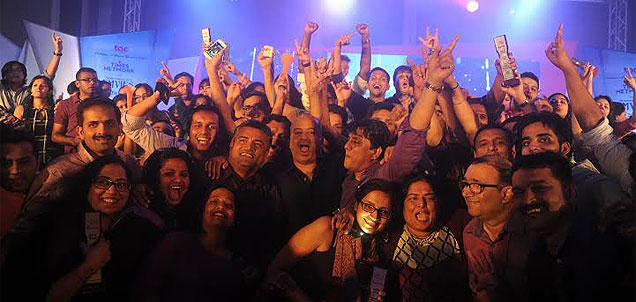
    A jubilant Mindshare team. Picture by Abhinav Kocharekar, Courtesy DNA


    When Ravi Rao, Leader, Mindshare South Asia spoke to MxMIndia on the eve of his departure to Dubai as Chief Client Officer – MENA in April, we asked him if he considered the agency’s loss at the Emvies last year, as a low during his stint. He said it was just a “momentary despair in the longest winning streak of Mindshare; we will continue to haunt others, year after year”. At the Emvies 2015 on Friday, Mindshare grabbed the title of Agency of the Year with five Gold, eight Silver and 17 Bronze metals. The now nine-time winner had its entire team in attendance, including COO Mindshare Asia Pacific Gowthaman Ragothaman and Prasanth (‘PK’) Kumar, who took over from Rao in March this year and had earlier said he was confident of winning the Agency of the Year crown this time. “There’s been lots of great work in the last year that Mindshare has done across clients, and a lot of effort into bringing in diversified and other business categories,” he had said. Friday’s win, however, left him cheering out loud for his team. “The voice is gone, but the action is full on,”  he said. (See Emvies points tally table here)


    Even though Maxus lost its last year’s glory to older sibling Mindshare, MD, Kartik Sharma was unfazed. “Whenever we’ve won or lost, our focus has always been our clients,” he said. “We’re very happy with the quality of work we’ve done. We’ve got quite a lot of clients in last two or three years and we continue to do some interesting work with them. He added: “Our focus has been more digital and analytics for the last couple of years. And today, if you saw the kind of awards that we’ve won, they had a layer of either of the two. But there’s always scope for improvement, and we’ll work on that.” Maxus was third in the pecking order of agencies, while Lodestar UM was at No. 4.


    Sam Balsara, Chairman, Madison World, whose agency was the first runner-up for the title of Agency of the Year, also said he was happy with his agency’s performance which was their best so far at the Emvies. Madison took home six Gold, four Silver and nine Bronze metals.


    Meanwhile, Tata Sky was conferred with the Client of the Year award, with Procter & Gamble India the first runners-up and Marico, a close third.


    Emvies 2015 launched a new category too, Media Partner of the Year, which was conferred on partners across various media. While the award for TV was won by Pogo, The Times of India walked away with the award in the print category. In the cinema category, it was won by Rohit Shetty’s Film Production house, in radio it was Big FM, while Torrent Sites and Google Ecosystem received the award in the digital segment.


    This year’s edition was the 15th of the Emvies. And Punitha Arumugam, Chairperson of the Emvies’ Committee and a senior media specialist herself, said it was the best she had seen so far. “The highlight this year was the fact that we started the process of online entries,” she said. “Secondly, we started including media owners in the Emvies because earlier we had only media agencies; then moved to media agencies plus client, and now from client to media owners. It’s been very exciting for us.” Since she’s not a part of a media agency any more, we asked Arumugam to trend-spot and tell us what she thinks of the way the media business is going, given the Emvies showing this year. “What we see is that digital probably gets the highest number of entries, and also the highest growth in terms of the number of entries year-to-year,” she said. “You’re seeing a genuine shift to digital. Even in offline media entries, for example, you get to see a lot more digital as a part of the whole product.”


    Another change that has taken place over the years, according to her, is in the field of data analytics and research, as evidenced from the number of entries going up and the amount of focus that agencies are putting on this.


    Arumugam was bullish about the spends on digital increasing with time since all agencies are now incorporating digital in various ways and moving towards it, even if at a slow pace. “While clients may be spending 10-15 per cent [of their budget] on digital, when you walk into any office, 80 per cent of the conversation is about online. Hopefully, the budgets will follow the conversations very soon,” she said, as celebratory cheers, accompanied by the beating of dholaks, took over the venue to get the party going.


    A part of this report first appeared in dna of brands


  • Will ‘PK’ see film producers break broadcaster unity on film buys

    By Nandini Raghavendra


    The long-awaited Aamir Khan-starrer ‘PK’ will release in a few days and producers Raju Hirani and Vidhu Vinod Chopra are a worried lot. But not for the reasons that you and I think. The makers of the much-acclaimed Munnabhai series are not so much focused on audience reception and reviews as on the negotiations with satellite television producers who are extremely reluctant to pay top dollar to Bollywood’s priciest productions.


    The big four broadcasters — STAR, Sony, Colors (Viacom) and Zee, decided about a year ago to stop buying satellite rights of films in production. Film producers reacted with anger and dubbed this as an act of cartelisation. But their wait for a break in the broadcasters’ ranks has proved never-ending and infuriating. Now, their only hope is that Aamir Khan’s magic will somehow make broadcasters see light and drop their resistance.


    It is a high stakes battle and there is tonne of crores at stake on both sides. The last big satellite deal signed was by STAR for UTV’s ‘2 States’ for Rs 13-15 crore and ‘Highway’ for Rs 3-5 crore. Many films are lying unsold, including the critically acclaimed ‘Haider’. While producers are crying foul, the channels are using business logic to justify their stance.


    A few years ago, all this was well outside the realms of the possible. Broadcasters loved satellite rights as they could show a movie for a 2-3 hours and gain higher gross rating points than a 30-minute serial slot. Producers had the chance to showcase their film before millions of viewers. While there has been a growth in the overall box office, the biggest cinema hall today is TV.


    The biggest film can only draw in an audience of 2-3 crore people while a television premiere can reach 20-30 crore people, making satellite an indispensable part of a film’s strategy, both in terms of revenue and eyeballs.


    But all this began to break up a year ago when broadcasters realised they were paying too much money for movies and that the returns were somehow not justified. The prices, they felt, had escalated beyond what they could afford and some new rules had to be framed.


    They decided that only one broadcaster would approach one film, leaving the producer with no choice but to take or leave the price being quoted. No satellite rights would be bought till a film was released and the rights would include digital rights and the terms of the rights would be nothing less than 10 years, unlike the five or seven years. A ceiling was set even for the biggest films which reports say is approximately Rs 40-45 crore. There would be no payment beyond that. STAR India COO Sanjay Gupta says ratings from films have remained the same in three years adding that the return on investment (RoI) has worsened in the past three years.


    He added saying STAR had a strategic shift in strategy and a bigger focus on fiction rather than films. “We are focusing on investing in high-end fiction, like we did for ‘Mahabharat’ or now Ashutosh Gowariker’s ‘Everest’ or Vipul Shah’s ‘Pukar’ or our very successful ‘Mahadev’. So, while we will continue to buy films, our bigger focus is on fiction,” adds Gupta. In fact last year, Gupta led one of the biggest changes in the satellite industry by signing an exclusive direct deal with Salman Khan and Ajay Devgn for their films over a five-year period.


    Other broadcasters too denied any cartelization, pointing instead to changed business circumstances. Colors feels it’s a single channel and cannot justify price beyond certain band, while Sneha Rajani, deputy president & head, MSM Motion Pictures and also incharge of buying films for Sony channels, says she’s “busted her budget already” and has no more money, with her deal with Yash Raj Films already in place.


    Zee’s Jayantilal Gada sticks to the fact that no film has value beyond a certain price. Yet, we hear Zee has closed the ‘Happy New Year’ deal for Rs 53 crore. The deal being a combined one, involving some performances as well as appearances by Shah Rukh Khan.


    Reports within the television industry say ‘PK’ (to be released on December 19) may break the broadcasters unity, though the reported asking price may put off many people. Producers may just be hoping that Aamir Khan delivers not just at the box office but also strikes a blow for their fraternity.


    Source:The Economic Times

    Copyright © 2014, Bennett, Coleman & Co. Ltd. All Rights Reserved

    Licensed to republish