The Market Research Society of India (MRSI), the apex body of marketing research in India, released the a report titled ‘Research & Insights Industry in 2021’. The report, released by Piyush Goyal, Minister of Commerce & Industry, Consumer Affairs & Food & Public Distribution and Textiles on November 17-18, covers the expanded definition of ‘research and insights’ including the traditional market research agencies, pure-play analytics firms, captives of global companies, outsourcing and various technology providers.
1.Definition and sizing of a new and up-to-date Construct of the Research & Insight Industry 2021
2. Industry recovers post pandemic due to accelerated demand from analytics and international clients
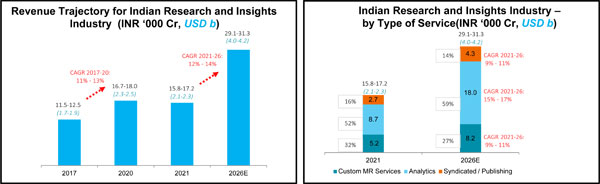
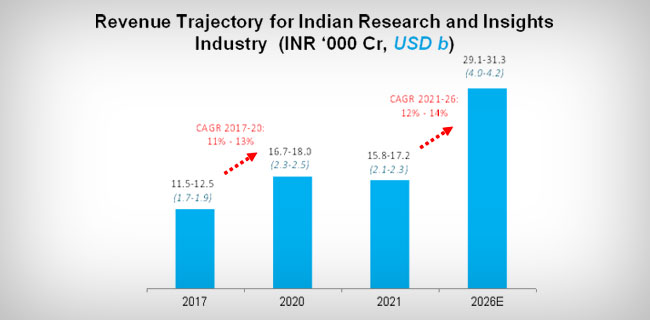
The revenue of Indian research and insights industry is expected to double by FY26, primarily driven by the increasing demand for analytics, also fueled by international demand.
FY21 revenue was expectedly impacted by the COVID 19 pandemic, with the biggest declines in custom MR services and syndicated products. However, robust international demand for analytics services ensured that the overall industry declined only marginally. The strong turnaround seen in H2 FY21 continues in the first half of current year (FY22), in line with economic recovery in both Indian and international markets.
3. International business is expected to remain on a strong growth trajectory due to demand for analytics, and tail-winds for outsourcing
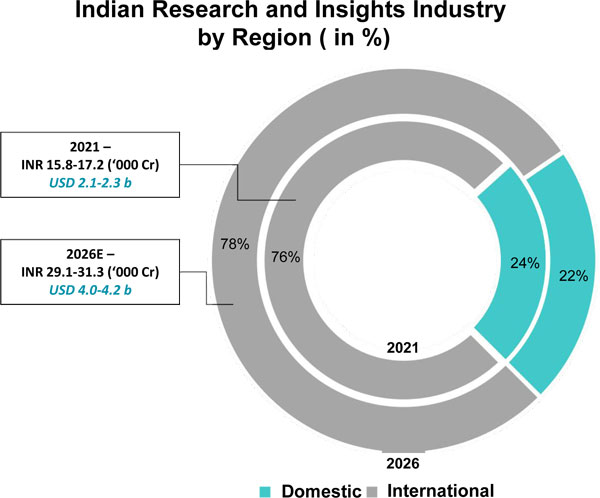
International business grew at a robust pace in FY21 despite the pandemic and the trend is expected to continue.
Key drivers for international business growth are demand for analytics and greater acceptance of the benefits of outsourcing in several major markets. These drivers should remain for the next five years.
Domestic custom market research services to recover and grow at double digits in FY22, to reach pre- pandemic levels. Thereafter, growth till FY26 is expected to settle at a rate of around 6% to 7%.
4. Consumer facing industries, ICT and BFSI are the verticals that will keep driving growth
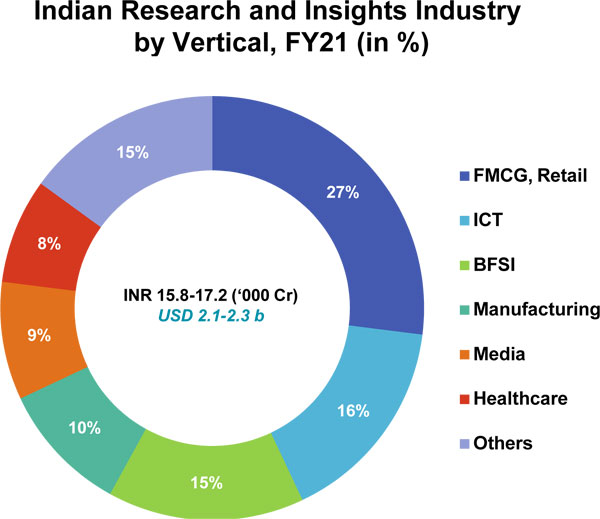
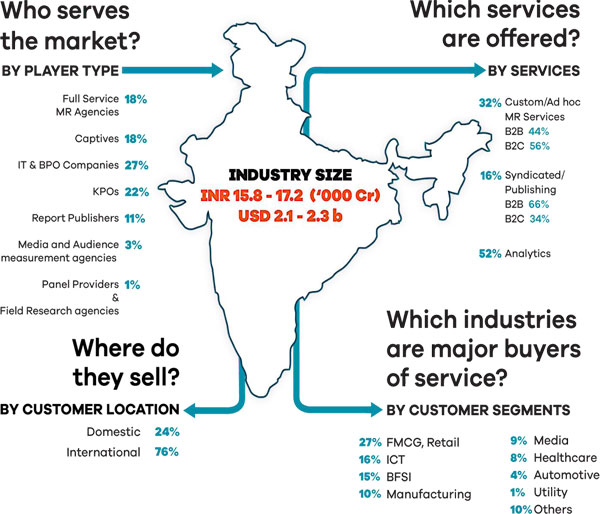
FMCG, Retail, ICT and BFSI are the largest buyers of research and insights services in 2021, and these sectors will continue to dominate. Fintech and digitalisation will drive demand from these sectors, both in international and Indian markets.
Verticals that got severely affected by COVID-19 in FY21, such as Travel and Hospitality, are expected to bounce back stronger post pandemic due to pent-up demand.
5. The escalating importance of technology is blurring the lines between the types of organisations that serve the research and insights industry
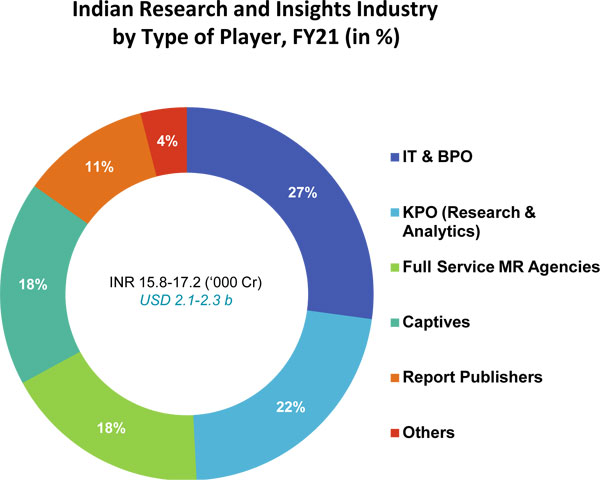
Unlike most countries, the Indian industry is characterised by diverse types of players. Apart from agencies that cater to the domestic market, there are a large number of companies that serve international markets. These include those who provide purely research services, report publishers, diversified BPO and IT firms, KPOs and captives of multinationals.
While these companies have different origins and strategies, the industry is witnessing a convergence in service offerings. The increasing importance of technology is accelerating this convergence, especially in larger firms that want to retain their share of the client’s wallet.
6. Consolidation is changing the contours of the research and insights industry
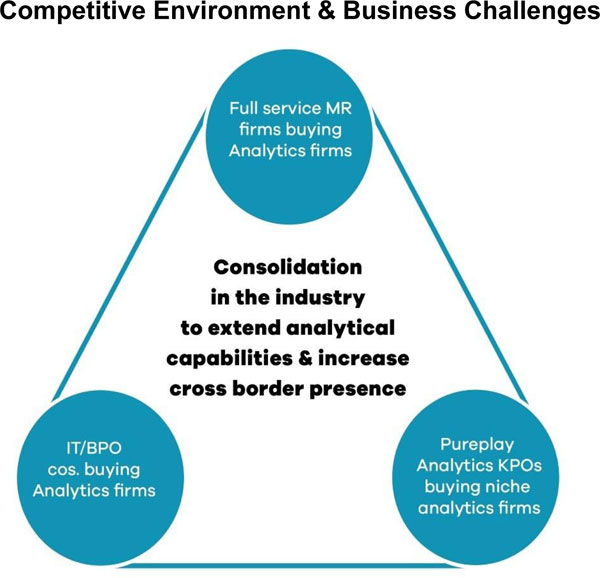
With the role of technology growing dramatically and the declining share of traditional services, the definition of a “full- service” research agency is changing and lines between player types are blurring.
Large full-service agencies and market research outsourcing companies are adding analytics to their offerings often through acquisitions. IT and BPO companies are muscling into market research as well as analytics. Report publishers are re-focusing on consulting or custom research. Large cash- rich companies in traditional consumer MR and IT/BPOs are aggressively acquiring niche analytics firms. This consolidation is likely to further intensify competition
Enthusiasm for Indian start-ups, coupled with the robust global demand outlook, means that their private and public funding is likely to scale new peaks in India.
7. A key business challenge for the industry to deliver on the growth potential Is attracting and retaining talent
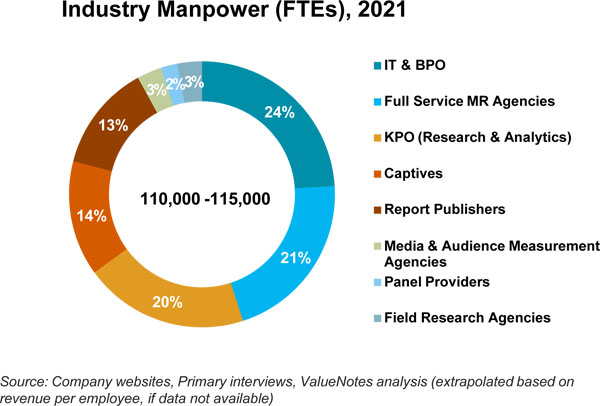
Roughly 110,000 to 115, 000 full-time employees are estimated as the workforce for the research and insights industry in FY21.
Workforce in analytics would increase by close to 15% annually, for the next few years. With the increased adoption of technology, full-service MR agencies and panel providers are likely to redesign or rethink their workforce to enhance IT and analytical skills and staffing.
8. Unveiling the concept of “MR 3.0” and signposting the journey
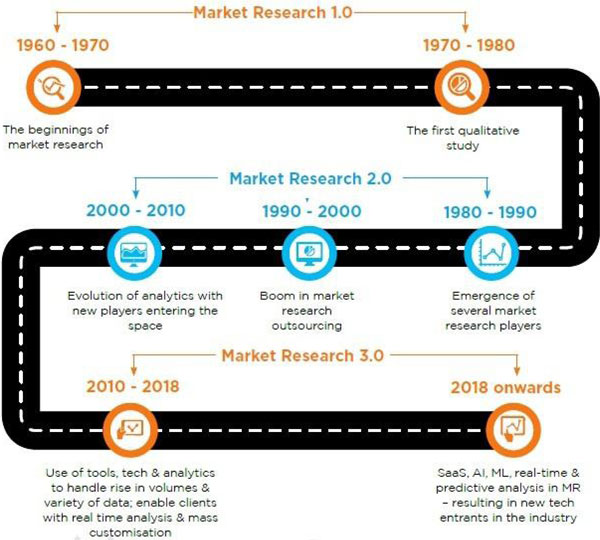
The Indian research and insights industry is on the path to adopting and adapting to the current and up- to-date version of “MR 3.0”
The consolidation of businesses and blurring of lines between types of players is part of this trend. The use of technology is another marker of the emergence of MR 3.0.
9. Technology and changing customer needs are driving the transition to MR 3.0
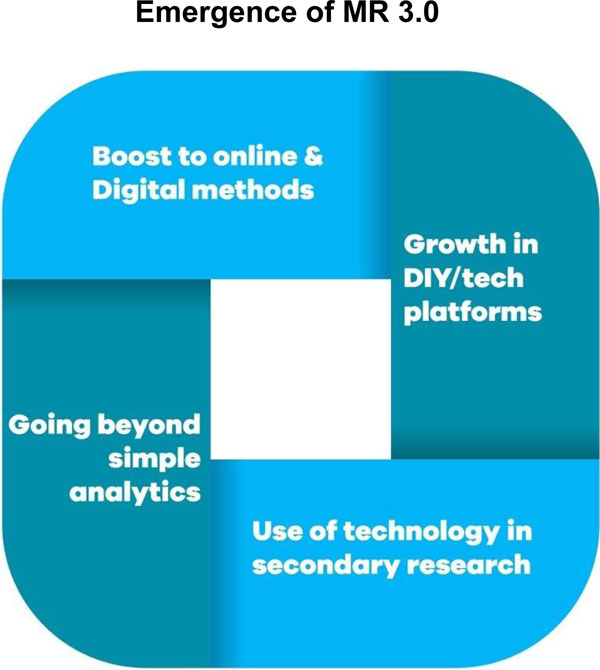
COVID-19 forced businesses globally to accelerate their transition towards digital. Online data gathering methods, online qualitative and online panels have gained traction in India as well. Similarly, there is an increased use of technology and automated extraction tools in secondary research. Growth in DIY platforms is seen, and this will encourage small-budget companies to start using market research more often
The researcher’s role is rapidly changing, with focus changing from data collection to data analysis. Moving beyond simple analytics, service providers are helping clients gain valuable insights using advanced analytics such as natural language processing (NLP), machine learning (ML), predictive analytics and decision intelligence frameworks.
10. Looking forward to 2026, these trends will continue and intensify
A. Moretechnology and business model disruption is foreseen
Technologies such as AI and analytics are still in their infancy today. These will be the new economic currency for the market research and insights industry. Rapid digitalization will pervade more sectors and create more data trails.
Productization and platform-based services will gain more traction.
B. Blended Story Telling
In the coming years, there will be specialists who would excel in Q & A based research and those who will excel in listening. The ultimate success paradigm would be one where best of both these are blended together to land powerful stories about why consumers are doing what they are doing, and how we can influence their choice decisions. That would lead to the creation of a new breed of researchers – Consumer Data Scientists: those who understand marketing, research and technology and have the ability to distil all three to deliver powerful insights
10. Looking forward to 2026, these trends will continue and intensify
C. The need for insights and data will become even more important in this radically changing world.
The focus will shift focus from asking to observing, questioning to discussing, collection to analysis, insight to foresight, rational to emotional, large surveys to data streams, geographically fixed to mobile, siloed to converged, cognitive self-reporting to precognitive neurosensing, and project-based work to engagement-based consulting. Research and insights will find ways to integrate itself across the strategic decision- making process, will help clients pull insights from disparate data streams, will aggressively leverage foresight tools, will be nimble, and will make speed a core competence by fully leveraging the 24-hour global clock.
