
Tag: Pitch-Madison

  • So how do the GroupM & Madison forecasts compare?


    By Indrani Sen


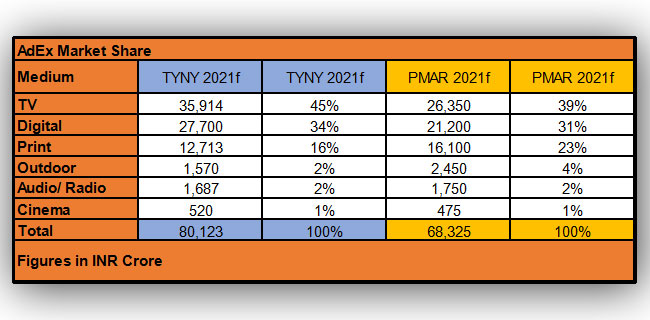
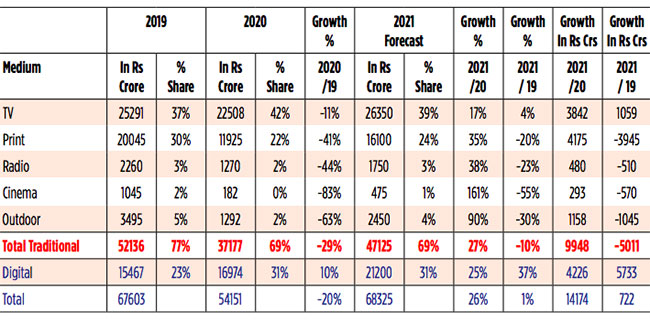
    Like every year, last week we saw the release of both This Year Next Year 2021 (TYNY2021) by GroupM and Pitch Madison Advertising Report 2021 (PMAR2021) by Madison Media. Both agreed that the pandemic year 2020 was a disastrous one for the Indian Media and Advertising Industry, when the overall AdEx dropped by 20% (PMAR2021) to 21.5% (TYNY2021) from the 2019 level. Both have predicted better days in 2021 with the overall AdEx growing by 23.3% (TYNY2021) to 26% (PMAR2021).  According to PMAR2021, the predicted AdEx INR 68,325 crore in 2021 will touch the AdEx INR 67,603 crore in 2019. According to TYNY2021, the forecast for 2021 is INR 80,123 crore, which falls short by 3.35% from the AdEx in 2019 which was INR 82,904 crore.


    In spite of the huge gap in the overall AdEx estimates by the two agencies, it is relieving to find that the trends predicted by both of them are similar. The gap in the estimated size of the Indian AdEx between the two reports has been existing over many years and the Media and Advertising Industry has learned to live with the differences. TYNY2021 has estimated both TV and Digital AdEx at much higher levels than PMAR2021. On the other hand, PMAR2021 has estimated Print AdEx at a much higher level than TYNY2021. The following two tables show the details of the two reports by medium for making easy comparisons.
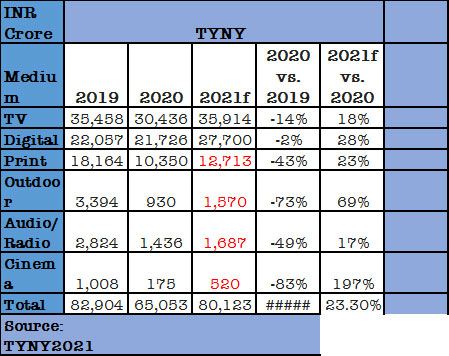
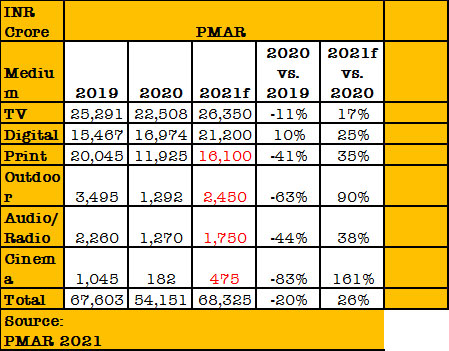


    According to PMAR2021, the pandemic year 2020 will go down in the history of Indian Media and Advertising as the year when Digital overtook Print and became #2 in terms of market share of overall AdEx. However, TYNY2019 showed Digital as the #2 and Print in the #3 positions in terms of market share. In 2020, GroupM estimated a 2% degrowth in Digital from 2019 level, while Madison Media estimated a 10% growth in Digital over 2019 level. Both the reports show Print AdEx in 2021 would be below the 2019 levels, while Digital AdEx would be crossing the 2019 levels in 2021. So, we can now conclude that Digital has the second highest market share in overall AdEx and it is unlikely that Print would be able to regain that position in 2021 or later.


    TV which holds the #1 position in Indian AdEx in both the reports, had degrowth of 11% (PMAR2021) to 14% (TYNY2021) last year, but is expected to grow at higher rate 17% (PMAR2021) to 18% (TYNY2021) in 2021 and touch or cross the 2019 AdEx levels.


    Both the reports show the huge loss which was suffered by the other traditional media, Outdoor, Radio and Cinema during 2020.  In spite of the overall growth of AdEx predicted for 2021, these three media would be far below their 2019 benchmarks. The combined market share of these three media continues to be less than 10% in both the reports. A difference in reporting between TYNY and PMAR has been noticed this year regarding Radio. While PMAR2021 has reported only on Radio, TYNY2021 has changed the nomenclature to Audio. It is however not very clear what other audio component apart from Radio has been included under that definition.


    It is encouraging to find from the two reports that the worst effect of pandemic is over; Media and Advertising industry is on the path of recovery; the process of digitisation has been accelerated; we are expecting a robust GDP growth and globally India will continue to be the second-fastest growing AdEx market among the top ten countries in 2021. At the same time, it is also frightening that the economic effects of Covid-19 have manged to wipe off two years of overall AdEx growth (2020 & 2021) and many media-owners and some media agencies still have to fight battles for survival.

     

  • Back to 2019 levels, as AdEx to grow 26%: Pitch Madison report


    By Our Staff


    It is the most respected of the forecasts of advertising expenditure in the country. We are referring to the Pitch Madison Advertising Outlook report that was unveiled virtually on Wednesday by Sam Balsara, Chairman, Madison World. According to the report, AdEx degrew 20% in 2020 and is expected to grow 26% in Calendar Year 2021.


    Sam Balsara
    Sam Balsara

    Said Balsara, Chairman, Madison World: “A number of macro-economic factors, study of AdEx historical behaviour and stupendous growth in Q4 leads us to make a high projection of 26%. Our full report gives you more details of the basis of our projection and some Advice to Advertisers.”


    Key findings of the report:

    A. Overall:

    1) In 2020 total Adex has degrown by 20% and Traditional Adex by as much as 29%.

    2) In absolute terms ADEX has degrown from Rs. 67,603 crore to Rs. 54,151 crore, a drop of a whopping Rs. 13,452 crore, the highest drop in one year ever, in Indian ADEX’s history. Adex is now at 2017 levels, but is expected to reach 2019 level by end of 2021.

    3) Although Traditional Media declined by 29% in 2020, its share in total Adex is as high as 69%, whereas the global average is 41%.

    4) Covid’s negative impact on Indian ADEX has been more severe compared to Global Adex  and many other countries of the world including US where the drop was only 4%.

    5) Q4 2020 has registered a whopping 61% increase over Q3 2020 and a 16% increase over Q4 2019. And this gives us a lot of confidence and hope that both Market and ADEX is going to bounce back sharply in 2021.

    6) Many Advertisers deserted TV, Print and Radio in Q2 2020, but by Q4 almost all Advertisers have returned to the Advertising fold.

    7) FMCG continues to be the main category spender and its share moved up to 38% compared to 33% in full year 2019.

    8) E-commerce and Education are the only two categories that increased spends, by 30% and 9% respectively.

    9) 10 new advertisers entered the Top 50 list of advertisers, key ones being Phone Pe, Pepsico, facebook and Disney Hotstar.


    B. Television

    1) Television media degrew by a mere 11% to reach Rs.22,508 crore, its 2018 level, but has further consolidated its position as the No. 1 medium with 42% market share.

    2) FMCG, continues to be the largest contributor for TV ADEX and further increased its share from 49% to 51%, though in value terms, the category de-grew by 9% almost in line with the TV degrowth of 11%.

    3) The only 2 categories to show a growth in absolute terms are E-commerce, which registered a 95% growth over 2019 and Education, a 193% growth over 2019.  Within e-commerce, in addition to online shopping, mobile wallets and media / entertainment / social media / OTT were the leading categories.

    4) The impact on regional channels has been the least, implying that national brands prioritised campaigns in their strong markets and regional brands came back to ADEX faster than national brands.

    5) TV Adex is expected to grow by 17% in 2021 to reach Rs. 26,350 crore, 4% higher than 2019.


    C. Print

    1) Covid damage to Print has been massive and Print ADEX lost as much as Rs. 8,120 crore or 41% and has gone back to a level it had reached in 2012.

    2) With a drop in share from 30% to 22%, Print lost its No. 2 rank in ADEX.

    3) However, a spike in ADEX during the festive season (Q4 20) has resulted in highest Volume and Ad  revenue.

    4) Print Adex grew by 59% in Q4 2020 vs Q3 2020, however, this is still 15% less than Q4 2019.

    5) All categories in Print seem to have got affected including E-commerce (-57%), Education (-14%), Auto       (-29%) and FMCG (-30%). Education increased its share of Print ADEX by 5 percentage  points, from 10% to 15% and Auto and FMCG by 3 percentage points each, from 13% to 16% and from 14% to 17% respectively. These 3 categories accounted for 47% of Print ADEX.

    6) Newspaper circulation in metros got affected a little more deeply and recovery seems to have taken longer. Because of which contribution of Hindi, in terms of volume has increased from 35% to 38% with English trailing at 24%. Kannada and Malayalam newspapers showed highest resilience and least degrowth in terms of volume, whilst Tamil, Telugu and Marathi publications de-grew the most.

    7) Print Adex is expected to grow by 35% in 2021 to reach Rs. 16,100 crore, but it will still be at the level it reached in 2015.


    D. Digital

    1) Digital is the only medium that grew in 2020 by 10% to reach Rs. 16,974 Digital is now the No. 2 medium, having displaced Print with a share of 31%, up from 23% in 2019.

    2) Digital has grown in 3 quarters and de-grew only in Q2 2019 by 35% when there was a strict lockdown. This drop of 35% must be seen in comparison to the drop of 79% in Print and 61% in Television in the same quarter.

    3) Share of Search has come down significantly by as much as 5 percentage points and now stands at just 18%. This is not because Search has degrown, but other verticals have grown much faster. Video, not only is the largest contributor but has further increased its share from 30% to 32% during the year. Both Social and Display have marginally improved their Share and all three have grown shares at the expense of Search.

    4) Programmatic has taken firm root in Indian Digital Adex and now almost 40% of all Digital spends are through Programmatic.

    5) Digital is set to grow by 25% in 2021 to reach Rs. 21,200 crore.


    E. Other Media

    1) Radio ADEX is the third worst affected medium which de-grew by almost 44% and came down in value from Rs. 2,260 crore to just Rs. 1,270 crore. This sharp drop has taken Radio back to its 2014 level. With this drop, Radio has also lost 1% market share and now has a share of 2%. We expect Radio Adex to grow by 38% and reach Rs. 1,750 crore.

    2) OOH ADEX also de-grew by as much as 63% to a low of Rs. 1,292 crore and its market share dropped by as many as 3% points from 5% in 2019 to 2% in 2020. OOH Adex in 2020 has gone back to its 2007 level. We expect OOH Adex to grow by 90%, to reach Rs. 2,450 crore.

    3) Cinema is by far the worst affected medium because of Covid and in our estimate, suffered an 83% drop, capsizing its low base of around just a little over Rs. 1,000 crore to under Rs 200 crore. We expect Cinema to grow by 161% to reach Rs. 475 crore.


  • 12 minute ad cap may turn to 12 death nails for FTA channels


    By Indrani Sen


    The right thing at a wrong time is a wrong thing.

    Taking liberty with the words of Charles Dickens, one can say this is not the best of times; this is probably the worst of times in the twenty-first century when we are fighting with the deadly Coronavirus, the total number of COVID 19 positive cases and death caused by the pandemic are going up every day in India, the Indian economy is in recession and Media & Advertising Industry has just seen a huge drop of 65% in advertising revenue in Q2 of 2020 (Source: Pitch Madison Advertising Report 2020 Midyear Review). What a time for TRAI to press for the 12% ad cap on Television by pushing for a hearing of the case at the Delhi High Court!


    Dust has not yet settled on NTO 2.0. Indian TV Industry and the Regulating body have been discussing the possible implications of implementation of NTO2.0 over the last few months. It has come as a rude shock to the TV industry that TRAI has pushed the Delhi High Court for an early hearing of the case on 12 min cap per hour on television advertising. The final hearing has now been fixed on 28th September, 2020. If Indian television industry is forced to accept the 12% ad cap during this difficult time, then many TV channels, particularly the free to air channels and news channels may be forced to close their business.


    Let us take a quick look at the effect of the pandemic on TV advertising. The Pitch Madison Advertising Report 2020 Midyear Review released last week has shown that against a 65% loss of total advertising in Q2 2020, loss of TV advertising was 61%. The chart below shows the TV advertising market in April, May, June TV advertising revenue over last 3 years. Across all categories, advertisers have spent less on TV during the first half of the year with 25% of the regular advertisers not spending on TV advertising. Even after the boosting of as spend in the second half of the year due to the festive season, IPL, big ticket properties on TV like Big Boss, KFC, the TV industry is expected to end the year 2020 with 12% to 17% de-growth.


    Source: Pitch Madison Advertising Report 2020 Midyear Review


    Based on consumer complaints in 2012, the TRAI first announced the regulation on 12% Ad cap in 2013. I wrote an article on 12th October, 2015 here comparing the systems of regulations on TV advertising across various countries (https://www.mxmindia.com/2015/10/mediasense-by-indrani-sen-to-cap-it-all/) and requesting TRAI to look beyond the regulatory system of UK to other countries across the world. Since 2015, some of the countries cited as example in my article, have changed their own regulatory frame works and have made it more user friendly for the TV channels. For example in Europe instead of 20% of advertising in every hour, it has been relaxed to overall 20% advertising between 7.00 to 23.00 hours with broadcasters’ own promotions, sponsors’ announcements and product placements not counting under the 20% stipulated time.


    As per the last FICCI EY report we had 918 TV channels in 2019 of which 65% were free to air channels.  Out of the registered TV channels in India 386 (42%) are news channels of which many are in the FTA category. These channels depend solely on advertising revenue and will be really badly hit if the 12% ad cap per hour is imposed at this unprecedented time. The eco system of Doordarshan’s Free Dish will also be affected in the process and the viewers will end up getting a raw deal in terms of the channels available on the Free Dish.


    It is obvious that it is not possible to attract advertising for the repeat shows after 12 midnight till 6am in the morning when the country goes to sleep. Many TV channels have already petitioned for changing the ad cap per hour to an overall ad cap per day. By relaxing the 12 min per hour cap to 12 minute overall cap during 24 hours, TRAI can allow the TV channels the flexibility to distribute the total commercial time of 288 minute per day in a more profitable manner. Alternatively, TRAI’s purpose of providing better content to the consumers would be self defeating as consumers will get less variety of content with many FTA channels going off the air or will have to pay additional cost for viewing better content with more established GEC channels introducing more ‘pay & view’ content.


    Finally, there is a time for taking all actions. If a right action is taken at a wrong time, then it can become a wrong action. After procrastination of 7 years, TRAI can surely wait for normalcy to return to our economy at large and the media and advertising industry in particular before enforcing the proposed ad cap on TV advertising.


  • Dramatic changes in Indian Ad Industry


    Editor’s Note: The Pitch Madison Advertising Report 2020 is a significant industry milestone held every year. Although MxMIndia belongs to the same space as the Exchange4media group-owned Pitch magazine, we believe the report is an industry property and are glad that the two entities – Pitch and Madison – are doing this for many years. Our report very clearly acknowledges the association of both Pitch and Madison, and have hence not called it the Madison Advertising Report, but the Pitch Madison Advertising Report 2020, as it should be.


    By Indrani Sen


    The Pitch Madison Advertising Report 2020 presented its mid-year review yesterday and revealed the extent of damage done by the pandemic to Indian ad industry.


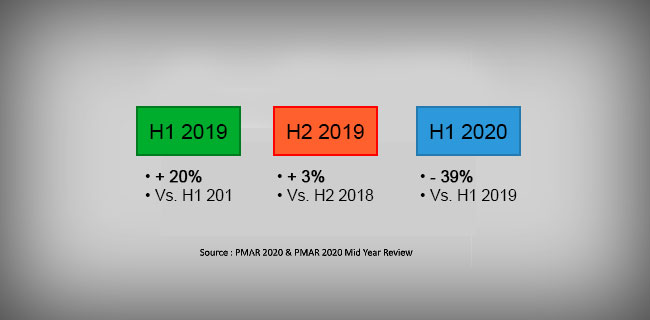
    A comparison with 2019 shows that the overall AdEx lost INR 14,000 crore and declined by 39% in H1, the first half of 2020 due to the effects of Covid-19. A break up of the first half by two quarters showed that Q1 had an 8% decline in the overall AdEx in the pre-Lockdown period due to the slowing down of Indian economy. In Q2, during the complete lockdown in April and May, the overall AdEx dropped into almost a bottomless pit. The fall was partially arrested with the unlocking starting in phases from June 1, but overall AdEx still declined by 65% in Q2.


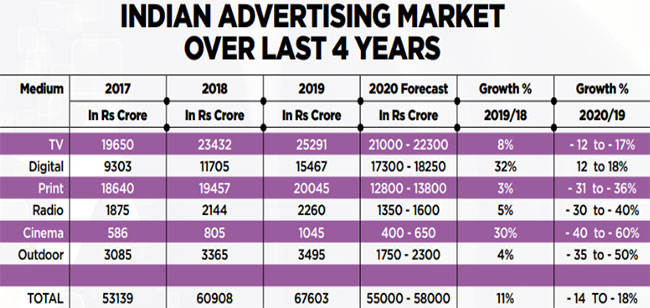
    Citing the trends of recovery of TV and Digital advertising in June and July, PMAR has predicted 60% -72% recovery of overall AdEx in H2, the second half of 2020 boosted by the festive season, revival of IPL, big ticket TV shows like KBC and Big Boss. The estimated recovery of AdEx in H2, is expected to arrest de-growth of overall AdEx in 2020 and contain it within a range of -14% to -18% as shown in the chart below.


    Source: Pitch Madison Advertising Report 2020 Midterm Review


    While TV and Digital are set on getting back to normalcy, Print is lagging far behind and Radio, Cinema and OOH are yet to show signs of regaining normalcy. The report has refrained from calculating a specific growth number in the forecast for 2020, instead has indicated a range for the AdEx value of each sector as well as the overall Ad Industry as reflected in the above chart. PMAR needs to be congratulated on their commendable efforts of mapping the effects of COVID 19 on Indian Ad Industry in the current situation.


    As per the usual format of reporting, PMAR has presented a detailed picture of TV, Digital, Print, Radio, OOH and Cinema and an analysis of advertisers active during the first two quarters of 2020 across different media. Among traditional media TV suffered the least damage with TV AdEx dropping by -43% in H1 ‘20 and retained 38% share of the advertising pie. Print AdEx dropped by 51% in H1’20 and it had to concede the number two position to Digital in terms of share in the advertising pie which dropped to 25%.  Adex dropped respectively by 52% in Radio, 55% in OOH and 52% in cinema in H1 ’20.  Digital had only a minor contraction of just 7% in H1 ’20 and its share in the advertising pie went up to 30%.


    As far advertisers are concerned, more than half disappeared from Print and Radio during the first half of 2020. TV also lost a quarter of its regular advertisers. 13 new advertisers entered the list of Top 50 advertisers which accounted for 31% of the overall AdEx. HLL topped the list with INR 1300 to 1500 crores advertising in H1 ’20. A wide gap was noticed among HLL and Procter & Gamble who ranked second with an ad spend of INR 250 to 350 crores.


    The Indian ad industry has never experienced such a decline. If we look at the last two decades, we find the industry growing in leaps and bounds during the first 8 years of this century with year on year double digit growth. In earlier PMAR reports we saw the growth rate of overall AdEx dropping to -8.9% in 2009 from 18.9% in 2008 as the international financial crisis triggered off by the sub-prime mortgage problem in the US led to recession in many countries and cast a shadow also on our economy. However, the overall industry recovered quickly with a whopping 27.9% growth in 2010. During the current decade there has been ups and downs in the performance of the overall AdEx but we never saw actual de-growth of our Ad Industry. According to PMAR 2020 Midyear Review, COVID 19 may set the industry back by 2 to 3 years. It is unlikely that the industry will recover as quickly as it did in 2010. A lot depends on how the government can control further spread of the pandemic and how soon vaccine for coronavirus can be available for Indian masses.


  • The Ripple Effect of Coronavirus


    By Indrani Sen


    A lot has happened in the last one week, when we speculated about how Covid-19 might affect the AdEx in 2020. As India fights against all odds to stop the accelerated outbreak of the virus through community transmission with the entire country is facing partial to total lockdown, there is no doubt that our economy will be badly affected like many other developed and developing countries. So, along with the rest of the world, India will be getting into a severe recession for the rest of the year. The point we need to speculate, will there just be a dip in the growth rate of AdEx or will we see a negative growth as we saw in 2009?


    The international financial crisis of 2008 which originated in the sub-prime mortgage crisis in the US and led to a severe recession in many countries over 2008 and 2009 also affected the Indian economy and we saw first a dip in the AdEx in 2008 and then a negative growth in 2009. However, AdEx recovered quickly from that recession and we saw a healthy growth in 2010.


    Source: Pitch Madison Media Advertising Outlook 2015


    The ripple effect of Coronavirus is going to create an employment crisis across the globe and India will not be an exception. We were already at a high unemployment situation before this crisis hit us. With industries experiencing forced shutdowns, many are asking their employees on go on leave without pay or with truncated pay.  Employees who work on the basis of contracts, as per terms and conditions of the contracts are often not paid unless they report to work and in the present situation are likely to lose financially. Financial loss will be experienced by the lower end of self-employed workers (Ola/ Uber drivers, auto drivers, rickshaw pullers, plumbers, electricians, etc.) as well as the daily wage earners. MSME sector which is known as the engine of growth and employment in India will also take a big hit. A combined effect of these muted wage or loss of wage will lead to decrease in consumer demand. In addition, there will be a disruption in the supply chain also due to temporary closure of production, lack of transport for distributing the goods, etc.  These changes in demand and supply will have adverse effect on the marketing and advertising budget forcing the advertisers to curtail their expenditure.


    Circulation of our print media so far has not been affected like global print media many of who have stopped the printing of hard copies, thanks to the last mile delivery by newspapers delivery persons and hawkers as against the sale through news-stands in developed countries. Indian newspapers managed to develop a schedule of work from home for their reporters and a system of rotation for other essential staff in order to reduce the number of employees present on their premises.


    The ‘Janata Curfew’ on March 22 followed by lockdown of some cities/ districts from March 23, may force newspapers also to take a call regarding their production as the distributors/ hawkers and the delivery boys will also get hit by the lack of local transport. Probably, newspapers from second-tier cities under lockdown will be less affected than the newspapers from metros facing a similar situation. So, some Indian newspapers may experience temporary closure and fluctuations in their circulation and readership and subsequently lose ad revenue as supplies of goods dwindle due to logistical issues related to production, transportation, etc. and consumer demand drops.

    There is going to be an increase in TV viewership, particularly the viewership of news and entertainment channels as people try to stay abreast with Covid-19 related news and entertain themselves with serials and movies during their stay at home. With all production of Film and TV industry closed till March 31, there is a chance that the serials will run out of their banked episodes which have been already shot and canned. Lack of new episodes will affect the viewership of serials adversely. Even if the viewership of GEC and Movie channels increase, ad revenue may go down due to demand and supply related issues as mentioned above in relation to print.


    Sports Channels are going to lose both viewership and advertising revenue with cancellation of sporting events and their telecast. As TV still accounts for the major share of our ADEX, the extent of loss of TV revenue will determine the fate of AdEx in 2020.

    Contributions of radio, cinema and outdoor to the overall AxEx are much less than Print and TV. However, ad revenue of FM radio stations will be affected as listening to car radio goes down with people being forced to stay at home. In the US, Nielsen is working on special analysis as well as a quick survey to give the advertisers some idea about how Covid-19 has affected radio listenership. Our Radio Audience Measurement is already affected by lack of financial support from the sector and it may not be possible for them to react in a similar way (http://www.insideradio.com/free/nielsen-to-release-study-on-covid–impact-on-radio/article_6c1e0246-6a81-11ea-8ab4-17d484c1eb56.html).


    Many of radio advertising deals are linked with on ground activities and consumer activations and radio ad revenue will see a decline due to curb on all such activities. With closure of malls and cinema halls, cinema will lose the ticket sales money as well as advertising revenue. Traffic on the roads, stations, airports will dwindle due to lock down of cities, social distancing and work from home which will have a negative impact on OOH advertising.


    Usage of digital as well as social media will increase during this troubled days as people are trying to get constant update on the pandemic, keep in touch with their friends and relatives while staying at home and opt for some entertainment of their choice on OTT platforms. There is a good chance that advertisers will try to utilise this opportunity by stepping up their budget on digital and social media till the ripple effect of Covid-19 force them to stop advertising.


    So far, we have seen only an estimate for loss by events and experiential industry which has been estimated as Rs 3000 crores with ten million jobs at risk which was published on March 17, 2020. (http://everythingexperiential.businessworld.in/article/Loss-to-events-experiential-industry-in-India-estimated-at-Rs-3000-Cr-due-to-COVID-19-ten-million-jobs-at-risk/16-03-2020-186335/). Other media sectors have not yet made any forecast of their probable losses.


    The ripple effect of Coronavirus will be directly proportional to the number of days that India takes to control the spread of the virus. In some European countries currently experiencing community transmission, economic analysts are already forecasting that at least 12 to 16 weeks period will be required to curb the virus. If India gets into a similar situation, it may take us longer to curb the virus given the expanse of our country and irresponsible behaviour of our citizens. In that case AdEx will end up with a negative growth like we experienced in 2009.


  • Traditional media grew 6% in 2019. Forecast for 2020: 5.1%: Pitch Madison report


    By A Correspondent


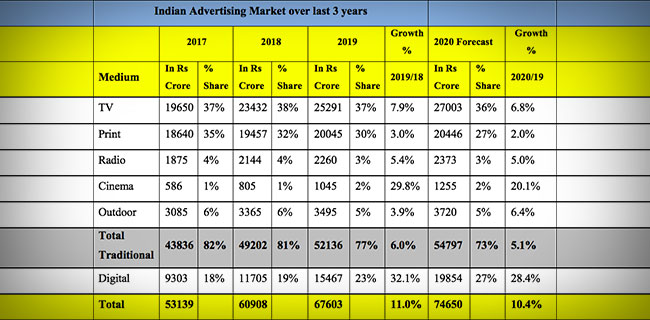
    The annual Pitch Madison Advertising Report 2020 was released on Thursday in Mumbai with the message that didn’t need much spelling out: traditional media grew only 6% in 2019 and actually degrew in the third and further quarter. The forecast for growth in 2020 is down to 5.1%. But digital media is galloping ahead. It grew 32 in 2019, and the forecast for 2020 is 28.4%.


    Said Sam Balsara, Chairman, Madison World: “Whilst 2019 has been a tumultuous year for AdEx, I believe Adex will grow dramatically over the next five years given that we are one of the larger growing economies of the world and already growing at twice the rate of global AdEx (11% vs 5.4%). Despite this India’s contribution to global AdEx is under 2%, which is bound to go up. Advertisers need to experiment more with media and do things differently to harness the power of media for Brands.”


    Key findings of the report:

    A. Overall:

    1) In absolute terms, AdEx has grown from Rs. 60,908 crore to Rs. 67,603 crores, an addition of 6,695 crores or 11%. This makes it the 2ndhighest addition to AdEx in a single year in the entire last decade.

    2) The growth rate of 11% in 2019 is lower than the PMAR mid-year projection of 13.4% and last year’s growth of 15%.

    3) 56% of this growth has been contributed by Digital, which has expectedly grown by as much as 32%.  Traditional media has grown by mere 6%

    4) TV still continues to be the largest contributor to AdEx with 37.4% share, followed by Print at 29.7%, Digital at 22.9%. Outdoor at 5.2%, Radio at 3.3% and Cinema at 1.5%. All mediums except Digital and Cinema have lost share.

    5) A quarter-wise analysis shows that unlike in most years, when Quarter 4 shows a blip because of the festive season, this year Quarter 2 showed a blip on the back of IPL, World Cup and General Elections and in fact Quarter 3 and Quarter 4 show a de-growth of 3% and 7% respectively.


    B. TV:

    1) After a rocking 2018 when TV AdEx grew by 19%, TV grew by only 8% in 2019.

    2) TV lost 1% share point and its share in the total AdEx stands at 37%, demonstrating that it is vulnerable.

    3) FMCG continues to rule the roost in TV AdEx, contributing 49% although its contribution came down by 1% share point in 2019. Telecom and Auto follow with 12% and 7% contribution respectively. Ecommerce category also gained dramatically during the year by as much as 20% and has reached Rs. 1,320 crore.

    4) The main categories that have fueled the overall growth of Rs. 1,860 crore in 2019 is FMCG (Rs. 740 crore), Telecom (275 crore) and Ecommerce (Rs. 220 crore). Predictably contribution of the Auto sector to the overall growth is negative in 2019 at -4%.

    5) There is a marginal decline in total FCT that has been telecast in 2019, perhaps because of disappearance of the FTA channels, unlike in most previous years when FCT has gone up year on year.

    6) In terms of revenue, Sports genre has grown the highest by as much as 47% and Hindi GEC by about 7%, which leads us to conclude that despite a soft market, these two genres have been able to command a rate increase.


    C. Print

    1) Print grew by 3% in 2019, lower than PMAR’s mid-year projected rate of 5%. Whilst this is the 3rdconsecutive year Print has grown less than 5%, it continues to be the 2nd highest contributor after TV with a share of 30%.

    2) Print share in AdEx has gone down from 42% in 2011 to 30% today.

    3) FMCG, Auto, Education, Real Estate and Retail continue to be the main cash cows and contributed almost 50% to Adex in 2019. Ecommerce is fast emerging as an important category for Print and grew 14%, over 2018. Political Parties are estimated to have contributed Rs. 200 crore on account of  Lok Sabha Elections.

    4) Nearly 65% of Print’s growth of Rs. 588 crore is accounted for by 4 categories – Education, Ecommerce, Real Estate and Retail.

    5) In terms of volume there is a 3% decline in 2019. Hindi publications continue to maintain the lead over English Publications, contributing 35% followed by English at a distant 25%.


    D. Digital

    1) Digital Adex made impressive gains during the year and achieved a growth rate of 32.1% in 2019, the highest growth achieved by any medium in the year taking Digital AdEx to Rs. 15,467 crore.

    2) Digital has grown at a compound annual growth rate of more than 30% over last 5 years and now contributes 23% of AdEx, an increase of 4% share points over last year.

    3) Search, Social, Video & Display have all equally contributed to the growth of Digital AdEx, with each contributing between 20% to 30% to the total.

    4) Consumption of video is going up year on year and in 2019 video spends grew by as much as 59% beating the Digital AdEx growth of 32%. Almost all of Digital AdEx (94%) is on mobile.

    5) 52% of Digital AdEx came from “classical advertising” ie display banners (22%) and online video (30%).

    6) If we were to combine TV+ Online Video, TV growth of 8% would increase to 16%.


    E. Forecast

    1. The PMAR Forecast for 2020 for AdEx is muted. In arriving at the projected growth figure for the whole year at 10.4%, the report is guided by the expectation that the economy should bounce back in the 2ndhalf of 2020 as indicated in the government’s Economic Survey published on January 31, 2020. PMAR therefore sees a subdued H1 for AdEx and a buoyant H2, specially Q4.

    2. We also expect a wide variation of growth rates across mediums with Digital medium leading the growth at 28.4% and ending the year with 27% share of AdEx at Rs. 19,854 to be precise.

    3. TV will continue to be the largest medium with a 36% share of AdEx, but will have a subdued growth rate of 6.8%.

    4. Print will lose 3 percentage points in terms of share of AdEx and end up with a 27% share registering a 2% growth.

    5. Radio and Outdoor are expected to grow at 5% and 6% respectively and maintain their share at 3% and 5%.

    6. Cinema, amongst traditional media should grow at a high growth rate of 20.1% taking its spend to Rs. 1255 crore.


  • Drop in TV AdEx leads Madison to revise 2019 forecast


    By A Correspondent

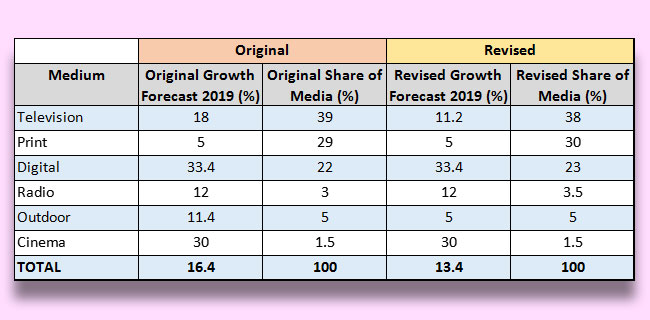
    The Pitch Madison Advertising Outlook Report 2019 has revised its forecast for AdEx 2019 downwards, mainly due to a drop in TV Adex in Quarter1 2019. According to the Original Report, released in February 2019 Adex was forecast to grow by 16.4%, but the it has now beeing revised  downwards to 13.4%. By medium, the revised forecast stands as follows:

      Original Revised
    Medium Original Growth Forecast 2019 (%) Original Share of Media (%) Revised Growth Forecast 2019 (%) Revised Share of Media (%)
    Television 18.0 39.0 11.2 38.0
    Print 5.0 29.0 5.0 30.0
    Digital 33.4 22.0 33.4 23.0
    Radio 12.0 3.0 12.0 3.5
    Outdoor 11.4 5.0 5.0 5.0
    Cinema 30.0 1.5 30.0 1.5
    TOTAL 16.4 100.0 13.4 100.0


    Whilst there is no change in the growth forecast for Digital, Radio and Cinema, there is a downward revision for Television and Outdoor, which has led to an overall downward forecast of AdEx for 2019. The major reason for the drop in Television AdEx is the drop faced in the first quarter (January – March 2019), because of the NTO order, which caused chaos in the Television market and led BARC to issue an advisory, not to use Ratings because of major changes in availability of channels.

    Another major reason that resulted in the drop in Television AdEx was the ill-fated decision of major networks to remove their Free-to-Air (FTA) channels from DD FreeDish. This led to a loss of 275 GRPs per week in the Hindi GEC + Movies market. New FTA channels that emerged could not make up the viewership enjoyed by the established FTA channels like Zee Anmol, Star Utsav, Star Bharat, Sony Pal, Colors Rishtey, etc. A few new FTA channels did emerge like Dangal, Enter 10, etc. but these could not make up the GRP loss. As a result for the first time in many years the first quarter of 2019 saw a de-growth of -5%% in Television Adex. In Quarter2 TV Adex recovered on the back of Parliamentary Elections, IPL and World Cup. We expect Quarter3 also to be reasonably strong on the back of the festive season, but we expect a softening in Quarter4.


    The Pitch Madison Advertising Outlook Revised Forecast by Media is as follows:

    Rs. in Crores

    Medium Original Forecast 2019 Revised Forecast 2019
    Television 27649 26050
    Print 20429 20429
    Digital 15612 15612
    Radio 2401 2401
    Outdoor 3750 3533
    Cinema 1047 1047
    TOTAL 70888 69073


    Said Sam Balsara, Chairman, Madison World, “It appears that the Consumer is looking for reasons to not spend or delay his spending. At a time like this Advertisers should not lose faith in Advertising, and use it aggressively but effectively to protect their Share.

  • Adspends to grow 12% in 2018: Madison


    By A Correspondent


    The agency that pushed the ‘Achche Din’ campaign for the BJP in 2014 indicated that it may well be the good times this year. For, what we had in 2017 was indeed ‘burre din’. The AdEx grew just 7.4 per cent last year. Compare the growth number in 2016… it was 12.5% and in 2010 it was 27.8%. Of course in 2012, it was just 5.2%.


    That’s enough to get a better view of the findings of the Pitch Madison Advertising Report 2018 that was released by D Shivakumar, President, Aditya Birla Group on Thursday. MxMIndia was invited to the event.


    Key findings of the report:

    A. Overall:

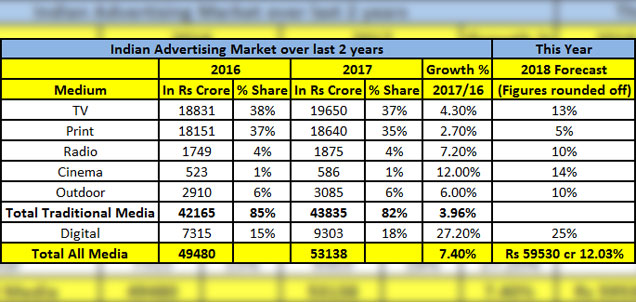
    1. Growth in the Indian Advertising Market slowed down to 4% in 2017, thanks to the after-effects of demonisation and GST roll-out. Traditional Media during 2017 grew by only 4%, the lowest in half a decade while Digital Media grew by 27.2%, taking the overall growth to 7.4%. In absolute terms, the Indian Ad market grew by Rs3,658 crores to take the industry to Rs 53,138 crores in 2017.

    2. AdEx was slow to recover from the impact of demonetization and first quarter of 2017 saw a de-growth of 2% and a growth of mere 2% in second quarter. Just when we expected AdEx to gather steam, GST was announced in July and the market saw a drop of close to 20% in traditional media over June 2017 and a drop of 5% as compared to July 2016. Mercifully, the  festive period brought cheer to AdEx and it grew from August to December by 13%. But because of the slow start in the first half and a drop in July the whole year’s AdEx is estimated at Rs. 53,138 crores, a growth of mere 7.4%.

    3. With a growth rate of 7.4% the Indian market has lost its stellar position of being the fastest growing advertising market in the world and has conceded that position to Russia, going by WARC estimates of international markets.

    4. Television continues to be largest contributor to AdEx with 37% share, but grew by just 4.3%, closely followed by Print at 35% share but with even a lower growth of just 2.7%.

    5. Digital that grew by 27.2% now contributes to a whopping 18% of Indian AdEx. Digital gained 3% share points at the expense of Television and Print who lost 1% and 2% share points respectively.

    6. Radio, Cinema and Outdoor have all grown at a much faster pace than Television and Print and maintained their share in 2017. But share of Digital continues to be more than combined share of Radio + OOH + Cinema and we don’t expect this trend to change in near future.

    7. The categories that have contributed to growth in Print, Television and Radio (and accounted for 56% of growth of Rs. 3,658 crores) have been FMCG followed by Telecom and Automobiles. FMCG continues to be the most dominant sector with a 32% share followed by Auto at 10% and Telecom at 8%. E-commerce that had taken the media market by storm three years ago contributed only 4% to AdEx (compared to 10% in 2015). With implementation of Real Estate Regulation and Development Act (RERA), Real Estate and Home Improvement category as a whole has registered a de-growth of -3%.


    B. Television:

    8. Television AdEx grew by a mere 4.3% and reached Rs. 19,650 crores. This is the lowest growth television has witnessed in the last 5 years. The growth is so low, despite the addition of 100 new channels including cable channels, which in turn contributed to an increase in FCT supply of 11% in 2017. Like-to-like channels shows an increased FCT supply of 7% leading one to conclude that on an average television rates were suppressed, but Advertisers could not reap the benefit of this because of lower ratings.

    9. HD emerged stronger during the year with the launch of 22 HD channels, now reaching 50 million homes split equally between Urban and Rural. Viewership of HD channels has also seen exponential growth and we estimate that HD is today Rs. 2,000 crore advertising market contributing over 10% to the television Adex.

    10. FMCG continues to rule the roost contributing 51% to the total Television spends followed by Telecom 12% and Auto 8%. It’s the same 3 categories that have mainly contributed to the growth of Rs. 820 crores in Television AdEx in 2017. E-Commerce maintained its contribution at 4%.

    11. Hindi GECs including FTA contribute 28% of overall television AdEx and Hindi is by far the largest contributor to television AdEx. FTAs channels have seen robust growth in viewership during the year and account for 19% of the Hindi GEC plus FTA genre.


    C. Print:

    12. Print grew by a mere 2.7% during the year. This is the lowest growth we have seen in 9 years. But it continues to be 2nd highest contributor after television with a share of 35%. It is significant to note that for the last 3 years, Print has been steadily losing share at a rate of 1% share point every year for last 3 years, but this year the decline accelerated and Print lost 2% share points. Dailies increased 3.4%, a bit higher than the total Print AdEx, because Magazines as a medium failed to gain advertiser interest for the 3rd year in succession.

    13. In terms of volume, Hindi publications continue to be ahead of English publications, contributing 34% of the total volume. English publications come close behind at 27%. Contrary to popular belief, volume in English publications has grown by 4% while volume in Hindi publications degrew by -4%. The degrowth in volume of Hindi publications has been observed for the first time in many years. Among other languages, Kannada and Gujarati publications have shown a substantial increase in volume, but Punjabi, Urdu and Tamil publications show a decline.


    D. Digital:

    14. Though there has been exponential growth in Video consumption over the past year, Display, Native and Programmatic have also picked up rather well with Mobile becoming the primary choice to consume content. Newer display advertising elements, Mobile, Online Video and Programmatic are all helping attract more advertising investment into Digital.


    E. Forecast:

    15. The forecast for 2018, is that Adex will grow by 12.03% taking the industry to Rs. 59,530 crores.Highest growth rate should be achieved by Digital (25%) followed by Cinema (14%), TV (13%), Radio & Outdoor (10% each) and Print (5%).


    Said Sam Balsara, Chairman, Madison World: “Demonetisation and GST have causedheadwinds resulting in a stunted AdEx. But you can’t keep advertising or for that matter the Indian economy down for too long. So we are cautiously optimistic about 2018 and project a growth rate of 12% for 2018 with digital again growing by 25%. To take advantage of the figures released by IRS which revealed dramatic growth in Total Readership, publishers will be well advised to offer incentives to advertisers for repeating the same ad in the same publication 2-3 times a month.”

    Pitch Madison Ad Outlook 2018 Published Report


  • LookBack 2017: Struggling & Taxing year for A&M


    We kick off our ‘LookBack 2017’ series with veteran adperson and MxM columnist Indrani Sen reflecting on the all-important AdEx barometer


    By Indrani Sen


    During December, 2017 we have seen quite a few industry reviews about estimated adverting expenditure for 2017, a struggling and taxing year for the Media & Advertising Industry in India. On December11, 2017 we learnt that AdEx for the year 2017 will probably be less than industry expectation, but industry is hopeful that AdEx will revive next year.


    The industry was on a roller coaster ride of growth from 2013 to 2015 when the annual growth rate of advertising expenditure went up from 11.3% growth in 2013 to 16.5% in 2014 to 17.6% in 2015 (Pitch Madison Reports). The sudden assault of demonetisation drove the growth rate down to 12.5% in 2016, but as predicted by the Pitch Madison Report in February 2017, industry was expecting an increase in growth rate to 13.5% in 2017. However, the early estimate of AdEx indicates that the growth rate will drop by at least 1% to 12.5%, or perhaps more. Recovery from the effects of demonetisation has taken longer time than expected by the industry analysts; on top of that the GST imposed from April 2017, created enough confusion in the market place and arrested the growth of advertising expenditure. It is now expected that the growth rate will be 11/5% or less.


    The entire retail and distribution system of FMCG sector in India use to run largely on the system of cash transactions. Demonetisation imposed in November 2016 created total disruption in that system which was carried forward to 2017. Subsequently, the introduction of  GST added more confusion. From the manufacturing companies to the distributors to the retailers to the small kirana shops, all of them and their tax consultants /accountants are still trying to understand the implications of the new tax system. During 2017, the consumers recovered from the effects of the cash crunch induced by the demonetisation, but the choking of the distribution system has led to decline in sales affecting the advertising expenditure.


    It is not only the distribution system of the FMCG sector which has been affected. Distribution of other manufacturing sectors and agricultural goods are also riding the same rolling boat in troubled water. There used to be a lot of cash transactions in agricultural sector which is still exempted from income tax. The entire sector is trying to come to terms with making payments through banks (not to mention the digital transactions preferred by the government) and the new tax regime of GST.


    Recently on December 4, 2017, Zenith predicted the market value of AdEx as INR 53,918 crore. Zenith report was first published in June 2017 and revised in December, 2017. It was followed by another report by Magna, the centralised IPG Mediabrands resourceon December 11, 2017 with a prediction that ad expenditure in 2017 will be INR 60,972 crore. The DAN (Dentsu Aegis Network) report published in afaqs in June, 2017 predicted a 13.5% growth for the year, same as the Pitch Madison predicted rate. Earlier in February, 2017 the reports by GroupM and Pitch Madison were published with prediction of varying projections.


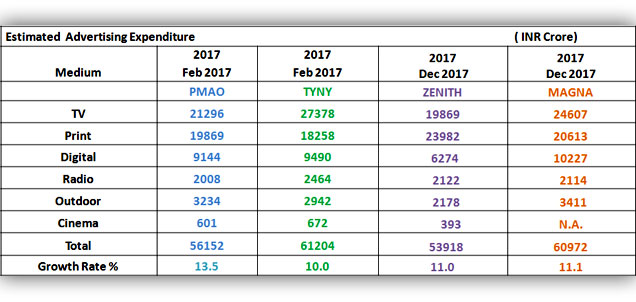
    While, the industry agrees that 2017 saw a decline in growth rate of advertising expenditure from 2016, the estimates for the growth rate and industry size vary from one source to the other as indicated in the following table.

    Estimated Advertising Expenditure     (INR Crore)
    Medium 2017

    Feb 2017

    2017

    Feb 2017

    2017

     Dec 2017

    2017

    Dec 2017

    PMAO TYNY ZENITH MAGNA
    TV 21296 27378 19869 24607
    Print 19869 18258 23982 20613
    Digital 9144 9490   6274 10227
    Radio 2008 2464    2122   2114
    Outdoor 3234 2942    2178   3411
    Cinema 601 672       393 N.A.
    Total 56152 61204    53918 60972
    Growth Rate % 13.5 10.0 11.0 11.1


    GroupM and Magna have estimated Indian advertising expenditure in 2017 as around INR 60,000 crore, while the estimates by Zenith and Pitch Madison hovers between INR 54,000 crore to 56,000 crore. While Madison predicted a growth of 13.5%, the other three agencies predicted growth of 10% to 11% in 2017 over 2016.  It is acceptable that estimates made by different agencies will vary to some extent. It would be a more comfortable situation for all of us if the ranking of ad expenditure on different medium remain in the same order. Currently, there is a difference of opinion on which medium has the highest share in the Indian advertising pie.


    As per an earlier Pitch Madison forecast, the industry was also expecting the AdEx to cross comfortably the mark of 50,000 crore in 2016, which fell short by few crores. In 2017, that mark will definitely be crossed, but without any fanfare as the overall moodin Media and Advertising industry is depressing. 2017 will go down in the history of Indian Advertising as an extended aftermath of demonetisation, which coupled with the woes of GST, slowed down the growth. Let us hope that in 2018, the industry will come to terms with GST, the distribution system will recover, the overall market situation will improve and growth rate of AdEx will rise.


  • Pitch-Madison revises 2016 adspend growth forecast from 16.8 to 13.2%


    It’s the weekend for celebrating. It’s Independence Day on Monday, August 15 and there are major festivals on this week. So this piece of news may be a bit of a dampener. But, worry not. It’s a reality check, and things could’ve been worse. Let’s cut to the communiqué we received from the office of Sam Balsara, Chairman, Madison World:


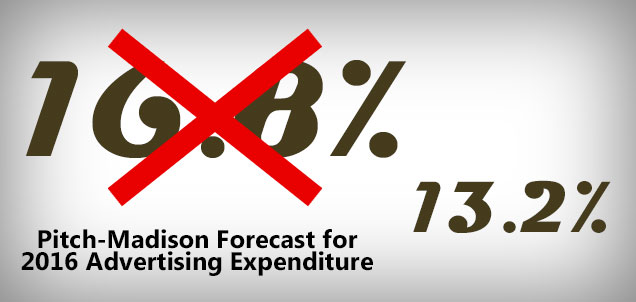
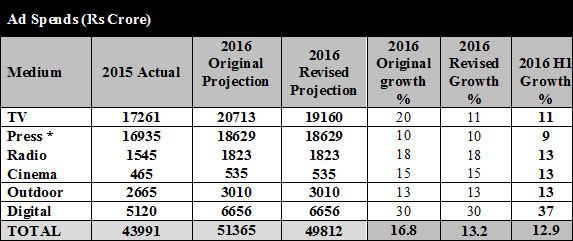
    Upon review of advertising expenditure in H1 2016 Madison Media finds that growth in all media is more or less as per its original projections released earlier in the year, but there is a slowdown in TV advertising growth rate.Against the projected growth of 20% in the TV advertising for full year, only 11% growth is achieved in H1. This compares poorly with the 35% growth rate achieved in H1 2015 over H1 2014 on the back of substantial increase in  E-Commerce spends and ICC World Cup. Drop in growth rate of TV advertising is also the main reason why the total ad market growth in H1 2016 is only 12.9%. This leads to a drop in 2016 annual growth forecast from 16.8% to 13.2%.


    *Excl tenders/appts/classifieds


    Most genres report lower FCT telecast in H1 2016 except Hindi Movies & Kannada Channels.


    Here’s what Sam Balsara, Chairman, Madison World, “The drop in growth rate of TV advertising does not augur well for the economy as generally a spurt in adspends leads to higher GDP growth.”


  • Adspend on TV grows sharply by 21%: Pitch Madison revised forecast

    By A Correspondent


    The Pitch-Madison Media Advertising Outlook has revised its forecast for 2015 upwards. Against the original forecast of 9.6% growth, projected in February 2015, the study has now revised its forecast upwards to 13.8% for the total advertising market. This upward revision is because of a steep increase in spends on TV during January-June 2015 period of  20.6%, a communiqué notes. This growth rate is likely to extend to the second half of the year too, resulting in a sharp growth in the TV advertising market of as high as 21%.  Such a high growth rate is unprecedented and has not been achieved in the last 5 years.


    Madison Media has not revised its forecast for Print, Radio, Cinema, Outdoor or Digital, which were earlier projected to grow as per table alongside, since it does not anticipate any major change in the growth rate projected, although actual growth rates for these media too may be marginally higher than the originally projected growth rates.


    Pitch Madison Media Advertising Outlook – 2015 Revised


    Original Growth Forecast 2015

    Revised Growth Forecast 2015 

    Television

    10%

    21%

    Print

    5%

    5%

    Radio

    6%

    6%

    Cinema

    9%

    9%

    Outdoor

    6%

    6%

    Digital

    29%

    29%

    Total

    9.6%

    13.8%

    Total Market Value

    Rs. 40,658 crore

    Rs. 42,234 crore


    The increase in the  advertising market from earlier projected 9.6% to 13.8% for full year and for TV advertising from earlier 10% to 21% for the full year, will result in the total market reaching Rs. 42,234 crore in 2015.


    Says Sam Balsara, Chairman Madison World, “If BJP promised Achhe din to all Indians, they have certainly arrived for the Indian Television Industry. A 21% growth coming on the back of a 14% growth in 2014 and without the Elections is quite unprecedented and shows the optimistic outlook of industry in Indian markets and the aggressive stance they are willing to take to protect and grow their market share. The growth is also significant in the light of growing conversations around Digital.”


    Highlights of advertising spending on TV in the period January-June 2015:

    TV spends have increased by 21% in H1’15 with total revenue of  Rs. 8200 crore as against Rs. 6800  crore in H1’14.

    a. The main categories who have fuelled the overall growth in H1’15 are E-commerce (+70%), Automobiles (+55%) and FMCG (13%). HH Durables and BFSI categories also increased their ad spends by more than 45%. FMCG has been largest contributor in absolute terms contributing as much as Rs. 4,200 crore and accounts for 51% of the total TV spend. E-Commerce players grew by 70% and now account for 6% of the market.

    b. Total FCT volume across all genres/channels has increased by 14%. FCT of SD channels increased by 11% and HD channels by 224%.

    c. Overall FCT of SD feed on Hindi Mass Genres (GEC + Movies) has increased by 8% comparing like to like channels.

    d. Many channels have telecast more than 12 mins/hr of FCT across all leading channels resulting in increase in ad revenue.

    e. New channel launches in Hindi Mass Genres (Sony Max2, Epic & TV, Sony Pal, Zindagi) from existing bouquets and spends on HD channels also resulted in a hike in advertising revenues.

    f. ICC Cricket world Cup, IPL, Delhi State Elections also contributed to the overall growth in H1’15.

    g. Finally, in H1’15 TV is the largest contributor to the total advertising pie with a share of 40% as compared to 38% in 2014.


  • So will media spends grow at 12 or 8%?


    By Johnson Napier


    A lot could be said about how the year 2011 has shaped up for the media industry in India. From a growth perspective, it possibly has shaped up the way brand marketers and industry observers had predicted it to be – a mixed year with its usual set of highs and lows. But despite the rise and fall, the enthusiastic performance displayed by the industry year-on-year is giving players from the space, as also research bodies, enough scope to track down this domain exclusively and come up with studies that predict the trajectory and also crystal-gaze into its performance for the forthcoming year.


    In pace with its observations on the growth witnessed by the media industry in India, a couple of media (agency) firms have rolled out reports citing healthy growth numbers for 2011 and a cautious-yet-optimistic trend for next year. After Mindshare India released its annual report titled ‘This Year, Next Year: Indian Media Forecast’, it was the turn of Pitch-Madison to reveal its report last week. Joining the above two reports was another finding from research firm Media Partners Asia that unveiled its study tracking the performance of media in 2011-12. (Disclosure: MxMIndia partnered with Mindshare to publish the report digitally and in print form as ‘The Mindshare Indian Media Forecast 2012’)


    2011 (cr) 2012 (cr) YOY % growth
    Mindshare 33,388 37,397 12
    Pitch-Madison 25,594 28,013 9
    Media Partners Asia 31,400 34,100 8.7


    While most studies have predicted a healthy growth trend what is noteworthy is the optimism in numbers that have been expressed through the various reports which range from a modest 8 per cent to a high of 13 per cent. This translates into adspend monies ranging from Rs 25,594 crore to Rs 33,388 crore approximately. As part of the ‘Mindshare Indian Media Forecast 2012’ published by MxMIndia, Ravi Rao, Leader, South Asia, Mindshare had expressed how predicting adspends has become more complex now than ever was. “The economic outlook is something that one can never get the handle right, with most studies not agreeing on one number. But this is what makes it exciting to look and estimate the Adex growth in India. Group M does yeoman’s service of providing some startling numbers based on science rather than gut, even though India tends to buck the trend away from global predictions.”


    When analysed further, the Mindshare study predicts an AdEx growth of 12.8 per cent in 2011 with net revenue totalling INR 33,388 crore. This was driven largely by the medium of television that contributed 18 per cent to the growth followed by Print at 7 per cent and Digital at 30 per cent. In fact for 2012, Mindshare predicts an overall growth rate of 12 per cent that will be led by spends on television – 15 per cent, print – 8 per cent and digital – 30 per cent.


    As for the insights by MPA, ad revenues in India for 2012 are expected to clock a growth rate of 8.7 per cent. According to MPA, this growth will be primarily driven by MNCs investing in India and stronger MCG sector, and if there are revisions carried out in 2H 2012. As for the advertising growth across key categories, MPA expects robust growth from the FMCG sector, which is the largest advertising category, contributing 30-35 per cent to total ad spend. The study predicts that MNCs are expected to report robust numbers while a few large MNC accounts are looking to increase spends by 50-70 per cent for the coming year. The other sectors that will see heightened activity include Auto – while traditional companies such as Maruti and Hyundai have reduced spends, global car manufacturers investing in India are driving the overall growth for the sector, Telecom and Life Insurance.


    On its part, the Pitch-Madison study (published by Pitch magazine, conducted by Madison) predicts a sluggish growth rate of 8 per cent due to slowdown worries in the second half of 2011. It predicts a cautious trend for 2012 which is expected to pick momentum only in the second half. It predicts a growth a 9 per cent with revenues totalling Rs 28,013 crore.


    The industry, on its part, seems undeterred with the varying figures being thrown up and appear comfortable with the current state of affairs so far. Divya Gupta, CEO, Dentsu Media India said, “The estimated adspend growth according to us stands at approx 9 per cent. Also, the growth trajectory may have slowed down versus what was reported in the last few years, but it is still very healthy!”


    According to Shubha George, Chief Operating Officer, South Asia – MEC, “Our estimate of 2011 closing numbers is close to 13 per cent. When analysed further, the mediums of TV, Digital and Cinema have outperformed vis-a-vis the overall 13 per cent whereas Print and Radio have been below par. As for 2012, our estimates are a percent lower than 2011 at 12 per cent.”


    Admitting that the so-called slowdown may have cast its effect on the growth of the industry, Anita Nayyar, Chief Executive Officer – India and South Asia, Havas Media said that “the actual rate that was predicted was in the range of 11-12 per cent but given the slowdown scare and also the volatility that was witnessed in the markets, the rate was revised to be in the region of 9-10 per cent.” Going forward, Nayyar feels that marketers will tread with a cautious approach as they are yet to see signs of recovery – a phenomenon that will start taking place in the second half of 2012. “Large clients like P&G and other FMCG units have announced a slash in the adspend rates. This indicates a cautious approach that’s being taken by the marketers. Even category-wise, sectors like FMCG, finance etc that used to spend heavily have taken a backseat for the moment. But what is surprising is the marketing drive that has been taken out by sectors such as education, real estate and to certain extent even auto, which are continuing to hike their adspend budgets.”


    Presenting a rather comprehensive outlook, S Yesudas, Managing Director – Indian sub-continent, Vizeum India stated that while the industry will grow at 10 per cent, growth will come in largely from three areas. “At a broad level it will come from investments in newer markets with the definition of India changing for many categories and consequent expansions. Share of voice reduction by certain categories will be balanced with increase by certain others which will include new launches particularly in the financial, automobile, IT and healthcare segment. Growth will also come from increased investments in the digital as well as out-of-home space and will be further boosted by changes in the audience buying-selling structure of traditional TV medium,” he asserted.


    While some clients may have decided to plug the unwarranted spends in advertising there are others who are jumping into the bandwagon to explore opportunities not found before. But slowdown or no slowdown, the industry appears to be keeping pace with its growth story the way it has been since the past few years and would continue to focus on ensuring that clients get maximum ROI for the monies spent.