
Tag: Pitch Madison Media Advertising Outlook 2015

  • The Ripple Effect of Coronavirus


    By Indrani Sen


    A lot has happened in the last one week, when we speculated about how Covid-19 might affect the AdEx in 2020. As India fights against all odds to stop the accelerated outbreak of the virus through community transmission with the entire country is facing partial to total lockdown, there is no doubt that our economy will be badly affected like many other developed and developing countries. So, along with the rest of the world, India will be getting into a severe recession for the rest of the year. The point we need to speculate, will there just be a dip in the growth rate of AdEx or will we see a negative growth as we saw in 2009?


    The international financial crisis of 2008 which originated in the sub-prime mortgage crisis in the US and led to a severe recession in many countries over 2008 and 2009 also affected the Indian economy and we saw first a dip in the AdEx in 2008 and then a negative growth in 2009. However, AdEx recovered quickly from that recession and we saw a healthy growth in 2010.


    Source: Pitch Madison Media Advertising Outlook 2015


    The ripple effect of Coronavirus is going to create an employment crisis across the globe and India will not be an exception. We were already at a high unemployment situation before this crisis hit us. With industries experiencing forced shutdowns, many are asking their employees on go on leave without pay or with truncated pay.  Employees who work on the basis of contracts, as per terms and conditions of the contracts are often not paid unless they report to work and in the present situation are likely to lose financially. Financial loss will be experienced by the lower end of self-employed workers (Ola/ Uber drivers, auto drivers, rickshaw pullers, plumbers, electricians, etc.) as well as the daily wage earners. MSME sector which is known as the engine of growth and employment in India will also take a big hit. A combined effect of these muted wage or loss of wage will lead to decrease in consumer demand. In addition, there will be a disruption in the supply chain also due to temporary closure of production, lack of transport for distributing the goods, etc.  These changes in demand and supply will have adverse effect on the marketing and advertising budget forcing the advertisers to curtail their expenditure.


    Circulation of our print media so far has not been affected like global print media many of who have stopped the printing of hard copies, thanks to the last mile delivery by newspapers delivery persons and hawkers as against the sale through news-stands in developed countries. Indian newspapers managed to develop a schedule of work from home for their reporters and a system of rotation for other essential staff in order to reduce the number of employees present on their premises.


    The ‘Janata Curfew’ on March 22 followed by lockdown of some cities/ districts from March 23, may force newspapers also to take a call regarding their production as the distributors/ hawkers and the delivery boys will also get hit by the lack of local transport. Probably, newspapers from second-tier cities under lockdown will be less affected than the newspapers from metros facing a similar situation. So, some Indian newspapers may experience temporary closure and fluctuations in their circulation and readership and subsequently lose ad revenue as supplies of goods dwindle due to logistical issues related to production, transportation, etc. and consumer demand drops.

    There is going to be an increase in TV viewership, particularly the viewership of news and entertainment channels as people try to stay abreast with Covid-19 related news and entertain themselves with serials and movies during their stay at home. With all production of Film and TV industry closed till March 31, there is a chance that the serials will run out of their banked episodes which have been already shot and canned. Lack of new episodes will affect the viewership of serials adversely. Even if the viewership of GEC and Movie channels increase, ad revenue may go down due to demand and supply related issues as mentioned above in relation to print.


    Sports Channels are going to lose both viewership and advertising revenue with cancellation of sporting events and their telecast. As TV still accounts for the major share of our ADEX, the extent of loss of TV revenue will determine the fate of AdEx in 2020.

    Contributions of radio, cinema and outdoor to the overall AxEx are much less than Print and TV. However, ad revenue of FM radio stations will be affected as listening to car radio goes down with people being forced to stay at home. In the US, Nielsen is working on special analysis as well as a quick survey to give the advertisers some idea about how Covid-19 has affected radio listenership. Our Radio Audience Measurement is already affected by lack of financial support from the sector and it may not be possible for them to react in a similar way (http://www.insideradio.com/free/nielsen-to-release-study-on-covid–impact-on-radio/article_6c1e0246-6a81-11ea-8ab4-17d484c1eb56.html).


    Many of radio advertising deals are linked with on ground activities and consumer activations and radio ad revenue will see a decline due to curb on all such activities. With closure of malls and cinema halls, cinema will lose the ticket sales money as well as advertising revenue. Traffic on the roads, stations, airports will dwindle due to lock down of cities, social distancing and work from home which will have a negative impact on OOH advertising.


    Usage of digital as well as social media will increase during this troubled days as people are trying to get constant update on the pandemic, keep in touch with their friends and relatives while staying at home and opt for some entertainment of their choice on OTT platforms. There is a good chance that advertisers will try to utilise this opportunity by stepping up their budget on digital and social media till the ripple effect of Covid-19 force them to stop advertising.


    So far, we have seen only an estimate for loss by events and experiential industry which has been estimated as Rs 3000 crores with ten million jobs at risk which was published on March 17, 2020. (http://everythingexperiential.businessworld.in/article/Loss-to-events-experiential-industry-in-India-estimated-at-Rs-3000-Cr-due-to-COVID-19-ten-million-jobs-at-risk/16-03-2020-186335/). Other media sectors have not yet made any forecast of their probable losses.


    The ripple effect of Coronavirus will be directly proportional to the number of days that India takes to control the spread of the virus. In some European countries currently experiencing community transmission, economic analysts are already forecasting that at least 12 to 16 weeks period will be required to curb the virus. If India gets into a similar situation, it may take us longer to curb the virus given the expanse of our country and irresponsible behaviour of our citizens. In that case AdEx will end up with a negative growth like we experienced in 2009.



  • Highlights of Sam Balsara’s presentation of the Pitch Madison Media Advertising Outlook 2015


    Hello and welcome to the Pitch Madison Media Advertising Outlook 2015.Thank you very much for coming this afternoon to find out about what happened in 2014 and what is our prognosis for 2015 in terms of media spends in different media and different categories.We have put together an interesting and hopefully educative afternoon with accomplished speakers talking about subjects ranging from Media to Fmcg to elections to the new age digital companies to corporate advertising.
    Last year we said that 2014 would be a Buoyant year and am delighted to inform you that we were right!I would now describe the year just gone by as FANTASTIC!
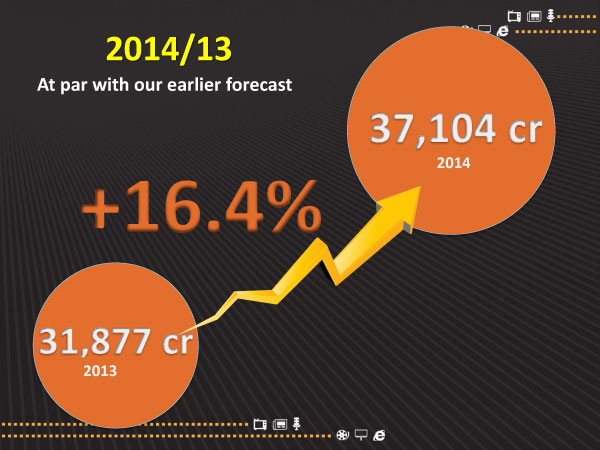
    Why do I say Fantastic?The Indian advertising industry in 2014 grew by 16.4%, almost at par with our forecast of 16.8%. When we projected a growth rate of 16.8% last February mostMedia professionals felt the projected growth was too high and Media sales professionals wondered if their bosses were going to increase their sales targets!

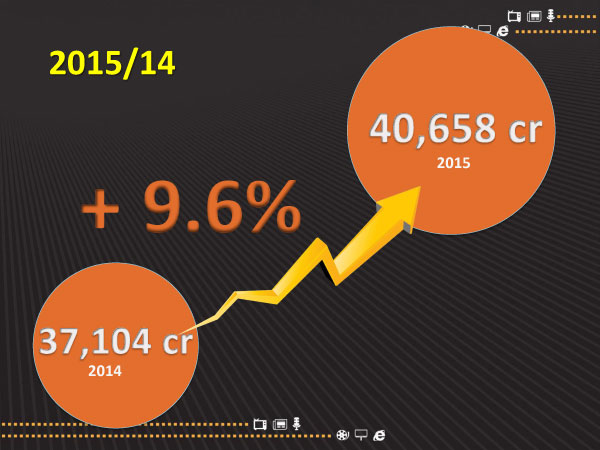
    In terms of absolute numbers, the advertising industry increased by Rs. 5,200 Crs and touched Rs. 37,100 crs in 2014.

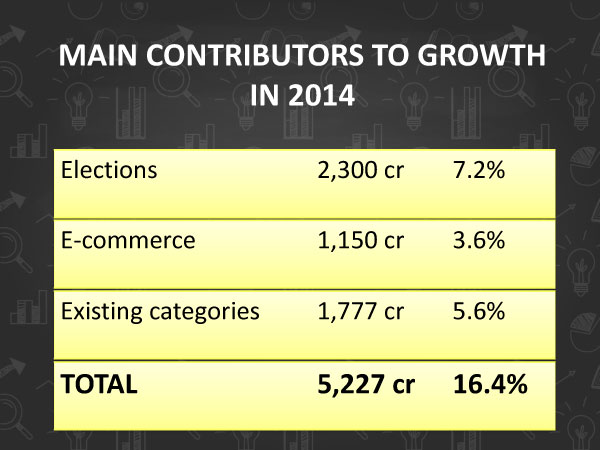
    The 2 main categories that have fuelled the overall growth in 2014 were the Lok Sabha general elections along with the 5 state elections, and E-commerce players contributing as much as Rs 2,300 Crs and Rs 1,150 Crs. respectively. Thus almost half the growth came from Elections alone and the 2 categories account for 2/3rd of the growth. Of the 16.4% growth rate registered in 2014 it is significant to note that nearly 7.2 percentage points is on account of elections alone, 3.6 percentage points is on account of E-commerce. It is again significant to note that existing categories contributed to only 5.6 percentage points of the overall growth.
    What is our growth forecast for 2015?
    Whilst the growth in 2014 was Fantastic, mainly because of election spends, we are equally bullish for 2015 too but our forecast has to recognize that 2015 is not an election year.
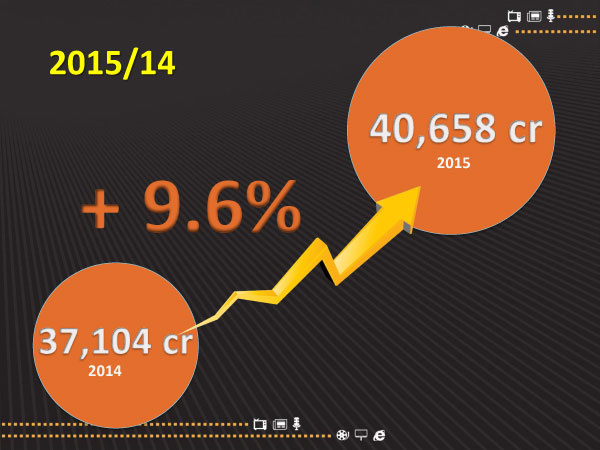
    A 9.6% growth rate, is what we forecast in 2015 which will take the industry further up to reach nearly 41000 crores. We expect the overall market to grow by more than Rs. 3500+ crores
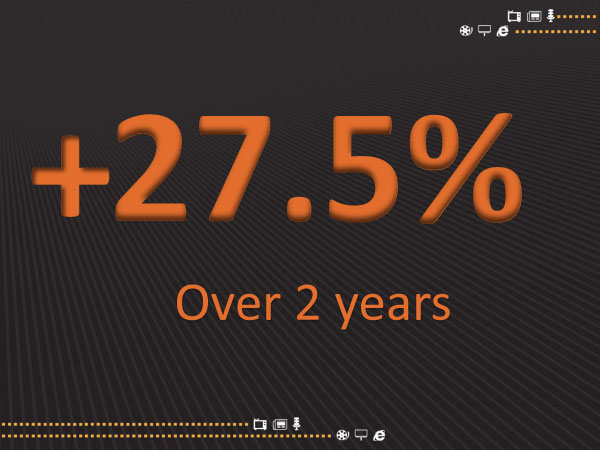
    That’s a spectacular growth of 27.5% over 2 years
    Note, this figure of 9.6% should be compared with the like to like category growth of 5.6% achieved in 2014 and not the overall growth of 16.4%. A stable government at the centre that is focusing on growth of the Indian economy, positive market sentiment, upbeat consumer confidence and India once again attracting global attention, are all the reasons why we are doubling our growth forecast to 9.6% from the earlier years like to like growth of 5.6%.
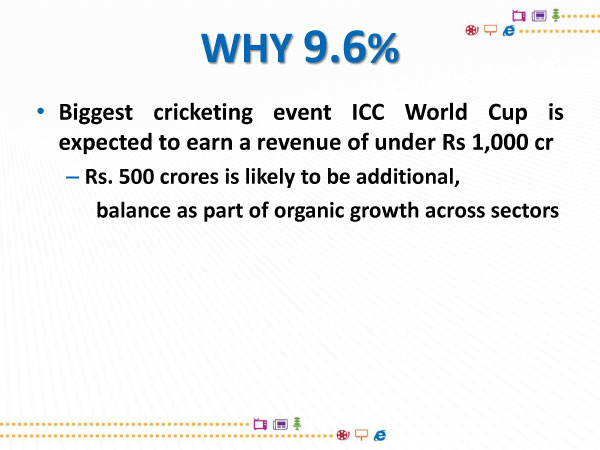
    Getting into the details of why 9.6% Biggest cricketing event ICC World Cup already underway is expected to earn a revenue of almost a 1,000 crores Rs. 500 crores is likely to be additional, just because of world cup and the balance as part of organic growth across sectors
    Other contributing factors to growth are likely to be: New advertisers Separate sales of HD channels, hopefully will attract new premium brands to advertising Facility of Geo targeting ads will attract more, local and retail advertisers on TV New channel launches from existing networks Further push by E-commerce companies and mobile and social apps Spends on Assembly elections in Delhi and two other states Increased government spending on print, since the new government strongly believes in communicating with their electorate about their new thinking, concepts, etc We are confident that government will finally launch phase 3 expansion no later than September 2015, and since a very large number of radio stations are expected to open up, this should pull in atleast Rs. 70 crores of additional advertising revenue in the last quarter of the year
    Here’s a 13 year review of the advertising market, having gone up from under 10,000 crores to almost 41,000 crores over 13 years. We have thus achieved a compounded annual average growth rate of 13% over these 12 years, but it is significant to note that the rate of growth in the last 6 years has been under 10%. Whilst, it appears that the advertising industry has grown steadily over these 13 years, the trend in growth rates as you can see is a wildly fluctuating one.
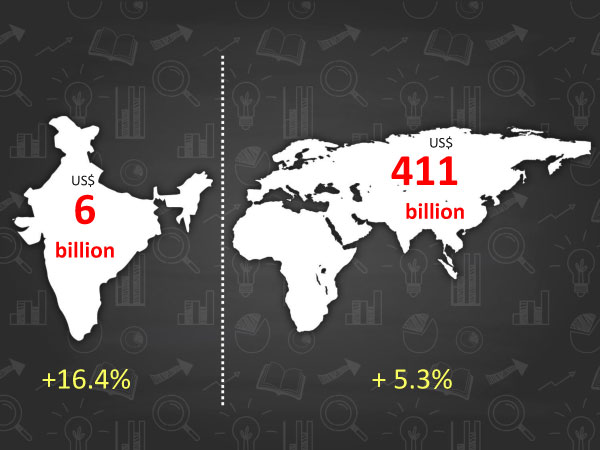
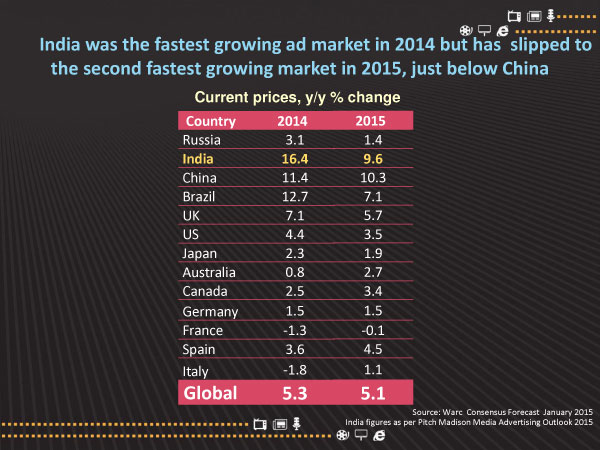
    Compared to India’s growth of 16.4%, the global advertising market grew by just 5.3% but of course in absolute terms the global advertising market is now estimated at US $ 411 billion where as India is at 6 billion which puts India’s share at a far from respectable 1.50%
    India maintained its 12th rank in the global ad market. The US further increased its share which now stands at almost 43% of the global market. China also increased its contribution from 11% to 14% and has overtaken Japan as the second largest advertising market. Japan has dropped significantly in terms of contribution from 13 to 9%.
    India was the fastest growing ad market in 2014 but may slip to the second position in 2015, just below China
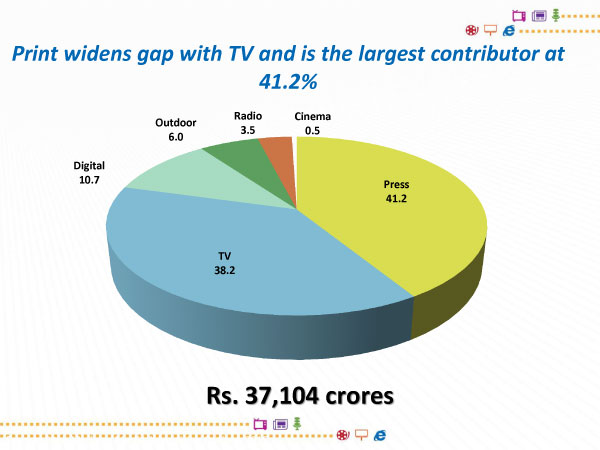
    Coming back to India, let’s look at the Medium wise figures. Print continues to be the largest segment and accounts for 41.2%, followed closely by TV at 38.2%. The gap between Print and TV has marginally widened. Digital has now got used to occupying the 3rd place with a 11% share. Outdoor, Radio and Cinema make up for the balance 10%.
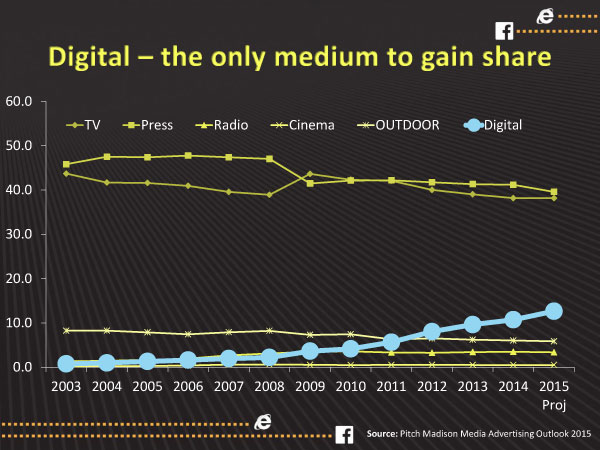
    Digital continues to be the only medium to grow share at the expense of TV + Print + OOH. Radio & Cinema have maintained overall share.
    Digital continues to be the only medium to grow share at the expense of TV + Print + OOH. Radio & Cinema have maintained overall share.
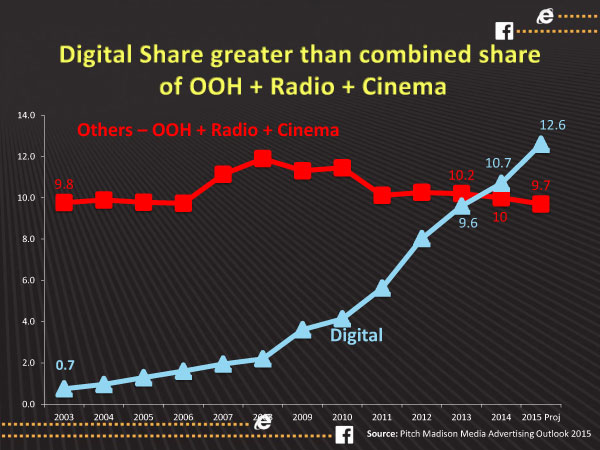
    It is interesting to note that the combined share of OOH, Radio and Cinema is lower than the share of Digital.
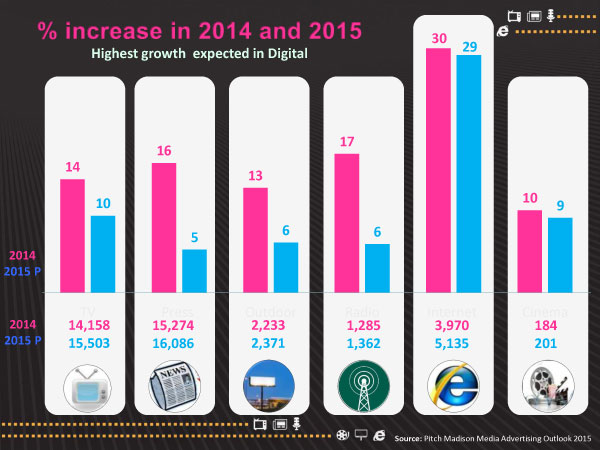
    In terms of growth rates, Digital grew the most in 2014 followed by Radio, Print, TV and OOH in percentage terms. In 2015, we expect TV to grow faster than all other media except digital at 10%.
    Moving to Television
    Television last year grew at 14% to reach Rs. 14,158 Crs but has dropped its contribution to total advertising and is now at 38%. The 2 main categories that have fuelled the overall growth of TV industry in 2014 are Lok Sabha general elections along with 5 state elections, and E-commerce players. The total spending by these 2 categories is in excess of Rs.1,050 Crs out of the total growth of Rs. 1,700+ crs. However this year we expect TV to grow by 9.5% on the back of ICC Cricket WC, Assembly elections in 3 states, HD Channels, Geo Targeting on TV, and new channel launches
    Hindi GEC contributes nearly 27% of the overall TV revenue and continues to remain the leader of the pack. A change in the pecking order saw Tamil Nadu C&S overtaking News to occupy the second rank with their ad revenues growing in contribution from 7.2% to 8.5%.
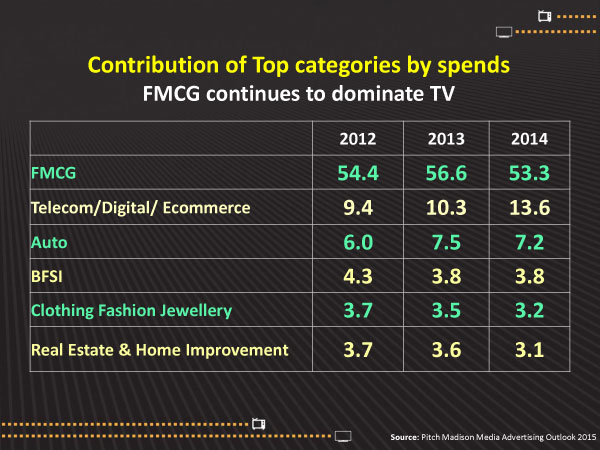
    In terms of category contribution, the pecking order remains the same with a marginal 3percentage points shift in contribution from FMCG to Ecommerce. FMCG, continues to rule the roost contributing 54% share of total TV spends (down from last year’s 57%), followed by Telecom/Digital/ Ecommerce (14%) & Auto (7%).
    In TV, the total FCT consumption has grown by over 18% in 2014. But if you take only those channels which existed in 2013, the growth in FCT comes down to 6.4%. Length of Average duration of a commercial seems to be inching up in the last 3 years and is now firmly at 24 seconds.
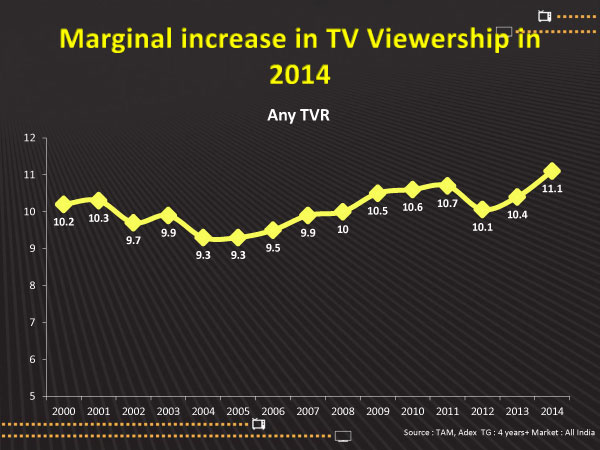
    There is a significant increase in average viewership of any TV channel of 7% in all day parts, but an even higher 11% increase in off prime. The drop that we had seen in 2012 has now been made up and more
    Let’s review Print
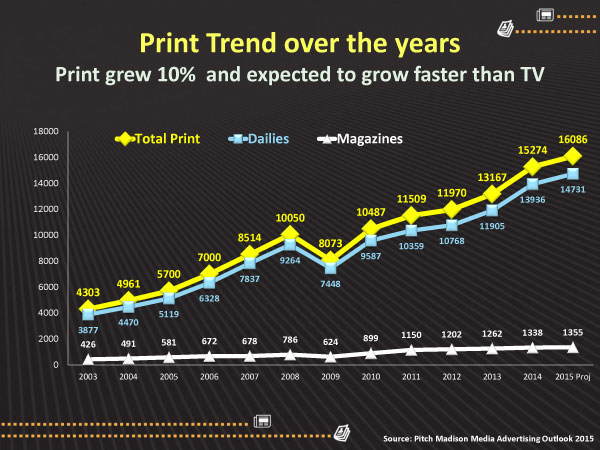
    Print grew by 16% to reach Rs. 15,274 Crs and continues to be the largest contributor in the total advertising pie with a share of 41%. Dailies has grown by 17% and is in line with our earlier projections. Magazines too have grown by 6% and is in line with our projections. Of the total growth of around Rs. 2100 Crs, nearly 85% or Rs. 1,800 Crs has been contributed by Elections & E-commerce players. Increase in advertising during festival season by smaller and retail advertisers has also contributed to the growth. And we expect Print to grow by another 5.3% in 2015.
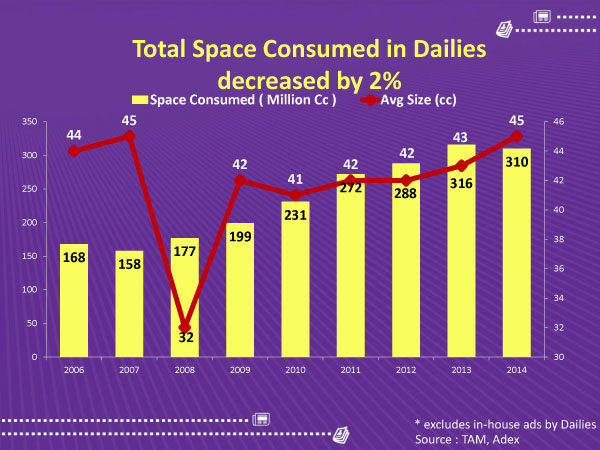
    Total space consumed in Dailies decreased by 2% but the average size of an ad also marginally increased to 45 col. cms.
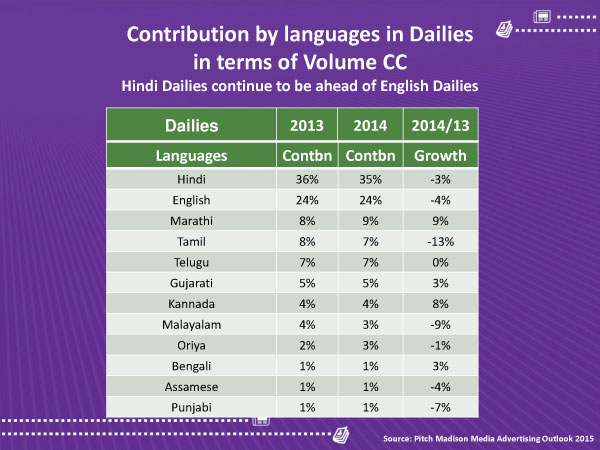
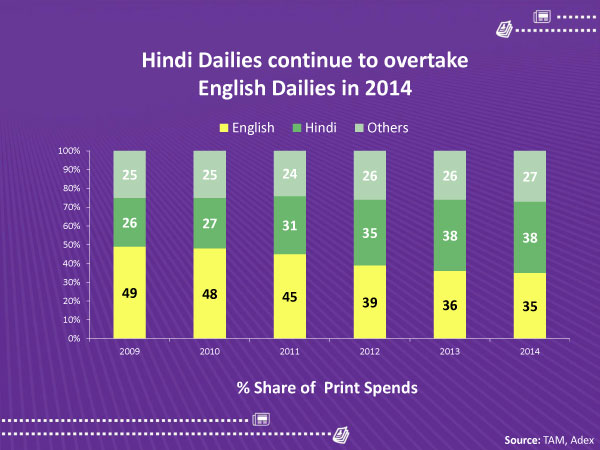
    In terms of Volume of advertising space consumed, Hindi Dailies continue to be ahead of English Dailies contributing 35% of the total volume from Dailies while English Dailies contribute 24%.
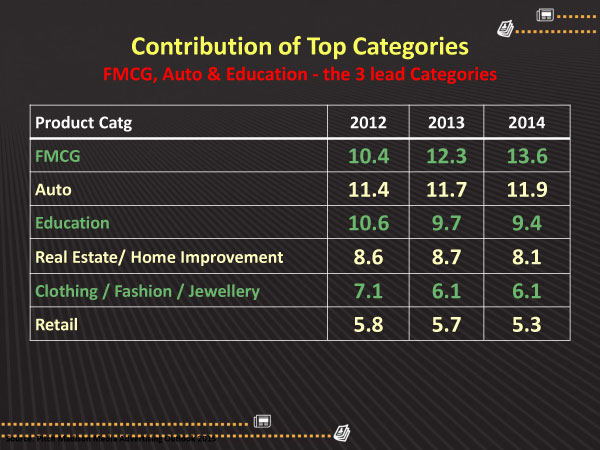
    It is significant to note that for the second consecutive year, FMCG is the largest contributor even in Print, although the contribution is only at 13.6% compared to TV where its contribution is 53%. For years FMCG was not a major contributor and it was Auto, Education and Real Estate that ruled the roost in Print. These categories along with clothing, fashion, jewellery and retail together contribute to only 40% of the total print spends.
    2014 also saw Hindi Dailies topple English with a share of 38% in spends. The dominance of English newspapers is declining for the second year. Hindi newspapers are now firmly the largest contributor to the Print advertising pie.
    Moving on to RADIO
    Radio being a local medium was extensively used by all political parties including individual candidates for campaigning during the Lok Sabha general elections & 5 State elections. Radio has grown by 17% as against earlier growth projection of 15%. This growth is despite Phase 3 not coming into force as anticipated at the start of 2014. E-commerce advertisers have also used the radio medium extensively for all their tactical offer based campaigns. The growth has also come on the back of higher inventory being sold across stations. Radio has maintained its share of 3.5% of the total advertising pie with total revenue of Rs.1,285 crores in 2014, an increase of nearly Rs. 190 crores over 2013.
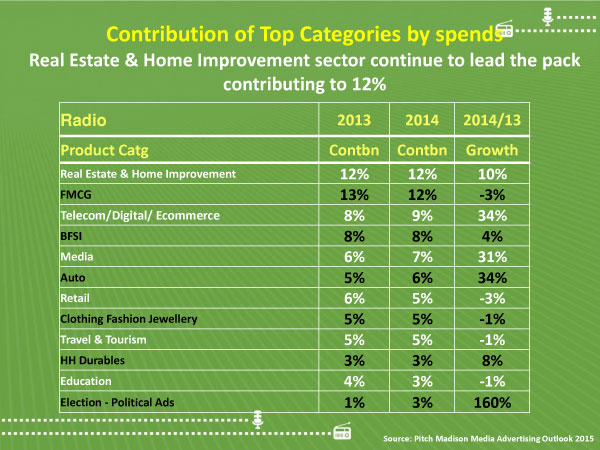
    In terms of category contribution, Real Estate & Home Improvement sector continue to lead the pack contributing to 12% of total Radio spends followed by Telecom/Digital and Ecommerce (9%) & BFSI ( 8%). Revenue from Ecommerce players sees the highest growth rate in 2015 followed by Auto and Media , while revenue from FMCG & Corporate sector shows decline in growth.
    Let’s see CINEMA
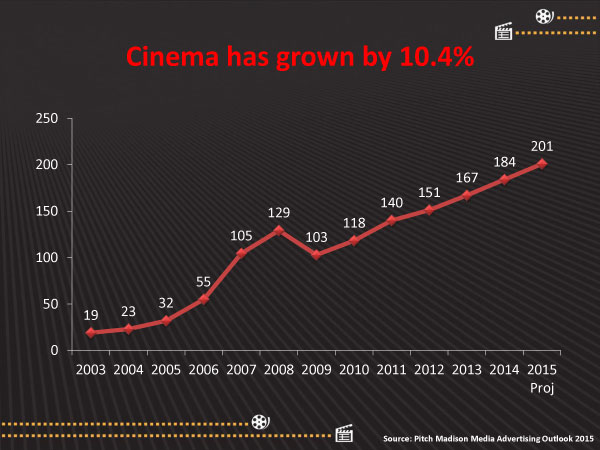
    Cinema has grown by 10% as against the projected growth rate of 7% and is at 0.5% contribution to advertising pie with total revenue of Rs. 184 crores in 2014. The rapid expansion of multiplexes in tier I and II cities is a big reason for the growth of cinema advertising in India
    Let’s see what’s happening in OUTDOOR
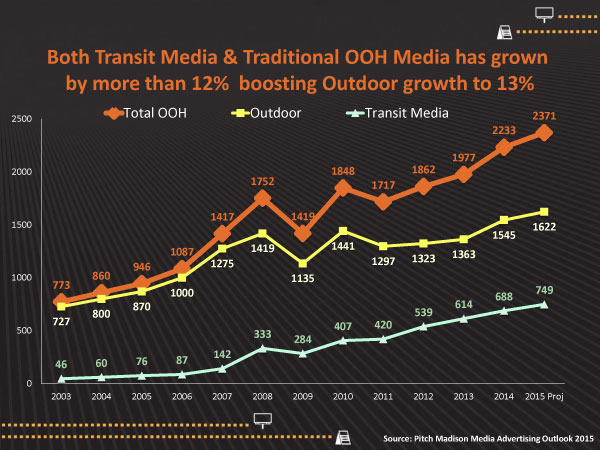
    The total Outdoor spends grew by 12.9% in 2014. Conventional Outdoor, against the projected 7% growth, grew by 13%. Transit Media too grew by 12% as against projected growth of 10%. Political parties spent heavily on OOH for both Lok Sabha Elections & 5 State Assembly Elections. E-Commerce category too gained momentum in 2014. Transit media rode on the back of new T2 terminal in Mumbai, initiation of Metro services in Mumbai & higher organic spends in Kolkata. Organic growth was seen in categories like Telecom, Automobile, BFSI and Retail. Outdoor has maintained its share of 6% of the total advertising pie in 2014 with total revenue of Rs. 2,233 crores, an increase of Rs. 256 crores over 2013.
    Finally we come to Digital
    Display including Video, Social and Mobile grows by 33% while Search increases by only 26%. With more FMCG and telecom players getting into the fray, Video, social and mobile formats saw larger traction. Given the explosion seen in smartphone adoption, we expect the trend to continue in the coming years
    So as you can see there has been a lot of action in the media world and to squeeze value out of this busy, noisy, media world, advertisers need to do a few things differently.I have 5 pieces of advise for my advertiser friends.
    My first piece of advise is to focus on effectiveness and not only on efficiency. Media seems to get the worst of everyone on rates. But Brands should not forget that the reason they advertise is to improve their brand health parameters and we have seen that certain properties, events and festivals, though expensive can impact brand health parameters in a substantial way, justifying the premium over vanilla buys.
    Experiment should be our mantra. And here our guiding principle should be “Fail often, fail fast”. I have often seen marketing teams are painfully slow on certain media decisions. We often suffer from analysis paralysis.
    Our recent experience with BJP and the aggressive e-commerce spends on Print and TV in the last year have ably demonstrated that “Media can Move Mountains”. But, in my view most brands fail to take full advantage of what media has to offer by under-resourcing their campaigns. Better to focus on few brands and advertise them heavily.
    A corollary point, I would like to make is that since budgets are finite and often limited by P&L considerations, you need to prioritize markets very sharply and in the priority 1 markets spend and exposure must be atleast twice that of priority 3 markets, otherwise prioritization is meaningless.
    For some unexplicable reasons I have noticed that as media spends get larger and larger, media decisions are been taken at lower and lower levels. If you want media to work its magic for you, greater involvement of corner rooms is required.
    Thank you