Tag: Pitch Madison Advertising Report

  • A Tale of Two Reports


    By Indrani Sen


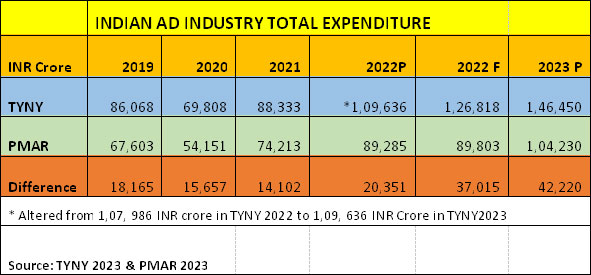
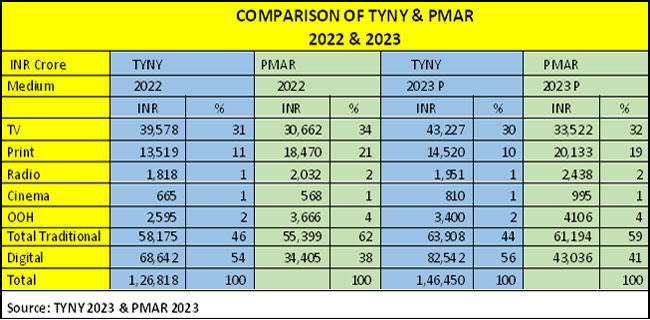
    Indrani SenIt is time to celebrate as the TYNY (This Year Next Year) 2023 report released by GroupM last week declared that the total value of Indian AdEx in 2022 has crossed the 100K crore mark touching INR 1,09,636 crore and in 2023 is estimated to grow at a healthy rate of 15.5% over 2022 towards another milestone of 150K crore (predicted as INR 146450 crore in 2023). Digital AdEx with an estimated 30% growth rate is expected to power the overall growth. India continues to be the fastest growing advertising market and as per the TYNY report has moved up from 9th position to the 8th position among the Top 10 countries with a share of 2% of the global adspend.


    As per the tradition set up over the last few years, the PMAR (Pitch Madison Advertising Report) 2023 was also released last week with a prediction that Indian AdEx will cross 100k crore mark in 2023 (predicted as INR 104230 crore) with a growth rate of 16% over 2022. Digital AdEX with an estimated 25% growth rate provide momentum to the growth.


    Both the TYNY and PMAR have been predicting in the same line over last few years with the gap between their estimates of the size of Indian AD Industry becoming wider year on year. By 2023 the size of the gap in the two estimates will be 40% of the total Indian ADEX size estimated by PMAR and by 2025 the size of the gap may become 50% of the Indian ADEX estimated by PMAR!! Globally is quite common to have difference in the estimates of the AD Industry size / AdEX estimated by different organisations, but if the difference becomes huge then it causes serious concern.


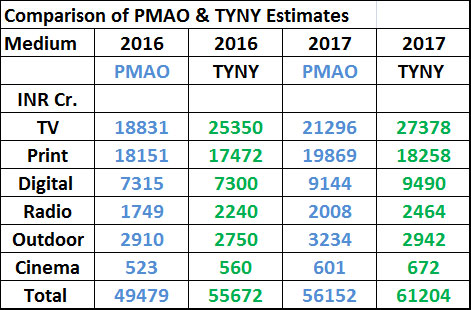
    Six years back, I wrote here an article comparing the estimates of TYNY 2017 and PMA 2017 https://www.mxmindia.com/2017/02/what-is-the-real-size-of-indian-ad-industry/. In that year, the estimates for Digital AdEx by the two agencies were almost the same, INR 7000+ crore in 2016 and INR 9000+ crore in 2017. However, the TV AdEx estimated by TYNY was considerably higher than the TV AdEx estimated by PMAO and hence the total Ad Industry expenditure estimated by TYNY was around INR 6000 crores higher than the that of PMAO.


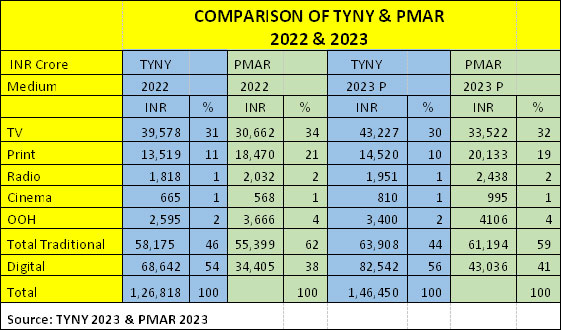
    It is interesting to note that over the last six years, Digital AdEx has increased at a much higher rate in the TYNY reports than in the PMAR reports. In 2022, the Digital AdEx INR 68,642 crore reported by TYNY was double the estimate INR 34,405 crore shown by PMAR.  AS per the TYNY report, Digital ADEX now has more than 50% share of the total AdEx, while in the PMAR report total traditional media is still enjoying around 60% share of the total AdEx as shown in the table below.


    The various industry websites including www.mxmindia.com and financial/ business publications have already reported on the findings of the two reports. Digital did not suffer during the three waves of Covid-19,  among the traditional media TV was the first to recover its pre pandemic revenue, outdoor recovered in 2022, print, radio and cinema are expected to recover in 2023. On the whole. 2022 was a good year for Indian Advertising and the immediate future looks bright.


    In spite of the widening rift between the TYNY and PMAR estimates, their leaders agree on the future directions. Prasanth Kumar, South Asia CEO, GroupM has said “As technology redefines interactions between consumers, brands and businesses the ad industry must navigate thru this changing environment.” Sam Balsara, Chairman and Managing Director, Madison World has advised the advertisers “to take advantage of the evolved digital infrastructure for distribution and advertising to prepare for the future growth and to invest in building their own D2C channels.” Only if the two agencies could stop the widening rift between the two reports, we would be in a happier situation.


    Indrani Sen is a veteran industryperson and educator. This is a new season of her Monday column on MxMIndia. Her views here are personal.


  • AdEx to grow 16.4% in 2019: Madison


    By A Correspondent


    Media agency network Madison is bullish about 2019 and expects a growth of 16.4% taking the total AdEx to Rs 70,888 crores. “The reasons for our high forecast are upcoming Parliamentary elections, increase in government spending to showcase its achievements, the upcoming ICC Cricket World Cup 2019, growth of OTT, increased spending in rural and India moving to a consumption society,” notes a communique, adding: “In 2019, we believe highest growth will come from Digital at 33%, followed by Cinema at 30% (although on a very small base), followed by TV (18%), Radio (12%), Outdoor (11%) and Print (5%).”

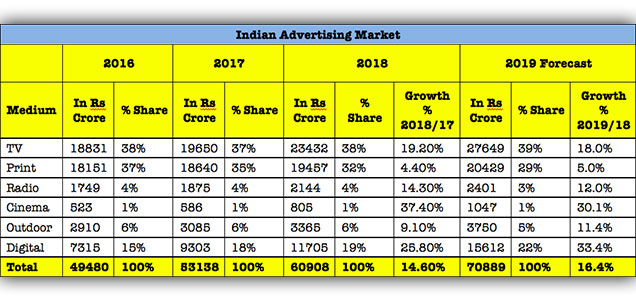
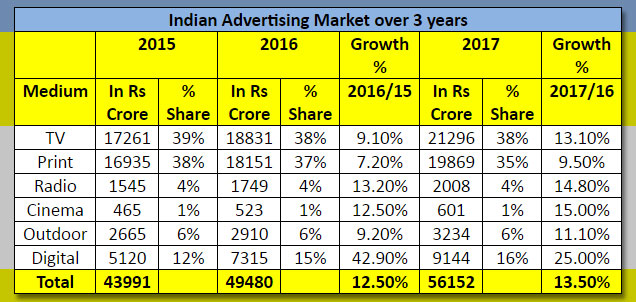
    Adspends have grown from Rs 53,138 crore to Rs 60,908 crore, an addition of  7,769 crores, the highest addition in one year in the last decade. The growth rate of 14.6% achieved in 2018 is almost double the growth rate achieved in 2017, notes the Pitch Madison Advertising Report 2019 release on Wednesday.

    Television still continues to be the largest contributor to Adex with 38% share, followed by Print at 32%, Digital at 19%. Outdoor, Radio and Cinema share has remained steady at 6%, 4% and 1% over the last 3 years.


    Figures at a glance:

    Indian Advertising Market
    2016 2017 2018 2019 Forecast
    Medium In Rs Crore % Share In Rs Crore % Share In Rs Crore % Share Growth % 2018/17 In Rs Crore % Share Growth % 2019/18
    TV 18831 38% 19650 37% 23432 38% 19.20% 27649 39% 18.0%
    Print 18151 37% 18640 35% 19457 32% 4.40% 20429 29% 5.0%
    Radio 1749 4% 1875 4% 2144 4% 14.30% 2401 3% 12.0%
    Cinema 523 1% 586 1% 805 1% 37.40% 1047 1% 30.1%
    Outdoor 2910 6% 3085 6% 3365 6% 9.10% 3750 5% 11.4%
    Digital 7315 15% 9303 18% 11705 19% 25.80% 15612 22% 33.4%
    Total 49480 100% 53138 100% 60908 100% 14.60% 70889 100% 16.4%


    Other findings of the report, as per the communique:


    1. TV:
      • TV grew by an unbelievable 19% to reach close to the   Rs. 23,500 crore mark, reinforcing regular Advertisers’ unshakable faith in this medium, no doubt aided by the robust measurement mechanism set up by our Industry.
      • This is the highest growth TV has witnessed in last 3 years. In terms of absolute numbers, TV advertising has grown by Rs. 3,782 crore in 2018.
      • And its share in the Adex pie stands at 38%. Whilst its share has declined over the decade from 43% in 2009, it is significant that since 2015 it has increased its lead over Print and now the gap in share is as much as 6 percentage points.
      • The main categories that have fueled the overall growth of Rs. 3,782 crores in 2018 are the evergreen FMCG (Rs. 1,660 crores) and Auto (Rs. 360 crores). E-commerce category too grew dramatically by 29% to reach Rs. 1,100 crores from Rs. 850 crores in 2017.
      • FMCG continues to rule the roost contributing as much as 50% to the total Television Adex, followed by Telecom at 12% and Auto at 8%.
      • Increase in FCT has also been a big contributing factor to the overall increase of 19% in the TV Advertising Market. The overall FCT demand in 2018 has increased by 12% led by growth in frequency channels and new channel launches.


    1. Print
    • India probably is the only major market where Print Adex is actually growing year on year.
    • Print grew by 4.4% during the year, marginally lower than our projection of 5%.
    • However, Print continues to be 2ndhighest contributor after Television with a share of 32%. And this share of Adex is also the highest in the world.
    • The resilience of Print is brought out in the fact that it has 200,000 Advertisers and the number is growing, compared to TV which has only 12,000 Advertisers.
    • Nearly 75%, of Print’s growth of Rs 820 crores is accounted by just 5 categories – FMCG, Education, Auto, Retail & E-commerce.
    • In terms of Volume, Hindi publications continue to be ahead of English publications contributing 35% of the total volume, while share of English publications dropped by 2% and now contributes 25%.


    1. Digital
    • The digital advertising market had an impressive growth of 26% in 2018. It has been growing at a compounded annual growth of 30%+ for last 10 years and 24% for last 5 years.
    • The continued growth of digital is fueled by mobile, online video and social media, which are increasingly attracting more advertising investment.
    • One of the key reasons for this growth has been the proliferation of OTT platforms. The OTT playing field has seen a 3.5x increase in number of players from just 9 players in 2016 to 30 players now.
    • Digital Adex at Rs. 11,705 crores is now 19% of Adex in 2018. It was only 9% in 2013.
    • Google and Facebook continue to dominate digital spends cornering 80% of the total digital pie.


    Says Mr. Sam Balsara, Chairman, Madison World, “After two dull years, 2018 has seen significant growth in Television and Digital and we expect the momentum to continue in 2019. With this growth, India has regained its pole position of being the fastest growing advertising market in the world and is expected to retain this position even in 2019.


    There is no doubt that for Advertisers, Media has become a complex subject and they need competent and experienced, creative media planners, working in enabling environments, provided by good media agencies to build their Brands.”


    If you would like a full copy of the Report, please email rj@madisonindia.com 


  • What is the real size of Indian Ad Industry?


    By Indrani Sen

    Last week was exciting for the advertising and media industry as the two major reports on industry Adex were released on two consecutive days. GroupM released its ‘This Year Next Year’(TYNY) 2017 report on February 14 followed by the release of ‘Pitch Madison Advertising Report’(PMAR) 2017 by Madison on February 15. In the last few days, both the reports have been published and analysed in the business newspapers and websites, leaving hardly any scope for adding any comment on the same.

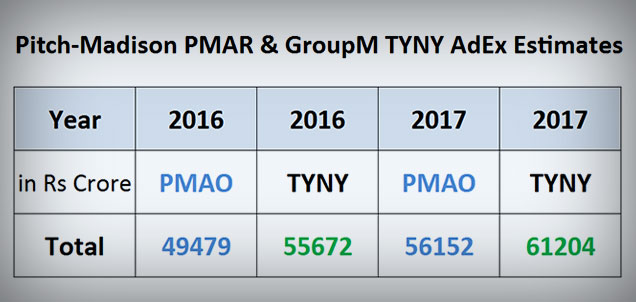
    As usual there is a difference between the two projections, this time it is of around Rs 5000 crore. The biannual report on advertising expenditure TYNY 2017 has forecast India’s advertising investment to reach an estimated Rs 61,204 crore in 2017 based on a growth rate of 10% over 2016. On the other hand, PMAR 2017 has projected a growth of 13.5% in 2017 over 2016 and has estimated the size of the industry to reach Rs 56,152 crore.

    According to Sam Balsara, AdEx dropped by Rs 1650 crore in the last two months of 2016 after demonetisation and as a result, the industry adspends narrowly missed the mark of crossing Rs 50,000 crore. On the other hand, the GroupM report, Indian advertising industry clocked Rs 49,758 crore in 2015 and crossed the Rs 50,000 crore mark comfortably in 2016 by scoring Rs 55,671 crores. Madison estimated Indian adspends as Rs 43,991 crores in 2015, Rs 49,480 in 2016 and has projected Rs 56,152 crore in 2017. The difference, between the two sets of estimates, has been hovering between Rs 5000 to Rs 6000 crore, which is not a small amount.

    If we compare the two sets of estimates by medium, we find that the major difference lies in the estimates of TV advertising expenditure, which is bit surprising as TV AdEx is very well-documented. Is there a difference in the way the two estimates are drawn up which leads to a gap of almost Rs 6000 crores between the estimated TV advertising expenditures?


    PMAR has shown more favourable estimates for Print and Outdoor than TYNY, while TYNY estimates for Radio and Cinema are higher than the estimates of PMAO. It is interesting to note that for Digital medium, the two estimates ran neck-and-neck for 2016 and are quite close for 2017.

    GroupM Report mentions that Media Adex reported do not include:

    • TV – special inventory like astons, L-bands, tickers, etc
    • Print – tender notices, appointments, classifieds/ matrimonial
    • Radio – activation spends
    • Digital – ad spends by SME segment
    • Outdoor – wall painting

    The above leads us to conclude that the numbers shown in the TYNY for the above five media would be actually higher than their estimations, particularly for Radio, where activation/ events tied up with digital has become a major source of earning for the FM radio stations.

    The Pitch Madison Advertising Report does not mention about the ad expenditures which are not covered in the report, but we can assume that Madison also has not covered the above expenditures which are not included in Media AdEx in their report.

    So, what is the real size of the Indian Ad Industry? Are we yet to cross the Rs 50,000 crore mark or did we cross it last year?


    Indrani Sen is a media services veteran, having worked with JWT, later Mindshare and then with Emami. In recent years, she is an independent consultant and academic. She is Adjunct Professor incharge of the Media Management programme at the Symbiosis Institute of Media & Communication, Pune. The views expressed here are her own.


  • 13.5% AdEx growth in 2017: Madison


    By Labonita Ghosh


    In February 2016, when Madison predicted that the Indian advertising industry would grow by 16%, it seemed overly-optimistic. Now it seems that Madison’s annual forecast report for that year would’ve been on the mark but for a small detail: a ‘tsunami’ called demonetisation. This derailed the entire industry, which eventually grew by only 12.5% last year as against the projected 16.8 %. Demonetisation also knocked off Rs 1,650 crore to settle at an industry size of Rs 49,480 crore, in the wake of a cash crunch and a drop in consumer off-take, which led to a lot of advertisers pulling out of campaigns in the last two months of 2016.


    Sadly, we haven’t heard the last of it. In 2017, the industry is expected to grow 13.5% mainly because the months of January to April will be the ‘recovery phase’ from the currency crisis. “My advice to advertisers would be to intensify campaigns during this period, and also have new product launches,” says Sam Balsara, Chairman of Madison World (who released the Pitch Madison Annual Report on Wednesday), mainly to make good the damage wreaked by demonetisation.


    Still, 2017, says the report, promises to be an exciting year for advertising. At a projected growth of 13.5%, the size of the industry may be a likely Rs 56, 152 crore. And this optimism for robust ad expenditures, comes on the back of high government investment in infrastructure, lower corporate and personal taxes for small and medium companies, good government support for the disadvantaged, and the general expectation of yet another year of high GDP growth. While the projected growth in the first four months is likely to be only 8%, ad expenditure will pick up between the months of May and October, to stand at a projected 14% growth. And since adex touched a low in the months of November and December of 2016, growth in the corresponding period in 2017 might – by comparison –appear as high as 24%.


    Television: Sector-wise, TV was still the biggest contributor to adex, registering a 9% and Rs 1,570-crore growth to reach the industry-size of Rs 18,831crore. This was largely propelled by FMCG (Rs 692 crore) and Telecom (Rs 475 crore), even though it lost an estimated Rs 850 crore to demonetisation. In 2017, TV will remain brands’ favourite medium and is projected to grow by another Rs 2,460 crore (13%) to close on Rs 21,300 crore. The forecasted reasons for this are organic growth coming from established FMCG advertisers as well as aggressive new players like Patanjali, and new channel launches by the existing networks.


    Print: Print grew by 7% in 2016 (three percentage points lower than the forecast for 2016), to stand at Rs 18,151 crore. In 2017, it is expected to grow by 9.5% to touch Rs 19,869 crore. Most of this growth will be because of dailies, and regional publications and new editions introduced by current publishers. As well as advertising from ‘print loyalists’ like auto, education, durables and mobile phones


    Digital: This was the (not-so-big) surprise. Digital was hardly affected by demonetisation, and grew by a whopping 43% to register an industry size of Rs 7,315 crore. Consumption of digital video content, which sparked huge spends on online video advertising in 2016, coupled with mobile displays, fuelled the growth of digital advertising, and will continue to do so. In 2017, digital is expected to grow to 25% to touch Rs 9,144 crore.


    Radio: Grew by 13% to register an industry size of Rs 1,749 crore in 2016. BFSI, media and auto advertisers were the main contributors to this growth. In 2017, radio is predicted to grow by 15% to become Rs 2,008 crore, and the likely reasons are greater aggression by e-commerce and mobile-wallet companies; the emergence of new radio stations who have won bids in Phase III auctions, and organic growth among retail and local advertisers


    OOH: The out-of-home market grew by 9% to register an industry size of Rs 2,910 crore, on the backs of retail, hospitals, education, real estate and restaurants, who are the biggest advertisers. As per the forecast, in 2017 OOH will grow by 11% to reach a size of Rs 3,234 crore, as e-commerce, M-wallet apps and telecom and mobile handsets will start advertising more aggressively using this medium.


    Cinema: Big-screen advertising grew by 12.5% in 2016 to settle at Rs 523 crore – which makes it a marginal player of all advertising media. In 2017, it is expected to grow by 15% to reach Rs 601 crore.


  • ‘PMAR’: Full Report

    By Sam Balsara, Vikram Sakhuja & Nilesh Bagaria


    Key Findings – 2015

    1. The Indian advertising industry in 2015 grew by another 17.6%, close on the heels of
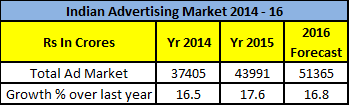
    LY growth of 16.5%. This growth is 4 percentage pointshigher than our mid-year projections of 13.8%. The Indian Media Industry is BOOMING, like never before. It is interesting to note that it took 5 years (2008 – 13) for Industry to add Rs10586 crores,moving up from Rs21520 crores to Rs32106croresbut only 2 years (2013-15) to add Rs11885 crores to reach Rs43991crores. With this growth, India finally earned the distinction of being the fastest growing Advertising market in the world.



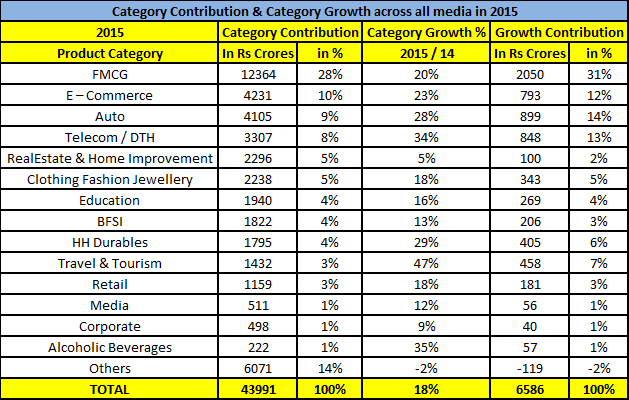
    In terms of absolute numbers, the Indian advertising industry has increased by Rs.6,586crores to touch Rs. 43,991crores in 2015. The categories who have contributed most to the overall growth in 2015 are FMCG, E-commerce,Autoand Telecom/DTH. FMCG continues to be the most dominant sector with a 28% share of the total Indian advertising industry followed by E-commerce (10%) & then Auto (9%). Contrary to the general perception that it is E-commerce that has taken the media market by storm, it is good old FMCG that has contributed more than Rs 2050 Crores to the overall growth. E-commerce came a distancefourth with a contribution to the overall growth of Rs793 Crores. E-commerce, though has become the second largest category, a distant second, but second, after FMCG
     

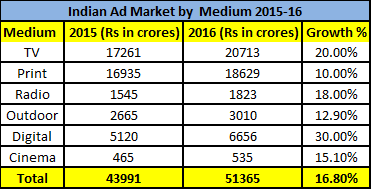
    2. TV has grown by a whopping 22% to reach Rs. 17,261crores and is on track with our mid-year projections of 21% growth. With close to 40% share, television continues to be  the largest contributor to the advertising pie. In terms of absolute numbers, TV advertising has grown by Rs. 3,103crores
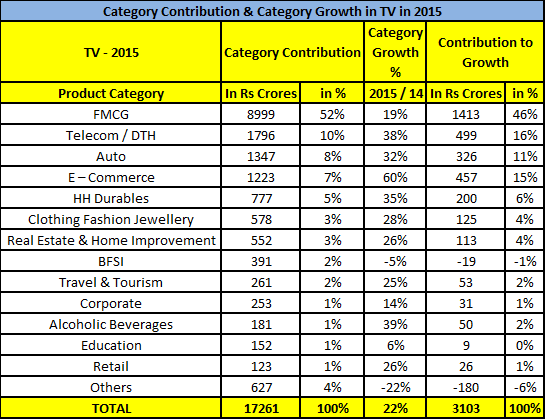
     

    • The main categories who have fuelled the overall growth ofRs 3103crores in 2015 are FMCG (Rs1413crores), Telecom/DTH (Rs499crores), E-commerce(Rs 457crores ) and Auto (Rs 326crores)
    • E-commerce category grew dramatically by 60% to reach Rs 1223crores. However in absolute terms it contributes only 7% to overall TV market
    • 2015’s biggest cricketing event ICC Cricket world Cup contributed approxRs 500 crores tothe overall growth. IPL had another successful year and netted almost Rs 1000 crores in 2015
    • In terms of category contribution, the pecking order remains the same with a marginal 2%agepoints shift in contribution from FMCG to E-commerce.FMCG however, continues to rule the roost contributing 52% share of total TV spends (down from last year’s 54%), followed by Telecom / DTH (10%) & Auto (8%).
    • Looking at genres, within Television, Hindi GEC contributes nearly 28% of the overall TV revenue and continues to remain the leader of the pack. In terms of growth, Hindi GEC, Sports and South regional show substantial increase.
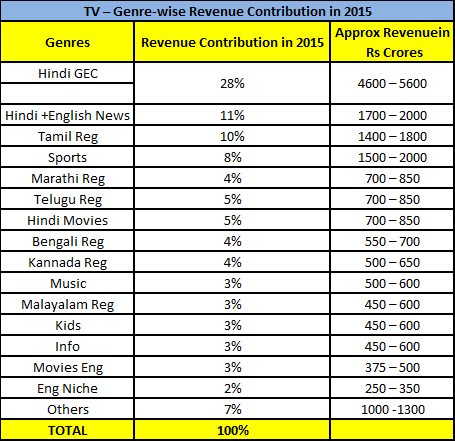


    • With all networks selling HD channels separately for regular as well impact properties, revenue from HD channels has grown dramatically in 2015 although the base is very small still.
    • The impact of TRAI’s 10+2 ruling seems to be on the wane, with many channels having telecast more than 12 mins/hr of FCT. This has also been confirmed by TRAI in their latest press release. This increase in FCT has also been a major contributing factor to the dramatic increase of 22% in the TV Advertising Market.


    3. Print has also grownsubstantially, by as much as 11% (compared to our forecast of 5.3 %) to reach Rs. 16,935crores and continues to be the second highest contributor after TV to the total advertising pie, with a share close to 39%. While dailies increased by 12% in 2015 over 2014, magazines as a medium failed to gain advertiser interest and has seen anegative growth of 3% in 2015. Nearly 70%, of Print’s growth of Rs 1661 crores is accounted by just 3 categories-Ecommerce (Rs 398 crores), FMCG (Rs393crores)and Auto (Rs360 crores). Another 22% is accounted by Education (Rs 224crores) and HH durables (Rs 144crores) to the overall growth.
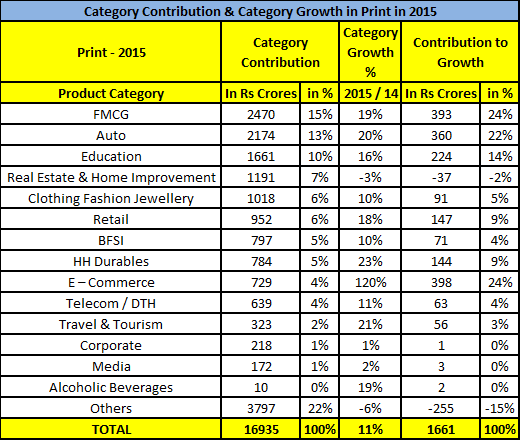


    In terms of category contribution, the decision of many publishing houses to follow a differential pricing for FMCG has begun to bear results and now FMCG is also the largest contributor to the Print Pie, with a contribution of 15%. Automobiles is second largest contributor at 13%, followed by Education (10%). Also whilst in contribution E-commerce comes way down, it shows the highest growth of 120%.


    While only 4 categories account for 75% of Television advertising, it takes as many as 10 categories to contribute the same to print advertising demonstrating that print is less vulnerable to any category degrowth.


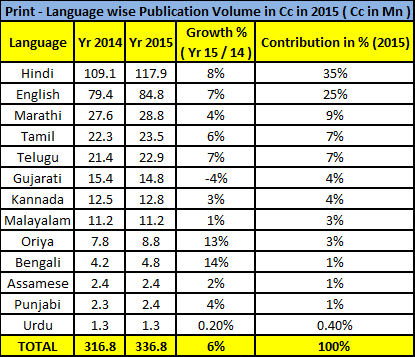
    In terms of Volume Cc among dailies, Hindi publications continue to be ahead of English Dailies. Hindi publications contribute 35% of the total volume while English publications contribute 25 %.In our estimates, though in terms of growth of volume Ccboth English& Hindi publication have grown at same rate of 7 – 8%.  Telugu publications also grown at the same rate.Bengali & Oriya publicationsshows the highest increase of 13 – 14% but Gujarati publications show a decline of 4%.


    4. Digital – At 29%, growth in digital media is in line with our earlier expectation. Digital advertising market now crosses the Rs. 5000 crore mark.


    Though the absolute spends on Search have increased, its share of the digital pie has gone down due to the fact that video, social and mobile display have grown at a faster rate last year. Desktop display growth has also further slowed down, as mobile is the all –pervasive platform of choice today.


    While E-commerce players are by far the biggest spenders on digital, spends are skewed towards Search and Social with Mobile as a key platform. The uplift in Video comes from the fact that more and more FMCG players are using the digital space to reach out to their audiences to support their television campaigns.


    5. Radio has grown by 20% in 2015 to become aRs1545 croremarket and has maintained its share of the total Advertising pie at 3.5%.In terms of absolute numbers, Radio advertising has grown by Rs. 260 crores.


    E-commerce advertisers have emerged as one of the main contributors to the growth followed by Automobiles category. Revenue from Ecommerce players in facthas almost doubled in 2015 on Radio on account of various offer-based tactical campaigns. Automobile category has grown by more than 36% on radio in 2015 on the back of new launches across segments.
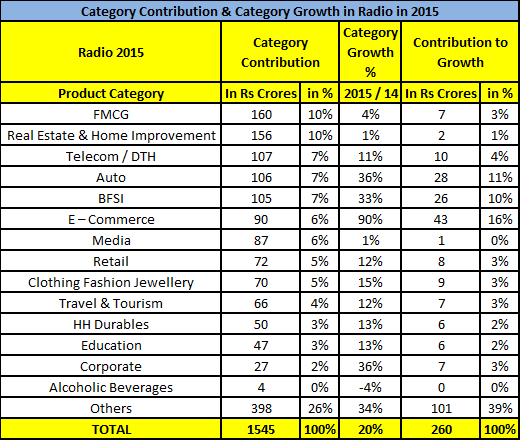


    In terms of category contribution, Real Estate &FMCG sector continue to lead the pack contributing to 10% each of total Radio spends followed by Telecom / DTH& Auto sector (both at 7%).E-commerce now shows up as a major contributor at 6%.


    The growth has come on the back of higher inventory sold across stations.


    6. OOH –Our OOH estimates now include Digital OOH & Malls which are growing quite rapidly and hence we have re-cast OOH revenue figures for last 3 years when this sub segment began to emerge. Digital OOH & Malls revenue are estimated at Rs 300 crores in 2015 (Digital OOH & Malls netted additional 100 Crores in 2014 & 50 crores in 2013). The OOH market has grown by  14%, in 2015. Transit media though grew by 13%.


    In terms of absolute numbers, OOH advertising is now a respectable Rs 2665 crores market.  Retail, Real Estate & Automotive continue to be thetop 3 categories in terms of contribution.


    Highest growth was in E-Commerce category (110%) followed by Automotive (66%), both together, contributing 60% of the overall growth. The usual big spenders- TV Channels, Banks, Print Media, Mutual Funds etc reduced their OOH spends in 2015.


    FMCG which is the largest contributor to TV, Print & Radio does not use OOH substantially except perhaps HUL, therefore FMCG contribution to OOH is only 7%
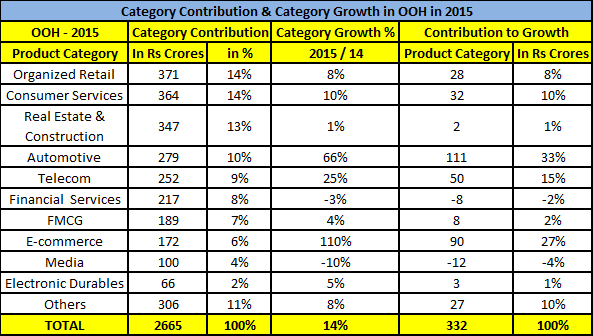


    In terms of city wise spread, Mumbai continues its lead as a major contributor (22%) followed by Delhi (19%). Bangalore replaces Kolkata as the number 3 city with a contribution of (10%).


    OOH has maintained its contribution to the total media pie, at 6%.


    7. Cinema

    We recognize that we have under-reported cinema advertising in our earlier estimates. Cinema advertising from various government agencies and many local / retail advertisersusing static slides are  a substantial contributor and growing quite rapidly. Therefore we have included spends by these advertisers for this year and also in our estimates of previous years.


    This has led Cinema to grow by 21% and now contributes 1% to the total advertising pie with total revenue of Rs. 465 crores in 2015. The multiplex boom in smaller towns, digitization of single screens, and substantially increased activity on marketing of movies (both Bollywood & Hollywood)has created interest around the medium thathas attracted new advertisers.


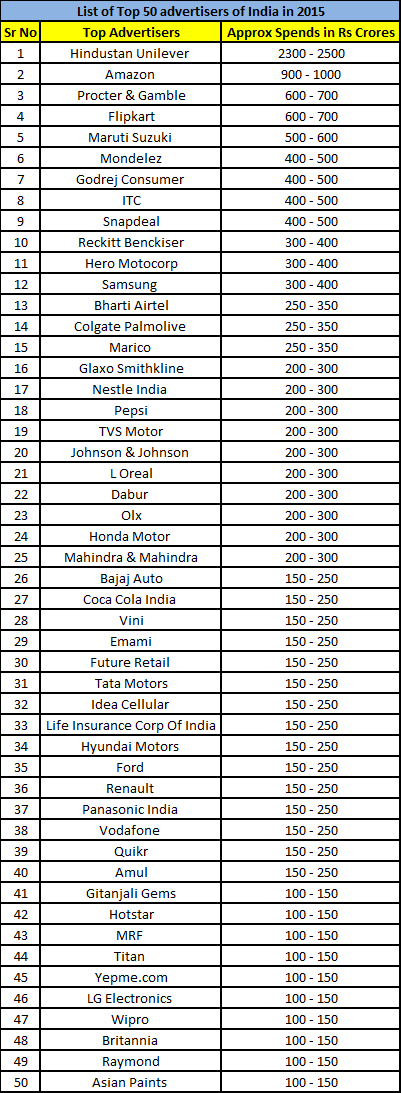
    8. Top Advertisers of India.This year in response to many requests from the advertising & media professionals, we are releasing approximate spends of top 50 advertisers of India for the year 2015.


    Advertising continues to be a game of the big boys. Top 50 advertisers account for 36% of the advertising market. This number is significant considering that there are over 2 lakhs advertisers in Print and over 12000 advertisers in TV. Top 10 advertisers account for as much as 17% of the total market and contribute to 47% of the total 50 list. By the time you reach rank 50, you are down from 2300 – 2500 crores to a 100 – 150 crores. A note of caution, some advertisers who in our list  rank between 50 – 60 may well be in reality in the top 50 list or vice-versa.


    HUL continues to lead the pack with  spends of about Rs. 2500 crores followed by Amazon India, Procter& Gamble,  Flipkart,Maruti Suzuki, Mondelez, Godrej,ITC, Snapdeal and Reckitt who has spends  between 400 – 1000 crores and who make up our  Top Ten list.


    We may mention that many Madison clients feature in this list but we hasten to add that we have not used confidential information that we are privy to in arriving at this list. The list has been arrived at using a standard structured process.


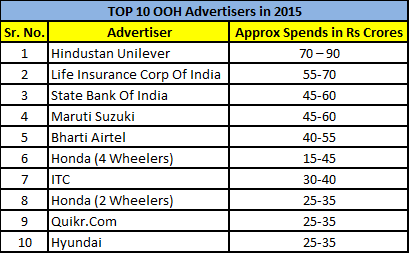
    HUL also leads the pack of top advertisers in OOH media for the year 2015


    2016 Forecast

    Our prognosis for 2016 is that it is going to be yet another GOOD YEAR for Media. In arriving at the numbers we are conditioned by the fact that the Indian economy has become the fastest growing economy of the world; our GDP growth rate at 7%+ is the envy of the western world, now  looking at India in new light; our BJP govt tells us that it has made a number of structural interventions to prepare the economy for high growth and continues to remind us that they are strongly focused on stimulating the country’s economic growth for which pro- business policies are essential; at the same time not ignoring subsidies for the poor, which should also add to purchasing power of Rural India  and finally Commodity prices including that of Oil  are likely to remain soft throughout 2016. Although Indian businesses have expressed concern that all the positive actions taken by the Govt. have not resulted in growth on the ground, we feel that India Inc. remains very optimistic about India’s future and they will once again invest heavily in advertising to protect and gain market share of their brands and also launch   a number of new brands and variants and ecommerce platforms and apps to capture the imagination and meet the requirements of modern India.


    All this will help the advertising market cross the Rs. 50,000 croremark.


    1. We expect the market to grow by more than Rs. 7300 crores to reach a total size of Rs. 51365 crores, which represents a growth of 16.8% over 2015.  India will also retain the distinction of being fastest growing advertising market in the world for the second consecutive year.


    On the supply side a big contributor of this growth will be the ICC Cricket T20 World Cup and the busy schedule of India Cricket for next 6 months. TV will continue as the largest contributor to the overall advertising pie with a share of 40% gaining a further one percentage point. Share of digital spends will increase to a respectable 13% of the overall advertising pie.


    2. TV: Paradoxically, as India races to have 500 million users on the Net, we expect TV, most Brands’ all-time favourite medium to grow by another Rs 3450 crores or 20% in 2016 to reach a total figure of Rs. 20,713 crores.


    Factors that will lead to this high growth are:

    • Organic growth coming from  the largest contributor to TV Market, FMCG.
    • Entry of new Chinese manufacturers that will enter India specially in Electronics and Mobile Handsets like Vivo, Xiomi, Le-Eco and many others.
    • Big bang launch of Reliance 4G services Jio anytime soon, and the defensive efforts of existing telecom operators.
    •  30 new car and 25 new two wheeler launches expected in the Auto industry.
    • Continued emergence of new E-commerce advertisers, covering more and more categories and new services.
    • Election campaigns of  Political parties, given that 5 State assembly elections in Tamil Nadu, West Bengal, Assam, Pondicherry  & Kerala are scheduled in  2016.


    New channel launches from existing networks will increase inventory supply to absorb this growth, as also the inevitable rate increases.


    3. Print: We expect the Print advertising market to grow by a further 10% in 2016, mainly from dailies, taking the total print market close to Rs. 18,600 crores. Most of this growth will come from language publications and new editions by regional publishers that will attract new Retail advertisers.


    Other factors contributing to growth of Print advertising market are likely to be:

    • Election campaign in the 5 States heading for Assembly Elections this year
    • Organic growth  from various  Print loyalists  like  Auto, Durables and Education.
    • Big Bang launches, using Front page jackets  by new Mobile apps and stream of tactical offers by Ecommerce  and Retail companies
    • Multiple launches across both 4-wheelers and 2-wheelers from all leading auto companies


    4.       Digital

    We expect Digital to gain momentum and grow by about 30% in 2016 to reach close to Rs 6,650 crores. Search spends are likely to stabilize and Desktop Display would see a further downward trend in terms of share of pie.


    Programmatic Buying has seen some traction in 2015; this is likely to get further strengthened in 2016. With more  users on mobile, spends will be strongly focused on this platform; and whether it is Search, Social or Video, about 80% of all ad impressions will be delivered on the mobile device.


    As the reach of digital crosses 400mn, digital will start coming into its own; some advertisers will begin to use it  as a reach and awareness building medium; it will, however, not lose its importance as a ‘conversion’ or ‘performance’ medium and as a strong support medium to TV.


    FMCG, telecom, consumer durables, real estate, apparel and BFSI will continue to be growth drivers; E-Commerce will remain the backbone of the industry.


    5. Radio: We expect Radio to grow by 18% in 2016 taking the total Radio Advertising market close to Rs. 1,800 crores


    Factors contributing to this growth will be:

    • Election campaigns in the 5 States heading for Assembly Elections this year.
    • Multiple launches across both 4-wheelers and 2-wheelers from all leading auto companies
    • Many new radio stations emerging  after winning bids in the recently held Phase 3 auctions.

    6. Outdoor: We expect Outdoor to grow by 13% in 2016  taking the total Outdoor Advertising Market to more than Rs. 3000 crores.

    Many of the factors outlined for Print and Radio will also be responsible for driving the growth of Outdoor. We see also a higher adoption of Digital and Technology and greater usage of Transit Media at Airports and Metros .


    7. Cinema: We expect cinema to grow by 15% in 2016 taking the total Cinema Advertising revenue to Rs. 535 crores.  Digitisation of single screens, presence of multiplex screens in tier-II and III towns & increasing popularity of Hollywood & Regional films in India are expected to fuel the  growth of Cinema advertising.


    In conclusion, 2016 promises to be yet another high growth year for the Indian advertising market. Perhaps no market anywhere in the world has grown consistently across last 3 years to achieve a growth of 60 %from 2013 to 2016.In the previous 3 years from 2010 – 2013, the growth has only been 28%.


    Paradoxically the market enablers are growing at a faster rate than the markets they hope to stimulate. Not many categories in the past 3 years would have grown by 60%.


    A sure sign that India Inc. has confidence in India’s future.


    Source: Madison World
     

  • Industry will once again invest heavily in advertising: Sam Balsara


    According to the recently-released Pitch Madison Advertising Report 2016, adspends grew by 17.6 per cent in 2015 and are expected to notch up another 16.8 per cent growth this year. Given the poor shape the markets and the economy are in, this does seem a tad unrealistic. But Sam Balsara, Chairman, Madison World, doesn’t think so. He tells Pradyuman Maheshwari that the optimism is not misplacedand if advertisers and media owners to read the full report, not only would they get a better understanding of the media market, but also sharpen their strategies in line with that.


    A 16.8 per cent, overall growth is huge. And we hear of doom and gloom all over. The markets are tanking, the economy isn’t looking hunky-dory either. So is the report being over-optimistic about  2016 adspends?

    The report outlines, in reasonable detail, the reasons for our optimism. Please see the commentary under Forecast 2016.  Primarily, confidence of the Indian Industry in Indian markets is growing by leaps is high and accompanied by low commodity prices. The industry will once again invest heavily in Indian advertising. Advertising is recognised as a trusted engine to stimulate demand.


    And the 17.6 per cent growth of 2015 confirms it’s ‘achche din’?

    Yes, the figures took us by surprise too. As you know, we revised upwards the TV figures mid-year, but the final figures for TV exceeded our mid -year revision, and all other media too grew more than our forecast. In fact, print grew at twice the growth rate we projected.


    Madison has always known to be more conservative than the others in its spends forecast…

    Our attempt is always to be realistic. And we try to base our forecast on data and numbers.


    Is this essentially on the back of ecommerce, 4G and telecom hardware, and the sporting encounters and leagues?

    FMCG, with its dominant size, will be the largest contributor to growth, supported by what you mention.


    Television is seeing a huge growth still. What would you attribute this growth to?

    Television continues to be the large advertisers’ chosen and dominant medium for brand-building. Many advertisers now use a support medium, though. TV, along with digital, makes for a potent combination today, with TV working at top of the funnel and  digital at the middle-to-lower end.


    And there’s no sign of print growing in a big way. But in print do you see different trends in English mainstream, regional and magazines?

    Print will grow by another 10 per cent in 2016, according to our forecast. Regional will grow at a faster rate than English. Magazines will remain flat.


    Would you predict the demise of the print magazine as it is today by, say, 2020

    No. Magazines are a useful medium and have a role, though limited in the marketing mix.


    Most forecasters are bullish about radio, and said the good times will begin with Phase 3. But do you really see much happening there? It’s the second-lowest among media vehicles in 2016…

    Over the next two years, radio should show high growth. It’s a good medium for new advertisers where entry barriers are low.


    The Top 10 spenders account for 17 per cent of the total market. In a sense, it’s far from the 80-20 Pareto Principle. But three e-commerce players in it, and no devices or telecom major in there. How come?As we said, advertising is a Big Boy’s game. The e-commerce players are in the growth stage and looking forward to converting millions more to e-shopping. Telecom is in a mature stage. But data wars will see more action here in 2016.


    The FMCG growth of 20 per cent to Rs 12,364 crore is heartening. Would you attribute this steady rise to any reason or was it expected?

    Soft commodity prices is one major reason. And FMCG advertisers know that it is very expensive to regain lost share, so nobody wants to let go.


    The Madison report is the last of the four annual adspend reports releasing at this time of the year. An unfair question to ask, but how would you differentiate this from the others which exist?

    We like to wait till we have seen data for January-December, and most companies in India follow an April-to-March panning cycle, so its timing is perfect.

    A slightly shorter version of this appeared in dna of brands on Monday, February 15, 2016