Tag: Pitch Madison Advertising Report 2020

  • 12 minute ad cap may turn to 12 death nails for FTA channels


    By Indrani Sen


    The right thing at a wrong time is a wrong thing.

    Taking liberty with the words of Charles Dickens, one can say this is not the best of times; this is probably the worst of times in the twenty-first century when we are fighting with the deadly Coronavirus, the total number of COVID 19 positive cases and death caused by the pandemic are going up every day in India, the Indian economy is in recession and Media & Advertising Industry has just seen a huge drop of 65% in advertising revenue in Q2 of 2020 (Source: Pitch Madison Advertising Report 2020 Midyear Review). What a time for TRAI to press for the 12% ad cap on Television by pushing for a hearing of the case at the Delhi High Court!


    Dust has not yet settled on NTO 2.0. Indian TV Industry and the Regulating body have been discussing the possible implications of implementation of NTO2.0 over the last few months. It has come as a rude shock to the TV industry that TRAI has pushed the Delhi High Court for an early hearing of the case on 12 min cap per hour on television advertising. The final hearing has now been fixed on 28th September, 2020. If Indian television industry is forced to accept the 12% ad cap during this difficult time, then many TV channels, particularly the free to air channels and news channels may be forced to close their business.


    Let us take a quick look at the effect of the pandemic on TV advertising. The Pitch Madison Advertising Report 2020 Midyear Review released last week has shown that against a 65% loss of total advertising in Q2 2020, loss of TV advertising was 61%. The chart below shows the TV advertising market in April, May, June TV advertising revenue over last 3 years. Across all categories, advertisers have spent less on TV during the first half of the year with 25% of the regular advertisers not spending on TV advertising. Even after the boosting of as spend in the second half of the year due to the festive season, IPL, big ticket properties on TV like Big Boss, KFC, the TV industry is expected to end the year 2020 with 12% to 17% de-growth.


    Source: Pitch Madison Advertising Report 2020 Midyear Review


    Based on consumer complaints in 2012, the TRAI first announced the regulation on 12% Ad cap in 2013. I wrote an article on 12th October, 2015 here comparing the systems of regulations on TV advertising across various countries (https://www.mxmindia.com/2015/10/mediasense-by-indrani-sen-to-cap-it-all/) and requesting TRAI to look beyond the regulatory system of UK to other countries across the world. Since 2015, some of the countries cited as example in my article, have changed their own regulatory frame works and have made it more user friendly for the TV channels. For example in Europe instead of 20% of advertising in every hour, it has been relaxed to overall 20% advertising between 7.00 to 23.00 hours with broadcasters’ own promotions, sponsors’ announcements and product placements not counting under the 20% stipulated time.


    As per the last FICCI EY report we had 918 TV channels in 2019 of which 65% were free to air channels.  Out of the registered TV channels in India 386 (42%) are news channels of which many are in the FTA category. These channels depend solely on advertising revenue and will be really badly hit if the 12% ad cap per hour is imposed at this unprecedented time. The eco system of Doordarshan’s Free Dish will also be affected in the process and the viewers will end up getting a raw deal in terms of the channels available on the Free Dish.


    It is obvious that it is not possible to attract advertising for the repeat shows after 12 midnight till 6am in the morning when the country goes to sleep. Many TV channels have already petitioned for changing the ad cap per hour to an overall ad cap per day. By relaxing the 12 min per hour cap to 12 minute overall cap during 24 hours, TRAI can allow the TV channels the flexibility to distribute the total commercial time of 288 minute per day in a more profitable manner. Alternatively, TRAI’s purpose of providing better content to the consumers would be self defeating as consumers will get less variety of content with many FTA channels going off the air or will have to pay additional cost for viewing better content with more established GEC channels introducing more ‘pay & view’ content.


    Finally, there is a time for taking all actions. If a right action is taken at a wrong time, then it can become a wrong action. After procrastination of 7 years, TRAI can surely wait for normalcy to return to our economy at large and the media and advertising industry in particular before enforcing the proposed ad cap on TV advertising.


  • Dramatic changes in Indian Ad Industry


    Editor’s Note: The Pitch Madison Advertising Report 2020 is a significant industry milestone held every year. Although MxMIndia belongs to the same space as the Exchange4media group-owned Pitch magazine, we believe the report is an industry property and are glad that the two entities – Pitch and Madison – are doing this for many years. Our report very clearly acknowledges the association of both Pitch and Madison, and have hence not called it the Madison Advertising Report, but the Pitch Madison Advertising Report 2020, as it should be.


    By Indrani Sen


    The Pitch Madison Advertising Report 2020 presented its mid-year review yesterday and revealed the extent of damage done by the pandemic to Indian ad industry.


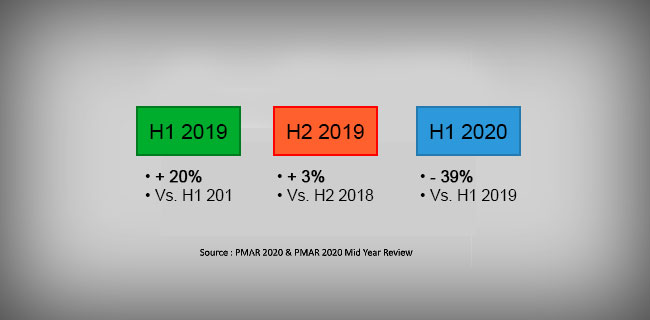
    A comparison with 2019 shows that the overall AdEx lost INR 14,000 crore and declined by 39% in H1, the first half of 2020 due to the effects of Covid-19. A break up of the first half by two quarters showed that Q1 had an 8% decline in the overall AdEx in the pre-Lockdown period due to the slowing down of Indian economy. In Q2, during the complete lockdown in April and May, the overall AdEx dropped into almost a bottomless pit. The fall was partially arrested with the unlocking starting in phases from June 1, but overall AdEx still declined by 65% in Q2.


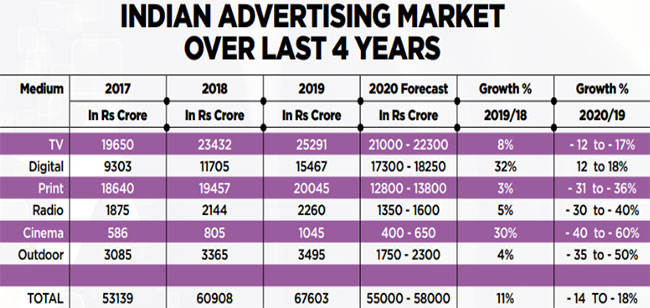
    Citing the trends of recovery of TV and Digital advertising in June and July, PMAR has predicted 60% -72% recovery of overall AdEx in H2, the second half of 2020 boosted by the festive season, revival of IPL, big ticket TV shows like KBC and Big Boss. The estimated recovery of AdEx in H2, is expected to arrest de-growth of overall AdEx in 2020 and contain it within a range of -14% to -18% as shown in the chart below.


    Source: Pitch Madison Advertising Report 2020 Midterm Review


    While TV and Digital are set on getting back to normalcy, Print is lagging far behind and Radio, Cinema and OOH are yet to show signs of regaining normalcy. The report has refrained from calculating a specific growth number in the forecast for 2020, instead has indicated a range for the AdEx value of each sector as well as the overall Ad Industry as reflected in the above chart. PMAR needs to be congratulated on their commendable efforts of mapping the effects of COVID 19 on Indian Ad Industry in the current situation.


    As per the usual format of reporting, PMAR has presented a detailed picture of TV, Digital, Print, Radio, OOH and Cinema and an analysis of advertisers active during the first two quarters of 2020 across different media. Among traditional media TV suffered the least damage with TV AdEx dropping by -43% in H1 ‘20 and retained 38% share of the advertising pie. Print AdEx dropped by 51% in H1’20 and it had to concede the number two position to Digital in terms of share in the advertising pie which dropped to 25%.  Adex dropped respectively by 52% in Radio, 55% in OOH and 52% in cinema in H1 ’20.  Digital had only a minor contraction of just 7% in H1 ’20 and its share in the advertising pie went up to 30%.


    As far advertisers are concerned, more than half disappeared from Print and Radio during the first half of 2020. TV also lost a quarter of its regular advertisers. 13 new advertisers entered the list of Top 50 advertisers which accounted for 31% of the overall AdEx. HLL topped the list with INR 1300 to 1500 crores advertising in H1 ’20. A wide gap was noticed among HLL and Procter & Gamble who ranked second with an ad spend of INR 250 to 350 crores.


    The Indian ad industry has never experienced such a decline. If we look at the last two decades, we find the industry growing in leaps and bounds during the first 8 years of this century with year on year double digit growth. In earlier PMAR reports we saw the growth rate of overall AdEx dropping to -8.9% in 2009 from 18.9% in 2008 as the international financial crisis triggered off by the sub-prime mortgage problem in the US led to recession in many countries and cast a shadow also on our economy. However, the overall industry recovered quickly with a whopping 27.9% growth in 2010. During the current decade there has been ups and downs in the performance of the overall AdEx but we never saw actual de-growth of our Ad Industry. According to PMAR 2020 Midyear Review, COVID 19 may set the industry back by 2 to 3 years. It is unlikely that the industry will recover as quickly as it did in 2010. A lot depends on how the government can control further spread of the pandemic and how soon vaccine for coronavirus can be available for Indian masses.


  • Well-Pitched Delivery!


    By Indrani Sen


    As per the Pitch Madison Advertising Report, in 2020 adspends in India are predicted to grow by 10.4%, while GroupM’s This Year Next Year predicts that in 2020 the same will grow by 10.9%. This rate of growth is the only aspect on which both the reports have shown some similarity.

    Even while commenting on the growth rate, GroupM sounded buoyant by comparing it with the 5.1% growth rate of global ad spends in 2020 and ignoring the Indian ground realities while Madison described the growth rate as “muted” expecting the economy to bounce back only in the second half of 2020.

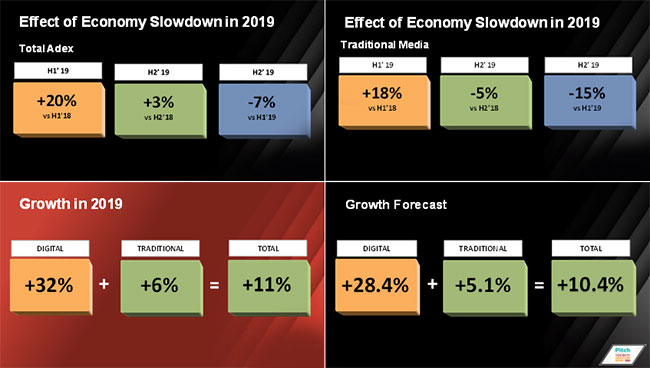
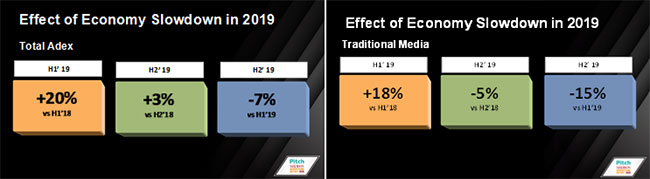
    PMAR 2020 is more firmly rooted in the Indian media and market scenario and has presented an excellent analysis of the ups and downs faced by the traditional media industry in 2019 and its consequences. In his presentation, Sam Balsara made an interesting observation by dividing 2019 in two halves and showing how AdEx grew very well during the first half riding on IPL, World Cup and Lok Sabha Elections, but collapsed during the second half due to economic slowdown. Balsara also showed how the traditional media suffered heavily during the second half of 2019, when compared to second half of 2018, there was a de-growth in second half of 2019.

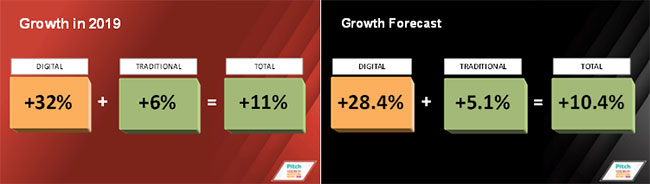
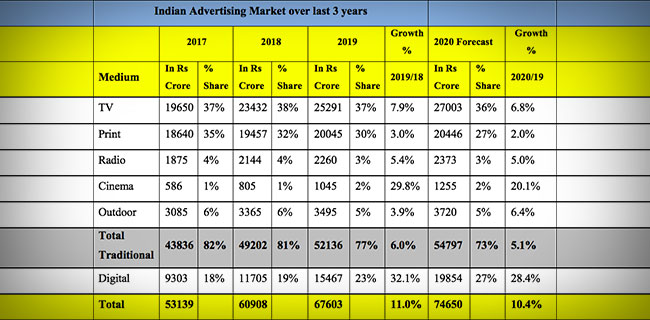
    Balsara presented  charts showing that the Digital media grew by 32% in 2019 and projected a growth rate of 28.4% in 2020 as against traditional media which grew by 6% in 2019 and is expected to grow by 5.1% in 2020.

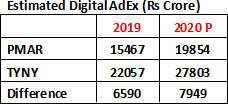
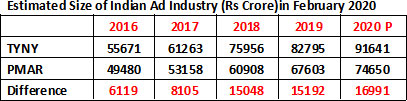
    He commented in his presentation that: “We also expect a wide variation of growth rates across mediums ranging from a low of 2% for Press, 5% for Radio, 6% for Outdoor, 7% for TV, to 20% for Cinema and 28% for Digital.” In 2020 TV will continue to enjoy the largest share of the advertising pie at 36% and Print may be demoted to number 3 with Digital securing a march over it. As of now, PMAR predicts 26.6% share for Digital and 27.4% share for Print in 2020. PMAR and TYNY also projects different estimates for the size of the traditional media, with TYNY estimating a value of TV AdEx almost 10000 crore higher than the value estimated by PMAR.

    The growth rates for Digital media estimated by TYNY is 28% in 2019 and 26% in 2020. Both the reports predict Digital as the main growth driver of Indian Adex in 2020, but there is again a significant differences between the estimated sizes of Digital AdEx.

    GroupM has revised their estimate for total AdEx upwards for both 2018 and 2019 while Madison revised their estimate for total AdEx downwards for 2019 due to economic slowdown and various headwinds faced by the traditional media industry. As a result of these revisions made by the two agencies, estimated sizes of Indian Ad Industry by TYNY are now 15000+ crore higher than the sizes estimated by PMAR, a difference which is not only difficult to reconcile, but also creates confusion in the market place.

    By now, we have learned to live with different sizes of the Indian Ad Industry estimated by different agencies. PMAR estimates are most acceptable by the industry at large due to its ability to link the market realities with their statistics supported by analysis of trends in Ad Spends as well as in depth analysis of individual media. Balsara also adds an icing on his presentation every year through advice to advertisers which are considered to be extremely useful and this year he has excelled himself on that score.


    Indrani Sen is a veteran advertising and media agency practitioner. She is now also an academician. Her views here are personal


  • Traditional media grew 6% in 2019. Forecast for 2020: 5.1%: Pitch Madison report


    By A Correspondent


    The annual Pitch Madison Advertising Report 2020 was released on Thursday in Mumbai with the message that didn’t need much spelling out: traditional media grew only 6% in 2019 and actually degrew in the third and further quarter. The forecast for growth in 2020 is down to 5.1%. But digital media is galloping ahead. It grew 32 in 2019, and the forecast for 2020 is 28.4%.


    Said Sam Balsara, Chairman, Madison World: “Whilst 2019 has been a tumultuous year for AdEx, I believe Adex will grow dramatically over the next five years given that we are one of the larger growing economies of the world and already growing at twice the rate of global AdEx (11% vs 5.4%). Despite this India’s contribution to global AdEx is under 2%, which is bound to go up. Advertisers need to experiment more with media and do things differently to harness the power of media for Brands.”


    Key findings of the report:

    A. Overall:

    1) In absolute terms, AdEx has grown from Rs. 60,908 crore to Rs. 67,603 crores, an addition of 6,695 crores or 11%. This makes it the 2ndhighest addition to AdEx in a single year in the entire last decade.

    2) The growth rate of 11% in 2019 is lower than the PMAR mid-year projection of 13.4% and last year’s growth of 15%.

    3) 56% of this growth has been contributed by Digital, which has expectedly grown by as much as 32%.  Traditional media has grown by mere 6%

    4) TV still continues to be the largest contributor to AdEx with 37.4% share, followed by Print at 29.7%, Digital at 22.9%. Outdoor at 5.2%, Radio at 3.3% and Cinema at 1.5%. All mediums except Digital and Cinema have lost share.

    5) A quarter-wise analysis shows that unlike in most years, when Quarter 4 shows a blip because of the festive season, this year Quarter 2 showed a blip on the back of IPL, World Cup and General Elections and in fact Quarter 3 and Quarter 4 show a de-growth of 3% and 7% respectively.


    B. TV:

    1) After a rocking 2018 when TV AdEx grew by 19%, TV grew by only 8% in 2019.

    2) TV lost 1% share point and its share in the total AdEx stands at 37%, demonstrating that it is vulnerable.

    3) FMCG continues to rule the roost in TV AdEx, contributing 49% although its contribution came down by 1% share point in 2019. Telecom and Auto follow with 12% and 7% contribution respectively. Ecommerce category also gained dramatically during the year by as much as 20% and has reached Rs. 1,320 crore.

    4) The main categories that have fueled the overall growth of Rs. 1,860 crore in 2019 is FMCG (Rs. 740 crore), Telecom (275 crore) and Ecommerce (Rs. 220 crore). Predictably contribution of the Auto sector to the overall growth is negative in 2019 at -4%.

    5) There is a marginal decline in total FCT that has been telecast in 2019, perhaps because of disappearance of the FTA channels, unlike in most previous years when FCT has gone up year on year.

    6) In terms of revenue, Sports genre has grown the highest by as much as 47% and Hindi GEC by about 7%, which leads us to conclude that despite a soft market, these two genres have been able to command a rate increase.


    C. Print

    1) Print grew by 3% in 2019, lower than PMAR’s mid-year projected rate of 5%. Whilst this is the 3rdconsecutive year Print has grown less than 5%, it continues to be the 2nd highest contributor after TV with a share of 30%.

    2) Print share in AdEx has gone down from 42% in 2011 to 30% today.

    3) FMCG, Auto, Education, Real Estate and Retail continue to be the main cash cows and contributed almost 50% to Adex in 2019. Ecommerce is fast emerging as an important category for Print and grew 14%, over 2018. Political Parties are estimated to have contributed Rs. 200 crore on account of  Lok Sabha Elections.

    4) Nearly 65% of Print’s growth of Rs. 588 crore is accounted for by 4 categories – Education, Ecommerce, Real Estate and Retail.

    5) In terms of volume there is a 3% decline in 2019. Hindi publications continue to maintain the lead over English Publications, contributing 35% followed by English at a distant 25%.


    D. Digital

    1) Digital Adex made impressive gains during the year and achieved a growth rate of 32.1% in 2019, the highest growth achieved by any medium in the year taking Digital AdEx to Rs. 15,467 crore.

    2) Digital has grown at a compound annual growth rate of more than 30% over last 5 years and now contributes 23% of AdEx, an increase of 4% share points over last year.

    3) Search, Social, Video & Display have all equally contributed to the growth of Digital AdEx, with each contributing between 20% to 30% to the total.

    4) Consumption of video is going up year on year and in 2019 video spends grew by as much as 59% beating the Digital AdEx growth of 32%. Almost all of Digital AdEx (94%) is on mobile.

    5) 52% of Digital AdEx came from “classical advertising” ie display banners (22%) and online video (30%).

    6) If we were to combine TV+ Online Video, TV growth of 8% would increase to 16%.


    E. Forecast

    1. The PMAR Forecast for 2020 for AdEx is muted. In arriving at the projected growth figure for the whole year at 10.4%, the report is guided by the expectation that the economy should bounce back in the 2ndhalf of 2020 as indicated in the government’s Economic Survey published on January 31, 2020. PMAR therefore sees a subdued H1 for AdEx and a buoyant H2, specially Q4.

    2. We also expect a wide variation of growth rates across mediums with Digital medium leading the growth at 28.4% and ending the year with 27% share of AdEx at Rs. 19,854 to be precise.

    3. TV will continue to be the largest medium with a 36% share of AdEx, but will have a subdued growth rate of 6.8%.

    4. Print will lose 3 percentage points in terms of share of AdEx and end up with a 27% share registering a 2% growth.

    5. Radio and Outdoor are expected to grow at 5% and 6% respectively and maintain their share at 3% and 5%.

    6. Cinema, amongst traditional media should grow at a high growth rate of 20.1% taking its spend to Rs. 1255 crore.