Because it’s the sentiment that counts, Sam Balsara, Chairman and MD of Madison World, tells Labonita Ghosh soon after the presentation of the Pitch Madison Advertising Outlook 2015. The current mood of optimism in India Inc, he feels, will translate into greater adspends, based on the expectation of a strong tomorrow.
Senior industry person Deepak Parekh recently said that the ‘achhe din’ haven’t really arrived for Indian business. Would you echo a similar sentiment with respect to adspends and advertisers in India?
It’s very important to understand that advertising works on India Inc’s sentiments, because everybody knows that you have to advertise first before you can get results on the ground. The advertiser has to make an investment first in advertising. So what does he base his advertising decisions on? He bases it on sentiment. He understands the mood of the nation, the mood of India Inc, what is happening today and expected to happen tomorrow, and takes a decision – on how much to spend on advertising – based on this. Clearly, he is guided by his P/L. But whether or not he should increase his investment on advertising is dependent on sentiment. Beyond doubt today, sentiment is high. My understanding is perhaps Mr Parekh was referring to the high, bullish sentiment not yet translating into higher sales for brands. Fortunately, it has translated into higher market valuation. I’m no expert, but I guess like advertising, the stock market, too, works on sentiment. So it is the expectation of a strong tomorrow on which you are valued today. Otherwise why are companies like Flipkart and Snapdeal valued so high? They have nothing to show for, except what we can expect from them in the years to come.
In the light of the fact that there is no Parliamentary election this year only sporting actions, would you justify your forecast as realistic?
Our forecast is always realistic. We never put out an either optimistic or pessimistic figure. It is a realistic figure, and that is why you will see that although we consider ourselves bullish, our actual forecast in 9.6 per cent versus what we’ve achieved in 2014 which is 16.4 per cent.This is so because last year, almost 50% of the increment came on account of the Lok Sabha elections. That will not be the case this year. But there are several other reasons – the World Cup, the continued aggressive push by e-commerce, other social media and apps; the appearance of Phase III in radio by the end of the year; the launch of new channels; geo-targetting becoming possible by newer advertisers and newer brands emerging and such. It is because of all this that we expect the television market to grow by 10%, and print by 5%, on the back of increased government spending.
Could you specifically comment on print growth, particularly with respect to magazines and regional papers?
We are extremely bullish about regional papers. English newspapers have already taken a hit in terms of percentage contribution. In the last decade, the contribution of English newspapers was dominant. All other languages, put together,could not match up to it. Today this is no longer the case. Now Hindi is the single largest language segment in terms of spend, and English is trailing behind it. And this will be the case in 2015 as well.
Magazines are a niche player, and I think increasingly, we are seeing a not very healthy trend in magazines in terms of growth. We think the future of magazines is in niche magazines rather than general-purpose publications. Magazines that are focused on specific areas, like cooking or golf or architecture, these have a sensible future. As an advertiser, if I am interested in particular products, I will look at only those magazines that relate to these. For instance, if I want to sell golf balls, I don’t have to advertise in India Today because that ad will be wasted since non-golfers also read the magazine. I should, instead, advertise in a golf magazine which will provide restricted, focussed circulation. That focus will be of immense value to the product-specific advertiser. That is why magazine advertising as a segment is so small.
Does all the sound and fury of news television attract good spends?
It does. News television goes to male audiences, who are otherwise difficult to catch. So news channels are a useful medium for advertisers who want to speak to men. We saw in the genre by spend, the largest is Hindi satellite TV, followed by Tamil satellite TV and news comes in third.
Digital growth may be high, but in terms of real spends it’s still low. Is it just a lot of euphoria?
By end of 2015, digital will account for 12%, but its growing at 30% (whereas print is growing at 5%). That’s why there is euphoria. But you can’t forget that while print is already at 40% plus, digital is simply growing from 10 to 12 %.
This interview first appeared in dna of brands dated February 23, 2015
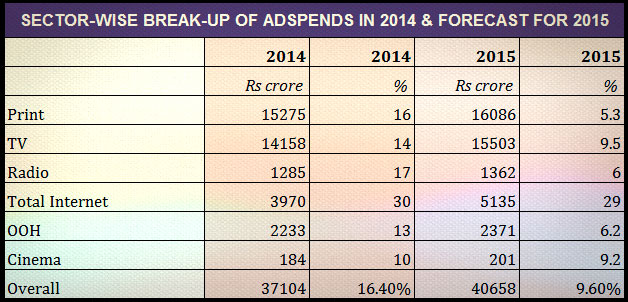
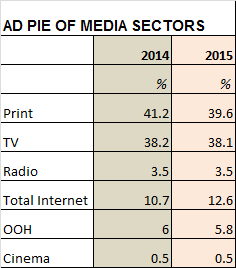 Among the more significant findings, print media continues to be the largest sector in advertising, and is expected to grab a 40% share this year. Brand advertising in print is likely to exceed Rs 16,000 crore. TV is next in line, and expected to touch Rs 15,500 crore. Digital, which has grown phenomenally in the last five years, is now larger than Outdoor, Cinema and Radio put together, will corner 12.6% of the market.