Tag: Persons with Disabilities

  • Red Alert! Monsoon Mazaa or Disability Distress?

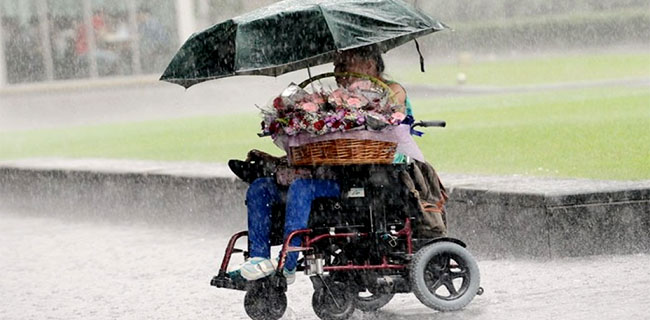
    Representative image. Photograph source: https://www.ohchr.org/


    By Shruti Pushkarna
     

    Shruti PushkarnaIn the past few weeks, monsoon fury has topped news headlines across different parts of India. If you google rain+news, the search throws updates of orange and red alerts in parts of Maharashtra, Gujarat, Karnataka and more. Then there’s the frightful, shrieky voices of television anchors warning us about the dangerously rising levels of Yamuna and Ganga. Not to miss the conspiracy theories and political buck-passing between neighbouring states on releasing excess water.


    Growing up in Delhi, I haven’t witnessed the city at such a standstill in the past, with roads completely blocked off because of water-logging. The situation is definitely bad. In fact, climate conditions across the world have been uncertain and alarming.


    Both traditional and digital (and social) media are brimming with accounts of lives lost, infrastructural damage, crops destroyed, poor urban planning, homes demolished, et cetera. Average (wo)man is posting photos and videos on social media from their places of work/ study and residence, highlighting the respective perils they are facing.


    I still recall the horror of July 26, 2005, one of the first few serious news stories I witnessed as a budding journalist. ‘Mumbai Deluge’, the headline and the corresponding pictures are vividly etched in my brain. The city received 944 mm rain, the eighth-heaviest 24-hour rainfall recorded ever, claiming thousands of lives.


    Then too, similar coverage ensued. Eighteen years on, our cities and states still seem unprepared to battle the nature’s wrath. But I’ll leave that debate for another day.


    For the average Indian citizen, what does monsoon mean? Baarish or pitter-patter raindrops throw up varied imagery and meaning for different people. A steaming cup of tea paired with hot pakodas, swaying lush green trees, potholes, overflowing sewers, watered-down roads, damp clothes, dripping huts, traffic snarls, careless children jumping in muddy puddles. I’m sure you can think of more!


    Ever think of what it means for an average disabled citizen?


    Twenty-nine-year-old Payal Bhattad lives in Virar near Mumbai and until recently, she traveled to Wilson College in Mumbai to teach history to undergraduates. The daily commute in the local train would easily take up three hours of her day. And Payal is a totally blind person who uses a white cane to navigate her way across the bustling city. When the heavy raindrops fall on the tin sheds of the train station, Payal is unable to register any other audio cues which otherwise guide her to move forward, backward, left, or right. She cannot hear the murmurs of fellow passengers, or hawkers’ cries, nothing that indicates any familiar direction or territory to her. Once, the roaring rain misled her to the edge of the platform and she fell onto the tracks. And no one noticed or stopped to help her up.


    Akash Nimbalkar is a 30-year-old social worker who also lives in Virar. He is a person with low vision, who finds it extremely challenging to wade through knee-deep water on his way to work, using a cane. He is always worried of submerging into an open gutter or losing balance and slipping on the flooded road. His family hesitantly stops him from going to the office every day, as they worry about their visually impaired son getting stranded in the rain.


    With wind blowing amidst heavy rain, it’s hard to steadily hold an umbrella, and manage to stay dry. Additionally, there’s personal belongings to juggle with the gamp. Forty-six-year-old Shirin Kheriwala works as a counsellor with a national helpline for the blind. She usually relies on sighted people to help her cross busy main roads and assist with directions. But during the monsoon, everyone is running to find shelter and save themselves. Coming back from work one day, she found herself isolated on the highway. And her umbrella broke. But as they say, necessity is the mother of invention. Shirin folded the umbrella to use as a cane and held her white cane up in the other hand as an indication to the rushing traffic, that she was walking across.


    The situation is equally precarious for persons with orthopaedic or locomotor disabilities. It is difficult, sometimes even impossible to use wheelchairs, crutches, or any other assistive aids in such extreme weather conditions.


    Saurabh Kohli is a 40-year-old person with multiple sclerosis (MS). Apart from the usual fatigue accompanying MS, he experiences balance issues and severe weakness in his legs. Although he drives a slightly modified automatic car to his office at Amity University in Noida, he uses a walker or wheelchair to get from one place to another. Walking without such assistance is next to impossible for him. He drives around 70 kms every day, but in rainy weather, he avoids stepping out alone. The humid weather conditions also adversely affect his medical condition.


    Prosenjit Chakraborty is also a person with multiple sclerosis. He lives in Guwahati, and drives a battery-operated tricycle to run his errands, visit the doctor’s clinic and the hospital for follow-ups. He fears the day when rainwater seeps into the battery of his vehicle and stops it from functioning, leaving him helpless on the road. So far, he’s been lucky!


    All these folks, like many other persons with disabilities don’t want to stay home, take leave, or not show up to work because of the additional challenges they face due to their disability, in the monsoon season. Instead, they look for solutions and brace up for perilous times.


    But is the administration aware of their difficulties? Are policies being designed and implemented to prevent or tackle such hazardous situations facing approximately 2.68 crore people?


    And what about the fourth pillar of democracy? Why doesn’t the media focus on reporting issues and accounts of persons with disabilities who have equal rights as citizens of India? Before raging another debate on urban development woes, climate change, or disaster management, the media should understand and include the stories of millions of overlooked disabled stakeholders.


    Wondering why MxMIndia publishes a disability advocacy column? Well, we strongly feel that the media can dramatically transform the world of persons with disabilities. And this series can help bring forth issues that the media must champion to create a truly inclusive and accessible India. To write this column, we invited Shruti Pushkarna, a former journalist who is now a disability inclusion advocate based in New Delhi. Her views here are personal. To access the archives of her 75-plus columns, please visit: https://www.mxmindia.com/category/ columns/shruti-pushkarna/


    If you have a view on the issues raise or would like to align with MxMIndia on this cause, write to us at editor [at] mxmindia.com.


  • Shruti Pushkarna: Does disability make social engagements less gratifying?

    By Shruti Pushkarna


    Shruti PushkarnaI personally love the winter season in Delhi. December and January are my favourite months, as long as the sun keeps shining. I enjoy stepping out after layering up adequately. But winter rain can be a downer.  Moist and gray outside, chilly inside, it’s hard to feel anything but gloom.


    Needless to say, it’s even more discomfiting to be locked in because of the rampant virus. The lack of choice, of going out to work, shop or meet someone, puts us under stress, unconsciously.


    In such harsh times, the idea of catching up with a friend over a steaming cup of tea or cocoa is exhilarating.  It’s the easiest, most casual thing for us to do. Call a pal, sibling or cousin, pick a café and chill. I have a list of catch ups planned once the Covid numbers start abating.


    Social engagements are intrinsic to human beings. A sonorous fact of the post Covid times. When we speak of inclusion, whether it’s gender, caste or disability, the conversations are mostly centred around empowerment through employment.


    We (organisations, governments, individuals) often underscore the need for social integration. Apart from the sense of dignity that comes with economic self-reliance, persons with disabilities (just like you and me) aspire for societal acceptance.


    Let’s take five commonplace scenarios which offer some form of gratification or liberation to us. And then picture if the 2.68 crore disabled population and 13.8 crore elderly (who may live with temporary disability or limitations in mobility, reading et cetera) feel the same way.


    1. As a woman and a working professional, driving gives me a sense of freedom. The fact that I don’t have to depend on anyone to shuttle me back and forth, or worry about hailing a taxi and contracting the virulent Omicron, is liberating. You can argue that disabled people cannot drive with their physical limitations. True. But there are ample solutions in the market. Here’s a picture of a paraplegic who drives himself around in a modified hand-controlled car.


    2. Catching the latest releases in a theatre nearby. And topping up the screening experience with popcorn and soda. How many wheelchair users have you encountered in a cinema hall? Even though some theatres have special access to a few seats. Did you know that a blind person relies on audio description to follow the visual narrative? A lot of OTT content on popular platforms like Amazon and Netflix now have audio described productions. Even if the disabled chap were to make it to the movies, can she or he really make an independent trip to the snack bar?


    3. Going out on a lunch date involves picking your favourite cuisine and the right ambience. Not so easy for someone with a disability, which often prevents them from even planning one. They have to ensure if the place is physically accessible for a wheelchair or a crutch or a walker. This includes entry/exit points, washrooms and seating area. Have you had to worry about a braille menu or a sign language interpreter for your meals?


    4. Shopping for clothes, shoes, bags or household stuff can be cathartic. But picking up something for yourself or a loved one is not easy if the shopping plaza isn’t accessible. Again, access is not defined in terms of physical navigation alone. The entire shopping experience has to be disabled friendly, including human assistance, secure transactions, quiet spaces for someone on the autism spectrum, and so on. Icing on the cake would be clothes and accessories designed for persons with disabilities. Online shopping does take care of some of these issues, except it’s not as delightful for those who enjoy the old school touch and feel version. A couple of years ago, Future Group’s Big Bazaar took a step towards making shopping inclusive and accessible.


    5. What better way of winding down in bed with an enjoyable book. I restrain myself from entering bookshops because of the urge to buy every interesting title. But if I want it, I can simply pick it off the shelf and start reading. Books have a way of expanding our imagination by transporting us into different settings. Can visually impaired people get a taste of something they will never see, by just reading about it? Yes of course. Except they access books in audio formats. Incidentally, India was the first nation to ratify the Marrakesh Treaty, an international legal instrument which makes it easier for blind and other print disabled people to access works protected by copyright. Yet, I know so many who struggle to find accessible books for their reading pleasure.


    In the last few years, I have made a lot of new friends who live with some form of disability. They share my urge to eat out, travel, gossip and splurge. Basic social engagements reiterate the ‘normal’, giving a chance to form connections without prejudice.


    Unfortunately, media portrayals hardly focus on the scope of collective light-hearted human indulgences, irrespective of (dis)abilities. Either disability is ridiculed, or treated too gravely, making it abnormal in some way.


  • Shruti Pushkarna: Disability Inclusion: How far are we from a Sugamya and Saksham Bharat?

    Shruti PushkarnaBy Shruti Pushkarna


    In his first term, Prime Minister Narendra Modi was applauded for path-breaking campaigns like Swachh Bharat, Jan Dhan Yojana, Sugamya Bharat, Ujjwala Yojana and so on. The promise of ‘inclusion’ for larger sections of the Indian population gave the country hope for a better tomorrow, or ‘Acchhe Din’.


    Having been sidelined and neglected for decades, the disabled community felt vindicated with the announcement of the Accessible India movement in 2015. Finally, the lack of ‘access’ was acknowledged at a national level. In a move to dignify their existence, PM Modi also coined a new term, ‘divyangjan’ or divine being replacing the demeaning usage of ‘viklang’ or handicapped.


    Furthermore, the passage of the Rights of Persons with Disabilities (RPWD) Act 2016 was celebrated as a landmark moment. Repealing the 1995 Act, the new legislation included 21 types of disabilities, with a view to empower and enable as opposed to a dependence on mere handouts.


    Often persons with disabilities face entry-level barriers in education and employment. The reasons could vary, discrimination, poor financial condition, ignorance or inaccessibility. And that adversely impacts their social and financial standing, mis-shaping the general societal perception.


    The RPWD Act 2016 introduced new sections, providing rights and entitlements to ensure barrier free access to the physical infrastructure as well as to information and communication technologies (ICT). Four per cent reservation in government jobs, equal opportunity policy for private establishments in addition to incentives for recruiting at least five per cent disabled employees, and extending the right to free education to every disabled child between the age group of 6 and 18 years, are some of the pertinent steps to level out the playing field.


    With all these initiatives and asseverations, one would assume all is hunky-dory. Except it’s not.


    The leadership seems to have mastered the art of utopian announcements. Spinning yarns ridden with lopsided statistics, they have created a false picture of progress to sway voters. The ground reality is not as idyllic as the written word. Red tapism, absence of coordination between departments and ministries as well as Central and State governments, creates roadblocks in implementation.


    Unique Disability ID (UDID) is a case in point. The UDID portal, swavlambancard.gov.in was launched in 2016 with the intent of creating a national database of persons with disabilities (PwDs) and also to ensure easy access to schemes and benefits. As opposed to a state issued Disability Certificate, UDID is valid pan-India, which enables PwDs to avail government provisions without producing multiple documents.


    But the rollout has been shoddy. As of March 2021, 54.84 lakh UDIDs have been issued against nearly 1.66 crore Disability Certificates. Across states, disabled folk face challenges in online application, medical verification from district hospitals, tracking the issuance status, editing wrongly registered details on printed IDs et cetera. Even after completing all the steps in registration, thousands of PwDs haven’t received their cards. See tweet below.


    1) Applied in 2016 till 2021 waiting (19150000016100029048)
    2) A Municipality/SUB DIVISION (HMC/SADAR )missing from WEB Page Application Form Howrah Dist ,WEST BENGAL #UDID@Drvirendrakum13@socialpwds @RamdasAthawale @kataria4ambala @MSJE_AIC@MSJEGOI#DigitalIindia pic.twitter.com/30w4lSbhFK

    — Mangal Hazra (@mangalhazra3) July 22, 2021

    A tweet stating UDID applied in 2016 has still not been received


    From June 1, 2021, the Centre notified for all disability certificates to be issued online. “The Department of Empowerment of Persons with Disabilities (DEPwD), Government of India has issued Gazette notification SO 1736(E) dated 05.05.2021 making it mandatory for all States/UTs to grant certificate of disability through online mode only using UDID portal w.e.f. 01.06.2021.”


    The notification conveniently puts the onus on the States and local hospitals at a time when they are preoccupied with administering vaccines and managing Covid-19. How does the Centre plan to achieve the desired digitisation when the online process so far has been moving slower than molasses?


    Just last week, the Ministry of Social Justice and Empowerment issued a notification exempting all posts under the Indian Police Service and Indian Railway Protection Force from the provision of four per cent reserved quota for persons with benchmark disabilities. This goes against Section 34 of RPWD Act 2016 which states that “the appropriate Government, in consultation with the Chief Commissioner or the State Commissioner, as the case may be, may, having regard to the type of work carried out in any Government establishment, by notification and subject to such conditions, if any, as may be specified in such notifications exempt any Government establishment from the provisions of this section.”


    In this case, only the posts for combatant roles should be exempt from reservation. Interestingly, a separate notification issued on the same day by the Ministry distinguishes between combatant and non-combatant roles, exempting all combat posts in the Border Security Force, the Central Reserve Police Force, the Central Industrial Security Force, the Indo-Tibetan Border Police, the Sashastra Seema Bal and the Assam Rifles.


    It’s important to note that all reserved posts are based on the jobs identified for PwDs by a specially appointed committee. There are several skilled and unskilled roles under Group A, B, C and D categories, where disabled people can be hired as clerks, technical specialists, engineers, delivery assistants, cleaners, telephone operators, designers etc.


    On January 4, 2021 the Department of Empowerment of Persons with Disabilities notified 3566 posts in Central Government establishments as suitable for persons with benchmark disabilities, adding 593 new posts to the previous list issued in 2013. The latest detailed list can be seen here: http://disabilityaffairs.gov.in/content/upload/uploadfiles/files/224370.pdf


    There are many more examples that point to a lackadaisical approach of the government when it comes to integrating persons with disabilities into the mainstream. While progress has been made on several counts, we need stricter enforcement and execution of policies. Empty sloganeering won’t suffice.


    It’s also time for the media to go beyond inspiration porn and focus on consistent hard-hitting coverage of issues facing the disabled population.


    Shruti Pushkarna heads operations of the New Delhi-based Score Foundation where she works as Director-Programmes & Communications. She is a former journalist (part of the founding team of MxMIndia) who has moved full-time to the social sector. Shruti writes for MxMIndia every other Thursday. Her views here are personal. You can tweet your comments and suggestions to @shrutipushkarna