Tag: Patanjali

  • Sorry, consumers. We’ve failed you!

    Sorry, consumers. We’ve failed you!

    Sanjeev KotnalaDear Customers, I am sorry and guilty as a member of the industry that has collectively, with the government, failed you, the consumer. I say this after Patanjali’s Baba Ramdev got away lightly with just a minor rap on the knuckles… an apology.  I can bet that the debate about Babaji’s Patanjali and its misinformation campaign will not die down quickly enough.


    Apology of an Apology

    Okay, so the size of the apology was increased. But it appeared once in the larger size and once in the smaller size. It is minuscule compared to the total space and time consumed by Patanjali with its misinformation campaign. Hence, expecting the audience to have the same opportunity to see the apology as they had when they saw the campaign is futile. This means that most will remain unaware of the apology and continue to be under the influence of all-powerful misinformation and miscommunication. In a true sense, if we want a real example and deterrent, the apology must appear in the same media (Press-TV-Digital) in the same size and with the same frequency as the misleading campaign. Now, that may be too much to ask, but should that not be justified for a habitual offender brand? And till it happens, the brand should be debarred from communicating in the media. That would have been justice.

    I wonder if they ran a 15-second apology on TV and digital with the same channel and platforms. Logically, they should have.


    The Products are not Bad, the Misleading Information is

    Before you take it otherwise, let me tell you I firmly believe in remedies and the products that Patanjali propagates. However, it is all about the hugely exaggerated, unscientific, unsubstantiated claims the brand has been pushing with heavy media exposure riding on Baba Ramesh Yoga and Ayurvedic Acharya image.


    This is no time for Celebration

    It is not the time to celebrate the victory. This is just a demonstration of the industry and the government’s failure to curb such brand menace.

    No time to rejoice for the apology that the brand was forced to publish.

    This is like any other time- a good time for introspection.

    An industry that expects a celebrity endorser to do a due diligent check on the brand must take the blame when it feels at the creative and media level to question misleading claims. And that is not just about Patanjali, it is about the non-healthy health drinks- the Fair that now Glows and many other such brands.

    It is time to once again call upon every stakeholder and see what genuine efforts are needed so that no other brand dares to create and release misleading communication.


    Two Questions

    One way in which the brand should be penalised for the long-term damage it could have created on the highly influenceable minds of the masses. The courts and the ministry must work together to ensure that even if it is a witch hunt, Baba Ramdev and the brand are made an example of it. Is taking brands off the shelf good enough? Should the brand be asked to mirror the product’s misleading campaign media plan for the apology media plan? Or should we ask the brand to provide 5% of the revenue as a deterrent?


    What about the Future?

    I have often said this – No One Is Worried Of ASCI and the fragmented industry. Recently, ASCI has been trying to act bravely and get some teeth by working with the consumer affairs and information ministry. However, it remains a source of a sparkling array of meticulously crafted guidelines-  which remain what they are: guidelines.  It does not have the power to sanction a brand. And without that, brands are willing to risk litigation delays and what escape routes they can exploit.


    It is Not a New Issue

    I had seen the brand’s damaging approach and attitude many years back. I raised the issue- the year- Baba Ramdev was fighting and defending the brand in court battles with other brands. That year, Babaji was a Guest of Honour speaker at Goafest- the advertising and marketing industry’s flagship festival. I protested that the Baba, who has refused to follow ASCI guidelines, must not be invited as a speaker at an Ad Club and IAA event. I asked the industry associations to stand together against a habitual offender of ASCI guidelines, which every brand should consider sacrosanct.

    But my voice of dissent failed to find enough takers.

    Babaji entered and exited to a standing ovation from the industry.


    Can’t Blame Media

    Many may even want to question the role of media. They knew what they were publishing. Advertising whose promises and claims were questionable. Were they not supposed to be the guardians of audience rights? Well, one should not expect them to start scanning every campaign and sit in the seat of justice. However, the creative and the media planners must answer – what they were doing. Everyone wanted the cream till the party lasted.


    ASCI and Polite Self-Governance/Self-Regulation is Not Working!

    We are the noisy, naughty students in preparatory school who need the teacher in the classroom to enforce discipline. Our attempt at nudging the misguided brands to follow the guidelines has failed. Most brands smoothly side-step and repeatedly flout guidelines- knowing nothing will happen and nothing happens.! ASCI asks for an explanation. The brands take time to provide. Then, if the communication is found fault, the brands silently say sorry, and the business goes on; otherwise, everyone would have learnt their lessons by now. Sometimes, like Patanjali did, the brand takes ASCI to court.

    We need something more. It is not working- it is so broken- we must do something about it. How long can the audience be asked to sacrifice their interest in the absence of some real action?

    The brands that flout the rules are big brands. They understand the legality and how to escape it. They do it knowingly. There is an intent behind every action of the highly paid planners and creative and strategic people. They do it because industry self-governance is toothless and needs to be fixed.


    We failed the Industry & the Audience

    The creative agency, if any, willingly follows the brand directive. It dare not ask for substantiation. It will never refuse the work- because many others are in the line to do it.


    ASCI must get teeth or…

    ASCI must graduate from an industry body of guidelines to something that still constitutes the same way but can enforce discipline. It should be powerful to dictate the terms, and the media and creative industry must accept the ruling.

    It may lead to many court cases. The cases will further clarify what is allowed and what is not. Maybe the Ministry of Information and Broadcasting should foot the bill for these cases.


    Net-net

    ASCI must be given Teeth as the first port of call, or a decision/penalty/guidelines enforcer or some other framework must be created to address it. 

    Trust me, Exaggerated, False, and Misleading Claims will continue to be created and released, putting the public at large at risk because we lack a system to quickly address and nip them in the bud. Patanjali has been doing so for more than a decade- and hopefully, we in the industry know that by allowing a brand this free run, we have not lived up to our duty and responsibility. 

    We, as an industry, have collectively failed the audience.

    Let the recent happenings on the FMCG Health front, and Baba Ramdev/Patanjali be a call to wake up. If we do not self–govern, the law will govern, which may be a sad phase.

    Maybe every marketer, communicator, brand custodian should take a print of the Patanjali apology, frame it, and hang it in their room. Just to remind them not to participate in any process of creating or releasing misleading communication.


    Sanjeev Kotnala is a senior business strategy consultant and educator. He writes on MxMIndia every Wednesday. His views here are personal.


  • Pivot or Perish… Using your business moat to survive in the pandemic


    By Bhuvi Gupta


    Bhuvi GuptaAs a marketer for the last decade if there is one thing that I can attest to be true is that marketing jargon comes and goes with an average lifespan of a year or two. The jargon du jour is backed by stellar logic, often introduced by a book, or a widely respected businessperson, and has wide applications in the entire gamut of business strategy.


    The latest buzzword is the concept of the ‘moat’ as espoused by Warren Buffett. While he first shared this concept during a Berkshire Hathaway shareholder meet in 1995, it has seemed to catch on in pandemic. (Maybe, because being stuck at home is like a having a moat around you?). Mark my words, we are just at the beginning of the lifecycle of this jargon and you’ll see multiple applications in interviews, podcasts, CEO roundtables et al in the coming times. 


    What are economic moats?


    The usage comes from ancient times, when a moat was a water body built around a castle so as to give the king some time to plan his defense when attacked by an invader.  The concept itself is golden, as most espoused by Buffett are – An economic moat is a distinct competitive advantage a company has over its competitors, which allows it to protect its market share and profitability over the long term. Companies can build moats by strengthening their brands like Apple and Coca-Cola, achieving economies of scale like Amazon, or even lobbying for special status from the government like Patanjali.


    Economic moats have existed since commerce has, but in the digital age, using data, network effects, online marketplaces, search, and social networks can help create wider and longer-lasting moats.


    According to a report from CBInsights, moats can be classified into four types –


    Network Effect– those products whose value increases the more people who use it. All social media networks have network moats, which explains why a Telegram has not replaced WhatsApp despite offering some advantages

    Cost Moats– when users have a high sunk cost in the product or service (high one-time or recurring membership fee) which make them reluctant to switch

    Cultural Moats– when consumers buy into the product for the brand promise and the values it represents. For e.g. people consume Dove because it promotes ‘real beauty’, Coca-Cola due to its great emotional marketing which talks about happiness

    Resource Moats– due to patents or preferential treatment on account of a governing body. Typically why pharmaceutical companies have huge lobbying budgets


    How companies have used their moats in India to remain relevant in the pandemic


    The pandemic has been a death knell to the global economy – USA’s economy has contracted by a third, in its largest quarterly contraction since 1921. India is not expected to fare any better, when numbers release later this month.


    Companies are being forced to be agile and leverage their business moats, and pivot to newer consumer behaviors to remain afloat. Many companies have successfully pivoted their products, launched line and brand extensions to have new health and immunity claims, which is why we even have Chyawanprakash and Haldi ice-cream now (from Amul and Dairy Day Plus). This has come easier to the behemoths like ITC and Dabur, which have both Innovation teams sitting on years of research, and vacant factories to put into use.  As a result, in the last three months, ITC has launched six, and Dabur 15 new products. Such companies also have the business advantage of well-established supply chain and distribution channels.


    How companies which don’t have a moat can remain relevant in the pandemic


    A July 2020 McKinsey survey found that an overwhelming 91% of consumers reported trying a new shopping behavior in India due to the pandemic. Two key trends that stand out from the survey are an acceleration in the rate of digital adoption which has seen a 10+ percent growth in online customer base during the pandemic & a new DIY culture in the middle class which was reliant on household help or access to almost everything via a few taps on their mobile screens. New product categories for fruit & veggie wash, contactless dispensers, dishwashers which would have years of promotion and audience interactions have seen demand rise exponentially.


    These two are the life jackets for Indian companies that can help save them in the coming months.


    The pandemic has facilitated trials (often via e-commerce) as well as repeat buys in the 5+ months of its duration. This is one of the silver linings of the pandemic because categories and products, which would have taken companies years to launch and for consumers to adopt, especially in a value-conscious market like India, have launched overnight.


    Restaurants, which are arguably the worst hit, have started retailing recipe and ingredient kits and sauces. Pictured above are the ready-to-cook sauces, and gravies launched by Jubilant FoodWorks (which runs Domino’s Pizza and Dunkin’ Donuts in India)
     

    Indian companies, especially the beleaguered ones, must leverage this time to pivot, because even if some of these consumption shifts are pandemic specific, many new behaviours will stick because, getting consumer trials is one of the most difficult parts in a product’s lifecycle.


    Talking from personal experience, now that I have been forced to realise that I am not a half-bad cook, I have often wondered why was I so reluctant to cook earlier and why was I so dependent on my cook or ordering food in. If the rough survey of my social circle is to be believed, I know I am speaking for scores of us in the middle class. These cooking sauces and cheaper dishwashers are only helping to cement this new-found realisation into a resolve to be more independent.


    Bhuvi Gupta is a marketer with over 10 years across industries, of which the last six have been in Media & Entertainment. She has been a part of many launch marketing campaigns – specifically at the Times of India group, Republic TV and the latest in marketing a Bollywood film. She will write on A&M (mostly marketing, but often on advertising too) every other Tuesday. Her views here are personal. She tweets at @bhuvigupta3


  • Ramdev: “Hum MNCs ko dhool chatayenge!”

    By Rahul Chandawarkar


    Yoga Guru and founder of the Patanjali g​roup of companies, Baba Ramdev predictably gave  Goa ​fest 2018 a rousing start when he took the battle into the MNC camp with his spirited and energetic, inaugural address in Goa on Thursday evening.


    With his aggressive statement, ‘Hum MNC companies ko dhool chatayenge’ ( we will make MNC companies bite the dust), Ramdev lambasted the business policies of fast moving consumer goods (FMCG) companies.


    Baba Ramdev’s Mantras

    :: Only when knowledge, skills, emotions, research and innovation gets converted into WEALTH does it make any sense.

    :: You only learn 1% in classrooms. The rest, you learn in ever day life.

    :: One must complete the task at hand despite all obstacles.

    :: No dishonest business can last more than 10 years.

    :: Health is wealth. Exercise One hour every day.

    :: Good diet, good thoughts, good exercise and good sleep is the only truth.

    Stating that the main objective of the Patanjali brand was to defeat and vanquish MNC companies, Ramdev said, “The East India company looted our country for centuries. The MNCs are doing the same now. This must stop. This why, we formed Patanjali to compete and beat them.”


    Pointing out his major grouse against MNCs, Ramdev said, “MNC brands have blatantly used chemicals in their products, made fun of our traditional raw materials like turmeric and tulsi, made an unfair distinction between dark skinned and fair skinned people in their product advertising and made obscene amounts of profits. All this hurt me and motivated me to start Patanjali to counter this MNC scourge.”


    Stating that Patanjali had been registered as a not-for-profit charitable institution, Ramdev said, “We want to offer our country’s people with completely organic and indigenous products at affordable prices. This is because our motive is not profit. We are service oriented instead.”


    Lambasting the popular advertising practices of MNCs, Ramdev criticized toothpaste and soap advertisments which had sexual overtones. “Why do we need to use young men and women in a glamorous setting to sell these products. We at Patanjali keep it simple. We simply speak about the strength of our products and it is paying us rich dividends. We avoid wasteful expenditure on advertising this way,” Ramdev said.


    Driving home the point, Ramdev claimed that the Patanjali toothpaste had captured  50% market share of a prominent, MNC toothpaste brand. “Likewise, our Aloe Vera brand is now a Rs 5,000 crore brand with less than Rs 10 crores of investment,” Ramdev said.


    Expressing his confidence in the Indian economy, Ramdev said, “The Indian economy is growing at 10% as compared to the US and UK markets which are struggling at an abysmal 2%. There are opportunities galore in our country.”


    Predicting that Patanjali would become the ​No 1 consumer products company in India very soon, Ramdev said:​ “We plan to introduce a wide range of dairy products, a complete range of apparels and even a drinking water brand called Divyajal next year.”


    Sharing his thoughts on human resource management, Ramdev stressed the need to compensate employees fairly and also creating an emotional connect to retain good quality human resource.


    In conclusion, the yoga guru stressed the need for working professionals to keep themselves fit and healthy. “Everybody must devote one hour every day to exercise and fitness. You must either do yoga, running, swimming, cycling or some exercise to keep healthy and fit,” the yoga guru said before proceeding to perform a string of yogic asanas on stage including a headstand!


    Rahul Chandawarkar is a former newspaper editor and presently a communication strategist and freelance journalist based in Goa​


  • Patanjali is #4 in Ipsos’ India’s Most Influential Brands study


    By A Correspondent


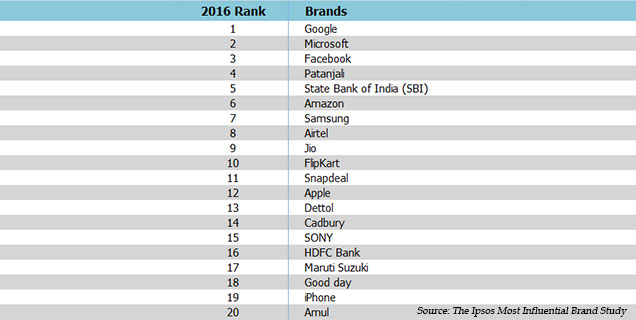
    Global research company Ipsos has unveiled its now annual Top 20 Most Influential Brands in India for 2016.  Google occupies the number one position followed by Microsoft and Facebook at number two and three respectively. Homegrown brands, Patanjali and Jio make an entry into the Top 10 ranked at fourth and ninth place respectively showing the enormous amount of influence that these brands wield in a short span of time. Both brands did not figure in the previous edition of the study.


    Among the Top 10 brands, Flipkart dropped three spots to take the tenth place while Amazon climbed a couple of steps to take the sixth place. Leading bank State Bank of India, which has been on a consolidation mode, move up four ranks to take the fifth place and is the only financial brand in the top 10.


    The Ipsos Most Influential Brand Study evaluates 100-plus brands across 21 countries and involved 36,600 interviews. In India the research covered more than 1,000 Indians online to assess 100+ brands.


    Said Parijat Chakraborty, Executive Director, Ipsos Public Affairs & Loyalty: “The Most Influential Brands are larger than life. They are aspirational. They enhance our lives – make it better. We trust these brands. We connect with them emotionally and cannot imagine our lives without them – they are influential”.


    The goal of the study, notes a communique, is to define and measure influence; to rank brands according to their influence within each country; rank brands according to their influence globally and identify what factors explain or drive the current level of influence for each of the brands at the country level and at the global level.


    Adds a communique:

    “It is important to note that the Ipsos study has measured the biggest, most well-known and/ or highest spending brands only. As a result, the Ipsos Most Influential Brand Study did not look at the entire market.

    “Interestingly, all brands that have featured in the Most Influential Brands List are those that consumer engages with on-a-daily-basis; a constant companion; an extension of consumer – Google, Microsoft, Facebook, Patanjali, State Bank of India, Amazon, Samsung, Airtel, Jio and Flipkart – if we look at the Top 10 list.

    “Next 10 – 11 to 20 too echoes the same story – these brands help the consumer define themselves better –  Snapdeal.com, Apple, Dettol, Cadbury, Sony, HDFC Bank, Maruti Suzuki, Good Day, iPhone and Amul.”

    “It’s impossible for consumers to imagine their lives without these brands.  The formula for success of Influence rides on those 5 pillars of trustworthy, engagement, leading edge, corporate citizenship and presence, “added Chakraborty.


    About the Ipsos Most Influential Brand Study (as per a communique):

    All data was collected via online panels by Ipsos across 21 countries and involved 36,600 interviews. In India the research covered 1,000 Indians online to assess 100+ brands.

    The sample is reflective of population where possible via online methodology. Within each country data is weighted back to either census population or the online age population where the representation of age groups online is skewed to younger population.

    At the Global level, countries are assigned a weight based on GDP, with higher GDP countries having a greater impact on the global influence score.

    A factor analysis was conducted using the 57 statements in the questionnaire and a total of six factors were revealed from this analysis. One of these factors contained 11 statements and was clearly the “Influence” factor. The average score across the 11 statements in the Influence factor was defined as the Influence Score for any given brand. The score was then converted to an index by dividing by the average Influence Score across all brands, multiplied by 100.

    The five remaining factors were used as attributes to help explain what makes each brand influential (as it varies from brand to brand). These five factors are: Leading Edge, Corporate Citizenship, Trustworthiness, Presence, and Engagement.


    What builds influence? How do some brands stand out from the rest? The Ipsos Most Influential Brands study shows there are five key factors that are the building blocks of influence.Trustworthy: Influential brands are trustworthy – consumers trust their message, proposition – that faith leads to consumption, patronage & relationship.

    Engagement: Influential brands engage with consumers across different consumer touchpoints. Consumers love them and want to stay connected. Brands stay relevant and constantly innovate to keep the relationship going.

    Leading Edge: They are model brands – iconic – they don’t toe the line, they are leaders – they stand out and define new paradigms – they grow the category – others emulate them and derive inspiration from them.

    Corporate Citizenship: Influential brands give back to society. Consumers patronize them as they are socially more responsible. It’s built in their ethos. Driven from the top.

    Presence:Influential brands play it big. They have astronomical marketing spends – are visible across consumer touch points with inspiring communications, visuals, adverts that are highly impactful, generating a strong consumer pull. It all hinges on placement, promotion and people.


  • Day 1 @ Goafest: It’s celebration time

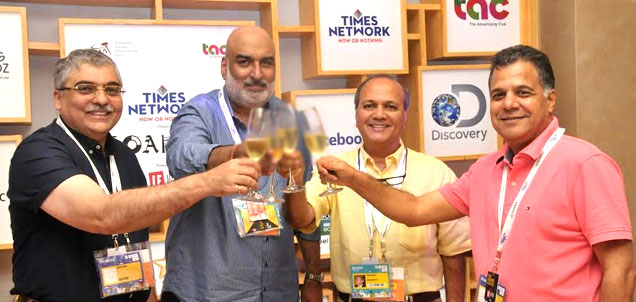
    L to R: Ashish Bhasin, Nakul Chopra, Ramesh Narayan and Raj Nayak


    It’s Goafest and while the knowledge sessions, masterclasses and awards, are on offer, it’s the networking and meeting old friends and making new that people look forward to. And in the spirit of things, the inauguration happened with champagne.


    The four heads of the organising committee – Ashish Bhasin, Ramesh Narayan, Raj Nayak and Nakul Chopra – appeared delighted that the event took off sans any hitches. Day 1 of the festival saw the Industry conclave with Archarya Balkrishna of Patanjali Ayurved being the star attraction. Other speakers included UpasanaTaku of Mobikwik and Hemant Malik of ITC Limited. The Media and Publisher Abbys were presented in the evening.


    Speaking about the event, Nakul Chopra, President –  Advertising Agencies Association of India said, “Twelve years ago, Goafest began as an event for people from the world of advertising to get together to network and celebrate quality work. Today, it gives me immense pleasure to see how this festival has grown into becoming one of the foremost events in the creative calendar. It’s extremely encouraging for us to see so many young people participating in the event with such enthusiasm – and not just attending the Abbys but also showing immense amount of interest in the varied seminars that we have lined up this year. The quality of work that has been felicitated today just goes to show how India has today become a tour de force when it comes to creative thinking. If the scene on day one is anything to go by, I’m pretty sure the next two days are going to be just as exciting with some exemplary speakers taking the stage and some must attend seminars taking place.”


    Added Raj Nayak – President, The Advertising Club: “Goafest is the world’s largest industry event in the advertising industry – organized by two industry bodies coming together. In the true sense, it is an event by Indians, for Indians and completely made in India. This year, we had over 300 jurors from across the country coming together to judge the entries for which awards will be presented over these three days of the event…with almost 112 of them judging tonight’s Media and Publishing Abbys. Goafest, when it started was only a creative awards ceremony. However, today, in its twelfth edition, it has become a festival of knowledge, wisdom, entertainment, fun and a great networking opportunity.”


    Elaborating upon the event, Ashish Bhasin, Chairman, Goafest 2017 said: “With changing times, Goafest has also evolved. For the first time Goafest is going green in part by getting the delegates visiting the event to conserve water and taking other baby steps to our bit for the environment. This year we have heavily subsidized entry to let more and more young people to attend the event. It is extremely exciting for us to see so many young people participating in the event and appreciating the changes we have brought in. Curious young minds are keen to attend seminars and talks by interesting speakers this year. Day 1 has been such a huge success. We can only see this getting better and better over the next two days.”


    Said Ramesh Narayan, Chairman of the Awards Governing Council of Goafest 2017: “The atmosphere at Goafest is always filled with excitement, camaraderie and a whole lot of fun. And this year is no different. It is absolutely heartening to see members of the advertising and marketing fraternity sending in some wonderful entries this year which have kept the jury on their toes. Judging any award is a difficult process and more so when you’re pitting one excellent entry against another. All I can say is, all the winners tonight are truly deserving of the honours that have been bestowed upon them. Judging by the level of excitement today, I’m sure that the next two days are going to be absolutely spectacular.”


    Karan Bajaj kicked off the Discovery Channel presents Industry Conclave on the topic ‘Role of brands in changing India’. “The brands that we experience in this room have a deeper impact on our lives than we realise. I’m happy to be in a roomful of people who are impacting people and lives,” he said. The UpasanaTaku, Co-Founder MobiKwik, came on stage to talk about demonetisation, the growth of digital payments and powering 55 million users and 1.4 million retailers in India. “Brands have played a role in transforming India. Consumer choice drives brands, and brands have the power to transform an entire country. 86% of India’s spending is cash. It’s a massive amount of money that moves in an unaccounted manner. I truly believe it’s the era of mobile wallets, and won’t deny that demonetization has sped up the journey,” she said.There was much anticipation for the session by Hemant Malik, Divisional Chairman of ITC’s Food Business, who also spoke about e-commerce and digitisation, while acknowledging the evolution of Goafest. “We are the only carbon positive company in the world.”


    But the session that everyone waited for was by Acharya Balkrishna, CEO and MD, Patanjali.  “If you learn to applaud yourself sometimes, the world will learn to applaud you,” he said. “The nation is ours, the children are ours, the life is ours. We must take care of it ourselves. Always remember, for the world India is just a market place; for us it’s our home,” he said.


    Earlier, the ceremonial lamp was lit by M K Anand, MD & CEO Times Network, Piyush Sharma, CEO New initiatives India Zee Entertainment India, Karan Bajaj, Senior Vice President & General Manager, South Asia, Discovery Networks, Asia Pacific, and Nagesh Alai other than Nayak, Chopra, Bhasin and Narayan.


    Click here for slideshow


    Media – Abby 2017 | Publishers – Abby 2017


  • Patanjali as 5th largest Indian FMCG?


    By Namrata Singh & Partha Sinha


    At Patanjali Ayurved’s manufacturing facility in Haridwar, there is brisk activity as cartons of freshly made products are being loaded onto trucks to be dispatched to stores across India. With the financial year nearing a close, an official pointed explained, all hands are on the deck to help the company achieve its targeted turnover of Rs 5,000 crore this fiscal.


    For a manufacturing company set up about 10 years ago, achieving a Rs 5,000-crore turnover is not easy. However, for Patanjali Ayurved, which is breaking conventional marketing norms, sales are inching up month on month. Sources in the know believe Patanjali could have clocked monthly sales of around Rs 600-700 crore in January and February, which means Baba Ramdev’s baby could become a billion-dollar entity, with its annualised turnover expected to cross the Rs 7,000-crore mark before the end of fiscal 2017.


    Brand Patanjali driving buzz on social media


    By Anumeha Chaturvedi


    Brand Patanjali generated around 15000 conversations on Twitter in the period between August 2015-January 2016, according to data compiled by social media analytics firm Blueocean Market Intelligence.


    Chatter around Patanjali was largely around its competitiveness (60%) as an FMCG brand. Some discussions were also led by the indigenous nature (17%) of the brand, the quality of its products (13%) and its marketing strategy (10%).


    In many instances, discussions/posts around the brand referred to Baba Ramdev thereby indicating that the brand is strongly associated with Baba Ramdev and he is a strong brand ambassador driving the brand’s image.


    A lot of buzz was observed around Patanjali becoming a strong threat in terms of market share to rival MNCs such as Colgate, HUL, ITC and Emami, in the FMCG space.


    Discussions touched upon Patanjali emerging as a strong player in the FMCG market; particularly its soaring sales graph gathered a lot of attention.Many consumers were seen commenting on how their products, particularly noodles and honey were not only cheaper but also better than those of other competitors. Few consumers went to the extent of expressing their wishlist of products such as sanitary napkins, fairness creams, that they expect in future from Patanjali. Top trending hashtags for the brand were Patanjali, Ramdev, and Babaramdev, according to Blueocean.


    In terms of its marketing strategy, discussions centered around Patanjali’s tie-up with Future Group. This partnership was seen as a sound approach to further strengthen the brand’s foothold in the FMCG market through Future Group’s outlets such as Big Bazaar and Easyday.


    Furthermore, efforts such as launching Patanjali Atta Noodles in the absence of Maggi noodles in the market, targeting market segments dominated by MNCs, direct marketing, seeking exclusive space at stores, were appreciated as compelling and strategic marketing moves


    The brand’s marketing related update that it is focusing on advertising and has kept aside Rs 300 crore for advertising and promotion, also gathered some attention according to the research.


    Which means, Patanjali could become the fifth largest FMCG company in the country, after Hindustan Unilever, ITC, Nestle India and Britannia Industries. This would bring it well ahead of traditional FMCG players like Dabur, Godrej Consumer Products and Marico.


    In an exclusive interview at the company’s headquarters, Acharya Balkrishna, MD, Patanjali Ayurved, said in the current fiscal, as of early-March, the company’s turnover has already crossed Rs 4,500-crore and is cruising at a monthly rate of about Rs 500-550 crore. “Our target is to go be yond Rs 500 crore a month.Because we are also making plans for future expansion, we are moving in line with the target,“ he said.


    “We may even reach Rs 600 crore a month mark -that will give us an annual turnover of approximately Rs 7,000 crore,” said Balkrishna.


    Even at the current level of Rs 4,500-crore turnover, Patanjali has paced ahead of oral care leader Colgate-Palmolive (India), challenging it which its `Dant Kanti’ toothpaste.


    Given that Patanjali has been grabbing eyeballs through its advertising, industry experts believe the company could soon even reach Rs 10,000 crore turnover, which would make it as big as ITC’s non-tobacco FMCG sales.But Balkrishna said that would take time. “We have to plan, right from procurement of raw materials to processing to manufacturing and marketing. We work on a single channel right from the farmer to the end consumer and that is the real reason why our quality and costs are under control. There are very few companies in the world which may be following such a system,” he said.


    “We buy raw materials directly from the farmer. In other companies, raw material sourcing and marketing of products are done by different entities. So we don’t have sudden peaks and troughs in growth, we plan a steady growth. It’s not like a share market where one day there is growth and the other day a slump,” Balkrishna said.


    The rural market is another area where FMCG biggies could face a tough challenge from Patanjali’s products, which are priced below regular brands because the company consciously operates on thin margins. “We are expanding our reach through tempos which can go deeper into rural markets. We will begin with 500-600 tempos and will gradually expand the network,” said Balkrishna.

    Source:The Economic Times
    Copyright © 2016, Bennett, Coleman & Co. Ltd. All Rights Reserved
    Licensed to republish

  • Baba Ramdev’s Patanjali sets aside more than Rs 300cr for ads and promotion

    By Shambhavi Anand


    Yoga guru Baba Ramdev’s consumer goods company Patanjali was the third most advertised brand on television in India during the last week of November, behind Cadbury and Fair & Lovely.


    Patanjali’s TV commercials were telecast 12,969 times during November 21-27, according to data released by the Broadcast Audience Research Council (BARC) India, a joint industry body set up in 2012 by broadcasters, advertisers and advertising agencies to measure television audience.


    “There is a definite shift in gear (on Patanjali’s part) to make themselves more visible,” said Vandana Das, president DDB Mudra (north), an agency that handles advertising for Patanjali’s key products – noodles and ghee. “They take up some key products and go for full blast advertising depending on the demand and supply situation,” she said.


    According to media and advertising experts, the Rs 2,000 crore Patanjali Ayurved has set aside more than Rs 300 crore for advertising and promotion, and is set to step up its publicity campaign further. The company recently hired actor Hema Malini to endorse its biscuit brand.


    Cadbury, owned by Mondelez, has consistently been on top since the week starting October 10 with insertions – number of times a TV commercial is telecast on different channels across the country – ranging from 31,052 to 46,872 in different weeks. While e-commerce companies Flipkart, Amazon and Snapdeal followed the chocolate brand closer to the festive season, they have since disappeared from the top ten advertisers chart.


    BARC India has a reach of 153.5 million TV households, representing the entire country and all modes of signal. Of this 77.5 million are urban TV households and 76 million are rural TV households. This includes metro cities, towns with population of 10-75 lakh, and urban and rural areas with population of less than 10 lakh.


    Source:The Economic Times

    Copyright © 2015, Bennett, Coleman & Co. Ltd. All Rights Reserved

    Licensed to republish