Tag: Partho Dasgupta

  • BARC India spruces up logo, brand identity

    BARC India, as part its build-up strategy has unveiled a new logo and brand visual identity.


    Trying to deal with a puzzle that has been vexing the industry for decades, the BARC India team has taken inspiration from a Rubik’s Cube to solve the puzzle uniquely, vibrantly and transparently.


    The new logo and brand visual identity, inspired from the Rubik’s Cube for solving the structural problem of moving the parts independently without the entire mechanism falling apart, now looks like an intelligent puzzle waiting to be solved.


    Engaging every customer with robust, intelligent, solid, comprehensive, accurate, reliable, transparent and accountable processes and possibilities, BARC India’s new brand identity packs an added punch of fun and challenge to all its users, associates and partners in India and across the globe.


    Partho Dasgupta

    Partho Dasgupta, CEO of BARC India stated, “It’s the process of solving the puzzle which adds to the excitement and challenge of finally getting it right. Which is exactly what we want our new brand identity to reflect. The idea is to enjoy every milestone in creating history while in the process of designing, commissioning, supervising and owning India’s Broadcast Audience Measurement System, which unarguably will be globally the largest and most modern system.”


  • BARC conducts workshop on Watermark Technology for broadcasters

    By a correspondent


    To enable deeper understanding of the watermark technology, BARC conducted Technical Workshops countrywide for broadcast engineers from March 18th-21st 2014. This helped in understanding the deployment of the future watermarked system at the broadcaster end.


    The workshop was conducted by technical experts from BARC’s technical partners. Watermarking technology inserts a mark inaudible to the human ear into programs. This mark contains the identification of the channel which broadcasts the program and the regular broadcast timestamps. The meters installed in panelists’ homes can retrieve this information. This audio watermark is inaudible to viewers, and is compatible with both digital and analog broadcasting.


    Partho Dasgupta

    On successful completion of this workshop, Partho Dasgupta, Chief Executive Officer, BARC said, “It was a delight to see a massive and encouraging participation from 150 plus broadcast personnel at the recently concluded Watermarking technical workshop by BARC. This technical workshop was successfully held at multiple locations in India. It gave a unique opportunity for the broadcasters to interact directly with the technology and service providers. The broadcasters have already started placing orders for the watermarking embedding technology required at their playout centres.”


  • BARC appoints Dutch firm Civolution for watermarking tech

    By A Correspondent


    Amidst issuing requests for proposals and advanced-level testing, the joint industry body of broadcast stakeholders BARC (short for Broadcast Audience Research Council) has contracted Dutch tech firm Civolution to provide the watermarking technology for its proposed measurement platform. The decision comes weeks after the announcement of Médiamétrie as its key technology vendor.


    Partho Dasgupta

    “India has one of the largest TV audiences in the world so it was critical for us to create an audience measurement system that is gold standard,” said Partho Dasgupta, CEO, BARC. “By leveraging Civolution and Médiamétrie’s expertise in audience tracking, technology and analytics we can now study viewers’ TV habits in precise detail, enabling broadcasters and advertisers to implement efficient strategies to reach their target audience.”


    According to a communiqué, the audience measurement system – which has already successfully been deployed by Médiamétrie in a few TV markets – relies on Civolution’s audio watermarking coding technology for automated content identification and integrates seamlessly into Médiamétrie’s TV meter system for panellists’ equipment and data processing.  It provides broadcasters with a detailed analysis of their exposure to the public, whether by the number of households tuning in to the programme or the amount of time spent watching each piece of content.


    Gwilherm Nicolas, Head of International Business Development at Médiamétrie added: ”We are very enthusiastic to embark on this project with Civolution and its watermarking technology, which is definitely the most powerful and error-free content detection technique available for TV audience measurement.  This means we are future-proofed in the fast-changing world of TV.  Médiamétrie has relied on Civolution’s technology for many years”.


    ”With so many new ways of watching TV content in this multi-screen universe, precise audience measurement has become increasingly complex. Audience measurement services must now report more accurately and reliably, from a larger number of channels, delivered through a fast-changing and diverse mix of broadcast platforms, and consumed either in real time or time-shifted” said Alex Terpstra, CEO, Civolution.


    Civolution’s audio watermark is embedded in the TV’s sound track prior to broadcast. Upon airing, the content is then identified by Médiamétrie’s TV meter, in real-time. In addition to granular measurement of the content being watched, the solution features support for catch-up TV. The technology provides cross-platform audience measurement and will enable mobile device measurement, triggering the creation of new services  and the reduction of operating costs. In parallel, the same watermark infrastructure deployed by Indian broadcasters could be used to synchronize with great accuracy their own interactive second screen applications.


    ”Through our close collaboration with Médiamétrie, we have devised a powerful solution that provides accurate and reliable audience data that will allow BARC to help broadcasters plan, entertain and monetize their TV audiences,” added Jean Michel Masson, SVP Watermarking Solutions, Civolution.


  • Kahaani Mein Twist: Nielsen cuts costs 20%+ for BARC TV measurement contract


    By A Correspondent


    In entertainment television, it’s called ‘kahaani mein twist’. In cricket commentary, you hear of ‘glorious uncertainties until the last bowl is bowled’. But in the course of business deals too, we often see twists in the tale. Or is it case of people getting real? Or is it too little, too late?

    For, the Broadcast Audience Research Council (or BARC) bosses are seeing a real-life soap opera playing out for them.

    Readers of MxMIndia would recall the reports that the BARC board had selected French joint industry body Mediametrie (along with watermarking tech provider Civolution and one or more set-top box providers) as the vendor for television measurement.

    It was a done deal. We even carried a ‘Big Story’ on Mediametrie. BARC representatives had visited France and the Frenchmen were in turn in India. The papers were getting readied, with a back-and-forth between the legal eagles.

    But after the news on Mediametrie was published, at least one other contender for the coveted contract got into action. As we know, TV measurement is currently managed by TAM, a joint venture of the research specialists Nielsen and Kantar. The latter is owned by WPP, which also runs GroupM, Ogilvy, JWT and several other media entities.

    The proposed government regulations are clear on cross-ownership – that the measurement company can’t be owned/co-owned by anyone with stakes in some media businesses. Sound logic, but then given ownership patterns of research companies, it rules out some firms. Also, cross-ownership rules have still not been administered in other media sectors.

    Given this although Kantar had made a bid for the all-important hardware tech partner phase of the BARC-ruled measurement business, there was a cloud on whether it would get the contract given the TRAI guidelines which are set to be notified soon.

    But cross-ownership wasn’t the reason why BARC ruled out Nielsen. It was dosh. Nielsen was charging the moon. Or so we were told.

    Pardon us for the looong backgrounder. But, this is television, and like the various soaps and sitcoms, some foreplay is a must. Okay, so let’s get to the point.

    Nielsen has now written to BARC saying it’s cutting price.

    Yes, you read it right. Nielsen has shaved off over 20 percent of the annual cost. President – India Piyush Mathur has reportedly written a letter bringing down the cost by Rs 13.1 crore per annum. This is thanks to the research major striking a deal with a large business conglomerate (rumoured to be the Tatas) to produce set-top box/meters and a few other components locally. The move saves Nielsen vital monies on custom duties and affords them another shot at the multi-million dollar contract.

    The rest of the scope of the project stays: 20,000 households, 25,000 meters, data, metering and collection systems and software. The all-important technology factor is a non-issue since Nielsen too is employing audio watermark knowhow. Nielsen Watermarks using audio signatures will ensure non-stop daily ratings. Given infrastructure issues in India, the crediting approach becomes critical which Nielsen has ensured it will administer very strictly.

    What Nielsen has also assured BARC is that the service ownership will be BARC’s.  Also, at the end of five years, the ownership of the meters will be transferred to BARC.

    So what does all of this mean? BARC has another Board meeting coming up next week and before that some of the technical/ commercial committee members may meet.

    What’s important to note is that the Nielsen pricing is in the region of what will have to be paid for the Mediametrie++ alternative. An industry observer told us this could only have happened with the Mediametrie number leaking out from someone in the BARC Board.

    While MxMIndia couldn’t reach BARC officials to confirm or deny these developments, according to the information available, there is a view that Nielsen may be excellent option in the short run and is a more tried-and-tested vendor, but there are many concern over costs escalating over time. The worry is that even though Nielsen has assured that the service ownership is that of BARC, in actual terms this may not be the case and BARC may have to fork out more. A lot of what Nielsen offers is proprietary, for which it could charge a royalty.

    Will TAM co-owner Nielsen be the new hardware/technology/data collection vendor for television measurement? It’s not going to be an easy decision for BARC. Like the soap opera on the GECs, we have already seen many twists and turns with television measurement. Watch this space for what happens next.


  • BARC eyes 50K panel in 1.5 years

    By A Correspondent


    Broadcast audience measurement research body BARC (short for Broadcast Audience Research Council) is eyeing an initial panel (households with set-top box installation) of 20,000 and 50,000 within a year-and-a-half thereafter.


    According to reliable sources, BARC is said to have zeroed in what is perceived as cutting edge technology in television audience measurement. The technology is said to be pilfer-proof, future-ready and economical.


    While the Establishment Study is expected to be complete by next month, the decision on the vendor will now be taken on the basis of the technology selected. BARC is said to have firmed up on three – international as well as Indian – players and the tests are due to begin soon.


    BARC is expected to award the contract by the end of this quarter or by January 2014. According to a source, the technology solution adopted is expected to be much cheaper and advanced than what is currently available. “What’s important is that BARC should have enough time to undertake tests,” said one CEO who did not wish to named.


    When asked whether the cross-holding rule will impact the selection of the incumbent TAM or its jv partner Kantar Media which is owned by ad conglomerate WPP, a BARC member who MxMIndia spoke with, said the TRAI recommendations have not been notified by the government yet so Kantar solely or as TAM can participate. However, it is believed that the government will toe the TRAI line and insist on no crossholding.


    On the size of the panel, the TRAI guideline says that while a minimum panel size of 20,000 must be implemented within six months of the guidelines coming into force, the panel size needs to be increased by 10,000 every year thereafter until it reaches the figure of 50,000. Also, the panel of homes has to remain representative of all television households in the country.


    BARC is a joint industry body comprising broadcasters, advertising and advertising agencies. The deliberations and final decisions on the selection of vendors is to be taken by the Technical Commiitee head Shashi Sinha. Puneet Goenka is chairman of the body and Partho Dasgupta is its CEO.


    See also:

    Earlier report: BARC close to final decision on measurement vendor


    TRAI recommendations on guidelines for TV rating agencies


  • Jaldi 5 with Partho Dasgupta & Neville Taraporewalla: No boring panel discussions and screaming on IAA Debates

    The India chapter of the International Association of Advertising has had a superactive calendar over the last year-odd. And one of the events that’s been making waves is the IAA Debates which are held across major cities on issues and themes that are vital to the industry and of course are much debated*.


    MxMIndia spoke with the co-chairs of the IAA Debates – Neville Taraporewalla (General Manager, Microsoft India) and Partho Dasgupta (CEO, BARC) on the success of the event series:


    01. The IAA debates have been a huge hit. While it would looked like a winner idea even before it started, did you think it would be so much fun when you embarked on them?

    At the outset, we need to thank Mr Srinivasan Swamy,  the IAA ( India Chapter ) President to give us this platform and allowing us blue ocean the opportunity. Yes, at the cost of sounding a bit arrogant, we knew it was a winner of an idea. We have dime a dozen panel discussions happening in Industry events all over but they are all very mushy and goodie-goodie discussions. Television debates have become monotonous and one way where the anchor tends to drive the discussion as to where he wants to. Our objective was to ensure that there was truly a debate! Thoughts and ideas are shared by leaders supported by hard facts and data to make a point rather than shouting and screaming that we see on television being based of as a Debate. Further, we wanted to infuse some energy into this and make them relevant with topics that are being discussed today. Hence we made the format very tight, went with classical debating and had some amazing speakers. It had to be a winner !!!


    02. Normally such properties have a fixed element in the form of the moderator. But you’ve gone out and changed them. Any reasons? Also, wouldn’t it be great to have it on a fixed day of every month – like the first or last Friday of a month?

    The fixed element in this is IAA Debates. Nothing or nobody can be bigger than that brand. We try and invite senior people for the debate so a fixed schedule is logistically difficult hence we have to be flexible. I guess this has worked very well for us. Our objective is to ensure that our topics are debaters are relevant to ensure we are able to help the industry actually take a point of view based on the arguments made by the debaters. That has resulted in some interesting results. For example in the first debate, the audience post the arguments continued to support traditional media than digital! We all thought the team speaking on behalf of digital would have a cakewalk but once the arguments were put forth, the audience actually voted for traditional media. Though it was a slender margin, but it was in favour of the underdog creating some excitement for everyone at the event. Similarly, the one in Bengaluru, and then the one at Social Media Week actually gave very different results.


    03. Have you had any reservations from industry captains who do not want to be seen on the losing side, at least in pubic?

    Not really, we have on the other hand, been surprised at the way everyone agrees to take part, whatever maybe the outcome. Take for example, Arun Anant, Group CEO of The Hindu who you wouldn’t have heard him in many forums. One call and he was on. We are building momentum. When we invite speakers, they know that to get a invite for this event is special and in most cases we get positive responses. We have been transparent and clear that the topics cannot be changed to suit the speakers and they like the stand. Our topics are carefully selected by the two of us and worded to ensure it appeals to the format that we have designed. Our speakers have loved it and we have got a pat on the back from our sponsor too.


    04. Your first edition was on television, why weren’t the others? It would be good for television, na?

    Yes, there are some contractual issues. We will sort out. The format is ideal for packaging for television. In fact, we would be happy to discuss this and take the IAA Debates onto the television platform.


    05. You’ve raised the bar on guests already with Subramanian Swamy and Jawhar Sircar… so who’s coming up next?

    Aha!!! You surely don’t want us to give out the surprise elements. Be assured – you will hear and see great names, and many whom you have not heard before. Our effort is to build this property over time and the fact that we have consistently done it is a good runway for many more debates in the coming months


    *Disclosure: MxMIndia has been partnering IAA’s Face to Face webinar series


  • BARC appoints Partho Dasgupta as CEO

    By A Correspondent


    BARC has appointed Partho Dasgupta as the first CEO of the apex association formed by various broadcast stakeholderscompany. Commenting on the development, Punit Goenka, MD & CEO-ZEE and Chairman-BARC, said, “We are delighted to have Partho on board. BARC is moving ahead aggressively with its plans. Partho has an excellent background in leadership, in successful startups, in broadcast, in research, in consumer products and in other industries. He will help us put the organisation in place and roll out BARC’s services in a tight time frame.”


    Mr Dasgupta has had a strong background in media startups like Times Now and Future Media, and has worked in leadership position with The Economic Times during its growth years. After an entrepreneurial stint, he was with Educomp, running their Preschool business and k12 new school initiatives.


    On his appointment, Mr Dasgupta said, “The foot is on the pedal – we have to just start accelerating. On a serious note, I am happy to do another startup in broadcast and media. The Board is full of friends from the industry and I am looking forward to working with them and make BARC happen.”


  • Is Digital eroding relevance of TV and Print?


    By A Correspondent


    The traditional media of print and television are under siege, as it were. Though they are still dominant media, they are seeing a sea change in the way they are being consumed. The explosion of new media also threatens their relevance and hold. Or so it is believed. But is it an overreaction and does digital not pose that much of a threat to TV and print?


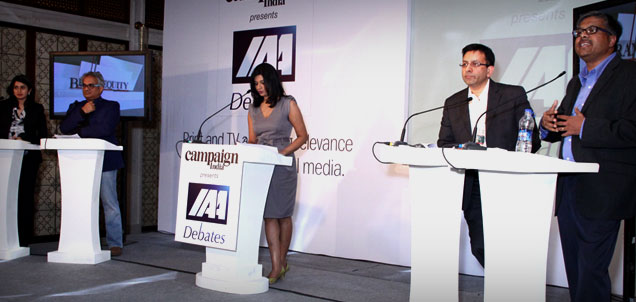
    To find out, the India chapter of IAA organised a debate in Mumbai on Monday (Feb 18) on whether television and print are losing relevance with the growth of digital in India. The debate series is being sponsored by Campaign India and the co-chairs of the IAA debates initiative are Partho Dasgupta and Neville Taraporewalla.


    Seasoned professionals Virginia Sharma of IBM and Mahesh Murthy of Pinstorm (and Seedfund) argued for the motion while Sanjay Gupta of Star TV and Arunabh Das Sharma of The Times of India group argued against the motion. The debate was moderated by Sonali Krishna, Anchor of Brand Equity show of ET Now. A cross-section of industry professionals were in attendance. As were some representatives from MxMIndia.

    We bring you some of the highlights of proceedings. Note, this is only a part of what was discussed.


    Mahesh Murthy: If you look at the Census report, if you see rural India there are just 33 percent homes that have television vis-a-vis 54 percent that have mobile phones. Overall if one compares, urban plus rural, TV used to take 32 percent penetration in 2001 which has grown and is at 47 percent at the moment. But mobile has grown from 9 percent in 2001 to 56 percent today. Mobile today is 24 percent larger in Indian households especially rural where the number is about 50 percent more.

    If you look at the numbers further, television has about 111 million viewers whereas mobile has about 133 million users – which further consist of 400 million users of SMS, 900 million SIM cards, etc. When one compares the publication number of The Times of India that is at 3-4 million which is dwarfed by 18 million users of Facebook every day in India.

    If you look from the consumer’s POV the three most desired audiences from an advertiser’s perspective is the 15-24 yr-old youth that barely reads a paper or watches TV and is highly digital-savvy; 25-34 yr-old females – Facebook alone has 11 million of those and I do not think any other medium in India can give you that kind of access to this age group; and finally 35+ age group – it will be hard-pressed to reach a CEO today as long as he is on his tablet or i-Pad or email, etc.

    When we move on to the advertisers, all of two years ago digital was all of two percent of the ad pie which has now become about 8.5 percent, meaning that digital has grown by 400 percent while the share of television or print has gone down.

    If you look at how digital has been explored by other people like politicians who have more than 200 people to handle just the digital medium, which I do not think is the case with other media. Even when one looks at the credibility factor, Nielsen states that the most credible medium is word-of-mouth, followed by what strangers write online followed by what is written on websites and then comes print.

    So what we are seeing is that print and television are not going zero; while they still have relevance they are losing their relevance because of the advent of digital. I’d like to end by requesting each one to ask themselves as to where do you see yourself in the future – whether five years from now you’ll be seeking a job in a company that does not do digital. The honest answer will decide where your preferences will skew towards the end of this discussion.


    Arunabh Das Sharma: I’d like to begin by saying that what we are discussing here is relevance. Is it about ad dollars; is it about ‘x’ percent more mobile penetration or is it about what these media have stood for the longest time – which is curated content. What digital has done is created a proliferation of choice and when that happens big becomes bigger. In such a situation everything grows. I’d like to share here an example of how the growth of social media has fuelled the growth of television and print and how they the two mediums are getting healthier now that the investment in content is becoming stronger and stronger.

    In the 1950s, it was said that radio was going to kill the medium of print and was followed in the 1970s where it was said that television would kill the medium of radio… none of that happened. There is a reason why different media play different roles in our lives. A recent study by research firm Ipsos talks about what are the global rules that different screens play in your life. So while the mobile screen is a lover, the computer screen is a sage while the tablet is a wizard but the fact of the matter is that you need a lover, wizard and a sage; the fact of the matter is that every medium has a special role to play and we ourselves will be very myopic if we assume that television is linked to a cathode ray tube or that a newspaper is linked to a piece of paper.


    Virginia Sharma: Is your motion that TV and print continue to be relevant or that they are growing in relevance?


    Arunabh Das Sharma: I think the topic needs to be redefined whether print and TV are losing relevance but whether digital will ever gain relevance? In fact I’d like to say here that 2012 saw some of the biggest gains in stock prices of print companies because of one aspect – they had figured out their business model. The issue was that in 1992 when the readership started dropping they had to figure out a business model which wasn’t to be.


    Virginia: Do you have any comparable stats to validate your observation?


    Arunabh: It doesn’t even show on the scale for India. I’d like to add here that a lot of people wouldn’t know about this but a gentleman in the US just brought a bunch of regional newspapers with the assumption that the growth of print will happen through hyper-local and regional papers, which is exactly what will happen here too.


    Virginia Sharma: I’d like to start off by answering the question, ‘What does relevance mean?’ In today’s world relevance means business impact. The fact that it was said that digital does provide a platform of choice is correct; also the fact that social as a medium has grown is also correct.


    Arunabh: If relevance is defined as business impact, are we talking the same scale in that sense in India?


    Virginia: What I am saying is business relevance to advertising agencies…


    Arunabh: But I thought it was also about ad dollars…


    Virginia: No ad dollars is about expense. Business relevance is about business outcomes and about what the CEO measures, particularly the RoI. To quote numbers from a CEO study that was conducted, the use of social and web from 11 percent to 48 percent for social and from 37 to 49 percent for the web in the primary way to interact with the customers.  That for me is business impact and what the boss sees this as a way to engage the audience. What do most brands like Coca Cola, Pepsi, ICICI, HDFC etc have in common – it’s their innate belief that this medium is relevant and their investment in this medium is not just what the ad agency says it is.

    So, two big cases. First, the primary metric of the CEO study for marketers for success is RoI. You can measure RoI based on the ability to understand customers and target them with what they need. You can only measure digital better than you can measure print and television. Therefore the future for marketing where RoI is concerned as a primary measure for success has got to be digital if you want to make the case.


    Arunabh: I think the challenge is not about measurement but about conversion and that’s how a medium works. Measurement that you are saying is how many people have seen the ad not how many people because they have seen the ad went and watched something.


    Virginia: Measurement for me is actually measuring consumer behaviour and doing it successfully. To sum up, the business case is very simple, if you want a good RoI you have to use digital as a key medium to be able to feature consumers and that ultimately is going to be key.


    Sanjay Gupta: When I started working 20 years ago I thought print is going to die and today print is about Rs 14,000 crore from Rs 6,500 crore it was a decade ago. For television the growth has been from 5,000 crore to 16,000 crore. The key points that I’d like to present here are that firstly, consumers love television and it is thriving. The thing is that if you find something relevant you spend time with it. Around 700 million people in this country spend three hours every day watching TV. When they start it is for two hours, which then picks up to three hours. Also in the last one year, 70 million new people have started watching television. That’s more than the number of people who watch digital in any given point in a month. The same is the case in developed countries like the UK and the US where the time spent is around 4-5 hours every day.


    The other thing is that big is becoming bigger on television. The belief is that proliferation of choice will make users fragment. A recent example I’d like to share is of the movie ‘Dabangg’ which was watched by 150 million people. Even shows like Balika Vadhu etc aggregate about 40-50 million viewers in that half an hour. The point I’d like to make is that social media is actually helping the business become bigger and better. The people fall in love with our characters and they do that only on television and not anywhere else.


    Mahesh: So essentially your point is that even TV uses digital…


    Sanjay: TV does use digital. To quote an example our show Satyamev Jayate was the biggest show that we did and we used the channel of social media to make people come and watch it. It was in fact the highest trending topic on Twitter. So what I am saying is that digital is driving our business to do better.


    Virginia: Is it content that drives behaviour and interest or is it the medium?


    Sanjay: It is content. To cite figures, in the UK people watch about 80 minutes of video and out of that 80 percent is either pornography or YouTube – that’s the power of that medium there. Whereas if you provide good content it makes the viewer keep coming back to watch more and more.


    As to what is changing, digitization is changing the way television companies do business. Till now only 20 percent of the revenues from digital medium came to the broadcaster but the transparency with DTH that number is moving from 20 to 100 percent. So subscription revenues of TV companies have grown five times and what does it give us – the power to invest in content. That is what will make it even more relevant in the future.


    Murthy: So your point is that television is using DTH or rather digital to deliver itself to homes?


    Sanjay Gupta: The point I am making is that the medium is powerful, profitable and is growing. The fact is that people will not consume any one or two mediums, they will consume all the mediums. The question is: how do we use the power of each of these mediums as they have to be relevant.  So print and TV will not lose their relevance they will continue to grow. The real question is that we need content aggregators and devices. Digital as a medium is just an aggregator of content and fundamentally the question we need to answer is how meaningful can this content get on the medium if it has to grow even further.


    Arunabh: Statistics do give us a picture. The fact of the matter is that both these media are huge and growing. If they were not then we could have turned around and said that it is not but like all new media they are finding newer ways – whether through a screen, a mobile, an app – of growing the medium. We are not here to debate whether one medium is better than the other, the fact is that we as consumers love to consume media and do it the way we want to. It is not about whether x, y or z is losing relevance, the fact is it is bigger and it is growing. In fact the next round of growth is already visible to us – it is coming from regional markets. Because of our infrastructural issues it will take digital some time to pick up speed but until such time our friends in the digital world would do really well to figure out what kind of content creates stickiness and what kind of content keeps readers going for 175 years. The day one of these digital mediums complete a 175 years in the form and fashion from what they started then we can talk about it further.


    Virginia: I think the four of us together have made a very compelling case for the growing relevance of digital and that it is powerful, profitable and here to stay. Such a combination would make this medium indeed relevant. Print and TV is going digital, decision-makers are going digital, politicians are going digital… the big question is, which side do you want to sit on? And no, digital does not want to be the medium it was 175 years ago, it wants to keep up with the times as well as the generation it is catering to and it will constantly evolve and is eager to change. It will make money regardless of the shape it will take. The question is, are you ready for the future – digital?


    The debate was won by the team against the motion. Before the debate started, 44 people from the audience were against the motion and 31 were for it. After the debate ended, the numbers were 42 against and 34 for.