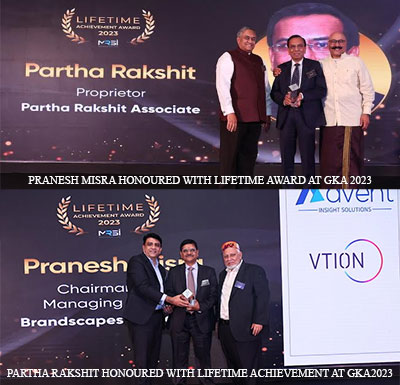
In 2019, the Market Research Society of India (MRSI) instituted the Golden Key Awards in to recognise the contribution of insights for the growth of India’s market research and insights industry. Each year, MRSI also recognises the industry’s veterans for their significant contribution. MRSI’s recently held Golden Key Awards 2023 honoured Partha Rakshit and Pranesh Mishra, two senior professionals from across the research and insights industry for the Lifetime Achievement Award.
While Rakshit last served as the Managing Director South Asia at Nielsen, from where he retired in 2010, Mishra, is Chairman and Managing Director at marketing analytics and insight consulting company Brandscapes Worldwide which he founded in 2008.
Notes a communique: “The Market Research Society of India extend their gratitude to both Partha Rakshit and Pranesh Mishra for their valuable contribution to the Indian and global research and insights sector.”
Thomas Pulliyel, long-time President of IMRB International, retires today (August 31). The IIM Calcutta graduate began his career with the Operations Research Group and first joined IMRB in 1981 as Manager for Overseas Projects, and a decade later, became Senior Vice President. In 1992, he moved out to Research International India as Country Manger, but was back at IMRB in September 2000 for a second stint. Friends, colleagues and even business rivals fondly remember the ‘strong and silent’ Pulliyel, and how he took the organisation to new heights.
Dorab Sopariwala
The Al-Futtaim group had asked IMRB to set up a market research unit for them. Thomas spent a year there and I spent the first and the last month. So that’s how I came to know Thomas; you needed to get to know him a bit, before he would open up to you. We were trying to see how we would run this company, and it was only through extensive discussions, that we could work. He would come back in the evening and work till eight pm. I don’t know how we managed for food and such. — Dorab Sopariwala, Consultant and Advisor to NDTV
Sunil Karve
I could trust Thomas very much. He is very straight and there are no lies or false claims with him. He helps you along even if you make mistakes, and is always there to support you. When he started Research International in 1992, nobody knew about it. It was a tough and challenging task for him at the time because there was IMRB and MARG, which were the biggies out there, along with MRS and others. I think that he built up an extremely good team, and the work ethics and output were the main reasons for the success of RI. — Sunil Karve, Partner at Autumn Leaves, Innovation and LLP, Varenyam Consulting
Partha Rakshit
I still remember the first Board meeting I had with Thomas. Everybody says that he is a man of few words. I found that this was, indeed, his way, but he could also be very firm. I can tell you that if Thomas has got something into his head, you cannot convince him to change his mind. It’s quite difficult to do that. But I think he was a great partner to work with. I think we got on pretty well, and I think of the time when even though we were fierce competitors on the outside, we had a fantastic relationship. — Partha Rakshit, Proprietor, Partha Rakshit Associates, and former MD for South Asia, The Nielsen Company
Colvyn Harris
I think the values of IMRB are the values of Thomas. When you think of Thomas, he is a strong, silent type of person. The leadership values of IMRB and the way Thomas conducted himself for the IMRB company, is what has kept the company where it currently is. — Colvyn Harris, Executive Director of Global Growth and Client Development at J Walter Thompson Company??
Eric Salama
Thomas has given all the freedom to his people to make their own decisions and even guided some of them over the years. He was always incredibly protective of IMRB – the company, the brand and the people within. He had a paternal instinct towards people and is incredibly patient. Incredibly also, he took both failure and success in his stride. I knew Thomas when he was at Research International, and he has been the heart of an industry that has grown [around him]. I can think of so many clients, so many competitors and so many colleagues who have worked for IMRB at one stage or another. As a talent magnet and a talent machine, IMRB has produced some of the most special people in the industry. Not just one or two people, but at scale, and Thomas has been at the heart of all that. — Eric Salama, CEO of Kantar Media
Preeti Reddy
It is always easier to take over a company which is not making money; where everybody hates the boss and hate each other. Fortunately, we are a growing company where everybody loves Thomas and he is a legend, so you can understand how much harder Thomas has made it [to hate the boss]. I would say that it is a huge legacy. Thomas has nurtured it for 15 years, but it is a 45-year legacy. IMRB has defined the industry and you have heard everybody talk about that. In a sense, it is actually giving the industry credibility. So it is a privilege to carry that legacy forward. I think that he epitomises the values of IMRB and, again, many people have said that. I think IMRB is what Thomas is, and he has been a mentor to not just me, but so many people. I’m hoping he will continue to be somebody whom we can turn to, in good times and bad, in the years to come. — Preeti Reddy, SVP & President-designate, IMRB International
This story first appeared in dna of brands dated August 31
In a recent development, the Ministry of Information and Broadcasting (MIB) has ordered broadcasters not to air advertisements that have been found in violation of the Advertising Standards Council of India’s (ASCI) code and not complying with the decision of its Consumer Complaints Council (CCC). While deliberating on the complaints received in ASCI, the CCC observed that many of the teleshopping advertisements made unsubstantiated claims & violated the provision of code for self-regulation as well as provisions under Drug & Magic Remedies (Objectionable Advertisements) Act, 1954. MIB has in its Advisory compiled a list of these ads and asked broadcasters not to carry them in their respective channels and to ensure strict compliance of the advertising code in the Cable Television Networks Act (CTN).
The CTN code and rules state that ‘no advertisement which violates the code of self-regulation in advertising, as adopted by ASCI for public exhibition in India, from time to time, shall be carried in the cable service’. Therefore, the ASCI decisions are not just bound for compliance by advertisers but also by TV channels.
Partha Rakshit
Partha Rakshit, Chairman, ASCI shared, “This is another feather in the cap of ASCI, in its efforts to make advertising more responsible. We were finding that some advertisers on TV channels, especially Tele Shopping Networks, were not complying with the ASCI decisions. We submitted the list to the Inter Ministerial Committee (IMC) of the MIB for their consideration. Based on that, IMC observed that any violation of ASCI code also violates the Advertising Code enshrined in the CTN Act and its rules. In short, IMC has directed that advertisements found to violate the ASCI code cannot be carried on TV channels.”
Advertising industry self-regulator Advertising Standards Council of India (ASCI) has released its final guidelines for the advertising of skin lightening and fairness products following industry and public feedback to a draft it had issued earlier. This, industry observers believe, could go a long way in correcting the communication issued by makers of a growing number of fairness products.
Commenting on the new guidelines, Partha Rakshit, Chairman, ASCI said:
“Setting up these new guidelines for the skin lightening and fairness products will help advertisers comply with the ASCI code which states that advertisements should not deride any race, caste, colour, creed or nationality. Given how widespread the advertising for fairness and skin lightening products is and the concerns of different stakeholders in society, ASCI saw the need to set up specific guidelines for this product category. As a self-regulating body, it is important to have the advertisers’ buy-in to the guidelines, and we are happy to note that both the industry and the consumer activists’ groups have welcomed these guidelines.”
The following guidelines will be used when creating and assessing advertisements in this category:
:: Advertising should not communicate any discrimination as a result of skin colour. These ads should not reinforce negative social stereotyping on the basis of skin colour. Specifically, advertising should not directly or implicitly show people with darker skin, in a way which is widely seen as, unattractive, unhappy, depressed or concerned. These ads should not portray people with darker skin, in a way which is widely seen as, at a disadvantage of any kind, or inferior, or unsuccessful in any aspect of life particularly in relation to being attractive to the opposite sex, matrimony, job placement, promotions and other prospects.
:: In the pre-usage depiction of product, special care should be taken to ensure that the expression of the model/s in the real and graphical representation should not be negative in a way which is widely seen as unattractive, unhappy, depressed or concerned.
:: Advertising should not associate darker or lighter colour skin with any particular socio-economic strata, caste, community, religion, profession or ethnicity.
:: Advertising should not perpetuate gender based discrimination because of skin colour.
In a move that would encourage more participation from aggrieved parties, the Advertising Standards Council of India (ASCI) now delivers its Consumer Complaints Council’s (CCC) decision on a complaint against an objectionable advertisement within a span of on an average just 12 days from the date complaint is received. With the consumers and regulators demanding that ads which are a) misleading or make false claims, b) indecent, c) showing hazardous activities and d) unfair to competition should be promptly removed or modified, ASCI has taken effective action to reduce the complaint processing turnaround time from 45 days two years ago to just 12 days on an average currently.
Some of the actions taken by ASCI to achieve this unparalleled turnaround time include:
1) From monthly meetings two years ago, the CCC now meets weekly by having two CCCs instead of one earlier and total number of CCC members moving up from 21 to 28.
2) The turnaround time taken at ASCI to process the complaint and time provided to the Advertiser to respond to the complaint has been significantly reduced with the use of email and technology.
3) Intra Industry complaints among ASCI members are being resolved in just seven days via Fast Track Complaint (FTC) process which was introduced in 2012. FTC, which handled 30 complaints in 2013/14 has been very popular among ASCI members who are seeing real time and cost savings by not taking the matter to the courts on intra industry ad content disputes.
4) In the recent past ASCI also introduced ‘Suspension Pending Investigation’ (SPI) by which ASCI can order an extremely objectionable ad to be removed immediately pending investigation and decision of the CCC.
Under its National Advertising Monitoring Service (NAMS), ASCI has also started tracking in print and on TV of all ads against which complaints have been upheld. And results show that over 90 per cent of such “upheld complaints” ads do not reappear or are appropriately modified. ASCI has now started reporting non compliant upheld ads to regulatory authorities such as the Ministry of Information & Broadcasting (MIB), the Drug Controller General of India (DCGI), the Medical Council of India (MCI), the Ministry of Health and Family Welfare, and the Food Safety & Standards Authority of India (FSSAI) for taking action as per the law of the land.
The faster complaint turnaround time and improved compliance upheld complaint decisions by ASCI has taken place at the same time when number of complained ads processed by ASCI has increased more than 10 times. In 2011/12 number ads processed by ASCI were 176 which post the NAMS initiative in 2012/13 increased to 784 and for April 2013 to Feb 2014 period (11 months), ASCI has handled complaints against 1833 ads.
Partha Rakshit
Commenting on these developments, ASCI’s Chairman, Mr Partha Rakshit said, “ASCI’s effectiveness and credibility as an advertising self-regulatory organisation has increased several fold with speedier redressal of complaints and high compliance of its CCC’s decisions by Advertisers. Regulatory bodies like MIB, DCA, FSSAI, FDA now recognise and support our self-regulation work with the inclusion of the ASCI in the Inter- Ministerial Monitoring Committee formed to review misleading ad content.”
The Advertising Standards Council of India (ASCI) unanimously elected Partha Rakshit, Proprietor, Partha Rakshit Associates, as Chairman of the Board of ASCI. Mr Rakshit has been a member of the Board of Governors for eight years. He takes charge from Arvind Sharma, CEO, Leo Burnett.
Narendra Ambwani, Director, Agro Tech Foods, was elected Vice-Chairman and Shashi Sinha, CEO, IPG Mediabrands India and Lodestar UM was appointed Honorary Treasurer.
The other members of the new Board of Governors are: Advertisers:  Hemant Bakshi (Hindustan Unilever), Shantanu Khosla (Procter & Gamble Hygiene & Health Care), Jayant Singh (Glaxo SmithKline Consumer Healthcare), Media: Rajan Anandan (Google India), Sunil Lulla (Times Television Network), Benoy Roychowdhury (HT Media), I. Venkat (Eenadu), Advtg. Agencies:Subhash Kamath (BBH Comms India), Arvind Sharma (Leo Burnett), Srinivasan Swamy (R.K. Swamy BBDO).  Allied Professions: Dilip Cherian (Perfect Relations), S.K. Palekar (S.P. Jain Institute of Management), Abanti Sankaranarayanan (CIABC)
During the year 2012-13, the Consumer Complaints Council (CCC) met 24 times and considered 3007 complaints against 788 advertisements. Of these, complaints against 642 ads were upheld, while 144 were not upheld and 2 were considered non-issues.  In 590 cases, the complaint upheld ads have been voluntarily withdrawn or modified as per the CCC’s decisions resulting in over 91% compliance rate.
Said Mr Sharma, “Last year has been a very eventful year for ASCI. The NAMS Initiative which has seen a five-fold increase in the ads complained against (from 177 to 788) has won ASCI the prestigious EASA Silver Award for Best Practices. The CCC now meets every week and approximately complaints against 200 Advertisements are deliberated upon every month. Set up of the Online Complaints and Monitoring Services (OCMS) in the new-look ASCI website also has started getting complaints against ads coming in from consumers in large numbers. ASCI has also introduced Suspension Pending Investigation where an Advertiser is asked to suspend an Ad immediately pending investigation when that Ad appears to be in serious breach of the Code.’
Added Mr Rakshit: “I believe ASCI’s biggest task in the coming year is to more vigorously disseminate ASCI’s guidelines through training programmes to advertisers and ad agencies who create the ads and to media who release them, so that the proportion of new ads that meet ASCI’s standards is high at the stage of release itself. ASCI will also liaise more closely with regulators to ensure that ads which do not comply with CCC’s upheld complaint decision are acted upon as per the law of the land”.
The Advertising Standards Council of India (ASCI) has appointed Arvind Sharma, Chairman of India Sub Continent, Leo Burnett, as Chairman of the Board. Partha Rakshit, Proprietor, Partha Rakshit Associates, was elected Vice-Chairman; and Vikram Sakhuja, CEO-South Asia – Group M Media India was re-appointed the Honorary Treasurer.
I Venkat, Director – Eenadu, and the outgoing Chairman of ASCIÂ said, “The last year has seen ASCI take various initiatives to strengthen the self-regulatory system. These included increasing the frequency of Consumer Complaints Council to twice a month, introduction of the Fast Track Service, having a National Conference on Strengthening Self-Regulation of Advertising Content, engaging with young creatives through a Mobile Film Contest at the Goafest, interacting with the Department of Consumer Affairs and participating in their conferences on misleading advertisements. ASCI has taken a giant leap forward in introducing the National Advertising Monitoring Service (NAMS) which monitors 1,500 TV and 45,000 newspaper ads per month. All in all a very satisfying year for ASCI. ASCI is the first self-regulatory body in the world to initiate monitoring of almost all newly released ads in print and TV nationally with NAMS.”
Arvind Sharma said, “It is indeed an honour to be elected as Chairman of ASCI which has progressively contributed to effective self-regulation in advertising content. We are confident that the ad sector, industry body’s regulators, consumer activists and the general public will actively seek ASCI’s services and take self-regulation forward.”
As a member of the Board of Governors for seven years, Mr Sharma has provided active support to self-regulation in the advertising movement.
During the year 2011-12, the Consumer Complaints Council (CCC) met 16 times and considered 2,986 complaints against 176 advertisements. Of these, complaints against 103 ads were upheld, while 69 were not upheld and 4 were considered non-issues. In 89 cases, the complaint upheld ads have been voluntarily withdrawn or modified as per the CCC’s decisions resulting in over 86% compliance rate.
The other members of the new Board of Governors include: Advertisers: Narendra Ambwani (Agro Tech Foods), Hemant Bakshi (Hindustan Unilever), Rajiv Dube (Aditya Birla Management Corporation), Shantanu Khosla (Procter & Gamble Hygiene & Health Care), Media: Rajan Anandan (Google India), Sunil Lulla (Times Global Broadcasting Co.), Benoy Roychowdhury (HT Media), I. Venkat (Eenadu); Advertising Agencies: Subhash Kamath (BBH Comms India), Srinivasan Swamy (R.K. Swamy BBDO). Allied Professions: Dilip Cherian (Perfect Relations), Dhananjay Keskar (IBS), Pranesh Misra (Brandscapes Consultancy P. Ltd.).
 In 2019, the Market Research Society of India (MRSI) instituted the Golden Key Awards in to recognise the contribution of insights for the growth of India’s market research and insights industry. Each year, MRSI also recognises the industry’s veterans for their significant contribution. MRSI’s recently held Golden Key Awards 2023 honoured Partha Rakshit and Pranesh Mishra, two senior professionals from across the research and insights industry for the Lifetime Achievement Award.