Tag: Parsa Venkateshwar Rao Jr

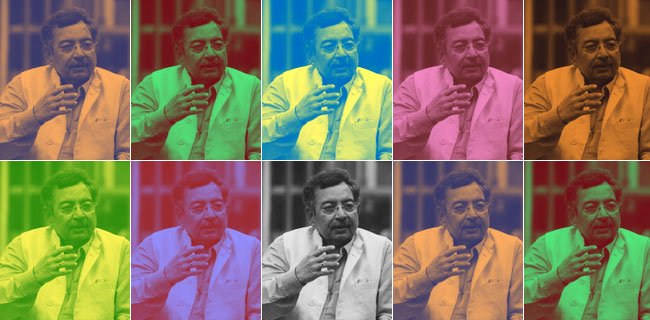
  • Vinod Dua – the Urbane Hindi Voice


    By Parsa Venkateshwar Rao Jr


    I must clarify before I go further that I watched Vinod Dua closely through all the election programmes that he presented with NDTV’s Prannoy Roy through the 1990s. (It was only in the last few that I came to know him slightly. I must also acknowledge that he was warm with new friends as well and never made you feel that you are a new friend.)  But it would be unfair to the man if we do not understand his place in the changing media scenario of the country after 1991. The tributes that I have read were that of his close friends, including journalists, but who bonded with him at a personal level. That he has so many friends showed the humane side of him. It is this humane side that was the undertow of his speech


    This was even before S P Singh launched the daily news capsule at 9.30 pm, where he signed off with his “intezaar kijiye kal tak”. Dua was a curiosity because the bilingual presentation was an effort by metro Indians to reach out to the Hindi heartland audience. Roy, or Dr Roy as he is known to many of his colleagues, seemed to have realised that without Hindi, the audience would be restricted to the drawing-rooms of the well-heeled. What made me curious as well as amused with Dua was his urbane manner of speaking Hindi, as smooth as the English spoken by Roy and others in the programme. One of way of sounding smooth and polished while speaking Hindi was to throw in a few Urdu words. But Dua did not follow that easy option. He spoke lovely Hindi, and pronounced the Sanskritised Hindi words with ease, without letting the accent fall too heavy on any syllable.


    I have always told myself that this Hindi was spoken with a clipped Oxford accent. It sounded good though there were times when the sophisticated ring of the voice became a little tedious even as Roy’s strangely accented English – outdoing the native English speakers – became an irritant.


    But looking back a quarter century and more later, it becomes easier to understand the social context. Dua’s was the first Hindi voice of liberalised India. Before him there were the admirable Hindi newsreaders on All India Radio and Doordarshan, who spoke Hindi with the perfect pitch and they made the unmusical official Hindi sound mellifluous. Economic reforms ushered in by the dull P V Narasimha Rao- Manmohan Singh duo excited urban, metro Indians. Roy and Dua reflected that excitement with their nuanced accents.


    It might seem uncouth to talk about accents while writing about Dua. But the voice and presence was what made a radio and television journalist. And Dua was that. Neither Roy nor Dua moved from print to the electronic media. Their native soil was the electronic media. When people liked Dua, and there were hundreds of thousands, they liked his sophisticated manner. In understanding Dua’s journalistic career, this becomes the keynote.


    One of the questions that came up as I was chatting with MxMIndia editor was: how is it that one of prime movers of television in liberalised India just fell off the map as it were. And it seems to be that he was left behind as what were his strong points – the urbanity in speech and manner – became a handicap as Hindi channels and anchors and reporters increased. The Hindi channels brought with them their earthy flavour of speech quite different from that of Dua. The Bihari accent, the UP accent, and even the Punjabi one, made a niche for themselves. The British Broadcasting Corporation (BBC) once stuck to its stiff upper lip Received Pronunciation (RP) but realised the need to democratise itself and accommodate regional accents of its journalists. Dua represented in a sense the Hindi Received Pronunciation, but soon the democratisation happened. S P Singh brought in earthiness and a certain authority because of his grasp of politics, and he did not fight shy of his Bihari accent. Dua knew his politics, but it seemed as though it was that of a slightly distant observer. The traditional hallmark of a journalist is his or her immersion in politics, and that non-English language journalists display to the hilt. Dua, the Hindi journalist, did not fit the bill. This is not a value judgment about Dua or Hindi journalists.


    Dua did a food show in Hindi, which is a lifestyle feature, and which political journalists are shy of doing because they would say that all they know is politics. For Dua, there were things other than politics in life. With his flair for singing, he could appreciate music along with food. And he loved his drink in the manner of connoisseur. He was an epicure in the general sense of term. He loved the good things of life and he enjoyed them. Dua was drawn into a controversy as the me-too movement caught on in 2018, but it came to nothing.


    It is important to remember Dua because for a flickering moment he projected a facet of Hindi language and journalism that was at once genteel and knowledgeable. And it is from this vantage point that he became a critic of the Hindutva politics of Bharatiya Janata Party (BJP) and of the manner of Prime Minister Narendra Modi’s government. The Hindutva side resorted to his crude arm-twisting methods by filing a case against him in Himachal Pradesh for being an ‘anti-national’, the charge that they bring against anyone and everyone who they disagree with and who they dislike. Dua challenged the false allegation and the Supreme Court ruled in his favour. This is a victory for Hindi journalists as well as journalists in general.


    It can be said that he fought the good fight against political tyrants as well as for his life. He won against the political tyrants and lost against the tyranny of the pandemic.


    Parsa Venkateshwar Rao Jr is a senior journalist and commentator based in New Delhi. His views here are personal
     

  • Newswatch: Katju, a harmless Rip Van Winkle

    By Parsa Venkateshwar Rao Jr


    Justice Markandey Katju, the chairman of the Press Council of India, has written a long-winded piece in The Hindu of November 5, expressing his views on the state of Indian society, economy, media and what to do with it all. It is a meandering argument with usual college textbook learning thrown in, with quotes from Firaq Gorakhpuri, Tulsidas, Shakespeare, some kind of socialist critique, some talk of a transition from the feudal age to an industrial age.


    The basic premise of the good judge is that India is in the age of 18th-century Europe, and what Voltaire, Diderot and Rousseau did then should now be done by the Indian media; fight the establishment, fight feudalism, fight superstition and worry about the plight of the poor people and the suicides of farmers as does P Sainath in The Hindu (Katju mentions Sainath by name). That is, fight the evil windmills.


    Then he talks of the need to regulate the media, especially the electronic media, which have programmes on astrology, devote more newstime to Lady Gaga and Kareena Kapoor’s wax image at Madame Tussaud’s than to the health and educational problems of the country.


    It is clear that Katju is a confused man. He has a bird’s-eye view of the situation, and he seems to miss both the woods and the trees. The judge is gravely mistaken in saying that India is passing from the feudal to the industrial age. There is no feudalism except in the minds of Marxist historians. The rural social set-up we find today, including the rightly hated caste panchayats, is not an example of good old feudalism but of an undeveloped rural bourgeoisie, with false sense of honour and tradition, with enough money and little wit. To think this is feudalism is reading the situation wrong with the help of dated textbooks, especially banal liberalism of the HAL Fisher-type A History of Europe, which is a silly book in retrospect or the CPI-type NCERT history textbooks in India.


    Katju is worried as to what will happen to displaced farmers moving to cities and not finding jobs because steel and automobile companies are producing more with less workforce. This is a perennial problem that has been with us for the last 60 years and more.  Farmers will pick up new skills as time goes along. All migrations involve changing lifestyles and working conditions.


    Then he makes the futile observation that more than 90 per cent of Indians are migrants, excepting the pre-Dravidian tribal populations. Now that statement is neither true nor false in any meaningful sense of the term.


    So, why was the media, especially the electronic media, getting angry with Katju? He uttered the word ‘regulation’ and said that no freedom is absolute. In themselves there is nothing wrong with the two ideas. Regulation if translated to transparent and fair rules is indeed the basis of any institution or sector. And even ardent liberals would accept that no freedom is absolute. We do not have radical liberals who argue for absolute freedom of speech, including hate speech. Our liberals are timid and politically correct.


    The real red rag in Katju’s long homily is that he wants to set himself as the watchdog of the media, which is what the Press Council is supposed to be. Either there should be no Press Council, or if there is one it has to be watching over the media. The only effective way of refuting Katju is to dissolve the Press Council. If the council is allowed to exist, then this Katju-type of exhortation – vain and in vain – will have a place in the public sphere. It will be interesting to pick holes in it. And it can even be ignored.


    Katju’s attitude does hint of paternalist socialism, the kind favoured by the Congress in its unconscious mind, where the government wants to tell people what is good for the people. Katju is no Stalinist – he would be horrified to know that there are intimations of Stalinism in his pompous obiter dicta – but he sounds very much a schoolmaster. It is, perhaps, nice to hear a schoolmaster once in a while, especially when you do not have to fall in line which is the case with Katju and the Press Council. But the truth is that Katju is a harmless intellectual Rip Van Winkle, speaking in the dead debating terms of a bygone era.


    The media should not have gone into a frenzy over what he said. As always, the media was looking for a good bone of contention and Katju provided one. The media should be grateful that Katju chose to be provocative in his own outdated manner.


    The writer works with the DNA newspaper at its Delhi office.

  • Newswatch: News cannot be customized

    By Parsa Venkateshwar Rao Jr


    It is the old story of a death foretold, and which is for ever deferred. The novel died and it has managed to live on. Poetry died, but a Swedish poet gets the Nobel for literature this year. Philosophy has died. And still there are a few too many philosophers around. So it is with the print media. The newspaper is dead. This was what that ostensibly venerable but really pseudo-ish news paper, The Economist, had prophesied not too long ago. And in the middle of market meltdown in the western world, most of the newspapers editors and owners are singing the dirge as well.

    India seems to be bucking the trend as of now. Newspaper circulation, including that of the English language ones, is rising and rising briskly too. Many social and economic factors have been invoked to explain the phenomenon. It is being said that the explosion of literary in a billion plus country means millions of readers every year, and that the high will persist longer than imagined. There is of course the cliche that we are a booming economic power in a world flattened by recession.

    Whether the newspaper survives as we know it is indeed a billion rupee question with long-term implications and with no philosophical or existential strings attached. Newspapers may change and even disappear but news will remain with what the 1930s British (Anglo-Irish really) poet Louis MacNeice summed up in a sardonic spirit, “Give us this day our daily news.” I an information age, news is not going to disappear into a black hole though there is the real danger of too much trivial news creating a mountain of information trash.

    Beyond the playful and woeful prospect of dealing with too much news, what seems to be of greater interest is whether the reader should be able to choose what he or she wants, the so-called customized news, whether in the newspaper, on the radio, on television and on the Internet. This seems to make immense market sense, and the idea is being bandied about as the ultimate winner in the business of purveying news.

    The dangers seem to be obvious to anyone except those who want to live by a new, untested and unexamined idea. News by definition should not be customized. The consumer – the reader in this instance – should not be choosing what he wants and ignoring the rest. For that he can walk through the libraries and go for the books he wants to read or even browse through racks of DVDs to get the sub-genre of films he or she is interested in. A similar exercise can be carried through on the iInternet as well, where you can Google and Yahoo the subject or theme you are interested in. You will not have to know anything about anything else.

    The idea of news is that a person gets to know things which one is not necessarily interested in. The Greek economic crisis is indeed of no interest to anyone but the Greeks themselves, and thanks to the overvaulting ambition of Eurozone, it has become the nightmare of rest of the European Union as well. News is all about something that has happened which may or may not impact you either in the immediate or in the distant future. The fact that it has happened needs to be noted – the word recorded sounds a little too pompous – for whatever it is worth and relegated to the archives. Someone interested in it will retrieve it sometime somewhere.

    So, those in the business of news cannot afford to package things for the consumers. That is a retail exercise that can take place lower down the supply chain as it were. The basic issue is that news – whatever has happened or said – has to be collected and gathered. Newsgathering is the primary function. The choices come much later. Customization of news cannot be made the basic premise.


    The writer works with the DNA newspaper at its Delhi office.