Tag: Parijat Chakraborty

  • Ipsos hires Sandeep Ghosh, as ED to bolster PA team

    By A Correspondent


    Sandeep Ghosh
    Parijat Chakraborty

    Ipsos India has further reinforced its Public Affairs team, by the hiring of Sandeep Ghosh as Executive Director.


    Said Parijat Chakraborty, Country Service Line Leader, Public Affairs, Ipsos India: “Sandeep Ghosh has enormous amounts of experience in the development sector, across prestigious clients and a great depth of work. I foresee, our position becoming stronger and well entrenched in social research and we hope to snag a lot of untapped work, which will further boost the business.”


    Added Ghosh: “Ipsos is the market leader in the development sector research, with all the remarkable work being done across the globe. It will be my privilege to grow the business for Public Affairs in India, leveraging my client relationships, and working closely with the team here.”


  • Ad execs, third least trusted professionals, notes Ipsos survey. Journalists & TV News Readers 8th & 9th from the bottom

    By A Correspondent


    According to a new global survey by Ipsos, Armed Forces have been adjudged the most trustworthy profession by majority (71 per cent) of urban Indians. Second and third places of trustworthiness in professions have been bagged by scientists and teachers. The survey christened Global Trust in Professions asked global citizens to rank professions by trustworthiness and untrustworthiness.


    At least 59 per cent urban Indians rate politicians as the most untrustworthy profession, followed by government ministers (52 per cent) and advertising executives (41 per cent).


    Parijat Chakraborty, Country Service Line Group Leader, Public Affairs & Corporate Reputation,  Ipsos India feels, it boils down to transparency and nobility, adding:  “Armed Forces are perceived to be a dedicated force, who are defined by values of sacrifice, commitment, discipline etc. – they serve, like their motto of service before self; likewise scientists and teachers are seen as persevering professions, contributing to nation building. Politicians, despite their efforts to clean up the system, have not yet won the trust of most. Also, the advertising professional, writing interesting copies and creatives, highlighting merits of brands, is viewed with scepticism,” says Chakraborty.


  • Ipsos India appoints Sonul Verdia as Customer Experience Vertical Head

    By A Correspondent


    Sonul Verdia

    Ipsos India has announced that Sonul Verdia will lead its Customer Experience (CX) practice, with immediate effect. He takes over from Parijat Chakraborty, who will focus on Public Affairs and Corporate Reputation businesses.


    Verdia, who already leads the Mystery Shopping practice, views his role as a great way of leveraging dual opportunities with clients: “There is a lot of synergy and linkage between Customer Experience and Mystery Shopping and clients can derive benefits of both at one point of contact and it will enable us to provide clients with a more robust and competitive strategy for enhanced customer satisfaction. I’m super charged about the new role and our enhanced offerings.”


    Said Amit Adarkar, CEO Ipsos India and Operations Director, Asia Pacific, sees ample opportunity for growth in CX business: “CX is the new battleground and at the top of every CEO’s agenda, as it ties in with healthy topline and bottomlines – Ipsos delivers a complete ‘Return on Customer Experience Investment, ensuring that CX delivers on some of the key challenges faced by organizations – how they can exceed brand promise, promote customer retention and recover those at risk, grow share of wallet, increase advocacy and drive up operational efficiency. Ipsos is already is key player in Customer Experience both globally and locally, but we feel some sectors have not understood the utility of measuring and monitoring of customer expectations and delivering on them. Because a bad experience can make customers reject the brand for life. Our enhanced offerings come backed with technology to capture in the moment experience, helping clients address issues with speed.”


  • Indians’ trust in politicians and media is declining: Ipsos survey


    By A Correspondent


    According to a new survey by Ipsos and as a part of the long running series on misperceptions of social realities – The Perils of Perception –more number of Indians think that fake news, filter bubbles and post truth are something that affect all people in general. Notably, the survey further shows our trust in politicians and media declining.


    The study of over 19,000 people in 27 countries shows that the majority of Indians say that they regularly see fake news and half of them said that they believed a fake story, only to discover later that it was fake.


    The survey shows that 74% Indians think that the average person in India lives in a bubble on the internet, mostly connecting with people like themselves and looking for opinions they already agree with. Only 55% Indians think that they themselves have the same tendency of living in the bubble.


    Unlocking Fake News

    70 per cent of Indians believe that they can tell real news from fake news, and less number of Indians think (56%) that the average Indian can tell the difference between the two – having less faith in the average person.

    When it comes to Fake News, 72% Indians profess to have seen news stories by media organizations deliberately saying something that wasn’t true. And 55% Indians say that they had falsely believed a news story as real until they found out that it was fake.

    Interestingly, Indians interpret Fake News in different ways: 55 per cent Indians say Fake News are stories where the news outlets or politicians only pick up facts that support their side of the argument; 53 per cent say Fake News are stories where the facts are wrong; 36 per cent Indians feel it (fake news) is a term politicians and the media use to discredit news they don’t agree with.


    Why are our perceptions misplaced?Why do we get it wrong?

    Indians blame it on multifarious factors that we get facts wrong about our country, how they are changing, what proportion of the population are immigrants, whether crime is rising or declining:56% blame politicians for misleading people; 47% believe that it is the media that is misleading people; 44% feel social media is the culprit for people’s lopsided views; 43% Indians think people per seare biased in their view of the world and tend to focus on negative things – they think that things are getting worse or sometimes they generalize from their own experience; 25% Indians blame it on the figures being wrong and exonerate people’s views for it; and 21% Indians blame it on the inherent discomfort with numbers, that people have, that warps the estimates.


    Said Parijat Chakraborty, Executive Director, Public Affairs: Fake News is a menace that can have serious repercussions unless we stop spreading and producing these. Common people are not generally producing fake news but everybody can contribute in stopping the spread of it. All it takes is a second of pause to assess the piece of news with rational logic.  And this is made more dangerous because we have an in-built tendency to think that we’re better at spotting lies and understanding reality than other people.   This pushes us to think that fake news, filter bubbles and post-truth are other people’s problems, not ours.  But the results of the survey show that these are a real concern for many people. We think things are worse now than in the past – and this is reflected in our view of decreasing trust in politicians and perceived increases in political and media lying.  But the reality is, in India we have seen people berating the previous governments for their lacklustre performance as well. What we should worry about is the decline of trust in politicians and media.”

  • Consumer sentiment looking up, says Ipsos Thomson Reuters PCSI survey

    By A Correspondent


    Consumer Sentiment in India in July has surged by 2.3 points over last month as per the Ipsos Primary Consumer Sentiment (Consumer Confidence) Index (PCSI) conducted in partnership with Thomson Reuters.

    The monthly PCSI result is driven by the aggregation of the four, weighted, sub-Indices: the PCSI Employment Confidence (Jobs), Sub-Index which is up 3.6 points; the PCSI Economic Expectations (Expectations) Sub-Index which is up 2.6 points; the PCSI Investment Climate (Investment) Sub-Index which is up 1.6 points; and the PCSI Current Personal Financial Conditions Sub-Index which is up 0.7 percentage points over last month.


    Said Parijat Chakraborty, Executive Director, Ipsos Public Affairs: “Boost in consumer sentiment bodes well for the economy. Which means the consumer is likely to loosen his purse strings for spending and that there is liquidity in the market. Interestingly, consumer is confident on all fronts, whether it is to do with jobs, performance of the economy, investment climate/ investment in big ticket items and personal savings. There is a form of stability in the economy, now that the post GST disruption has worn off and the Indian economy is placed in the sixth place, having overtaken France, as per the latest World Bank Report. Ergo, there is optimism seen in consumers.”

  • Patanjali is #4 in Ipsos’ India’s Most Influential Brands study


    By A Correspondent


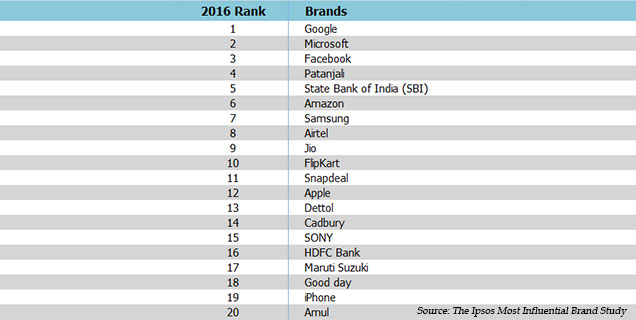
    Global research company Ipsos has unveiled its now annual Top 20 Most Influential Brands in India for 2016.  Google occupies the number one position followed by Microsoft and Facebook at number two and three respectively. Homegrown brands, Patanjali and Jio make an entry into the Top 10 ranked at fourth and ninth place respectively showing the enormous amount of influence that these brands wield in a short span of time. Both brands did not figure in the previous edition of the study.


    Among the Top 10 brands, Flipkart dropped three spots to take the tenth place while Amazon climbed a couple of steps to take the sixth place. Leading bank State Bank of India, which has been on a consolidation mode, move up four ranks to take the fifth place and is the only financial brand in the top 10.


    The Ipsos Most Influential Brand Study evaluates 100-plus brands across 21 countries and involved 36,600 interviews. In India the research covered more than 1,000 Indians online to assess 100+ brands.


    Said Parijat Chakraborty, Executive Director, Ipsos Public Affairs & Loyalty: “The Most Influential Brands are larger than life. They are aspirational. They enhance our lives – make it better. We trust these brands. We connect with them emotionally and cannot imagine our lives without them – they are influential”.


    The goal of the study, notes a communique, is to define and measure influence; to rank brands according to their influence within each country; rank brands according to their influence globally and identify what factors explain or drive the current level of influence for each of the brands at the country level and at the global level.


    Adds a communique:

    “It is important to note that the Ipsos study has measured the biggest, most well-known and/ or highest spending brands only. As a result, the Ipsos Most Influential Brand Study did not look at the entire market.

    “Interestingly, all brands that have featured in the Most Influential Brands List are those that consumer engages with on-a-daily-basis; a constant companion; an extension of consumer – Google, Microsoft, Facebook, Patanjali, State Bank of India, Amazon, Samsung, Airtel, Jio and Flipkart – if we look at the Top 10 list.

    “Next 10 – 11 to 20 too echoes the same story – these brands help the consumer define themselves better –  Snapdeal.com, Apple, Dettol, Cadbury, Sony, HDFC Bank, Maruti Suzuki, Good Day, iPhone and Amul.”

    “It’s impossible for consumers to imagine their lives without these brands.  The formula for success of Influence rides on those 5 pillars of trustworthy, engagement, leading edge, corporate citizenship and presence, “added Chakraborty.


    About the Ipsos Most Influential Brand Study (as per a communique):

    All data was collected via online panels by Ipsos across 21 countries and involved 36,600 interviews. In India the research covered 1,000 Indians online to assess 100+ brands.

    The sample is reflective of population where possible via online methodology. Within each country data is weighted back to either census population or the online age population where the representation of age groups online is skewed to younger population.

    At the Global level, countries are assigned a weight based on GDP, with higher GDP countries having a greater impact on the global influence score.

    A factor analysis was conducted using the 57 statements in the questionnaire and a total of six factors were revealed from this analysis. One of these factors contained 11 statements and was clearly the “Influence” factor. The average score across the 11 statements in the Influence factor was defined as the Influence Score for any given brand. The score was then converted to an index by dividing by the average Influence Score across all brands, multiplied by 100.

    The five remaining factors were used as attributes to help explain what makes each brand influential (as it varies from brand to brand). These five factors are: Leading Edge, Corporate Citizenship, Trustworthiness, Presence, and Engagement.


    What builds influence? How do some brands stand out from the rest? The Ipsos Most Influential Brands study shows there are five key factors that are the building blocks of influence.Trustworthy: Influential brands are trustworthy – consumers trust their message, proposition – that faith leads to consumption, patronage & relationship.

    Engagement: Influential brands engage with consumers across different consumer touchpoints. Consumers love them and want to stay connected. Brands stay relevant and constantly innovate to keep the relationship going.

    Leading Edge: They are model brands – iconic – they don’t toe the line, they are leaders – they stand out and define new paradigms – they grow the category – others emulate them and derive inspiration from them.

    Corporate Citizenship: Influential brands give back to society. Consumers patronize them as they are socially more responsible. It’s built in their ethos. Driven from the top.

    Presence:Influential brands play it big. They have astronomical marketing spends – are visible across consumer touch points with inspiring communications, visuals, adverts that are highly impactful, generating a strong consumer pull. It all hinges on placement, promotion and people.


  • Ipsos study identifies ideal role women essay in society

    By A Correspondent


    A majority of Indians surveyed (64 per cent) think the role of women in society is to be good mothers and wives revolving around home, according to Ipsos Global Trends Survey 2017. As part of the Global Trends study, Ipsos examined global attitudes toward the role of women, parenting, and family across 22 countries by interviewing 18,180 adults.


    Parijat Chakraborty, Executive Director, Ipsos Public Affairs is not surprised with the findings: “More Indian women maybe moving out of their homes, seeking employment and carving out a niche for themselves at workplaces, but society sees them more as accomplished mothers and wives in primary role, relegating other roles to secondary positions. Indian women cannot be seen shirking from domestic duties and winning accolades at work – at the cost of neglecting primary role that society has deemed on them.”


    When it comes to having children, traditional views on the family are more widespread in India. About Eight in Ten (78 per cent) Indians believe that it is better for parents of children to be married than unmarried. Interestingly, for parenting also traditional views were found to be prevalent among Indians. 72 per cent of Indian respondents felt that there was further scope for parents to take more responsibilities for behavior of their children.


    “It is encouraging to see India leading the pack on men taking increased responsibilities for home and childcare than ever before – a whopping 81 per cent of Indians conforming to this change,” added Chakraborty.