Tag: Paranjoy Guha Thakurta

  • Do journalists need to be qualified?


    By Ananya Saha and Meghna Sharma


    Press Council Chairman Justice Markandey Katju recently issued a press note that said, “Since the media has an important influence on the lives of the people, the time has now come when some qualification should be prescribed by law”. Justice Katju announced a committee mandated to “consider all aspects of the matter” and submit a report to him “suggesting the qualifications a person should have before he can be allowed to enter the profession of journalism”.


    The committee constituted by him, in addition to its mandate of recommending qualifications for journalists, will also recommend in what manner the Press Council can supervise and regulate the functioning of the institutions and departments of journalism in India so that high standards of imparting knowledge in journalism are maintained.


    MxMIndia spoke to senior journalists, academics and industry observers for their views on this (in alphabetical order of their last names).


    Prof Chandan Chatterjee, Director, Symbiosis Institute of Media & Communication

    The role of education in building a foundation for thinking as well as building an worldview is well-accepted. More so for professions that have an ability to shape the thinking and beliefs of a society


    Journalists are the scribes and opinion leaders of modern society and culture which can impact a nation’s destiny, or the adoption of a new way of doing things. Hence, journalists ought to have capabilities and skills of recording facts and events and also analyse and interpret their observations.


    The role of upgrading curriculum of post-graduate Journalism courses, to reflect the current trends and thinking becomes equally important. And, like most other professions, journalists too need to be re-skilled and upgraded in their specific areas, periodically.


    After all, every point of view has two sides. It takes a balanced and educated mind to get the breadth and depth of issues involved. Else, we will have to learn with just one point of view!

     

    Deepa Gahlot, Film Critic

    To be a journalist or a film critic one needs to have certain attributes – ability to write and passion for the medium. If one has aptitude for it then qualification only adds to it. Therefore, both training and education go hand-in-hand.


    Today, a lot of newspapers carry articles written by people who have nothing to do with journalism too. Having said that, I do believe that a degree will only help the person. Also, it depends on an organization, what are they looking for – someone with good skills but no degree or someone with a degree and good skills.


    I won’t say that Katju’s recommendations are harsh because even if one is passionate about law but he/she still can’t practice without a law degree, why not for journalism?


    Arati Jerath, Senior Journalist

    I think journalists need qualifications, which are not necessarily taught in journalism school. A good journalist should have the nose for news especially in a war or terrorist situation, extract right information, should be a sensitive human being when reporting on a rape case or terrorist attack. It cannot be taught in any institution. These are the values that they imbibe from their parents, schools, colleagues, mentors.


    Most media houses are very professional and hire talent based on their requirements. If the new hire does not perform, irrespective of their qualification, they are let go. A journalist needs to be a good reader, researcher but mostly, they learn on the job outside of the formalized structure.


    The Press Council’s role is of being an ombudsman and a watchdog in case media oversteps. Frankly, the council is trying to impose professional qualification on a person who wants to become a journalist.


    Chandramohan Puppala, Senior Journalist

    This is debatable. Yes, the basic qualification is necessary but not necessarily in journalism; it could be any basic qualification that would equip a person to make them capable of understanding situations or aspects. In my career, I have hired many new people as journalists who are far more knowledgeable and equipped than journalists who have spent years in journalism or have earned degrees in journalism. It is important, however, that a crime-beat reporter has orientation towards the subject. A reporter who covers economy will be more equipped if he has a degree in economics but it is not necessary that if they have a degree, they will turn out to be a good journalists!


    There are, in any case, very few specialized beats; journalists are all-rounders, and that happens over a period of time: during school, on field, the right sources, and is not dependent on a single qualification.
     

    Prof Dr Kiran Thakur, Journalist-turned media teacher

    Justice Markandey Katju’s plan to prescribe qualifications for journalists is absurd and Utopian. By his logic, politicians should be qualified in political science and NGO founders should be trained in social work. If he wants legal beat reporters to be law graduates, war correspondents will have to be trained in military science if not in warfare, health reporters in medicine, farm journalists in agriculture and so on.


    He will do well to realize that qualifications for reporters and sub-editors alone would not suffice. The owners of media houses, print and electronic, should also possess qualifications. The owners should be trained particularly in media ethics and their social responsibility. Justice Katju should recall the fate of the report of the Press Council committee on paid news. The representatives of owners in the Council opposed the committee and its recommendations.


    I do not understand why the PCI should be burdened with responsibilities to supervise and regulate media schools. There are bodies in the university system to look into these aspects. Let them discharge these responsibilities with efficiency. In the meantime, Justice Katju should find ways how the PCI can function effectively.
     

    Paranjoy Guha Thakurta, Independent Journalist and Educator

    The idea is ridiculous. It is like saying that if you want to become a politician, one must have a BA or a MA degree. The issue of lowering standards of journalism, values or journalism ethics becoming less important or declining quality is very separate. Mr Vinod Mehta himself said that he flunked his graduation exam, and look at him today. Pritish Nandy flunked his exams, and they were not even studying journalism, and look at them today. There is no dearth of examples of journalists who have succeeded without degrees much as journalists with degrees such as Dr Chandan Mitra. The ability to communicate, write or express articulately is nothing to do with a qualification in journalism.


    The Press Council should be concerned much more about its own role and duties than all of this.


  • Is news media ownership a cause for worry?


    By Shruti Pushkarna


    Hardly had the news of the acquisition of English news channel NewsX by ITV Media Group and Hindi news channel Live India by Prosperity Agro filterd in, there were murmurs on whether it was vital for the government to impose entry barriers for the news media. ITV of course has been in the news for around five years and Live India already had a sizeable stake by a property developer HDIL.


    As part of MxM Mondays, we spoke to a cross-section of news media practitioners to offer their views on the issue.


    This issue of media ownership has been debated on in the past, and more so recently, because of the entry of corporate groups into the news media. Earlier this year we saw two big corporates enter the media domain, when Reliance Industries bought a stake in Raghav Behl-led Network18 and Aditya Birla Group invested in the Aroon Purie-led Living Media India.


    While big business owning media is not a new phenomenon, there are numerous instance of politicians owning and controlling sections of the media, especially in Southern India.


    Hence the question arises: Is it a cause for worry when people with non-media interests start owning the mass news media?


    Here are a cross-section of views from captains of the industry (in alphabetical order of their last names):


    Tariq Ansari, Chairman and Managing Director, Next Mediaworks Ltd

    Tariq Ansari

    The worry is not around who owns the media but whether they act in a way that is consistent with journalistic standards of integrity and fair play. We seem to have forgotten simple journalistic conventions like a declaration of interest from the owner of the publication/channel on stories in which there is a substantial commercial interest.


    Media, much like steel or fertilisers or communications, will eventually belong to those who have the means and desire to invest in it. The point about it being the preserve of a few is inexplicable. Nobody is stopping anyone from raising the capital to start a newspaper/magazine/TV station/radio station/website. We live in a free country. Anyone who has the ability to own media should be able to do so, without limitation. Clearly my preference would be that criminals or those with clear vested interest should not own media, but I am not sure if the law of the land can prevent this from happening.


    Vinod Mehta

    Vinod Mehta, Former Editor-in-Chief, Outlook magazine

    I am worried. Media diversity is very important for freedom of the press. I don’t want Media in the hands of a few owners. It should be open to all.


    And here’s what MxMIndia’s regular columnists say:
     

    Ranjona Banerji, senior journalist, columnist and Contributing Editor, MxMIndia

    Media ownership is a worry to the extent that journalists are not able to withstand corporate pressure. For instance, the Birlas started Hindustan Times and the Tatas has a stake in The Statesman (to name just two) and the battle between marketing and editorial is as old as the profession. The problem comes when senior editors capitulate and reader interest is surrendered or sacrificed. I would turn the spotlight back on journalists: are we fighting the good fight?
    _______________________________


    Mediaah/Pradyuman Maheshwari, editor-in-chief, MxMIndia:

    Many years back when I asked a leading industrialist why he was keen on starting a news channel he replied with the famed Deewar dialogue (some alcohol in the system did the trick): Aaj mere paas buildingey hai, gaadi hai, bank balance hai, but even then these guys owning newspapers and channels are ruling the world. We were in the late 1990s, and journalists and news media owners were indeed much sought after. That may have waned over the years, but the desire to own news media stays. What hasn’t changed is that the intent of owning the news media goes far beyond returns on investments.

     

    When the British ruled India, it was the desire to mobilize public opinion that led to several national leaders and even businessmen to embrace news. Post-Independence, with the birth of a new economy, it was a mix of nationalistic sentiment and also to use it as an ally in a tightly controlled business environment. The ’60s and ’70s saw the media taking off with magazines like the Illustrated Weekly of India, later India Today and several others in regional languages. The imposition of the Emergency got people to realize the importance of the news media as the liberalization of the economy and and the airwaves ensured that there is no looking back.


    Being a democracy, there are no entry barriers to the media. And rightly so. However, when a few years back a few real estate and assorted players jumped into news television there were representations to the information and broadcasting ministry that there ought to be tighter controls.


    The current murmurs are being heard because NewsX has been acquired by businessman Kartikeya Sharma. ITV, his media company, also runs the newspaper Aaj Samaj and regional and Hindi news network India News. And the reason for the concern: it was feared that being the brother of Manu Sharma who has been convicted in the Jessica Lallmurder case, he could misuse his position to influence the executive and the judiciary. Well, the Supreme Court upheld its sentence of life imprisonment in 2010, so evidently he didn’t achieve much. To be fair to Sharma, a senior editorial and business executive who has worked with him, told me that he saw no interference on content, especially on the Manu Sharma front.


    Clearly, the money power of rich businessmen and politicians cannot bring in readers or viewers, as the case may be or make a success of the media enterprise. In the late’80s, the Ambanis acquired Commerce Weekly and converted it into a business daily. They also acquired The Sunday Observer that was once edited by Vinod Mehta and was exceedingly popular.  The Ambani indulgence in the media failed despite hiring top journalists and publishing executives. They could only use the papers to fight a few minor battles, and even those without much success.


    Mehta worked and fell out with industrialists Vijaypat Singhani and L M Thapar as both found news too hot to handle and counter-productive to their primary businesses (and revenues). One had assumed he would meet the same fate when Rajan Raheja, a then-emerging industrialist with some interests in real estate, set up the Outlook magazine group. Mehta has led many battles with the mighty and powerful in his magazine and both Raheja and Mehta have survived each other.


    Save the Outlook example which is a good indicator of business interests and independent journalism co-existing, clearly big money is not enough to drive consumption of news media. My worry though lies elsewhere:

    1. Lack of transparency in the ownership of media.

    2. Creation of a monopolistic scenario with business groups investing in multiple and similar vehicles

    3. Level playing field for competition in case of vertical and/or horizontal cross-ownership, and

    4. Diversification of media companies  into entities beyond news


    1 & 2. Transparency requirements in media ownership are critical. When the government announced recently that a certain conglomerate doesn’t not have interests in the media, is it really the case, or is that what is on paper and hence deemed correct? While doubts have been raised about how the acquisition of a sizeable chunk of Network 18 via an independent trust would impact the editorial independence of the group, the real worry is the rumoured interests of the group in other media ventures too.


    Could we have a situation that a genre of channels or newspapers or the media entities in particular region of the country be owned – directly or indirectly – by one group? How do we tackle a monopolistic scenario such as this?


    3. The PR head of a radio station in Delhi once complained that she could never hope to get her press release into the two main English dailies in the city because both had their own FM stations. So, while the most inane event from the group’s radio station gets covered, the lady’s FM frequency never got a mention even for a big activity. So rampant is this blacking out of a rival group’s activities that it’s now considered standard practice. In many countries there are strict rules for horizontal and vertical cross-ownership. While the TRAI has suggested restrictions in vertical ownership (a TV channel can’t fully own a DTH or cable platform etc), horizontal ownership is fine (so a TV channel can also run a newspaper, radio station etc).


    4. The last of my worry areas can be a bigger concern, and, if misused, even graver than big business or a political party getting into the media. Many news media groups have invested in sectors outside of news and doubts have been expressed if there is any connect between the relationships with governments via the news media and the winning of such contracts.


    Even though the government at the Centre is weak, and we can be sure it will flex its muscles often enough in the run-up to various elections until 2014, I don’t see any immediate solution to the problem. But what can play a deterrent for those who abuse the media will be public opinion via social media.


    Sevanti Ninan, Editor, thehoot.org and Columnist, Mint

    Sevanti Ninan

    Yes, it is a cause for worry when people with vested interests start owning the mass media because political ownership of the media is increasing, and there are no transparency requirements on media ownership.


    Readers and viewers are unable to discern ownership-related biases. There is also a renewed trend of corporate investment in media increasing. Media companies are supposed to file ownership details with the registrar of companies, but one, it is not properly done, and two it is very difficult for lay people to access the correct and latest data.


    On the issue of media being a preserve of only a certain groups, even now it is fairly widely owned.


    Maheshwar Peri, Chairman, Pathfinder Publishing India Pvt ltd

    Maheshwar Peri

    In my opinion there is no cause for worry. I think, increasingly, the cause for worry comes from a few industrialists who’ve gotten into media. But if you go back to the flag bearers of Indian journalism in the 1980s, Indian Express was owned by RNG, an industrial group. So, to say that ownership by industrialists would hurt media is a slightly wrong way of looking at it.


    There is definitely a cause for worry when people get into media for reasons other than running it as a professional empire. If you look at some of the politicians who’ve come into media or political parties that are launching their own channels, that’s a cause for worry because they have a reason to dish out news which suit their needs and opinions.


    So there is a problem when people in public office get into media, but it’s not so much of a problem if industrialists or venture capitalists or any others moneybag get into it because they want to make it a commercially viable operation. And they know they can make it commercially viable only when the reader/viewer respects them. In case of politicians, they are not interested in making it commercially viable; they just want to ensure that their point of view finds a space in the public domain.


    I think unless a reader or consumer respects you, you won’t be able to sell beyond a point. So all of us, whether or not owned by corporates, are always trying to ensure that we give unbiased and credible information so that the reader continues to respect us as well as the advertiser continues to invest in us.


    And what makes one think that they have a better opinion about media than a fruit vendor? I don’t think there can be a classification of who has a better opinion about certain things in this country – we are a democracy. So the worse thing is to say that ‘these’ kind of people can get into media and ‘those’ kind cannot.


    Tarun Tejpal, Editor-in-Chief, Tehelka magazine

    Tarun Tejpal

    To some extent, there is cause to worry about media ownership. We have to air, discuss and examine issues of monopolies, cross media ownerships, and of cross business ownerships. And to try and build in some structural safeguards that both help ensure the financial viability of honest, robust media, and deter media owners from using their media instruments for unfair advantage in their other businesses.


    Theoretically, it (media) should be open to all. But we must build in safeguards that minimize the misuse of public discourse and public instruments of media. This is not easy, but a discussion must start on this issue at all levels.


    Paranjoy Guha Thakurta, Senior Journalist

    Paranjoy Guha Thakurta

    The growing corporatization of the Indian media is manifest in the manner in which large industrial conglomerates are acquiring direct and indirect interest in media groups. There is also a growing convergence between creators/producers of media content and those who distribute/disseminate the content.


    In India’s unique ‘mediascape’, it is often contended that the proliferation of publications, radio stations, television channels, and internet websites is a sure-fire guarantor for plurality, diversity, and consumer choice. There were over 82,000 publications registered with the Registrar of Newspapers. There are over 250 FM radio stations in the country. Despite these impressive numbers of publications, radio stations and television channels, the mass media in India is possibly dominated by less than a hundred large groups or conglomerates, which exercise considerable influence on what is read, heard, and watched.


    One example will illustrate this contention. Delhi is the only urban area in the world with 16 English daily newspapers; the top three publications, the Times of India, the Hindustan Times, and the Economic Times, would account for over three-fourths of the total market for all English dailies.


    However, what is unacceptable is media barons using news outlets as tools to further their business interests. In this country, as in the world over, large media corporations are clearly playing a bigger role in the political economy that they report on. Though a free media is fundamental to the existence of a liberal democracy, concerns about the accountability and transparency of media companies remain. For instance, the RIL deal has enabled Network 18, Eenadu, and the merged group to expand its offerings to benefit its stakeholders and its advertising target audiences. What remains to be seen is whether clear boundaries can be etched between the boardroom and the newsroom.


    There’s absolutely no doubt about the fact that if it’s truly going to be a responsive media, then the media should reflect the views, the interests, the aspirations of a larger section of population as possible. The problem with much of our media is that they are too busy trying to ‘reach’ consumers to potential advertisers than providing information to citizens.


    Next Week:

    Why do we all like to damn TAM?

    The Sectoral Innovation Council recommendations last week said that there was need for an alternative to TAM, short for the media research company formed by a jv of two international research biggies: Nielsen and Kantar. This is a view that has been expressed several times over the years.


    One of the main peeves against TAM is the number of Peoplemeter boxes present to collect data. Can 8000+ boxes effectively poll a populace of 1.2 billion, is what many broadcasters keep asking in public. In private though, not many are ready to pay up by increasing their subscription fee to enable the installation of more boxes across the country.


    Also, what’s happening to BARC, the joint industry body that was to provide an alternative?


    MxMIndia will speak to a cross-section of the industry to get answers. Meanwhile, if you have a view, email it to us at editor@mxmindia.com with the subject ‘MxM Mondays #2’


  • Loss of plurality is worrying: Paranjoy Guha Thakurta

    Paranjoy Guha Thakurta

    By Paranjoy Guha Thakurta


    This sort of an acquisition is part of a growing trend of ‘corporatization’ of the media where big business houses such as the Aditya Birla Group and the Reliance Industries group are investing into existing media groups. Through this process of consolidation, they are also bailing out these groups.


    The Raghav Behl-led Network 18 and Ramoji Rao-led Eenadu are now part of one big conglomerate because Reliance Industries Ltd (RIL) has bailed out both by pumping in a huge amount of money. On paper, it appears as if they are still separate corporate entities, which they are, as per the laws of the land. But the kind of associations they have struck gives an impression that they are now going to work like a conglomerate. Now this is exactly what has happened in the case of Mr Aroon Pourie who heads the India Today group which is also going to be one major conglomerate. So what we are seeing, in that sense, is the ‘cartelization’ of the media. There are cartels being formed, there are oligopolies being formed.


    The recession in the west has led to shrinking of advertising expenditures for the media in India and across the world especially after 2008, and this has had a direct impact on the fortunes of media organizations. So this process of consolidation has got expedited. What this means is that the media in India is going to become less plural, it’s going to be dominated by relatively fewer groups. What you are really seeing is, large corporate groups exercising greater dominance on the media. Now there are two implications.


    Also read:

    AV Birla group buys 27.5% in India Today group


    Birla may use personal money for buy, Mail Today may now launch editions in Mumbai, other metros


    Why media purists needn’t worry about Kumar Mangalam Birla’s 27.5 % in Living Media

    One is, of course, you are finding telecom companies (Mr Aditya Birla also happens to be the head of Idea and Mr Mukesh Ambani’s RIL is a major player in the broadband wireless access space), which are providing you communications, are also now playing an important role in companies that produce content. So the content providers and content distributors are coming together. This, in my opinion, is going to result in a loss of heterogeneity, resulting in a loss of plurality. In a sense, the oligopolies that are going to be formed will also impact the listeners of content, the viewers of content, or the readers of content. The content they get will be less heterogeneous.


    The other part of the story is that these companies are also big advertisers. Therefore, the clout of the advertiser will go up. As I said, the telecom service providers are now becoming important stakeholders in companies that are producing content. So the distributors of content are becoming stakeholders in the producers of content. Similarly what you also see at another level, the companies which are big advertisers are also now becoming the owners of the media. So in my opinion, these trends towards ‘cartelization’, or the formation of these giant corporate conglomerates is not going to lead to greater plurality as far as the consumers of content are concerned.


    The numbers of TV channels and newspapers and websites often give you a very deceptive kind of a picture and the capital is a classic example of that.Delhiis the only city in the world with 16 English language daily newspapers. This gives you a misleading picture, that readers of English dailies inDelhihave a huge choice. But the fact of the matter is that two newspapers, The Times of India and Hindustan Times would account for well over three-fourths of the total market of all English daily newspapers. And if you add to that Economic Times, then these three publications put together would account for more than 80 per cent of the total circulation of all English newspapers in India. So, in terms of numbers it looks good, but if you look at the structure of the market, you see few dominant players.


    In India, unlike in other countries of the world, like US, UK or Australia, there are no cross-media restrictions. In other countries, there are both vertical as well as horizontal restrictions. Vertical restrictions mean that the content producer and the content distributor are different companies/groups. In India, the same guys who are producing content are also distributing the content. You have the DMK controlling the distribution channel and also producing the television channel; you have Zee News producing news and also controlling Dish TV. There are clear conflicts of interest that arise if your distributor and the provider are the same. That’s only one part of the story.


    The other is what is called horizontal cross media restrictions. That means, the same company dominates all forms of the media, like print, radio, TV, in the same geographical area. In our country we don’t have any legal restrictions on cross media holdings. As far as the media is concerned, the group concept or the conglomerate concept does not operate in our country. So you have Bennett Coleman Ltd which brings out various print publications, and then you have Times Global Broadcasting which brings out the television content. These two companies happen to be controlled by the same set of people. But because the legal restrictions that exist in India apply to individual entities and not to conglomerates, effectively you have no cross-media restriction.


    Speaking of editorial content, editors will not publish or broadcast anything that would go against the interest of the corporate that controls; these would become subtle forms of censorship and control. For instance, Living Media which includes, Aaj Tak, India Today, Headlines Today and Mail Today, these publications or these broadcasters are unlikely to publish anything negative that could affect the business interests of the Aditya Birla Group. So that could be an eminent danger, that degrees of freedom that editors and content providers would enjoy, would get curtailed not just because of the pattern of ownership but also because the owners of major conglomerates are also major advertisers.


    Even if on paper, the editors have the autonomy and independence to publish what they like, there could be subtle forms of censorship wherein editors would feel constrained or would think twice before publishing any story that could in any way go against the interest of the promoters of the company that control these media conglomerates.


    I am optimistic about the future of media in India but I am also concerned about the fact there is loss of heterogeneity, loss of choices to the consumer.


    (As told to Shruti Pushkarna)


    Paranjoy Guha Thakurta is a senior journalist, editor and broadcaster based in New Delhi.


  • Apology + Rs 500cr: Is Indian Express right in sending Open a legal notice?


    By Pradyuman Maheshwari and Shruti Pushkarna


    Shekhar Gupta

    It was the most read story on MxMIndia yesterday. As the news of the legal notice served by a lawyer representing Indian Express, Shekhar Gupta and three others filtered in, there were heated discussions in newsrooms on whether the Express and its legal eagles were right in serving a legal notice to Vinod Mehta, Open and its senior staffers.


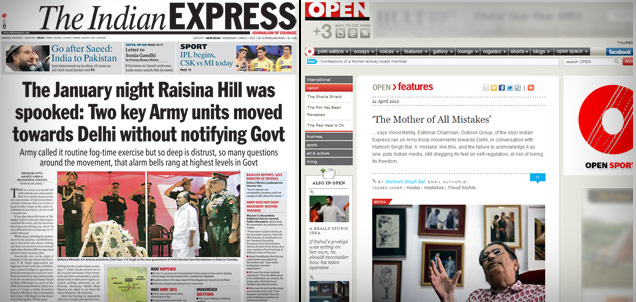
    First some background. On April 4, The Indian Express carried a story by editor-in-chief Shekhar Gupta with Ritu Sarin and Pranab Dhal Samanta on two key army units moving towards New Delhi without informing the government. Ajmer Singh contributed to the report.


    Vital Links
    The Indian Express report (April 4, epaper)
    The Open interview (April 21)
    The ‘notice’ (May 15, note: source unverified and unknown)

    There was outrage and denials issued by all and sundry in the government and armed forces. However, save the outbursts, it wasn’t proven that the Express story was incorrect.


    Meanwhile, ever since the report appeared, The Indian Express – while still respected as a no-nonsense, credible newspaper – was the butt of ridicule by commentators and on social networks. Those in print may have been a lot more gentle, but a few television discussions were indeed scathing.


    And then came this interview with Outlook’s editorial adviser (and former editor-in-chief) Vinod Mehta in newsmag Open on the issue. The headline of the interview said it all: The Mother of All Mistakes (issue dated April 21, 2012). In his inimitable style, Mr Mehta suggested that Mr Gupta was taken in by a story that was planted on the Express.


    While a magazine has a limited readership, since the article was freely available on the internet and it carried a very pointed allegation by one high profile editor on another, the interview viralled in the media fraternity a great deal.


    This legal notice by a lawyer representing The Indian Express and the four writers of the story – Shekhar Gupta, Ritu Sarin, Pranab Dhal Samanta and Ajmer Singh – came less than a month of the publication of the interview.


    One would’ve let the notice be, but its contents make for interesting reading. So while Mr Mehta may be suggesting in the interview (and he also said  amidst some cheer at the Press Club Bombay awards recently) that he quit the Independent owning moral responsibility of an incorrect story, the notice points out that in his memoirs (Lucknow Boy), he projects that he was compelled to do so. “Till now, I am unsure why I had to quit.”


    The notice asks for an apology and pulling the story off Open’s internet edition openthemagazine.com. At the time of filing this report, Open hasn’t done either and two senior staffers told MxMIndia that the magazine does not intend to do either.


    The notice also demands damages of Rs 100 crore each to the lawyer’s clients. That’s five of them – the Indian Express, Shekhar Gupta, Ritu Sarin, Pranab Dhal Samanta and Ajmer Singh. The Rs 500 crore damages have to be paid regardless of the apology.


    MxMIndia asked a few senior editors for their views on the issue. While many of them did not want to be drawn into the controversy, there were a few who told us that they didn’t know enough of the matter to be able to comment.


    Our questions were: Is the media too sensitive to criticism? Just as the Express, Shekhar Gupta & Co sent a legal notice to Open and Vinod Mehta, can governments, politicians, businesspersons and even film-makers who are critiqued by the media also send notices and ask for crores as damages?


    Here are reactions from four veteran commentators:

    Dileep Padgaonkar

    Dileep Padgaonkar, former editor-in-chief, The Times of India:

    Of course it is… the media is sensitive to criticism. The media thinks it is fit to criticise everyone but the minute everyone points a finger at the media, the media bristles. I think media should take criticism directed against it in its stride, this is part and parcel of democracy. And I don’t think one should be too prickly in these matters unless of course there is a clear case of personal attack, defamation… in that case legal course is available but otherwise one should ignore these things and go on.


    As it is, the censorship of cartoons was a dismal warning of the sensitivity of the political establishment. Now if media is going to go at another section of media, there is going to be a free-for-all and the big casualty out here would be good, decent, honest journalism.


    Sevanti Ninan

    Sevanti Ninan, editor, The Hoot, columnist and media-watcher:

    Criticism is not an accurate word for what Vinod Mehta called The Indian Express story. He essentially said it was a planted story and it was a huge mistake to carry it. Considering that the first byline on the story was that of the chief editor, that is quite statement to make. You are saying the chief editor and his colleague are susceptible to plants, thereby seriously questioning their credibility. So I guess the Express could hardly ignore it. IE did come in for a lot of criticism on the import of the story and the display given, including a critical editorial in the Hindu but nothing quite as damning as Mehta’s statements.


    This is the 3rd 100 crore notice involving the media over the past year, in any case. So it is becoming more common.


    Paranjoy Guha Thakurta

    Paranjoy Guha Thakurta, independent journalist and commentator:

    I think The Indian Express has over reacted. I think it’s gone a little over the top. They may disagree with what Vinod Mehta has said… my personal view is that it’s a point of view which obviously the Express doesn’t agree with but I don’t think that what Mr Mehta has said can be construed to be criminally defamatory. And the kind of damages sought are excessive. They are as excessive as the damages that Justice Sawant has sought from Times Now and what Times Now has sought from TheHoot. I mean these are ridiculous sums of money.


    I think we’ve become an extremely intolerant society. I think people talk about freedom of expression being a fundamental right but I don’t think people are really believing in Article 19(1)A of the Constitution of India. Like so many sections of Indian society, including our political leadership which is very upset about these political cartoons that have appeared in textbooks, I think even sections of the media are becoming extremely intolerant of criticism. If you are in a democracy, you have to give the right to everybody to disagree with you.


    Sucheta Dalal

    Sucheta Dalal, senior journalist and commentator, consulting editor, Moneylife:

    Well, not the media, but The Indian Express is too sensitive to critcism… It’s an interesting thing, it’s the first time it is happening and we should see where this goes, whether they follow through by actually filing a case. It’s the first time that somebody in the media is suing another person in the media, we need to look at how it goes… as I said everybody else is sensitive, everybody else does send defamation notices but I don’t know how many of those notices actually get converted into legal action. So we have to wait and watch.


    Otherwise the notice is also a way of making a point, it’s a way of putting pressure. It’s not just Vinod Mehta, if he looks at what was said about that story on the social media, then there are a lot more people that they would probably need to sue. So maybe he is making a case out of Vinod Mehta and Open magazine, we need to see whether they follow through. I would say that the test is not in the legal notice, the test is in seeing whether they are actually going to follow through, stand in court and argue it out.


  • Possible for ethics & profit-making to co-exist: Paranjoy Guha Thakurta (Text & Video)


    By Shruti Pushkarna


    As he launched the second expanded edition of his book, ‘Media Ethics: Truth, Fairness and Objectivity’,  in the capital last week, MxMIndia caught up with veteran independent journalist and educator,  Paranjoy Guha Thakurta for an exclusive interaction. In this candid one-on-one, Mr Guha Thakurta spoke at length about ethics in media today, self-regulation vs. regulation; the debate on the freedom of expression on the internet and the need for media to be ethically and socially responsible.


    Mr Guha Thakurta’s experience spanning nearly 35 years, cuts across different media: print, radio, television and documentary cinema. He is a writer, speaker, anchor, interviewer, teacher and commentator in three languages, English, Bengali and Hindi. His main areas of interest are the working ofIndia’s political economy and the media, on which he has authored/co-authored books and produced documentary films. He lectures on these subjects to general audiences and also trains aspiring and working media professionals.


    Mr Guha Thakurta has served as a member of the Press Council of India nominated by the University Grants Commission between January 2008 and January 2011. In April 2010, as a member of a two-member sub-committee of the Council, he co-authored a 36,000-word report entitled ‘Paid News: How Corruption in the Indian Media Undermines Democracy’.


    Does an expanded edition mean a lot more to discuss in media ethics?

    The first edition of this book came out more than three years ago, since then a lot has happened. Moreover, after the book came out, there were a lot of people who came up with suggestions on how this book could be improved. So this book is about 40 per cent bigger and thicker than the earlier edition. There are new chapters – there is an entirely new chapter on corruption in the media based quite a bit on my experience as a member of the sub-committee of the PCI, which inquired into corruption in media and how it undermines democracy, the entire phenomenon of paid news. There’s also a new chapter on reality television and some of the existing chapters have been drastically rewritten and revamped, notably the chapter on the internet because a lot has been happening in the internet space; also the chapter on advertising, which was particularly weak in the first edition – I think it has been strengthened substantially in the new edition.


    Also a whole lot of major developments have taken place concerning the media in the recent past; these have all been incorporated in the new edition. Among these would be the News of the World and Rupert Murdoch controversy in UK, the entire Wikileaks and Julian Assange phenomenon and back home here in India, the entire Niira Radia conversations; all of these have raised significant questions pertaining to media ethics and these have been incorporated in the new edition of the book.


    How important is the ‘code of ethics’ in today’s commercialized scheme of things?

    Ethics is very important in every sphere, particularly so in the case of media, because you are dealing with information which is akin to a public good. The problem essentially arises because this information is being disseminated by privately owned corporate bodies with an important goal to maximize profit; therein lies the conflicts of interest. The problem arises because there are sections of the media that are interested in profit maximization to the exclusion of other goals.


    It’s become a bit of a cliche – once upon a time it used to be said, ‘journalism is a mission’, today journalists work only for a commission. We are seeing the corporatization and commercialization of the media having an impact on the kind of content that is being produced. The viewers of television channels, the readers of newspapers, and the listeners of radio stations are being perceived more as ‘consumers’ rather as citizens. They are ‘consumers’ of products and services which are being provided by companies which advertise.


    Can journalistic ethics and profit-making can co-exist?

    I do believe it can, it’s not easy but it is possible for ethics and profit-making to co-exist.


    What is your view on the issue of regulation v/s self-regulation? What works for you?

    In an ideal world, self-regulation is the best form of regulation. But what do you do with those who cross that proverbial ‘lakshman rekha’, what do you do with those who don’t follow the code of conduct which is supposed to be self-regulatory in nature. I’ll give you an example, in the US, when Janet Jackson had a wardrobe malfunction in the middle of a live broadcast, the channel was fined immediately by the Federal Communications Commission because the wardrobe malfunction happened during a live broadcast, it happened during primetime and the channel had to first pay the fine and then appeal against the decision in a court of law.


    What happens in India? Not very long ago, there was a series of incidents involving Bhanwari Devi Maderna episode in Rajasthan and content was put out during the day on television, which many considered to be pornographic in nature. When the Ministry of Information and Broadcasting issued show cause notices against these TV channels, all of them came to Shastri Bhawan saying, ‘we apologize and we won’t do it again’. That’s the nature of self regulation in this country.


    As far as print is concerned, we have a Press Council of India which has no powers to punish anybody, it cannot impose a fine, leave alone put a person behind bars, and its recommendations are not even binding on the government. We don’t have statutory organizations which are empowered in the manner in which say the Federal Communications Commission is, or the Office of Communications in the UK is. So it’s fine to talk about self regulation but what do you do when somebody doesn’t listen to you, do you have the wherewithal to punish them?


    Do you think we need an independent official regulatory authority for television news channels as against one set up by the channels?

    Yes, I do personally believe that it is possible and desirable to have an independent regulatory authority which is independent of the government as well as the media. Such a regulatory authority can be funded by the government, but it can nevertheless be autonomous and independent of the government, in the manner in which bodies like the Supreme Court of India, or CAG or Election Commission of India function.


    So, I do believe it is possible to have such a communications commission. The problem is that for the last decade we have been debating the need for such a commission and the joke is that every time the government proposes to form such a commission, the government collapses. There have been 10 or 12 avatars of a Bill to set up such a commission; time alone will tell when and if such a commission is established in India.


    Your view on Dirty Picture not being allowed to air during the day on Sony?

    The whole Dirty Picture episode has thrown up a number of issues pertaining to censorship, pertaining to what content is appropriate or not, and if adult content can be shown on television, if so when. I think these issues are contentious and debatable and they are going to be debated for quite some time to come.


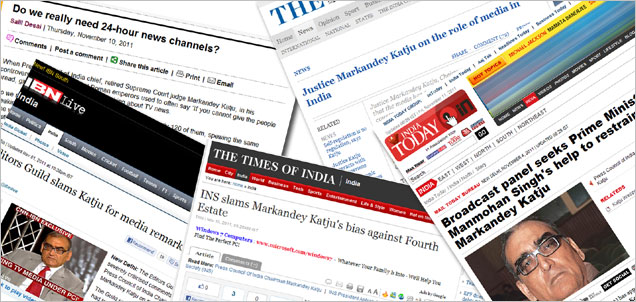
    Would you agree with Justice Katju’s view when he says people in media are of poor intellect?

    I think Justice Katju is exaggerating. There are journalists who are dumb and there are journalists who are not dumb. I think Justice Katju is not being fair to the media fraternity but that’s his personal point of view, he also thinks 90 per cent of Indians are fools, I beg to disagree with him.


    There’s a belief that the Indian media doesn’t take too kindly to criticism. Agree?

    Who among us are willingly going to accept criticism? All of us have our egos, in that sense, I don’t think the media is unique. I think there is neither any individual nor any group who likes criticism but the point is if you do believe in democracy, if you believe in fairness, and if you are in the public eye, then you better get used to criticism otherwise you’ll end up like Ms Mamata Banerjee who could not take being lampooned online. This shows not only lack of tolerance on part of individuals, especially public figures, but I think it fails to appreciate the nature of freedom of expression.


    Isn’t it upsetting that all the journalists’ organizations like Press Club, Editors Guild are tightlipped about Paid News?

    I won’t entirely go along with you on that, I mean there was a conspiracy of silence about corruption in media and paid news, even the report of the subcommittee that was prepared by me and my colleague for the PCI, was sought to be suppressed by a powerful lobby of publishers within the PCI. Finally in October 2011, the PCI was literally forced to make that report official, place it on their website with a disclaimer saying that entire council had not approved of its content. But I won’t say all journalists’ organizations conspired to put under wraps this report. There have been sections of the media who have been reticent of highlighting corruption within the media fraternity, but I don’t think it’s true for the entire media.


    Do you think that Public Relations has adversely impacted the quality of journalism?

    No, why blame the PR person…she or he is doing his or her job. You can also say the government has bribed the media, you can say that corporate captains have bribed the media. So I don’t think we need to look for excuses, I think journalists have to look within if they have to introspect about why there is corruption in the media. You can always hold somebody or the other responsible for your sins but at the end of the day, you are yourself responsible I believe.


    Your views on the ongoing debate on the freedom of expression in the internet age

    I think this is a huge debate. The internet is not just the newest medium of mass communication, it’s also a form of personalized communication, and it’s difficult to control. Issues relating to freedom of expression on the internet have acquired many new dimensions and these are very contentious and not easy to resolve. And we’ve seen this debate been going on for a while…the ‘infamous’ Danish cartoons on the prophet Mohammed were all drawn ostensibly to generate a debate on freedom of expression. Yes, that cartoon was widely circulated on the internet, as was the gruesome video showing Daniel Pearl getting beheaded. But it’s also worth remembering and underlining the fact that the mainstream media were restrained in reprinting, publicizing either the Danish cartoon or Daniel Pearl’s beheading.


    The point is, sometimes in the name of freedom of expression, you want to generate a debate but you end up generating one huge controversy which goes out of control. It was the Danish PM who argued that the cartoon controversy was the biggest crisis that small Scandinavian country faced after the Second World War and he was particularly worried because it even had an impact on the economy of Denmark because countries of West Asia stopped buying dairy products made inDenmark.


    So very often we might want to start a debate without realising its wider ramifications. But the bigger question of what constitutes the right to offend, what is freedom of expression and the new dimensions these issues have acquired in the day and age of internet, these are very important, they are being debated and I think these debates are going to go on for quite some time.


    And given all of this, your view on the future of news media in India?

    The future of news media in India is very bright. Unlike many countries in the world, all media in India continue to expand, whether it’s print, radio, TV or internet. According to 2011 census, one out of four persons in India still cannot read or write her or his name, so as more and more people become literate I think all sections of media are going to expand. At the same time, media has to become more responsible, not just socially responsible but also more ethical if it indeed has to contribute to building democracy, to building a better country.


    If you were still a kid getting out of college, would you get into journalism given the ethical standards followed?

    That’s a difficult question…when I became a journalist 35 years ago, the Emergency had just got over. That was a unique 19 month period in the history of the country where for the first and so far the only time in politically independent India, the government of the day sought to abridge freedom of expression. For 19 months, during the Emergency, freedom of expression was sought to be curbed. I don’t think that will happen again, but the very fact that I was a student during that period did influence my decision to become a journalist. If I was born 35 years later, I don’t know if I would have preferred to become a rock star, or an airline pilot or a heart surgeon instead of a journalist.


  • Paranjoy Guha Thakurta upgrades book on ethics


    By Shruti Pushkarna


    Veteran journalist, Paranjoy Guha Thakurta came out with a second expanded edition of his book, ‘Media Ethics: Truth, Fairness and Objectivity’. The revised edition of the book was launched in the capital on April 27 at the India International Centre.


    The first edition of this book had come out in 2009. When asked, why he decided to bring out a second edition, Mr Thakurta told MxMIndia, “After the book came out three years ago, a lot of people came up with suggestions on how this book could be improved. So this book is about 40 per cent bigger than the earlier edition and there are new chapters…there is an entirely new chapter on corruption in media. There’s also a new chapter on Reality television and some of the existing chapters have been drastically rewritten and revamped.”


    ‘Media Ethics’ discusses key ethical issues in media today, delving into issues like truth, objectivity, sensitivity and privacy. The expanded edition has new chapters on paid news and reality television. It has also has revised chapters on introduction to media ethics, media market, new media and ethics of advertising.


    Attending the event were senior journalists, academicians and students. The launch was followed by a discussion on media ethics by an eminent panel comprising Chief Election Commissioner, SY Quraishi, and senior journalists, Vinod Mehta and Rajdeep Sardesai.


    Media has to inform and educate…

    Addressing the gathering at the book launch, Chief Election Commissioner SY Quraishi said, “The title of this book, truth, fairness and objectivity is an acid test of media’s fairness. This book is a virtual encyclopaedia and Paranjoy is a crusader of media ethics.”


    Mr Quraishi, in his address, also touched upon issues like paid news, opinion polls, hate mails on social media and the whole debate around freedom of expression in the internet age. He said: “Media has a duty to inform and educate the citizens of this country. And, in the context of elections, media has assumed new proportions. There was a revolutionary 30 per cent increase in the voters turn out in UP this year because of the partnership between the CEC and the media.”


    Talking about freedom of expression, he said, “No one wants to encroach on freedom of expression but there are some things which are illegal. Anonymity of the internet media is disturbing and damaging.” Mr Quraishi concluded by saying that media is like the eyes and ears of the society and we should do everything possible to check malpractices in media.


    Editors are like ordinary people…

    Mr Vinod Mehta, Advisor, Outlook magazine started his address by saying that the custodian of any media organization is its Editor. If the Editor is corrupt, the organization is corrupt. He said: “The biggest myth about media is that editors are like gods, that they are independent, that they make no mistakes and they are on a social mission to tell the truth. While this might largely be true, it is highly exaggerated. Editors are like ordinary people, often most opinionated, and they have a view on everything. So they come with their own baggage. So what you get in media is various shades of opinions where the editor’s point of view is reflected. After this polarization of views, in the end you get something approximating the truth.”


    Mr Mehta added that one of the greatest assets of media, which is public trust, is declining and the uproar that used to be about the fourth estate has gone down significantly in the last few years.


    According to Mr Mehta, two reasons for the rise of unethical practices in media are: the reluctance on the part of media persons to admit their mistakes and secondly, intense competition, which has created its own problems. He also said that Editors often assume a larger than life role, thinking that they are setting the national agenda. He said: “We journalists are not players, we have the best ring side seats but we are not players, we can’t get involved in the game.”


    On self-regulation, Mr Mehta said: “We in the media are always telling the other guy what’s wrong, we never correct ourselves. Self-regulation is always for the other guy. So I believe we need a strict code of conduct.” Mr Mehta also suggested that all Editors like politicians should declare their assets on the Editors’ Guild website.


    Problem lies in the business model…

    Mr Rajdeep Sardesai, Editor-in-Chief, IBN18 Network confessed: “Media is more powerful than ever before, but it is also less respected than ever before. In this age of quantification we are facing a credibility crisis.” But he added that the viewer has almost a ‘schizophrenic’ attitude towards the media, so the messenger (media) who is expected to play ‘god’ is repeatedly shot at. Mr Sardesai indicated two main threats to the main stream media, internal and external. Talking of the external threat he said: “The business model is the main problem. The declining ethical standards are because of how the business model is, where 95 per cent dependency for revenues is on advertisements. The channels have to pay what is called a carriage fee, which is actually illegal and completely unethical.”


    Mr Sardesai offered ‘disclosure’ as a solution to paid news. He said: “If it is paid news, then it needs to be said that it is paid news. Disclosure is the only way out, tell the world it is paid news. If an advertiser or a political party is sponsoring a certain programme, then you need to mention outright that the show is sponsored by xyz. But the problem is, in this era of maddening competition and declining revenue, who will set the rules of disclosure?”


    Speaking of the internal threat, Mr Sardesai said that this is one area where you can’t blame the proprietor. He said: “Who asked us (journalists) to replace sense with sensationalism, to replace news with noise? The moral compass that makes journalism different from any other profession has gone.” Mr Sardesai cited the example of theNorwayissue where a domestic problem within a span of no time took the shape of a diplomatic battle.


    He also added that what has changed about media today is the fact that the public is turning against media, the public is willing to teach media a lesson. For ethical cleansing to happen, Mr Sardesai concluded, “We have to name and shame the transgressors and the naming and shaming has to happen by someone within the system.”


  • Headlines Today scores on 2G

    By Ranjona Banerji


    The fault is mine: I got to the television two hours late on Thursday – after the Supreme Court ruling on the 2G licences. The punishment was purgatory: I knew something had happened but I had no idea what. Every TV news channel showed a press conference addressed by the BJP’s Arun Jaitley reacting to the court ruling but no one told us what the ruling was. I travelled up and down the channels that my cablewallah allows me and learnt nothing. Jaitley could have been ranting or talking sense but since I had no context I could not fully appreciate or understand him.


    After 10 minutes of fruitless frustration I did the sensible thing: got online and read the latest updates by print journalists. Till Thursday evening, the whole thing was only about “reaction” on television, sometimes from small-time party functionaries and sometimes by bigwigs like Kapil Sibal who had to counter Jaitley with his own spin. One poor reporter even ran after the judge AK Ganguly as he retired and asked him how he felt. The honourable judge ran away as fast as he could. All through the day they broadcast a reaction from some telecom honcho but never told us who he was.


    It says something about the way television journalists operate that they cannot explain events or interpret them for viewers themselves. Something as important as this 2G ruling requires reporters and anchors to get all the facts themselves and tell the viewers exactly what has happened before playing the “reaction” game. Also, instead of telecasting every single press conference live in its entirety, they could edit or cut back to studio to explain what was happening mid-way.


    Business channels were, sadly, no better since they are all obsessed with the stock market and cannot consider implications beyond that. But one would imagine that the cancelling of 122 licences would have huge impact on their constituencies. I guess one imagines wrong.


    The most sensible TV debate on the subject was a surprise – it was not at prime time and it was on Headlines Today. Thanks largely to Paranjoy Guha Thakurta as well as to Sandeep Bamzai, we got a clear idea of the economic and political implications of the judgment.


    The rest of debates seem to have the usual suspects who talk about everything – Chandan Mitra, Ravi Shankar Prasad, Mahesh Jethamalani, Nirmala Seetharaman, Renuka Chowdhury and perhaps Suhel Seth was there somewhere but I didn’t catch him.


    Niira Radia and Ratan Tata were not there.


    * * *


    This round once again goes to newspapers who explained the matter in every detail from the political implications for the UPA government to the business implications for the telcos to the fortunes of A Raja and P Chidambaram and so on. However, while every newspaper and TV channel said it was 122 licences, The Times of India decided on 121. No idea why.


    Most newspaper editorials did raise the question of the unfairness meted out to telcos which were being punished for following government laws. This is a tricky one. It would be interesting to see whether there’s more discussion about the dangers of corporate lobbying and the role played by journalists in getting A Raja the ministry of his choice.


    I’m not holding my breath, actually.


  • More bite for toothless PCI?


    By Akash Raha

    Recently Chairperson of Press Council of India (PCI), Justice Markandey Katju triggered a volley of criticism and discussion after he lambasted the broadcast media, saying most of them suffer from “very poor intellectual level”. He went on to suggest that broadcast media should come under the purview of the PCI. MxM India asked some well-known media faces what they think.

    Arnab Goswami, Editor in Chief, Times Now and Vice President, Broadcast Editors’ Association (BEA) told MxMIndia: “I don’t know why Justice Katju is making these comments. There is absolutely no need to try and demolish the principle of self-regulation in TV news which ensures that electronic media is free and out of control of vested interests. Justice Katju should not make these sweeping generalizations.”

    Upset over Justice Katju’s comments on the media, former Chief Justice of India J S Verma too is reported to have recently called the PCI an “ineffective” body and said it should wrap up if it does not meet its mandate. Verma chairs the News Broadcasting Standard Authority (NBSA), which is set up by the News Broadcasters Association (NBA). In a recent statement Verma said that he is “deeply anguished” with the kind of language that Justice Katju uses which “sounds authoritarian”. NBA has requested the Prime Minister to stop the PCI from meddling with the dealings of broadcast media.

    On whether broadcast media should come under the ambit of the PCI, Rajdeep Sardesai, Editor in Chief, IBN18 Network said “I believe that the self-regulation mechanism which has been put in place by major news broadcasters must be allowed to strengthen itself. The Press Council has been unable to curb pernicious practices in the print media such as ‘paid news’, so I don’t see how mandating it to now to oversee the electronic media will serve any purpose.”

    Talking about whether he thinks electronic media should be brought under the purview of  PCI Paranjoy Guha Thakurta, an independent journalist and critic, said, “The electronic media needs to be regulated independently – this is because self-regulation is inadequate and ineffective under certain extreme circumstances. The regulator should be independent of both media interests – including the interests of the big corporate media – as well as the government. Even if the regulator is funded by the government, it can be truly autonomous and/or independent if it is Constitutionally mandated thus – such examples include the Supreme Court of India, the Election Commission of India and the Comptroller & Auditor General of India. Ideally the electronic media should have a separate regulator. Even if the ambit of the Press Council of India is widened to include the electronic medium, it has to be made truly independent and autonomous and, most importantly, empowered. The Press Council in its current form has no punitive powers and is hence akin to a toothless tiger.”

    To put things in perspective, PCI was established as a statutory print watchdog by an Act of Parliament in 1978. In recent times, PCI has come under question following chairperson Justice Markandey Katju’s recent remarks on the state of the media in India and its inability to keep a check on paid news.

    When asked if Justice Katju was trying to police the media, Mr Guha Thakurta played down the suggestion, saying, “The Press Council of India is a quasi-judicial body set up an act of Parliament. The way it is supposed to function has been clearly laid down. There is no question of Justice Katju (or for that matter, any Chairman of the Press Council) acting as either a good cop or a bad cop.”

    The question remains, should news broadcast come under the ambit of PCI? One of the reasons for opposing such a suggestion remains that since PCI has been unable to check the menace of paid news in print, there is no reason why it should make any positive change in the broadcast industry. Another argument says that the only reason why PCI has been unable to make a change is because it is still a toothless quasi-judiciary body and the government needs to empower it and give it some tooth. Either way, in this chatter and amidst much confusion is set Justice Katju and his criticism of media professionals as he sees them as naïve and stupid. Criticism which has obviously riled the veterans of the broadcast industry.

    In the wake of this controversy, several discussion forums are being organized on the PCI, the question of paid news, etc. The Foundation for Media Professionals (FMP) is organizing a panel discussion in collaboration with the Press Club of India on the topic ‘Media and Public Interest: Freedom vs Accountability’ on November 12 at Press Club of India, New Delhi. The panelists at this discussion will be Markandey Katju, Rajdeep Sardesai, Neelabh Mishra, Zoya Hasan, Pankaj Pachauri, Abheek Barman, Madabhushi Sridhar and Paranjoy Guha Thakurta with T R Ramachandran as moderator.

    Later, on November 18, MxMIndia has partnered the event ‘Paid News: Fooling People all the Time’ organised by Moneylife Foundation and Citizens Action Network with the support of industrialist Cyrus Guzder to be held in Mumbai’s Madame Cama Hall. The evening will see the screening of the documentary ‘Brokering News’ followed by a panel discussion with senior journalists and the film-maker Umesh Aggarwal. The panelists at this discussion are Umesh Aggarwal, Ayaz Memon, Paranjoy Guha Thakurta, Bhawana Somaaya, and Sucheta Dalal. This panel plans to discuss the issue of paid news, which has been a bugbear even for regulatory bodies such as the PCI.

    For more: http://www.mxmindia.com/2011/11/mxmindia-partners-%E2%80%98paid-news%E2%80%99-event/