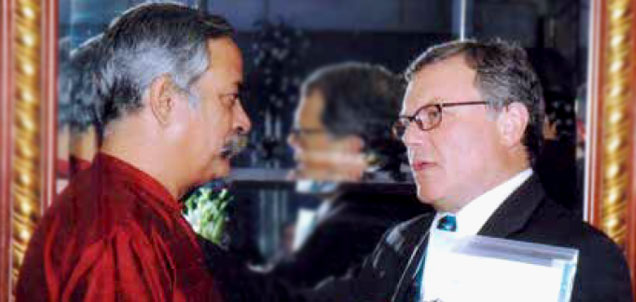
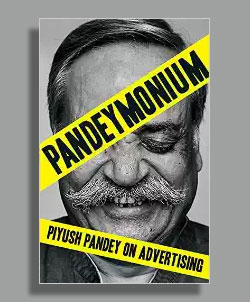
On Wednesday, Piyush Pandey’s memoirs ‘Pandeymonium’ was released in Mumbai with much fanfare with Amitabh Bachchan releasing the book and several dignitaries, family and friends in the audience. It was tough pulling out an extract from the book, but here’s one that we though we thought would interest MxMIndia readers…
By Piyush Pandey
 People would like to believe that Martin is a control freak—nothing could be further from the truth. Martin’s name is misused by his managers in the operating companies so as to help them achieve their own ends. Martin would not even be aware of many of the things that his managers claim that he has an opinion on. His interest is in communication, in the health of his companies, in the finances, in corporate-governance issues, in the stock price and in WPP’s shareholders. Martin does not interfere in the running of the companies and has little interest in decisions that ought to be taken by his local managers-which is perhaps why WPP does so well globally. The fact that India is so important to WPP now, and yet the Indian operations are run totally by Indian managers underlines his belief that global businesses are best run by managers who know the lay of the land.
If cigarettes helped me spend more time with David* than was warranted by my designation, it was cricket that helped build my relationship with Martin. Martin is a huge cricket fan, following the game from wherever he may be in the world. In London, he watches matches at Lord’s whenever he gets the opportunity. He plays as well, taking part in charity matches for causes that he believes in.
|
Review in 164 words. Unputdownable
By Pradyuman Maheshwari
Why a hundred and sixty four words? Piyush Pandey’s Pandeymonium can be reviewed in just one. Unputdownable.
It’s a breezy read. The way Piyush speaks. And the way his ‘curator’ Anant Rangaswami writes. You can read it in one post-dinner sitting.
The first part of the book is great fun. Depending on how much other people’s experiences move you, you can possibly have tears rolling a few times. I cried a bit.
The second part of the book gets him into talking specifics about Ogilvy. To those not into advertising and Oglivy, in particular, this could be a stretch, but Piyush ensures that he doesn’t get too much into details.
I was hoping to read some juicy comments and comments on people and issues, one has heard Piyush feels very strongly about. But there’s none of that.
Pandeymonium is a must-read for all those whose lives have been touched by Piyush or his advertising. It’s a mustest-read for those wanting to get into advertising.
|
Planning for one of his earlier trips to India, he mentioned to Ranjan Kapur that he wanted to play a cricket match in India. He asked him to get me to sort it out (he was aware that I had played first-class cricket). He wanted the teams to be formed from employees of the three larger agencies WPP had in India those days: Hindustan Thompson Associates (HTA); Contract (which was considered a separate company, though it was 100 per cent owned by HTA); and O&M. Martin also wanted a couple of former India cricketers to play so as to add some flavour to the match.
I did the maths and decided that each of the three agencies would contribute six players, making it eighteen players. Martin would make it nineteen. That would leave us three players short. I requested Bapu Nadkarni, Eknath Solkar and Ashok Mankad to play, and they all agreed.
We now had twenty-two players, and the next challenge was the composition of the two teams. I had some thoughts on that. I wrote to the managers of HTA and Contract asking each of them to send me the names of their six players—and their heights. They wrote back and asked me why I wanted to know about their heights. I told them that it was for the cricket whites that we needed to play in.
Martin was to captain one team, while I would captain the other. I divided the remaining twenty players into two teams.
Martin came to the ground and discovered that his team was called Short Legs XI and that mine was Long Legs XI. I had created the teams based on the heights of the players. Martin came up to me and said, ‘You cheeky bastard.’
For me, Martin is a human being and no more.
That match set the tone for my relationship with Martin. It allowed us to be relaxed, frank, trusting and honest with each other—and that makes for a profitable working relationship.
During another of Martin’s visit, I planned something else. When you entered the office, from far you could see a poster outside my room with ‘WPP’ written on it. WPP did not have an office at Ogilvy. So when Martin came, he saw the signage and walked to my room. From close, you could see the small letters between WPP. It said, ‘Worldwide Office of Piyush Pandey’. ‘Cheeky bastard’ is what he said to me again, as he laughed.
‘Cheeky bastard’ is a phrase that Martin loves to use, and I’ve been described as one by Martin on more than two occasions. In 2000, I was flying to judge the Cleo Awards at Aspen, Colorado. The perks of being a juror meant that I flew first class on British Airways. First class was a rarity as WPP’s policy did not allow it. I was in the first-class lounge in London, waiting for my connecting flight to the US, when I bumped into Martin. I walked up to him and said, ‘Hi, Martin, Cleo is paying for this trip. Just in case you call up Rane (my colleague and then Finance Head of Ogilvy in India) and ask him who is paying for this.’ ‘You cheeky bastard, did I ask you?’ He said. ‘No, you didn’t, but you would have called up Rane; I just saved you a couple of pounds on the phone call,’ I replied.
When we meet now, conversations are relaxed and direct. Martin discusses larger issues with me, such as the company’s reputation and corporate governance, two areas where he spends considerable time and energy. We hardly ever talk about work or revenues. Indeed, sometimes we have to contrive devices which get him to look at recent work that has been done; I do not think that he has ever asked for a formal review.
I’ve learnt so much from Martin-perhaps because I saw him as a human being and no more. Approach Martin with fear or trepidation or guile, as many do, and what you have achieved is to ensure that Martin doesn’t relax. That’s your loss.
* reference made to David Ogilvy whom he refers to earlier in the chapter
Pandeymonium
Piyush Pandey on Advertising
By Piyush Pandey
Penguin Books India (Portfolio)
Hardback, Pages 244
Rs 799
(Rs 556 on Flipkart)
​Excerpted with permission from the publisher​