Tag: paid news

  • Mediaah! ‘Paid News’ needs detailing in PRB Act amendments

    By Pradyuman Maheshwari


    The I&B ministry has invited suggestions to the amendments it has proposed to the Press and  Registration of Books Act (PRB Act), 1867. While many of these are welcome, among the changes that the MIB has made, there are two significant ones that still need some detailing.  Here are the changes I think should be added and I have taken the liberty of adding one more element that will cleanse the system:


    1. The definition of a newspaper: While it’s good that the online editions of newspapers are now under the purview of the PRB Act, what about standalone online news entities? What about online entities that curate news from various online sources including newspapers? The PRB Act must also clearly include non-news entities like magazines and their websites. These magazines could be of the non-political variety (say: realty or business or films or even media)


    2. Paid news:  The government is concerned about paid political news, but it should actually be having all forms of it under its scanner. Brands, parties, marriages, community/club news… whatever. Any news (text, pictures, video) that is published for reasons beyond an editorial discretion and because it’s paid for. Fine print placed next to the masthead of a supplement or tucked into the corner of a supplement’s front-page are not enough to label a part of the newspaper as a legitimate paid news offering. Since the paid news component is a part of the main paper and the average reader believes that content in the paid news section is selected in the same way as it gets done for the main paper, the undertaking/declaration must be prominently displayed on the Front Page of the main paper in a point size larger than what is used for the rest of the body matter on the page, in bold and boxed. All articles/reports/photographs/graphics must individually be clearly tagged ‘This report/pic/graphic/whatever is paid for by the advertiser’


    3. Group news: One of the big problems that many media firms face is when their news gets blanked out by the big papers because their group has a similar entity. For instance, Newspaper X and Y don’t carry the news of Radio Station Z because X and Y also own radio stations. And ditto with events etc.  Will Times of India carry news of the Star Screen or IIFA awards when it has its own Filmfare and TOIFA? It was heartening to see TOI, HT and DNA carry the news of the India Today group conclave on Sachin and mention the India Today name in it, but these instances are few and far between. Failure to give fair coverage to news  just because it belongs to competition should be referred to whosoever is policing complaints on fall-out of cross-ownership.


    There are some more changes in the PRB Act that the ministry is mulling – like a declaration on advertisements received as well as on the registration of an entity’s title. The last of these has relevance given the dispute between The Times of India and Financial Times over the Financial Times title.


    The revised bill has been uploaded in the website of Ministry of Information & Broadcasting (home page – What’s new) on November 8, 2013. Suggestions have been invited by the ministry which may be sent to the Under Secretary (MUC), Room No.749, Ministry of Information and Broadcasting, ‘A’ Wing, Shastri Bhavan, New Delhi 110 001, Fax No 011-2338 7240, Email : mediaunitcell@yahoo.in  by November 19. In case no suggestions are received within the stipulated time, it will be presumed that the stakeholders are in agreement with the amendments of the bill.


    Mediaah!’s view is that the government should not get into the business and conduct of news entities. However, in the absence of a self-regulator and given that the Press Council of India is toothless and often regressive, the government needs to step in to cleanse some of the ills in the system. The government can of course police the media since it grants various favours like cheaper land, DAVP ads and a variety of other concessions.


  • MxM Monday: Paid news – yes or no?


    By Ananya Saha


    Mediaah! Are disclaimers enough to pass off paid content?

    Readers expect the content in the newspaper to be published based on the decision of the editor, and not an advertiser paying for it, writes Pradyuman Maheshwari. Read more…


    Paid content such as Medianet has gained much ground. Despite flak from different quarters, it appears that buyers are still willing to pay for space that resembled news and features. And readers may never know the difference. More media houses have begun indulging in paid content, but surely that does not make it right?


    We ask industry folks to weigh in with their views.


    Arun Anant, CEO, The Hindu Group of Publications

    People may not know that some newspapers carry paid-for articles, and some people do not care either. That does not make it right. If an article is paid for by an advertiser, it should be made clear that there is an interested party that has paid for it.


    Ranjona Banerji in ‘Freaking News’
     

    :: Medianet mars an otherwise trendsetting paper

    :: Not too late for TOI to correct practices


    Santosh Desai, MD, Future Brands

    Globally, it has become a phenomenon where sponsors pay for news. There needs to exist a clear difference between journalism and an act of promotion. If not kept separate, the line of demarcation will blur between the two. However, what is more dangerous is that when news is influenced by a transaction. Many do not care about Page 3, so if you have paid for it, it does not matter. The issue arises about hard news, when you do not know who has paid for it. MediaNet in itself not a wrong thing as long as you are announcing it who is paying for it. For instance, if you are reporting about a policy being announced and you do know which political party or a corporate house has paid for it. What is a much bigger issue is the corporate ownership of the media houses. There has to be a divide between news and advertisement: and how do you tell it? How do you divide ownership and journalism: and do you – that is more serious threat than MediaNet, in my opinion. The bigger point is about trusting the ‘news’.


    Bharat Kapadia, Chairman, Whatuwant Solutions, and Founder at ideas@bharatkapadia.com

    Using Medianet is completely unethical – whether readers do not seem to notice it or whether they do not care. There are two parts to it: the publisher and the readers. The publisher has been doing it for a much longer time than visible, especially at the time of elections. The readers, unless told, would not know which news is being paid and which is not. When, it all began, Bombay Times used to mention with a small symbol that it is paid news. Now even that is gone. People buy or consume news media trusting for a fair perspective. Now, if this perspective can be influenced, it is definitely not fair.


    Anamika Mehta, COO, Lodestar UM

    My personal point of view is, for a newspaper or any other medium, there are different and more questions about paid content. It happens globally in various forms but of course, it is not a good practice. A lot of brands and advertisers have jumped on this wagon, yes, but as a responsible media one should know where to draw the line. If one considers Page 3, where you can pay to get featured, it is all for entertainment. So one does not seem to mind. The moment it starts entering news or motivate political, business or economic sentiment, then it is a problem.


    One can see that business pages also carry small snippets or news that might sway the reader into investing in a particular stock, or to create impact. Some of the brands do MediaNet for promotion. However, a line needs to be drawn. The reader should not be misled, and motivated information should be kept under check.


  • [MJR] Holier than thou Hindu takes on the Times


    Ranjona Banerji

    By Ranjona Banerji


    The Hindu has published a massive “expose” on paid news in The Times of India. According to painstaking research done by veteran journalist P Sainath, the Nagpur edition in 2008 carried a special feature about how farmers in Vidarbha had benefited from using Bt cotton seeds. This went against all other evidence that it was the use of Bt cotton which had led to falling yield, depleting the land, increasing debt burden and consequently the large number of suicides in the region.


    The TOI team spoke to farmers who said they were making much more money than they thought and were very happy. The villagers spoken to said no one had committed suicide. The trip was sponsored by the manufacturers of the Bt cotton seed – Mahyco Monsanto Biotech. The newspaper added this as a disclaimer, maintaining however that the journalists had done their own research.


    According to Sainath, in 2011, the same feature was dredged up and re-printed, this time as an advertising feature – paid for by Mahyco Monsanto Biotech – and published in all editions of The Times of India except the Nagpur edition.


    Yet, the same villagers, when they spoke to a Parliamentary Standing Committee in March this year, Sainath points out, said that 14 people had committed suicide since Bt cotton had been introduced and that their financial plight was pitiable. The enormous amounts of money being made – as claimed in the TOI report – were untenable and were also contradicted by figures provided by Union agriculture minister Sharad Pawar.

    So what do we have here? A cynical manipulation of events to help a giant corporation out of a PR disaster? Or exploitation of journalists to further the commercial interests of the newspaper? Or complete contempt for the reader and disregard for the newspaper’s credibility?


    I would say the worst sin is number 3. The first two lead to the third. The fact that Bt cotton has aggravated rather than alleviated farmers’ problems ought to be a fact universally acknowledged. It is also well-known that Monsanto has an extremely aggressive public relations department. Further, the government has also pushed farmers to opt for Bt cotton and thereby helped Mahyco Monsanto Biotech.


    However, it has to be pointed out that The Times of India is not the only practitioner of paid news. This menace is prevalent through the media, both print and television. The ways in which it is done can be subtle or brazen – here TOI seems to have opted for the latter. It is also not clear if this deal with Monsanto was limited to the Nagpur marketing department which then shared it with headquarters or whether the entire editorial team was aware of what was going on.


    Either way, though, both the initial report and the use of that report as an ad are highly questionable. Cynicism on the part of journalists will only make life worse for them more than anyone else.


    There is one more question here as well. Holding the media up for scrutiny is necessary and important. But The Hindu’s tendency to take this holier than thou line is bound to boomerang at some time. It now has to keep its house cleaner than everyone else’s.


    The link to Sainath’s column in The Hindu: http://www.thehindu.com/opinion/columns/sainath/article3401466.ece?homepage=true#.T6tjbKDv3XQ.email


  • Possible for ethics & profit-making to co-exist: Paranjoy Guha Thakurta (Text & Video)


    By Shruti Pushkarna


    As he launched the second expanded edition of his book, ‘Media Ethics: Truth, Fairness and Objectivity’,  in the capital last week, MxMIndia caught up with veteran independent journalist and educator,  Paranjoy Guha Thakurta for an exclusive interaction. In this candid one-on-one, Mr Guha Thakurta spoke at length about ethics in media today, self-regulation vs. regulation; the debate on the freedom of expression on the internet and the need for media to be ethically and socially responsible.


    Mr Guha Thakurta’s experience spanning nearly 35 years, cuts across different media: print, radio, television and documentary cinema. He is a writer, speaker, anchor, interviewer, teacher and commentator in three languages, English, Bengali and Hindi. His main areas of interest are the working ofIndia’s political economy and the media, on which he has authored/co-authored books and produced documentary films. He lectures on these subjects to general audiences and also trains aspiring and working media professionals.


    Mr Guha Thakurta has served as a member of the Press Council of India nominated by the University Grants Commission between January 2008 and January 2011. In April 2010, as a member of a two-member sub-committee of the Council, he co-authored a 36,000-word report entitled ‘Paid News: How Corruption in the Indian Media Undermines Democracy’.


    Does an expanded edition mean a lot more to discuss in media ethics?

    The first edition of this book came out more than three years ago, since then a lot has happened. Moreover, after the book came out, there were a lot of people who came up with suggestions on how this book could be improved. So this book is about 40 per cent bigger and thicker than the earlier edition. There are new chapters – there is an entirely new chapter on corruption in the media based quite a bit on my experience as a member of the sub-committee of the PCI, which inquired into corruption in media and how it undermines democracy, the entire phenomenon of paid news. There’s also a new chapter on reality television and some of the existing chapters have been drastically rewritten and revamped, notably the chapter on the internet because a lot has been happening in the internet space; also the chapter on advertising, which was particularly weak in the first edition – I think it has been strengthened substantially in the new edition.


    Also a whole lot of major developments have taken place concerning the media in the recent past; these have all been incorporated in the new edition. Among these would be the News of the World and Rupert Murdoch controversy in UK, the entire Wikileaks and Julian Assange phenomenon and back home here in India, the entire Niira Radia conversations; all of these have raised significant questions pertaining to media ethics and these have been incorporated in the new edition of the book.


    How important is the ‘code of ethics’ in today’s commercialized scheme of things?

    Ethics is very important in every sphere, particularly so in the case of media, because you are dealing with information which is akin to a public good. The problem essentially arises because this information is being disseminated by privately owned corporate bodies with an important goal to maximize profit; therein lies the conflicts of interest. The problem arises because there are sections of the media that are interested in profit maximization to the exclusion of other goals.


    It’s become a bit of a cliche – once upon a time it used to be said, ‘journalism is a mission’, today journalists work only for a commission. We are seeing the corporatization and commercialization of the media having an impact on the kind of content that is being produced. The viewers of television channels, the readers of newspapers, and the listeners of radio stations are being perceived more as ‘consumers’ rather as citizens. They are ‘consumers’ of products and services which are being provided by companies which advertise.


    Can journalistic ethics and profit-making can co-exist?

    I do believe it can, it’s not easy but it is possible for ethics and profit-making to co-exist.


    What is your view on the issue of regulation v/s self-regulation? What works for you?

    In an ideal world, self-regulation is the best form of regulation. But what do you do with those who cross that proverbial ‘lakshman rekha’, what do you do with those who don’t follow the code of conduct which is supposed to be self-regulatory in nature. I’ll give you an example, in the US, when Janet Jackson had a wardrobe malfunction in the middle of a live broadcast, the channel was fined immediately by the Federal Communications Commission because the wardrobe malfunction happened during a live broadcast, it happened during primetime and the channel had to first pay the fine and then appeal against the decision in a court of law.


    What happens in India? Not very long ago, there was a series of incidents involving Bhanwari Devi Maderna episode in Rajasthan and content was put out during the day on television, which many considered to be pornographic in nature. When the Ministry of Information and Broadcasting issued show cause notices against these TV channels, all of them came to Shastri Bhawan saying, ‘we apologize and we won’t do it again’. That’s the nature of self regulation in this country.


    As far as print is concerned, we have a Press Council of India which has no powers to punish anybody, it cannot impose a fine, leave alone put a person behind bars, and its recommendations are not even binding on the government. We don’t have statutory organizations which are empowered in the manner in which say the Federal Communications Commission is, or the Office of Communications in the UK is. So it’s fine to talk about self regulation but what do you do when somebody doesn’t listen to you, do you have the wherewithal to punish them?


    Do you think we need an independent official regulatory authority for television news channels as against one set up by the channels?

    Yes, I do personally believe that it is possible and desirable to have an independent regulatory authority which is independent of the government as well as the media. Such a regulatory authority can be funded by the government, but it can nevertheless be autonomous and independent of the government, in the manner in which bodies like the Supreme Court of India, or CAG or Election Commission of India function.


    So, I do believe it is possible to have such a communications commission. The problem is that for the last decade we have been debating the need for such a commission and the joke is that every time the government proposes to form such a commission, the government collapses. There have been 10 or 12 avatars of a Bill to set up such a commission; time alone will tell when and if such a commission is established in India.


    Your view on Dirty Picture not being allowed to air during the day on Sony?

    The whole Dirty Picture episode has thrown up a number of issues pertaining to censorship, pertaining to what content is appropriate or not, and if adult content can be shown on television, if so when. I think these issues are contentious and debatable and they are going to be debated for quite some time to come.


    Would you agree with Justice Katju’s view when he says people in media are of poor intellect?

    I think Justice Katju is exaggerating. There are journalists who are dumb and there are journalists who are not dumb. I think Justice Katju is not being fair to the media fraternity but that’s his personal point of view, he also thinks 90 per cent of Indians are fools, I beg to disagree with him.


    There’s a belief that the Indian media doesn’t take too kindly to criticism. Agree?

    Who among us are willingly going to accept criticism? All of us have our egos, in that sense, I don’t think the media is unique. I think there is neither any individual nor any group who likes criticism but the point is if you do believe in democracy, if you believe in fairness, and if you are in the public eye, then you better get used to criticism otherwise you’ll end up like Ms Mamata Banerjee who could not take being lampooned online. This shows not only lack of tolerance on part of individuals, especially public figures, but I think it fails to appreciate the nature of freedom of expression.


    Isn’t it upsetting that all the journalists’ organizations like Press Club, Editors Guild are tightlipped about Paid News?

    I won’t entirely go along with you on that, I mean there was a conspiracy of silence about corruption in media and paid news, even the report of the subcommittee that was prepared by me and my colleague for the PCI, was sought to be suppressed by a powerful lobby of publishers within the PCI. Finally in October 2011, the PCI was literally forced to make that report official, place it on their website with a disclaimer saying that entire council had not approved of its content. But I won’t say all journalists’ organizations conspired to put under wraps this report. There have been sections of the media who have been reticent of highlighting corruption within the media fraternity, but I don’t think it’s true for the entire media.


    Do you think that Public Relations has adversely impacted the quality of journalism?

    No, why blame the PR person…she or he is doing his or her job. You can also say the government has bribed the media, you can say that corporate captains have bribed the media. So I don’t think we need to look for excuses, I think journalists have to look within if they have to introspect about why there is corruption in the media. You can always hold somebody or the other responsible for your sins but at the end of the day, you are yourself responsible I believe.


    Your views on the ongoing debate on the freedom of expression in the internet age

    I think this is a huge debate. The internet is not just the newest medium of mass communication, it’s also a form of personalized communication, and it’s difficult to control. Issues relating to freedom of expression on the internet have acquired many new dimensions and these are very contentious and not easy to resolve. And we’ve seen this debate been going on for a while…the ‘infamous’ Danish cartoons on the prophet Mohammed were all drawn ostensibly to generate a debate on freedom of expression. Yes, that cartoon was widely circulated on the internet, as was the gruesome video showing Daniel Pearl getting beheaded. But it’s also worth remembering and underlining the fact that the mainstream media were restrained in reprinting, publicizing either the Danish cartoon or Daniel Pearl’s beheading.


    The point is, sometimes in the name of freedom of expression, you want to generate a debate but you end up generating one huge controversy which goes out of control. It was the Danish PM who argued that the cartoon controversy was the biggest crisis that small Scandinavian country faced after the Second World War and he was particularly worried because it even had an impact on the economy of Denmark because countries of West Asia stopped buying dairy products made inDenmark.


    So very often we might want to start a debate without realising its wider ramifications. But the bigger question of what constitutes the right to offend, what is freedom of expression and the new dimensions these issues have acquired in the day and age of internet, these are very important, they are being debated and I think these debates are going to go on for quite some time.


    And given all of this, your view on the future of news media in India?

    The future of news media in India is very bright. Unlike many countries in the world, all media in India continue to expand, whether it’s print, radio, TV or internet. According to 2011 census, one out of four persons in India still cannot read or write her or his name, so as more and more people become literate I think all sections of media are going to expand. At the same time, media has to become more responsible, not just socially responsible but also more ethical if it indeed has to contribute to building democracy, to building a better country.


    If you were still a kid getting out of college, would you get into journalism given the ethical standards followed?

    That’s a difficult question…when I became a journalist 35 years ago, the Emergency had just got over. That was a unique 19 month period in the history of the country where for the first and so far the only time in politically independent India, the government of the day sought to abridge freedom of expression. For 19 months, during the Emergency, freedom of expression was sought to be curbed. I don’t think that will happen again, but the very fact that I was a student during that period did influence my decision to become a journalist. If I was born 35 years later, I don’t know if I would have preferred to become a rock star, or an airline pilot or a heart surgeon instead of a journalist.
     

  • @FF12: Day 3: Industry expects thoughts to lead to pertinent actions

    By A Correspondent


    The last day of FICCI Frames 2012 was an eventful day — insightful sessions, a lot of networking, sharing of ideas, deals being cracked — and amongst all of this, the highlight was the session on Women in Media and Entertainment.


    The day started off with a keynote presentation by Ashok Chawla, Chairman, Competition Commission of India (CCI). He said that the media and entertainment (M&E) industry was one of the fastest growing sectors inIndiawith an expected CAGR of 14-15 per cent. He then proceeded to outline the role of the CCI and its importance: “CCI is an overall market regulator whose objective is to ensure that market forces operate with transparency and fair play. It has been put in place to identify the boundaries of behaviour of the industry.


    Mr Chawla opined that self-regulation was of prime importance to avoid infringement of law or market practices and cautioned industry players that consumers should be given primary importance.


    Taking on the Digital threat

    The next session was on “Sustaining Long-term Newspaper Loyalty” by two biggies — N Ram, former Editor-in-Chief, The Hindu and Girish Agarwal, Director, Dainik Bhaskar Group, who shared their views on the future prospects of the newspaper industry.


    Mr N Ram started off his speech by stating that there was ‘anxiety and gloom’ over the fact that journalism was seeing a meltdown in the mature markets. He outlined two media world phenomenon next, where the less developed countries are witnessing increase in circulation of newspapers unlike the mature market. But he added a word of caution when he said that TV, even in the developing world, is going through a crisis which it has so far covered by showing entertainment as part of news. Inspite of this, Mr Ram was optimistic that the medium term prospects for the media industry are looking good.


    As is been spoken widely about, the key factor for the decline in the newspaper is the increasing popularity of the digital media. Mr Ram called this the Digital Age Paradox and added that in recent times the newspapers have seen an increase in the readership of their online editions but have witnessed a “double squeeze” on their revenue, as they have had to subsidise digital journalism, which in turn is cannibalising their circulation.


    On how to sustain loyal readers, he tipped, “Stick to the basic principles of journalism – they can build a relationship with the readers, which it can rent out to the advertisers. And most important – “newspapering” should not be reduced to consumer marketing of news.”


    Mr Girish Agarwal took the stage next. Contrary to Mr Ram’s belief, he said that Indian newspapers are growing in their circulation and readership. He spoke about the need to engage the ‘consumer’ by asking “How relevant are we (newspapers) to the reader?”


    He opined that a newspaper cannot rest on its past glory but should move ahead by acknowledging and understanding what the consumer wants and giving him what they think he needs. On how to keep pace with changing times, Mr Agarwal said that newspapers should have global vision and hyper local content.


    After the speeches the floor was opened to the audience who questioned Mr Ram and Mr Agarwal about threat perception of the culture of medianet and media houses being bought over by MNCs. Mr Ram denounced paid news as a rogue practice which has been rubbished by the Press Council. Mr Agarwal said that ethically media should report anything that may be perceived as defaming by the parent company but the ground reality is not always so rosy.


    Women to the fore

    A big highlight of Day 3 was a session titled   ‘Women in Media & Entertainment circa 2012: Leading from the front’.

    The panel members of this session were Vidya Balan, Actor; Anurradha Prasad, Managing Director, BAG Films; Jeni Tosi, CEO, Film Victoria; Ekta Kapoor, Creative Director, Balaji Telefilms; Barkha Dutt, Group Managing Editor, NDTV; and Usha Uthup, Singer. The session was moderated by Rajeev Masand, Entertainment Editor, CNN-IBN.


    This session discussed the journey of each of the above eminent women personalities and the challenges they faced during their journey. As the moderator, Rajeev Masand put it: “Traditional media, for long, was dominated by men, but not any longer. It’s become outdated.”


    All the eminent women personalities claimed that despite all their challenges they had an incredible journey and the results have been fruitful.  Ms Tosi observed that there would always be obstacles in a woman’s journey but, at the same she also admitted that at times a little bit of luck and timing also plays a part in one’s success nevertheless, she must also be hard working and committed to succeed.

    According to Ms Dutt, the real heroes are the women who came before them i.e. those who made a mark and their presence felt in the male dominated industry.


    One of the topics discussed at the session was whether ambition for men meant one thing and another for women, and how society reacts to ambitious women. Ms Ekta Kapoor agreed that ambition for men is a virtue, but for women it is seen as something negative. “I never took being a woman as a disadvantage. Today I am successful not in spite of being a woman but, because I am a woman,” she added.


    Ms Prasad said: “Today women have become mature, and so have their families. Women have to juggle multiple roles. Had I thought that since I am a woman, I cannot take on a task, then I would not have been successful. If you are happy with what you are doing, you will be successful in life.”


    Ms Uthup was of the view that what has really changed is the audience. “The field of Arts has been a level playing field for women. You really don’t have gender bias. I believe if we want change to take place, the people need to be awakened. Men and women must work together, but then there are things that women can do and men can’t and there are things men can and women can’t do.”


    Ms Balan said: “The Indian actress today has been humanized; she is getting to play a part in the story. I have never seen my gender as a disadvantage, all I knew was I had to be strong to move ahead in life. There is a wide variety of roles for women today and the fact that there is no model code for women any more is liberating.”


    While all these eminent women had plenty of inspiring stories to share, each of them have had to overcome their own tough challenges, change the societal mindset about women being weak and docile, to climb their way to the top.


    The road is set for 2013


    In a session which ran parallel to the one on Women in M&E, a panel of regional TV experts got together to discuss growth avenues. Moderated by Nachiket Pantvaidya, Executive Vice-President, Star Pravah and with speakers like K Madhavan, Managing Director, Asianet and Sharada Sunder, EVP – Regional Channels, Zee, the session concluded that “Regional was the new National.” One issue which was discussed in the session was how to attract talent and also how does regional broadcast channels attract youth, the single largest segment inIndia.


    A session on GEC regulation discussed dos and don’ts as far as content is concerned, what is permissible and what not. It included Justice AP Shah, Prof Jonathan Askin, Ashok Nambissan of Sony Entertainment Television and Naresh Chahal of IBF.


    The general feedback from delegates was that Frames 2012 had pertinent topics discussed. One hopes that industry put the many ideas and resolutions discussed to action.


  • “No Paid News” in Dainik Bhaskar

    By A Correspondent


    Dainik Bhaskar has unveiled a campaign  ‘No Paid News’ with a promised to readers that they will not be misguided.


    Simple yet stark statements and visuals in a very common man’s language and imagery were used to drive home the differentiator and the message was amplified by radio. The campaign ran through the entire election duration ending with the polling.


  • No discretionary quotas for journalists please

    By Ranjona Banerji


    The story of the day, on Tuesday, January 3, as far as the media is concerned is the front page expose by The Indian Express, headlined: “Meant for ‘distressed’, Orissa plot quota goes to babus, judges, journalists”. The strap below reads: “Row leads to CM scrapping discretionary land or house allotments last month”.


    The upshot is that a system of patronage was established in 1985 by the JB Patnaik government to allot houses or land for “the dependent of a person who has made a supreme sacrifice for the nation, but has not been properly rehabilitated so far; member of a family who has been a victim of unforeseen circumstances (terrorist attack, earthquake, flood etc); physically handicapped person…” The categories go on to include police, military, paramilitary and government employees permanently disabled on duty, the families of those who lost their lives in abnormal circumstances as well as eminent professionals, sportspeople, artists, literary figures and women of “high achievement in distress’ and individual cases of extreme hardship.


    After this, the beneficiaries appear to have been ministers, bureaucrats, judges and journalists. A scandal where a minister okayed the allotment of two houses to the family of another led Naveen Patnaik to abolish this discretionary quota.


    The story, does not tell us how many distressed, disabled people in extreme hardship actually got any land or houses, but it does list the journalists who benefited.

    http://www.indianexpress.com/news/meant-for-distressed-orissa-plot-quota-goes-to-babus-judges-journalists/895060/


    This raises a very serious question for journalists everywhere, many of whom have profited under similar schemes elsewhere in the country. The Express story, while naming benefiting politicians and so on has broken the covenant of silence on journalistic transgressions by printing the names of the lucky journalists and the minister under whose discretion they got so lucky. The names belong to several media houses and some are familiar.


    One journalist has defended his allotment, pointing out that when he got his plot in 1997, the scheme was legal. He also said that other journalists had lied that they had no other properties – a requirement of this lucky dip system.


    The question here is of something else. To what extent can journalists be objective in their reporting/covering/editing/commenting on government affairs if they benefit from government schemes and awards? Does acceptance of such largesse come under the tag of corruption or just luck? Is objecting to such acceptance an expression of self-righteousness or sour grapes?


    The profession of journalism has been under the scanner recently for a number of not very salubrious reasons. This is one more criticism which ought to stick. Paid news campaigns as orchestrated by media houses is totally reprehensible. But so is the custom of individual journalists accepting what cannot be called gifts but will have to be seen as bribes which compromise not only their integrity but that of all their fellows.


    The Indian Express has done the profession a great service by printing the names of journalists who are beneficiaries. If we are to fight both media corruption and paid news, then the only way is for us to become each other’s watchdogs. We cannot be sanctimonious about everyone else but ignore our own transgressions.


    The way The Hindu exposed the Hindustan Times on its story on infant gender changes in Indore or The Guardian has been relentlessly attacking News of the World and others on phone-hacking, is it time for Indian journalists to stop applying the discretionary quota to each other?

  • Gouri Dange: The Media Menu Card

    Talking of paid news, it’s interesting to see how it all works. Meaning the modus operandi. Not just the big-ticket paid news where political parties and heavyweights slip big bucks to large newspaper and tv corporations.
     

    I’m talking about the mere-mortals path to godhood via the media. Well if not godhood actually, at least the pay-your-way route to your five-minutes-of-fame. Everything’s on sale, going by Media Menu Cards that doctors, lawyers, academics, business people, sportsmen, performers et al have been getting via email over the last couple of years. They are sent by big papers and small, national as well as local and some tv channels too.


    Here’s a sample menu card, with the cunningly worded introduction.

    Dear So-and-so

    Your contribution to society is a matter of pride for us. It would be our pleasure to feature you and your achievements in our paper. Your valuable opinions are also solicited on matters of importance in our city. Please contact Ms X or Ms Y (note, they are interchangeable, the first is a journo and the second is an adgirl from the publication) after going through the contents below.


    Page 3 package

    Rs 4,000/- + taxes for parties

    Our Deliverables : Your presence at any Page 3 event, and/or your and your spouse photograph.

    Rs 8000 + taxes (photos to be provided by you) for family wedding

    Our Deliverables: Event will be reported, pictures of you and any important guests will be featured.


    Opinion-maker package

    Rs 8,000 + taxes
    Our Deliverables : Your views solicited and quoted in stories relating to your field of operations.


    Conference reporting package

    Rs 5000+ taxes (local); Rs 8,000 + taxes national; Rs 10,000 + taxes international. (with photo to be provided by you)

    Our Deliverables : When you attend a conference as a speaker/delegate, it will be our pleasure to report your contribution to the proceedings.


    Hospitalization

    Rs 5000/- taxes

    Our Deliverables: Successful emerging from surgery or illness will be reported, along with pictures (our photographer will be sent).


    …and so on and so forth, you get the point! There are these packages offered foreign trips, awards, donations that you make, stuff that you publish, charitable visits that you undertake to cancer-struck kids and slums…all of it can go up there as news, if you tick the right choices in the Media Menu Card.


    That last one is my favourite – I mean I had never thought of coming out of hospital as news, unless you were a loved leader, or a jailed corporate type pretending to be ill, or had climbed Mt Everest and were in hospital for exhaustion. And one would imagine that the ordinary person wouldn’t particularly like to be shown wheeled out of somewhere. But it looks like there is some valuable brand-enhancement to yourself by being hospitalized. Go figure! Perhaps the hospitals involved are also being contacted as we speak, for their frontage to appear in the papers, at a price. But hell, everything is on sale, so why not!


    While I haven’t been offered this Media Menu Card myself (what, I’m not a potential news-client? My money’s not good enough for these people?), I and other book writer friends have been offered similar menus, by bookstores. Not the ordinary corner bookstores that invite you to actually talk about book; and not the ones where I have launched all my books without paying a penny. But a few other new entrants, that go by lofty names. Their ‘bill of fare’ goes something like this. On an ascending scale starting from Rs 8000 right up to Rs 25,ooo (this was last year, perhaps the rates have gone up in a year), you are offered packages like:


    > venue

    > seating

    > sound

    > f&b (tea and cookies for 40 people)

    > art work for invitation card

    > invitation to our databse


    Write out a larger cheque and you can get
     

    > media presence

    > venue

    > seating

    > sound

    > f&b (tea and cookies for 40 people)

    > art work for inviation card

    > e invitation to our databse


    Then come options where you pay for the book to be stacked on the cash counter. Perhaps they haven’t thought of it yet, but they could easily offer you a package in which a stack of your books accidentally falls on people’s heads.


    And then come the more expensive add ons that maketh or breaketh your book, they say:


    > Your book banner up for 4 weeks in our store


    And the crowning glory that is within easy reach if you’re ready to fork out more mullah:


    > All of the above facilities for your book, PLUS it is placed on our bestseller list for eight weeks running.


    Somebody pass me the antacid, this menu’s a little too rich for me.

  • Upclose with Paid News


    By Johnson Napier


    Imagine being told by a news channel or a newspaper that the minister you voted for was as right a choice as could be or that the zonal officer from your local municipal ward has done an inimitable task or that the food that you consume from a particular brand has the ingredients to unleash the hidden potential out of you or even better, that if you carry out an assignment on an auspicious day as predicted by the pundits your fortunes would change forever…? You’d fall for the bait, right? If not all, a majority of the consumers would be taken in by the promises being unleashed as the source that it is coming from couldn’t be doubted in the least. But that is the irony. From being the messengers of truth and entrusted with the task of upholding the morals of society, the fourth estate of India’s democracy is increasingly being looked upon with uncertainity. And there is every reason for readers’ and viewers’ apprehensions, as docu-filmmaker Umesh Aggarwal would want us to believe.


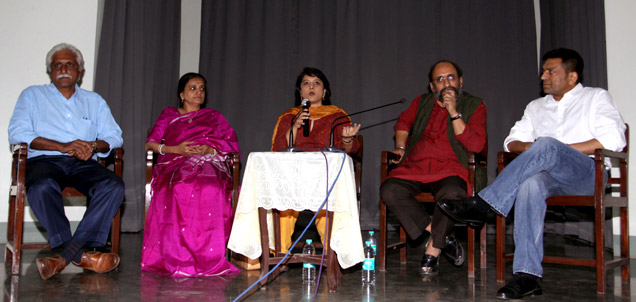
    Presenting his take on the sorry state of affairs prevailing in the print and news broadcast sector, Aggarwal presented a one-hour documentary titled ‘Brokering News—the inside story of paid news.’ The film is the initiative of the Delhi-based non-governmental, not-for-profit Public Service Broadcasting Trust (PSBT). The event was held at Mumbai’s Madame Cama Hall and was organised by Moneylife Foundation and Citizens Action Network with the support of industrialist Cyrus Guzder. MxMIndia was the media partner for the event.


    Being the first of its kind initiative on the sector, the documentary provides a harsh outlook on the filthy mannerisms being employed by most prominent newspapers and news broadcast houses where consumption of news is concerned. Spanning the streams of politics, business, sports and entertainment the film addresses a significant challenge facing Indian democracy today—which is the state of its media. The film looks at three aspects of paid news—how politicians are paying for positive coverage during elections, with the result that those who don’t pay are blanked out by the media; how the coverage and reviews of movies are orchestrated and paid for and of course, paid news about business and industry. It depicts in detail how journalists were forced to broker deals to offer editorial coverage to politicians.


    Following the screening, the event headed for a lively panel discussion and comprised of the following notable panellists: Umesh Aggarwal, director of News & Entertainment Television, Ayaz Memon, veteran journalist and currently consulting editor at IMN News, Paranjoy Guha Thakurta, educator & commentator, Bhawana Somaaya, noted film critic and columnist and Sucheta Dalal, Trustee of Moneylife Foundation and Managing Editor of Moneylife Magazine.


    When left to express their initial comments on the screening, Paranjoy Guha Thakurta began by highlighting the last action that was shown in the documentary – the disqualification of a local MLA from one of the constituencies in the North by the Election Commission of India because of the malpractice the individual resorted to with the help of the media. “It was the first ever such judgement that was carried out by the ECI and we hope to follow that when a judgement is pronounced on the former chief minister of Maharashtra Ashok Chavan.” According to Mr Guha Thakurta, while SEBI has made it mandatory for news and print houses to disclose their relationships and dealings with corporate hoses and influential individuals, there is still no transparency on such a ruling as nobody has even challenged the visibility or the outcome of this ruling as yet. “We hope to do a lot more and see a lot of action going forward.”


    Sucheta Dalal began by questioning the level of dishonesty that existed in business journalism. “Having worked as business journalist myself for many years, I can say that most of the stories that appear in newspapers are advertising-driven. And the sorry part is that it is a trend that is gaining ground with nobody doing a thing about it. I haven’t even heard of reports of anybody approaching the RTI for finding information of such corporate dealings with the business news organisations.”


    Probably, the most straightforward answer was unleashed from Ms Somaaya who vouched that in her entire career spanning over 30 years, she has never resorted to the concept of being entertained at the gesture of the entertaining parties. “I am an idealist. I can proudly state that I am not the same as the others in the space. Even today, there is a place for ethics and integrity in journalism,” she quipped.


    Presenting his rationale on the tale, Ayaz Memon asserted that there was a turmoil being currently witnessed in the media sector what with the explosion of several mediums in the space. “As a result there are not enough checks and balances leading to dangers lurking in every nook and corner of the business.” Citing the example of cricket, Mr Memon went on to describe the state of affairs of players who played in the earlier days and how they were paid minimal dues to the players of today who aspire to be paid huge sums. “This has led to match-fixing and spot-fixing being introduced to the sport today. While it is still not as widespread as is made out to be, the danger of such things going unchecked is huge.”


    When questioned by a member from the audience on which is the bigger worry – watching damaging news versus news that is paid for and how to distinguish between the two, Ms Somaaya reverted by stating the practice that she follows when reviewing films. “I’ve always refused offers for special screenings as after they lavish you with undue attention they expect that you judge the film in their favour. Reviewing films has become a big business today and one cannot predict the veracity of the reviews that get published.”

    Mr Guha Thakurta added here that it was largely the media that has played a huge role in giving damaging news or news that is paid for. “The need of the hour is to amend the Act and make paid news a cognisable offence.”


    Mr Aggarwal added here by saying that “we have our priorities misplaced. We need to figure out what kind of news gets featured and whether it is a pertinent one.” He cited the classic example of the small kid Prince that was covered live on almost all television channels for three days but another important news of 57 miners being trapped underground the same day was totally missed by everybody.


    Proceeding to the immediate solutions that were required to be taken by the industry, Mr Guha Thakurta called for an underlying need to have a regulation in place. “The thing about self-regulation is that in most cases it is not an effective thing to do. Recently there were two channels who were questioned for showing obscene content but what about the judgement? The problem is that we do not have an independent regulatory body which could govern and control the media; a body that acts as a statutory ombudsman for the electronic media.” Continuing further, Mr Guha Thakurta said that the issue was also how we strengthen the defamation laws in the country. “We need to go beyond individuals and focus on the systems. That should be the immediate priority.”


    Ms Dalal stated here that it was essential that media houses portray the right picture and not otherwise.”Most media houses are going in losses amounting to several crores of rupees but they are putting up are brave front and are getting help from the media to hide their plight. The owners need to question themselves as to what is it that we are doing to broadcast the right news?” Summing up, Mr Memon added that “we don’t live in a perfect society. It’s a time-bound initiative and will require the industry to come together and fight the menace.”

  • MxMIndia-partnered ‘Paid News’ seminar today

    By A Correspondent


    MxMIndia has partnered the event ‘Paid News: Fooling People all the Time’ organised by Moneylife Foundation and Citizens Action Network with the support of industrialist Cyrus Guzder.


    To be held in Mumbai’s Madame Cama Hall (Opp Lion Gate, Kala Ghoda) on Friday, November 18, the evening will see the screening of the documentary ‘Brokering News’ followed by a panel discussion with senior journalists and the film-maker Umesh Aggarwal.


    About the film: The Delhi-based non-governmental, not-for-profit Public Service Broadcasting Trust (PSBT) recently released a documentary titled “Brokering News—the inside story of paid news”.


    The film by Umesh Aggarwal addresses a significant challenge facing Indian democracy today—which is the state of its media. The film looks at three aspects of paid news—how politicians are paying for positive coverage during elections, with the result that those who don’t pay are blanked out by the media; how the coverage and reviews of movies are orchestrated and paid for and of course, paid news about business and industry. It depicts in detail how journalists were forced to broker deals to offer editorial coverage to politicians.


    Details of the Event:

    Panelists: Umesh Aggarwal, Ayaz Memon, Paranjoy Guha Thakurta, Bhawana Somaaya, and Sucheta Dalal.

    Timings: 5.30-7.30pm (Registration and Tea starts at 5pm)

    Venue: Madame Cama Hall, KR Cama Hall Institute, Bombay Samachar Marg, Opp. Lion Gate, Kala Ghoda, Mumbai 400 023

    Admission: While admission is free, registration is required. Contact details: Call Judith/Seraphina on 022-24441058-60, or mail at mail@mlfoundation.in,or log on to www.mlfoundation.in

  • More bite for toothless PCI?


    By Akash Raha

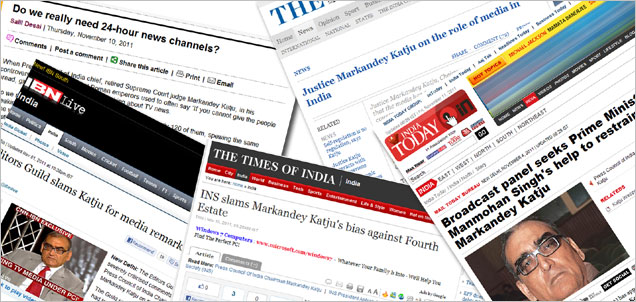
    Recently Chairperson of Press Council of India (PCI), Justice Markandey Katju triggered a volley of criticism and discussion after he lambasted the broadcast media, saying most of them suffer from “very poor intellectual level”. He went on to suggest that broadcast media should come under the purview of the PCI. MxM India asked some well-known media faces what they think.

    Arnab Goswami, Editor in Chief, Times Now and Vice President, Broadcast Editors’ Association (BEA) told MxMIndia: “I don’t know why Justice Katju is making these comments. There is absolutely no need to try and demolish the principle of self-regulation in TV news which ensures that electronic media is free and out of control of vested interests. Justice Katju should not make these sweeping generalizations.”

    Upset over Justice Katju’s comments on the media, former Chief Justice of India J S Verma too is reported to have recently called the PCI an “ineffective” body and said it should wrap up if it does not meet its mandate. Verma chairs the News Broadcasting Standard Authority (NBSA), which is set up by the News Broadcasters Association (NBA). In a recent statement Verma said that he is “deeply anguished” with the kind of language that Justice Katju uses which “sounds authoritarian”. NBA has requested the Prime Minister to stop the PCI from meddling with the dealings of broadcast media.

    On whether broadcast media should come under the ambit of the PCI, Rajdeep Sardesai, Editor in Chief, IBN18 Network said “I believe that the self-regulation mechanism which has been put in place by major news broadcasters must be allowed to strengthen itself. The Press Council has been unable to curb pernicious practices in the print media such as ‘paid news’, so I don’t see how mandating it to now to oversee the electronic media will serve any purpose.”

    Talking about whether he thinks electronic media should be brought under the purview of  PCI Paranjoy Guha Thakurta, an independent journalist and critic, said, “The electronic media needs to be regulated independently – this is because self-regulation is inadequate and ineffective under certain extreme circumstances. The regulator should be independent of both media interests – including the interests of the big corporate media – as well as the government. Even if the regulator is funded by the government, it can be truly autonomous and/or independent if it is Constitutionally mandated thus – such examples include the Supreme Court of India, the Election Commission of India and the Comptroller & Auditor General of India. Ideally the electronic media should have a separate regulator. Even if the ambit of the Press Council of India is widened to include the electronic medium, it has to be made truly independent and autonomous and, most importantly, empowered. The Press Council in its current form has no punitive powers and is hence akin to a toothless tiger.”

    To put things in perspective, PCI was established as a statutory print watchdog by an Act of Parliament in 1978. In recent times, PCI has come under question following chairperson Justice Markandey Katju’s recent remarks on the state of the media in India and its inability to keep a check on paid news.

    When asked if Justice Katju was trying to police the media, Mr Guha Thakurta played down the suggestion, saying, “The Press Council of India is a quasi-judicial body set up an act of Parliament. The way it is supposed to function has been clearly laid down. There is no question of Justice Katju (or for that matter, any Chairman of the Press Council) acting as either a good cop or a bad cop.”

    The question remains, should news broadcast come under the ambit of PCI? One of the reasons for opposing such a suggestion remains that since PCI has been unable to check the menace of paid news in print, there is no reason why it should make any positive change in the broadcast industry. Another argument says that the only reason why PCI has been unable to make a change is because it is still a toothless quasi-judiciary body and the government needs to empower it and give it some tooth. Either way, in this chatter and amidst much confusion is set Justice Katju and his criticism of media professionals as he sees them as naïve and stupid. Criticism which has obviously riled the veterans of the broadcast industry.

    In the wake of this controversy, several discussion forums are being organized on the PCI, the question of paid news, etc. The Foundation for Media Professionals (FMP) is organizing a panel discussion in collaboration with the Press Club of India on the topic ‘Media and Public Interest: Freedom vs Accountability’ on November 12 at Press Club of India, New Delhi. The panelists at this discussion will be Markandey Katju, Rajdeep Sardesai, Neelabh Mishra, Zoya Hasan, Pankaj Pachauri, Abheek Barman, Madabhushi Sridhar and Paranjoy Guha Thakurta with T R Ramachandran as moderator.

    Later, on November 18, MxMIndia has partnered the event ‘Paid News: Fooling People all the Time’ organised by Moneylife Foundation and Citizens Action Network with the support of industrialist Cyrus Guzder to be held in Mumbai’s Madame Cama Hall. The evening will see the screening of the documentary ‘Brokering News’ followed by a panel discussion with senior journalists and the film-maker Umesh Aggarwal. The panelists at this discussion are Umesh Aggarwal, Ayaz Memon, Paranjoy Guha Thakurta, Bhawana Somaaya, and Sucheta Dalal. This panel plans to discuss the issue of paid news, which has been a bugbear even for regulatory bodies such as the PCI.

    For more: http://www.mxmindia.com/2011/11/mxmindia-partners-%E2%80%98paid-news%E2%80%99-event/

  • MxMIndia partners ‘Paid News’ event

    By A Correspondent

    MxMIndia has partnered the event ‘Paid News: Fooling People all the Time’ organised by Moneylife Foundation and Citizens Action Network with the support of industrialist Cyrus Guzder.

    To be held in Mumbai’s Madame Cama Hall (Opp Lion Gate, Kala Ghoda) on Friday, November 18, the evening will see the screening of the documentary ‘Brokering News’ followed by a panel discussion with senior journalists and the film-maker Umesh Aggarwal.

    About the film: The Delhi-based non-governmental, not-for-profit Public Service Broadcasting Trust (PSBT) recently released a documentary titled “Brokering News—the inside story of paid news”.

    The film by Umesh Aggarwal addresses a significant challenge facing Indian democracy today—which is the state of its media. The film looks at three aspects of paid news—how politicians are paying for positive coverage during elections, with the result that those who don’t pay are blanked out by the media; how the coverage and reviews of movies are orchestrated and paid for and of course, paid news about business and industry. It depicts in detail how journalists were forced to broker deals to offer editorial coverage to politicians.

    Details of the Event:

    Panelists: Umesh Aggarwal, Ayaz Memon, Paranjoy Guha Thakurta, Bhawana Somaaya, and Sucheta Dalal.

    Timings: 5.30-7.30pm (Registration and Tea starts at 5pm)

    Venue: Madame Cama Hall, KR Cama Hall Institute, Bombay Samachar Marg, Opp. Lion Gate, Kala Ghoda, Mumbai 400 023

    Admission: While admission is free, please register well in advance. Contact details: Call Judith/Seraphina on 022-24441058-60, or mail at mail@mlfoundation.in,or log on to www.mlfoundation.in

    While MxMIndia.com is Media Partner of the event, other media organisations (including trade media) are welcome to register and cover the event