Tag: Paid Content

  • Das ka Dum with Dr Bhaskar Das: Is it right for a news media company – respected or otherwise – to pass off paid content as editorial-generated and editor-okayed?

    Bhaskar Das

    Greetings on this Friday before Dassera. We’re here with a question that a lot of us have been seeking an answer to. So read on for Dr Bhaskar Das’s views on paid content… in Das ka Dum.

    Please go to the Das Ka Dum tab on the website’s top navigation bar, to visit the archives of Q&As.


    Q. Is it right for a news media company – respected or otherwise – to pass off paid content as editorial-generated and editor-okayed?


    A. The slant of the question has a definitive drift towards an answer of  ‘right’ or ‘wrong’. These days, more often than not, answers may not be in black or white but somewhere in between. What the media industry eulogises as native content can also be clubbed under your question. Or for that matter how some public relations companies facilitate content in the media.


    I think a more fundamental question needs to be asked if the veracity of a story is compromised. Or if the concerned story has been flagged as sponsored content. Infomercials are a legit route to consumer awareness. The problem starts when the paid  content is camouflaged as non- sponsored content. One can’t take the audience’s intelligence for granted. They can see through it in case paid content is masqueraded as news.

  • MxM Monday: Paid news – yes or no?


    By Ananya Saha


    Mediaah! Are disclaimers enough to pass off paid content?

    Readers expect the content in the newspaper to be published based on the decision of the editor, and not an advertiser paying for it, writes Pradyuman Maheshwari. Read more…


    Paid content such as Medianet has gained much ground. Despite flak from different quarters, it appears that buyers are still willing to pay for space that resembled news and features. And readers may never know the difference. More media houses have begun indulging in paid content, but surely that does not make it right?


    We ask industry folks to weigh in with their views.


    Arun Anant, CEO, The Hindu Group of Publications

    People may not know that some newspapers carry paid-for articles, and some people do not care either. That does not make it right. If an article is paid for by an advertiser, it should be made clear that there is an interested party that has paid for it.


    Ranjona Banerji in ‘Freaking News’
     

    :: Medianet mars an otherwise trendsetting paper

    :: Not too late for TOI to correct practices


    Santosh Desai, MD, Future Brands

    Globally, it has become a phenomenon where sponsors pay for news. There needs to exist a clear difference between journalism and an act of promotion. If not kept separate, the line of demarcation will blur between the two. However, what is more dangerous is that when news is influenced by a transaction. Many do not care about Page 3, so if you have paid for it, it does not matter. The issue arises about hard news, when you do not know who has paid for it. MediaNet in itself not a wrong thing as long as you are announcing it who is paying for it. For instance, if you are reporting about a policy being announced and you do know which political party or a corporate house has paid for it. What is a much bigger issue is the corporate ownership of the media houses. There has to be a divide between news and advertisement: and how do you tell it? How do you divide ownership and journalism: and do you – that is more serious threat than MediaNet, in my opinion. The bigger point is about trusting the ‘news’.


    Bharat Kapadia, Chairman, Whatuwant Solutions, and Founder at ideas@bharatkapadia.com

    Using Medianet is completely unethical – whether readers do not seem to notice it or whether they do not care. There are two parts to it: the publisher and the readers. The publisher has been doing it for a much longer time than visible, especially at the time of elections. The readers, unless told, would not know which news is being paid and which is not. When, it all began, Bombay Times used to mention with a small symbol that it is paid news. Now even that is gone. People buy or consume news media trusting for a fair perspective. Now, if this perspective can be influenced, it is definitely not fair.


    Anamika Mehta, COO, Lodestar UM

    My personal point of view is, for a newspaper or any other medium, there are different and more questions about paid content. It happens globally in various forms but of course, it is not a good practice. A lot of brands and advertisers have jumped on this wagon, yes, but as a responsible media one should know where to draw the line. If one considers Page 3, where you can pay to get featured, it is all for entertainment. So one does not seem to mind. The moment it starts entering news or motivate political, business or economic sentiment, then it is a problem.


    One can see that business pages also carry small snippets or news that might sway the reader into investing in a particular stock, or to create impact. Some of the brands do MediaNet for promotion. However, a line needs to be drawn. The reader should not be misled, and motivated information should be kept under check.


  • Wanted: a mast, mast Mid-Day

    Pradyuman MaheshwariBy Pradyuman Maheshwari

    We’ve been promising a review of Mid-Day. It would’ve been unfair to do one by just appraising a single day’s edition, so we thought of doing that over the last 10-odd days since the paper went for a new look.

    First off, a couple of disclosures. Okay, let me use the ‘I’ instead of ‘We’. I worked with the group for seven years (1993-2000), was a shareholder for a bit and I take great pride in the rapid strides that current executive editor Sachin Kalbag has been taking in his career.
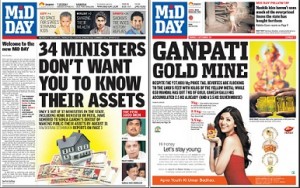


    Yet another disclosure, I was invited to write for the paper’s new-look, but declined the offer because of a Medianet-like scheme that Mid-Day runs for part of the paper.

    But let’s get to the relaunch. I’ve always perceived Mid-Day as a Mumbai institution, with the paper celebrating the city and reporting on what’s happening in here. At first, it lost its constituency of the society circuit to Bombay Times and over the last six-odd years, Mumbai Mirror has been steadily eating into Mid-Day’s dominance on civic and Bollywood news.

    The Medianet-like practice that the paper started was the final nail on the coffin. When I spoke to former owner Tariq Ansari for an interview with Impact last year, he said he was against the concept but was forced to given commercial considerations. Well, a couple of crores of revenue is good to have, but all of it at the cost of integrity?
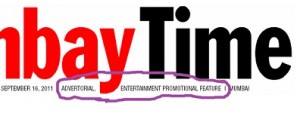
    While The Times of India group clearly says that Bombay Times is an ‘advertorial entertainment promotional feature’, while the statement upfront is a step in the right direction, it’s not enough as it ought to make a very clear announcement of what it means on its main Times of India page as well as on Bombay Times. I’m sure not many have noticed that small line under the Bombay, Delhi etc Times mastheads

    Back to Mid-Day, I believe it must reinforce as identity as a Mumbai paper. The Page 1 story must be ‘Bambaiyya’ in content and outlook, the feel ought to be tabloidy and the stories must have punch. I would like to see the Mate and snippety Diary back on Page 3. Or at least Page 2.

    Despite an edit page and some pretty good (and serious) content, Mid-Day was always known as a timepass read. Sachin was around in Mid-Day those days, so he should know.

    Agreed the look-and-feel has got to be more contemporary, but if it wants to create the same magic as it did until a few years back, it’s got to get its masti back.

    Why jail only for political paid content

    Beware, media barons and editors accepting money for publishing editorial content. While the election commission can do precious little about the corrupt practices of media entities carrying content in lieu of money and not clearly tagging it as an advertisement, it’s heartening to note that all those who are doing it for politics will be put behind bars for 2 years.

    Now, what about those doing it for lifestyle products? Shall we count the years?

    Read: an IndianTelevision report

    What’s a piece on the Campaign A-List doing on MxMIndia.com?

    If you’re surprised why the MxM anchor has Everest Brand Solutions president Dhunji Wadia telling us why it’s great to be on the Campaign India A-List, don’t be. It’s not that he put my name on the mail instead of the Campaign editor’s. We asked him to write it. He did that in record time, in between meetings. (Read Dhunji on the A-List)

    Here’s my take on the issue: MxMIndia is media-neutral and would like to write about every media entity. We will write about all the activities of even those who consider MxMIndia it’s rival. For in my books, no one is. I’ll be happy to cover the activities of all business publications and the media trade publications. This includes the Campaign A-List, the afaqs events, the exchange4media group events etc etc. That is, of course, if an MxM reporter is allowed in.

    Buzz me if you have a story to tell. Confidentiality assured. There are various ways you can reach me: pradyumanm[at]mxmindia.com, 23050B5D, Gtalk: pradyumanm[at]gmail.com, @pmahesh, 98338 76278