Tag: Page 3

  • MxM Monday: Paid news – yes or no?


    By Ananya Saha


    Mediaah! Are disclaimers enough to pass off paid content?

    Readers expect the content in the newspaper to be published based on the decision of the editor, and not an advertiser paying for it, writes Pradyuman Maheshwari. Read more…


    Paid content such as Medianet has gained much ground. Despite flak from different quarters, it appears that buyers are still willing to pay for space that resembled news and features. And readers may never know the difference. More media houses have begun indulging in paid content, but surely that does not make it right?


    We ask industry folks to weigh in with their views.

     

    Arun Anant, CEO, The Hindu Group of Publications

    People may not know that some newspapers carry paid-for articles, and some people do not care either. That does not make it right. If an article is paid for by an advertiser, it should be made clear that there is an interested party that has paid for it.


    Ranjona Banerji in ‘Freaking News’
     

    :: Medianet mars an otherwise trendsetting paper

    :: Not too late for TOI to correct practices


    Santosh Desai, MD, Future Brands

    Globally, it has become a phenomenon where sponsors pay for news. There needs to exist a clear difference between journalism and an act of promotion. If not kept separate, the line of demarcation will blur between the two. However, what is more dangerous is that when news is influenced by a transaction. Many do not care about Page 3, so if you have paid for it, it does not matter. The issue arises about hard news, when you do not know who has paid for it. MediaNet in itself not a wrong thing as long as you are announcing it who is paying for it. For instance, if you are reporting about a policy being announced and you do know which political party or a corporate house has paid for it. What is a much bigger issue is the corporate ownership of the media houses. There has to be a divide between news and advertisement: and how do you tell it? How do you divide ownership and journalism: and do you – that is more serious threat than MediaNet, in my opinion. The bigger point is about trusting the ‘news’.

     

    Bharat Kapadia, Chairman, Whatuwant Solutions, and Founder at ideas@bharatkapadia.com

    Using Medianet is completely unethical – whether readers do not seem to notice it or whether they do not care. There are two parts to it: the publisher and the readers. The publisher has been doing it for a much longer time than visible, especially at the time of elections. The readers, unless told, would not know which news is being paid and which is not. When, it all began, Bombay Times used to mention with a small symbol that it is paid news. Now even that is gone. People buy or consume news media trusting for a fair perspective. Now, if this perspective can be influenced, it is definitely not fair.


    Anamika Mehta, COO, Lodestar UM

    My personal point of view is, for a newspaper or any other medium, there are different and more questions about paid content. It happens globally in various forms but of course, it is not a good practice. A lot of brands and advertisers have jumped on this wagon, yes, but as a responsible media one should know where to draw the line. If one considers Page 3, where you can pay to get featured, it is all for entertainment. So one does not seem to mind. The moment it starts entering news or motivate political, business or economic sentiment, then it is a problem.


    One can see that business pages also carry small snippets or news that might sway the reader into investing in a particular stock, or to create impact. Some of the brands do MediaNet for promotion. However, a line needs to be drawn. The reader should not be misled, and motivated information should be kept under check.



  • Making fun of Page 3 culture

    By Ranjona Banerji


    Have to say, I just love the new Hindu ads. Making fun of your competition is not just unexpected from India’s most sober newspaper but it is also rare in India. Are these ads a direct response to The Times of India’s Chennai campaign, where the ads alleged that the Hindu put people to sleep? Perhaps not, since the Hindu campaign seems all-India and directly accuses the Times of dumbing its readers down. There is nothing implied in the Hindu ad – we can clearly see that all the idiots being quizzed on their knowledge (or lack of it) claim to read The Times of India, bleeped out though the name may be.


    The print ads include one which says “we also have pages 1,2, 4, 6” and so on, a clear dig at The Times’s introduction of society and celebrity news on Page 3 of the Bombay Times many years ago. “Page 3” culture is now part of our lexicon and indeed Madhur Bhandarkar even made a film about it, almost as scathing as the Hindu’s ads. The funny thing is that we always have had a society-celebrity media, what Bombay Times did was to both magnify and expand it. The even funnier thing is that almost every other publication in the country was quick to copy the TOI. Even the Hindu, which may not have a celebrity circus page, was increased its light feature content.


    It’s also curious that DNA ran a very similar campaign to the Hindu’s recently – interviewing young people who knew nothing about anything except Bollywood and then it turns out that they only read DNA After Hrs! In DNA’s case, there was apparent pride in ignorance; Hindu mocks it.


    In these times, when the media itself has become the news, the Hindu ads – done by Ogilvy – are bound to get attention and approval. There are many who believe that trivialisation of the media is dangerous and that there is cynical marketing manipulation of our apparent obsession with Bollywood. The Press Council of India chairman Markandey Katju is probably nodding away happily, especially when he sees line like “Because government malfunctions matter more than wardrobe malfunctions” – another of the Hindu’s print ads.


    For my money however far worse than the trivialisation of newspapers is the fact that all celebrity news and gossip is actually fake – paid for by the stars, studios, sponsors and so on. The readers are fooled into believing that what they are reading is the result of some digging up by journalists – as it used to be in the old days, even film news. The truth of course is that it is handed to newspapers by public relations companies or by the marketing department to the editorial staff.


    Bad enough that we are trivial, we are also, it seems, foolish and exploited!


  • Hindu hits back with a tough punch


    By Tuhina Anand


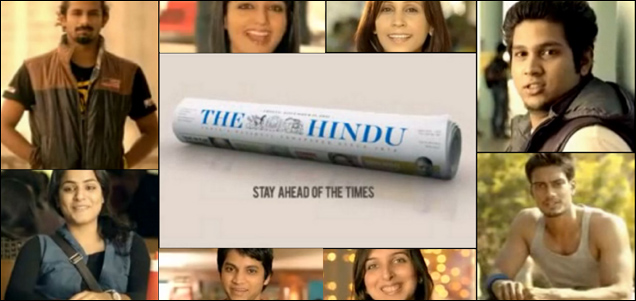
    The Times of India fired the first salvo with its hints at a “boring” newspaper. The Hindu has countered with its ‘Stay ahead of the times’ campaign. A bit of a revelation coming from the house of the newspaper which is perceived as traditional and old-fashioned, the 360-degree pan-Indian advertising campaign seeks to bring the core values of journalism to the fore. At the same time it shows how the ‘popular’ read has trivialised the kind of news being dished out to the readers, with the result that they are more clued in about Aishwarya’s baby and Hrithik Roshan’s pet name than knowing the name of the Vice President of India.


    What is more surprising is that in the campaign, even though it’s bleeped out, one knows that people who have been featured say that they read The Times of India, thus clearly acknowledging at one go that TOI is a force to reckon with but at the same time responsible for this trivialization of news. The tagline leaves no room for doubt as it states, “Stay ahead of the times.”


    This kind of aggressive marketing could be the answer to the campaign that The Times of India had come out with a few months ago in the Tamil Nadu market which targeted The Hindu for being boring. The Times of India campaign says, “Stuck with the news that puts you to sleep? Wake up to The Times of India.” In fact, it is learnt that the TOI had even printed a dummy newspaper, circulated within the industry, with The Hindu masthead and “zzzzz” printed all over, to underline its message that reading the newspaper put people to sleep.


    Mr Suresh Srinivasan, Vice President (Advt), The Hindu Group of Publications insists that the campaign is not a reaction to the earlier TOI salvo. He said, “We have been on a path of transformation and change where we have not only undergone organizational changes but also been contemporising our product in order to connect better with our reader. The changes have been in content, layout and packaging based on the research we had commissioned, and their suggestions.”


    He added, “We are the country’s most respected English daily and the number 1 English daily in the South, with a growing footprint in the North. While we build on our strengths there is also a need to protect our turf. The Times of India is definitely our single largest competitor down South.”


    The Times of India, meanwhile, has been watching the recent development with a  touch of amusement. Mr Rahul Kansal, Chief Marketing Officer at Bennett Coleman & Company Limited, said: “It is good fun to watch it from the sidelines. TOI is an all-India brand and has redefined the news and newspapers altogether. In fact, this doesn’t really damage our brand in any way. On the contrary, it reiterates the fact that we are a very strong contender for the leadership position in the Chennai market. Remember, the Coke and Pepsi war? It didn’t hamper Coke in any way but it did establish Pepsi as a worthy young brand.”


    One of The Hindu TVCs
    [youtube width=”400″ height=”200″]http://www.youtube.com/watch?v=xmXPBp7DpQw[/youtube]
    The Times of India TVC
    http://timesofindia.indiatimes.com/videos/news/Wake-up-Chennai/videoshow/10557020.cms

    “While advertising, one does exaggerate and that’s what we had done when we said in our earlier campaign that The Hindu is a staid brand. One takes extreme positions in advertising to bring out the humour, so even now when the ad says we give only Page 3 news that just to bring out humour. Everybody knows that the TOI is a complete newspaper,” added Mr Kansal.


    Despite the impressive numbers of The Hindu, there definitely seems some concern about the might of the TOI which led to this kind of aggressive marketing. Mr Narendra Kumar Alambara, Vice President at Starcom Worldwide, who has been observing the Chennai market, explained: “The TOI has made inroads into the Chennai English newspaper market and there is no denying that. While the gap between the leader and TOI is still huge, but the latter has become a strong competitor. Youngsters and migrant population have been picking up this newspaper, especially, because of the kind of news reporting that TOI has been doing. While earlier there was no option, but now there is an alternative read. In terms of readership, I think that for The Hindu it has remained stagnant while TOI has grown the category itself. However, one should remember that in the Chennai market retail advertisers lead and for them The Hindu is still a priority.”


    On the campaign, Mr Srinivasan said: “The Hindu believes that, more than ever in a globalising, knowledge-driven economy, it is vital that readers are well-informed about the world at large. And yet, over the last few years, the news and media industry in India has become increasingly focused on serving up a steady diet of trivia, shying away from the national and international issues that really matter. This may help sell more newspapers or get more viewership in the short term, but it is the news equivalent of junk food. And the long-term result is a steady dumbing-down of readers who end up knowing more about Aishwarya’s baby than the Arab Spring.”


    The campaign shows how one may be creating a country that is fully conversant with gossip and Page 3 culture but clueless about current affairs and world events.


    Mr Srinivasan says, “The campaign is aimed at triggering conversation and if we succeed in provoking thought and debate that would be the measure of our success. It is intended as an eye-opener to get people to re-evaluate their media choices, to demand a smarter newspaper.”


    The campaign will be on TV, radio, cinema, print, outdoor and digital. It will be supported by on-ground activities in malls, cafes and other locations.