Tag: Padma Shri

  • Columbia Pacific Communities celebrates Seniors Day

    By A Correspondent


    On the occasion of World Senior Citizens Day on August 21, Columbia Pacific Communities is celebrating the spirit of ‘un-retirement’ through a series of social media posts and a special message from actor Anupam Kher.


    Speaking about the campaign, Piali Dasgupta, Vice President, Marketing, Columbia Pacific Communities, said: “’Unretire’ is a state of mind, and one that we want senior citizens to actively embrace. Life takes a thrilling new turn at 60, in one’s golden years that one can reconnect with old hobbies, reinvent oneself and give back to society in a meaningful way. That’s what our campaign Unretire tries to convey. We couldn’t have had a better person than Mr Anupam Kher to share this message of positivity on a very special day such as World Senior Citizens Day. Mr Kher, after over 500 films and Padma Shri and Padma Bhushan under his belt, believes that his best is yet to come. And that’s exactly the message we have for senior citizens.”


  • Rajdeep Sardesai presented Prem Bhatia Award for political reporting

    By A Correspondent


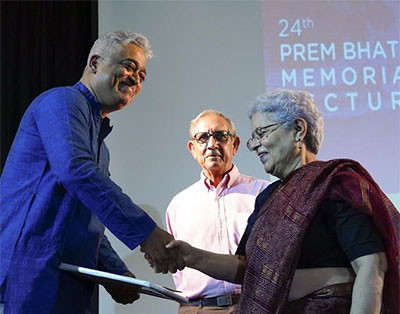
    Senior journalist and India Today TV Consulting Editor Rajdeep Sardesai has been awarded the 2019 Prem Bhatia Award for Outstanding Political Reporting, in an event held in New Delhi on Sunday, August 11.
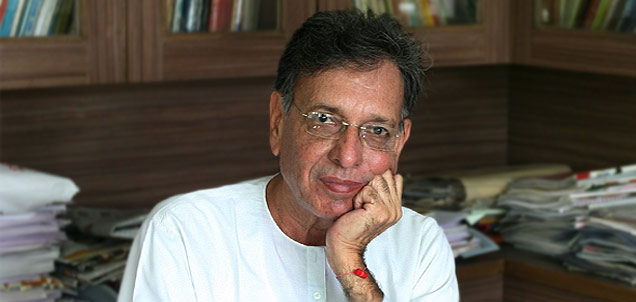
     

    The annual award, which carries a prize of Rs 2 lakh, was established in the memory of veteran journalist Prem Bhatia, who was well-known for his political reporting and far sightedness. Every year, two awards are given to distinguished journalists in the fields of political and environmental reporting.


    Sardesai has been the recipient of many awards in the past, including the Padma Shri (2008), the Ramnath Goenka award for Journalist of the Year (2007) and the International Broadcasters’ Award for his coverage of the 2002 Gujarat riots and many more.


    On winning the award, Sardesai said: “I am delighted to receive an award which is for, of, and by journalists and is widely regarded as one of the most credible awards in Indian journalism. The award is a recognition of not just an individual but of a wonderful team at India Today which worked tirelessly while offering the best election coverage of the 2019 general elections”.


  • Piyush Pandey awarded Padma Shri

    By A Correspondent


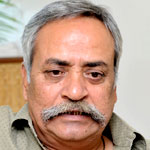
    Veteran adperson and Ogilvy bossman Piyush Pandey has been named as a Padma Shri recipient.

    Piyush Pandey                                                                     Â


    As reported by MxMIndia earlier today, Pandey was tipped to be named as a Padma Shri winner. He was the only representative of the advertising and marketing services fraternity in the list of 112 awardees, 83 of which are being accorded the Padma Shri. According to the grapevine, Ogilvy India bossman Piyush Pandey’s name is set to be announced in the list of Padma Vibhushan, Padma Bhushan and Padma Shri winners to be unveiled today.


  • Padma Shri for Sakal chairman Pratap Pawar

    By A Correspondent

    Pratap Pawar


    There weren’t any names specifically marked ‘media’ or ‘journalism’  in the list of ‘Padma’ awardees released on Saturday. Even Pratap Pawar, Chairman of the Sakal Media Group, has been listed under ‘Trade and Industry’.

    Mr Pawar, a veteran mediaperson, becomes the fourth Padma awardee fromthe Sakal group, as per a report in the group’s Sakaal Times newspaper. Other than Sakal founder-editor Nanasaheb Parulekar being awarded the Padma Bhushan in 1969, Dr Banu Coyaji, a well-known doctor, social worker and director, was a Padma Bhushan recipient in 1989. Scientist Dr Raghunath Mashelkar who has been awarded the Padma Vibhushan this year (and earlier the Padma Bhushan and the Padma Shri), is also a director with Sakal.

    “Thousands of workers are working in organisations which I am associated with. I have been honoured due to their efforts,” Mr Pawar was quoted in the paper. “If the potential of the country is properly utilised, this country will progress. If every citizen does his duty, there is a bright future for the country,” he said.

    Though this year’s list did not have any names directly associated with the media, there were several names from films and a few who have written in publications (like Ruskin Bond who started out as a journalist) or a few others like Prof Ashok Chakradhar who have been regulars on television.

    Padma Awards, the country’s highest civilian awards, are conferred in three categories, namely, Padma Vibhushan, Padma Bhushan and Padma Shri. The awards are given in various disciplines/ fields of activities – art, social work, public affairs, science and engineering, trade and industry, medicine, literature and education, sports, civil service, etc. ‘Padma Vibhushan’ is awarded for exceptional and distinguished service; ‘Padma Bhushan’ for distinguished service of high order and ‘Padma Shri’ for distinguished service in any field. The awards are announced on the occasion of Republic Day every year and conferred by the President of India at a function held at Rashtrapati Bhawan sometime around March/ April.


    Picture: Sakal group corporate website

  • Gujarati writer-journalist Devendra Patel’s journey to the Padma Shri


    By Ananya Saha


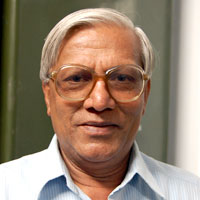
    At 68, Devendra Patel reads 4-5 hours daily, which includes 25-30 newspapers. He watches television for two hours  and keeps himself updated with national and international news, ranging from Barack Obama and Manmohan Singh, to Bipasha Basu and Katrina Kaif. Mr Patel, Advisor to the Editor and columnist for Gujarati newspaper Sandesh, was recently awarded Padma Shri in the discipline of Literature & Education.


    “I was elated at the announcement. I am not a hypocrite to say that I did not feel good. Naturally, it feels good,” he said. Mr Patel who was born on October 20, 1945 in Gujarat, began his career as a journalist began in June 1967, when he joined Gujarat Samachar as a reporter. It was actually by accident that he chose this career. “I was to join the Intelligence Bureau, and could not go because of some reason. I was desperate to work, and joined this field. It was a dramatic incident,” he shared.


    Mr Patel maintains that he does not have any idols or role model in journalism that he followed, but he was impressed by Mahatma Gandhi and his journalistic efforts and launguage. “I was only influenced by Gandhiji indirectly, not as a journalist,” he clarified.


    Mr Patel has written “lots of stories”, but he gave prominence to human interest news stories. He recalled, “Some hardcore criminals of Dadva village inBhavnagargang raped one 19-year-old female, the young wife of atemplepujari(priest), burnt their house and shop and ultimately forced them to leave the village. The policed refused to lodge their complaint and the couple came to Ahmedabad to commit suicide in theKankariaLake. Before doing so, they came to Gujarat Samachar and told me the whole story.” Gujarat High Court took note of the story and sent a notice to the Gujarat government suo moto. The government had to act and more than 12 culprits were behind bars within 24 hours.


    The woman became the sarpanch of that village later. “Back then, I used the name of the woman and even her picture in the story I filed. The story created quite a stir. In those times, SC had not ordered yet that the victim’s name and identity cannot be revealed,” he said.


    Thirty years ago, Mr Patel through his articles alerted parents of girls against fraudulent US green card holders who used to cheat the cultured, educated Gujarati girls through marriage. “More than 50 cases came to me. I wrote every story. The same is happening inPunjabnow. But after I published my stories, the educated girls no longer got excited by the prospect of getting married to a green card holder. Now, parents are also cautious about NRI boys who want to get married to Gujarati girls,” he said.


    But the good work comes with various bad experiences as well. Mr Patel recalled, “In 1985, the students of the B.J.Medical College started ‘Anti-reservation movement’. The Madhav Singh Solanki government wanted to crush this movement aggressively. The police started torturing innocent people by baton charge and firing. I started a column ‘Wohi Raftar’ against this torture in Gujarat Samachar, which was the true reflection of the people’s mood in Gujarat. It became ‘the voice of Gujarat’ ultimately. This made some elements furious and irritated and as a result, they set Gujarat Samachar press on fire. However, the daily began again after 15 days and I wrote, ‘We will write from the ashes of Gujarat Samachar’. The Madhav Singh government desperately wanted to put me behind the bars and I had to go hiding with my family for 15 days. However, the Delhi high command had to take serious note of this and ultimately Madhav Singh was forced to resign as the chief minister of Gujarat.”


    It was in December 2007 that he joined Sandesh as the advisor to the Editor and column writer and very soon, became an integral part of the ‘Sandesh’ family. In his career spanning 42 years, Mr Patel has penned 40 books apart from two books in Gujarati on America’s war onIraqtitled ‘Gulf War’ and ‘Saddam Hussain’. His book ‘Israel: the land of the Bible’ received the Best Book award by Gujarat State Sahitya Akademi. In 2009, he got the Best Writer award by the Trans Media, Mumbai, for the TV serial ‘Kabhi Kabhi’ on Zee Gujarati.


    Mr Patel is confident that the young generation is going to take the cause of journalism more aggressively. He said, “I am really inspired by the new generation. We started the concept of fieldwork 45 years ago, but the new generation is more excited and intelligent. If they get to know of the issue, they take action and do good work. Every new generation is better than the previous generation. I see the youngsters and feel proud about the way they work and research.”


  • Vijaydutt Shridhar: Passion for the printed word

    The Padma Shri award for Sahitya (Literature) this year has gone to author Vijaydutt Shridhar, 60, former editor of Navbharat and the only journalist on the list. The award is well-deserved for the man who has almost single-handedly taken up the task of preservingIndia’s history through the lens of time, past and present – the newspapers, magazines and periodicals.


    In an email and telephonic interview with MxM India’s Archita Wagle, Mr Shridhar talks about his passion, the Madhavrao Sapre Samachar Patra Sangrahalaya evam Shodh Sansthan in Bhopal, Madhya Pradesh.


    Q: Tell us about your career, and what you are doing now.

    I am retired now and I concentrate on the museum and my books nowadays. Before that I was the director at Makhanlal Chaturvedi University of Journalism and Communications. I also worked as the editor of Navbharat. I have worked with several state level committees related to journalists and newspapers in Madhya Pradesh. I was a member of the Madhya Pradesh Vidhan Sabha Press gallery committee for two decades.


    Q: What prompted you to start the Sapre Sangralaya in 1984?

    I was working on my book Shabd Satta, which chronicles 150 years of journalism in Madhya Pradesh. I had to travel far and wide to research for my book. While researching for the book, I realised that there was no systematic classification of the material that I required. Authenticating the material was also difficult, and posed a lot of problems for me as history is incomplete without properly verified material. I visited individual collectors, but the newspapers in their collections had started deteriorating. This sparked the idea of preserving newspapers.


    Q: How did you get the material for starting the museum?

    I met Pandit Rameshwar Guru, a veteran journalist, Hindi poet and Mathematics teacher. He also had an extensive collection of journals, newspapers and periodicals going back two generations. But due to family obligations he was ready to donate them. He had two conditions, though. One, he wanted the material to be saved systematically and in the name of future generations. Two, the collection or the museum which would house them will not be handed over to the government or any university as Mr Guru feared that the material would not be cared for properly at either places and that the universities are more concerned with their salaries than preserving the heritage that such a collection represents.


    Q: Can you tell us more about the Sapre Sangralaya and the work it does?

    After Mr Guru agreed to donate his collection, a society was set up in the name of Madhavrao Sapre, the pioneer of Hindi journalism. The ideology that Lokmanya Tilak had when he started Kesari, was the same ideology that Shri Sapre had, so he launched Hindi Kesari. The Sapre Sangralaya collects all kinds of old periodicals and newspapers in all the languages – Hindi, Marathi, Urdu and so on – for the purpose of preserving them. Earlier I used to travel to different places scouting for materials. I once bought an old collection of Punch magazines from a man who sold them for a song because he wanted to pay for his liquor. But as time passed, people came to know about the work we are doing and they donate their private collections to us, knowing that we will take good care of the material they donate.


    Q: How are the footfalls in the museum? Do you get a lot of visitors?

    The museum is acknowledged as a research centre by many universities. We mostly get journalists and academicians who come to the museum as they know that what they might not get anywhere else, they will find it here. Once, the editor of an established and well-known Hindi newspaper came to the museum because he wanted to see a copy of a particular issue for January 1962 of his paper. It was a moment of pride that we had the issue which their archives didn’t have.


    Q: How do you arrange for the funding for the Sangralaya?

    The Central and the state government provide funding for the museum but they never interfere in the day-to-day working. We also receive donations. So funding is not a problem for us.


    Q: Any future plans for the Sangralaya?

    You should know that the paper a newspaper is printed on is not of the finest quality. We have newspapers and journals dating from the 1600s. Constant handling also accelerates the deterioration. We have preserved the material we have gathered so far by chemical treatment, pest control, laminating the old papers, and transferring the old papers onto microfilm. So far, we have transferred material up till the 19th century. But now we are looking at digitising the content we have. We are looking at transferring all the material to DVD so that people who come to the museum to look at these newspapers for their research will be able to go through the DVDs and the newspapers can be preserved better.


    Q: The website for the museum is in Hindi. Would you consider having a website in English, in order to reach a wider audience?

    The suggestion that you have given is a good one. We are translating the summary for the website in to English and other languages… but only the summary, the rest of the website will be in Hindi as that is the language we work in. But once we translate the summary, that will provide enough information for people about what we do.


    Q: You are an author; any work in progress on that front?

    I have written three books and now I am in the process of completing my fourth. My first book was Bhartiya Patrakarita Kosh, which is an in-depth study of Indian journalism in the pre-Independence period (1780-1947). The book covered the whole sub-continent -India,Bangladesh and Pakistan. It is the history of Indian journalism in all languages of country – origin, growth, struggles, achievements and contribution.

    My second book was Shabd Satta which covered the history of 150 years of journalism in Madhya Pradesh from 1849 to 1999. My book Choutha Padav is the history of 1000 years of Bhopal with special reference to BHEL. Now I am working on my latest work, Pahela Sampadkiya, which is a collection of the first editorial in prominent Hindi language newspapers. The book has about 28 editorials and my comments and analysis on each of the editorial.


    Q: How do you find time to manage both your writing and your day-to-day commitments?

    Now that I have retired, I can devote more time to writing and my work at museum. So it is not difficult.


    Q: How does it feel to have your efforts recognized by the government in the form of the Padma Shri in Sahitya?

    I didn’t expect to be awarded. I have been working on the museum for the last 28 years. I never expected to get the award as the government doesn’t declare it in advance, but it feels good.