Tag: OYO

  • What business are the aggregator apps in?

    What business are the aggregator apps in?

    With apologies to none at all

    By Vikas Mehta

    Vikas MehtaA few weeks back I had written on the decline in the services of aggregator apps and related my personal experiences with a few apps. You can find the article here.

    Some of you readers wrote back and asked me for the reasons of this decline. As one put it, usually new offerings with new technology get ironed out over a period of time. So, why should the aggregator apps be an exception to this? Fair question and it set me thinking.

    Before I continue, I would like to convey my thanks to Hamsini Shivkumar, Brand Consultant and Semiotician par excellence. It was she who nudged me into thinking deeper and we had a fair exchange of ideas. Much of what I write today is the result of her thoughts.

    Let’s look at this decline in quality, first by looking at the Indian consumer.

    Most of the aggregator apps like Ola, Uber, Swiggy, Oyo; when they came on to the scene, they offered a new service, promising higher standards of delivery at cheap rates. I am using the word cheap deliberately. The transport aggregators offered cabs at your doorsteps within minutes and their rates were lesser than a traditional ‘kaali-peeli cab’. They offered not only the convenience of quick service but also avoided the hassle of looking for a cab and the cabbie declining to take you to your destination.

    Food service apps suddenly provided one with the comfort of home delivery from various restaurants at no extra cost.

    Oyo provided cheap hotels with a minimum quality assurance.

    Make My Trip offered everything one needed to travel including air schedules and bookings across airlines, railways and gradually also bus service. Hotels, cab pick-up and drop-offs and even guides for tourist places were gradually added on. And there was hardly any extra charge in the beginning.

    And almost all of them started peddling discount coupons and more offers to make the deal even sweeter.

    That’s why I used the word cheap. New services, new comforts and new conveniences were available cheaply.

    All these were targeted at the Indian middle class. And the Indian middle class still confuses value with cheap. Typically, value could be defined as same for less. Or more for same. Or more for more. Or even less for less.

    Same for less means cheaper, discounts. More for same means you add some more benefits. Buy one get one free or 200 gms extra in a pack of 500 gms at the same price of 500 gms. More for more would be pay only Rs 500 extra for buffet breakfast with a room. Less for less would be a star hotel giving you a room but not allowing you the facilities of a gym or a swimming pool.

    The Indian middle class as a generalisation picks up more for same or same for less. Give them a room at a discounted price and they are happy. Free airport drop and pickup is accepted. But adding buffet breakfast at a marginal cost may not be appealing. No extra money shelling out. Period.

    This is not to say that the middle class is not quality seeker. But they want best quality at low prices. They are not even looking at more for more. That’s why howls of protest arose throughout the country as transport aggregators started charging peak hour or rush hour or traffic surge surcharge. So much so, that public opinion forced some states to ban these surcharges by law! The typical middle class consumer has no problems accepting discounts but when charged extra due to high demand it demurs!

    More for more works for the luxury good or premium service seekers. These may not be the typical middle class. So, a Vistara charges you higher fare as they give wider seats, more leg space and free food and it has its premium users. Or these are people who will not want an anonymous biryani but a biryani from Paradise or Shah Ghouse in Hyderabad. The premium- or luxury-seekers are fine with these.

    And such people are few in numbers compared to the vast middle class who mostly is looking for more for same or same for less. The focus is solely on the price.

    Therefore, when the aggregator apps were launched and everything was same for less or more for same, these were lapped up. Cabs available at your location without any extra fees and maybe even cheaper than metered kali-peeli cabs were a hit. Food delivered in fast time without any delivery charge was a success. Hotel rooms available at much cheaper price with a promise of cleanliness and sanitation were lapped up.

    Now let’s see this picture from the viewpoint of the aggregator. Understanding the propensity of the middle class, they offered value but focussed on price. For the aggregator, it was hot food offered at the comfort of home at no extra cost but for the consumer it was about food at some discount too. It was not about cabs available quickly at your location without the fear of being declined by the cabbie but about great rates. It was not about an alternative available between 3-star and hole-in-the-wall shady hotels but about shady hotels available cheaper. To be honest, for both the cab aggregators and hotel aggregators, the story about cabs without declining and hotels with a standardised hygiene version were played up but these advantages were soon frittered away.

    Their partner service providers had been acquired also on the lure of substantial earnings. Hotels and restaurants were promised big incremental revenues. The delivery riders were promised lucrative, per ride fees. Transport aggregators too were giving the drivers big monies. And as word spread about easy money, more partners accrued.

    Discounts and price-cuts and subsidising of partners lasted for some time. And soon the aggregators were under pressure to improve margins. Move towards profitability. VCs wanted IPOs to cash out.

    The partners became disenchanted when aggregators cut the big incentives, subsidising of vehicles and even helping spruce up the hotel property. Rider fees were slashed. And delivery charges crept in. Travel aggregators included convenience fees. The situation became piquant as the consumer suddenly realised that the free or discounted does not make sense as extra charges were levied. So, s/he demanded more accountability. The brunt of this was faced by the partners such as delivery riders, hotels, cab drivers, airlines etc. In turn, these partners resorted to all sorts of jugaad. This led to service standards declining.

    And the jugaad mindset led to ingenuity of the partners. Cabbies, not wanting to travel short distances, would deliberately arrive late. Forcing the customer to call them. And on enquiring the destination, they would cancel the booking or say that they did not find the customer. Thus, not only causing major unhappiness but also destroying the advantage of ‘no declining’ as in traditional cabs. Restaurants realised that they could, in their own areas, do their own delivery. Hotels started asking regular visitors to book directly and gave them equal if not more discounts.

    The aggregators tried to control the partners with technology. OTPs, rating points, incentives based on ratings were introduced. But service is an interesting concept. It can be aided with technology but it cannot replace the human touch. The aggregators, under cost and margin pressure did not accentuate the human touch. Nor did they expand technology to aid the human touch. In fact, the reverse happened. It used to be difficult to get through customer service numbers. Now the customer service numbers just disappeared. Bots supported by AI came in. Social media sites were flooded with complaints. This spooked the investors who put more pressure on the aggregators. Things just went downhill.

    Another thing about service is that it becomes increasingly difficult to deliver consistent service online. In offline, service expectations differ according to customer segment and their location. Someone with a premium service mindset in Gurugram cannot be treated in the same way as a discount-oriented customer in Saharanpur. But in online, we have a single set of guidelines. We have one operating SOP. And this fails to deliver. No attempt has been made into moving into customisation of service.

    And because most aggregator apps have not defined their target group but want to engage all possible users, they are dealing with different set of users. This results in trying to keep all segments happy without aiming at anyone in particular. To use a mathematical analogy, this results in service systems which cater to the lowest common denominator, LCD. And not HCF, the highest common factor.

    Offline service standards are tweaked depending upon the location and your target customer. That’s why service companies do attain good standards, offline. But online, heavy investments are required to make it reach the customized HCF level. A luxury which the under-pressure aggregators cannot afford.

    And that’s why, all these aggregator apps, while realising that they are in different business must also realise that by being an aggregator, their core is about service. Transportation, food delivery, rooms, travel is the second level of tangible benefit. The most important tangible benefit is service.

    I think Amazon is the only aggregator which has focused on service. It openly declared that it isn’t in the business of ecommerce or entertainment. But it is in the service business. This has helped it achieve higher customer satisfaction and loyalty than other aggregators. And Flipkart which had the first-mover advantage in India, is today owned by Walmart, a discount store brand. Maybe therein lies a tale.


  • Aggregator apps- One step forward? Nah!Definitely two steps backwards

    Aggregator apps- One step forward? Nah!Definitely two steps backwards

    Vikas MehtaWith apologies to none at all


    I am an ancient relic. When I started working, forget email or computers even faxes were a rarity and corporates had STD phones (no, not the disease-inducing ones but the ones which enabled long-distance calls), which were always under lock and key lest they were misused. Telexes were the most often used mode of communication.


    In three decades, the evolution of technology in workplaces and for an individual has been astounding. And the last one decade has seen the emergence of new type of companies, brands and technology.


    But what stood out were the aggregator companies. These companies used technologies to aggregate various goods and services to be available at your fingertip and one could access it through the smartphones. Mobility, hospitality, food delivery, grocery delivery, in fact any type of delivery are all assembled under one platform. Now one did not have to go to a taxi stand or a travel agent or a market but the aggregators put everything together under one roof and it was all available at your doorstep.


    Personally, I revelled in the emergence of Ola and Uber, Swiggy and Zomato, Amazon and Flipkart, Make My trip and Oyo, sorry strike out Oyo. But I did enjoy the offerings of these aggregators. Planning a trip at a short notice, intra-city travel, ordering food, all became child’s play. And also, one experimented, tried new travel routes, destinations, hotels and of course food. Initial hiccups were accepted with a pinch of salt and improvements were always expected to be round the corner. But, when the novelty disappeared, the frustrations mounted. Improvements were far and few. Same problems were being encountered and overall standards of these new kids on the block was shockingly abysmal. On my travel two weeks ago, I used most of these aggregator apps and following is my review of these.


    I will start with Oyo. Inspite of persistent advice from my well-wishers, not to touch Oyo with a bargepole. I decided to try it out again, after a gap of maybe 6-7 years. Earlier, I have had mixed experience with Oyo and at least twice I was pleasantly surprised with their offerings in Gurugram. So, this time when I had some work in Delhi, in an area where Oyo seemed to be the only option available, I had to clock in by 8:30 am and I did want to stay, preferably, walking distance away, so I opened my Oyo app.


    I had about 6-7 Oyo options available in a kilometre radius and most were pretty cheap. The photographs were decent and approval ratings hovered between 3-3.5. I took the plunge. I even prepaid as the amount was not big. Big mistake, as I learnt later. One day before the trip I get an automated call saying there is a problem at the Oyo I have chosen. So, I was given an option to cancel or get my booking transferred to another Oyo. No mention of which. I just disconnected, worried about what to do next.


    After 15-20 minutes, a customer service executive called. Like a rote she repeated the automated message. When I ask her about the option she mentioned some hotel 500 metres away from this one. I was tempted to change but I asked her about the charges of this place and will it be adjusted against my payment? Oh, for that I need to call the helpline, she said. And she volunteered the number. Irritated, I ask her why should I call? You are changing my booking so please first tell me the rate and refund/ adjustment status, I retort. Sorry, sir. She replied without any hesitation, I do not have access to that information. You just tell me if I need to cancel or transfer your booking. By this time, I had lost my patience so I asked her to cancel my booking.


    I go back to my app and I find a message that my refund has been initiated. Emboldened, I look for alternatives and this time choose a Oyo Townhouse. Supposed to be a Oyo-owned property. So must be good. I book it and pay up. In the meantime, I got a message that my full money has been refunded. Since it was a UPI payment, I got it back the same way. I felt relieved and happy.


    Next day, I land up in the area and I find at least 4-5 Oyos exactly in the same place where my townhouse is supposed to be. In adjacent buildings. I trudge up one of those. The receptionist looks at my app, scrolls up and down, calls someone else who repeats the process and then tells me that ‘aapka Oyo’ is two buildings away. Off, I go again. Find my Oyo. Am checked in a jiffy and someone escorts me to my room. On the way up I see two young couples coming down. No bags. Nothing on them. They just handover the key to the guy accompanying me and say, check out. And leave.


    I entered the room. It was basic. Paint peeling off. The bathroom looked okay at a glance. The room had no towel or soap. On asking I was given a towel and two small bottles of body wash. I suddenly realised that I have not been given any room key. My escorter, searched the room for a lock and then saunters out saying I will get one.


    Ten minutes later, I was down, wanting to go out and I asked for my room key. The guy looked around and then asked me to wait. He was busy taking photocopies of Aadhar cards of another bagless couple. Another gent sauntered in and asks if his room was ready. He had been told to come back in 15 minutes and it was now 30 minutes. He was told to go upstairs and check it himself. He gulped. I rolled my eyes and realised that I have made a mistake. I ask for room key again and am told not to worry as CCTV cameras are everywhere.


    At this stage, I told them I want to check out and did some namedropping. Suddenly, a suitcase lock emerges and I am asked to please not cause a problem. I lock my room and leave. I returned late around 9 pm and found that my toilet was very dirty. The cold and my tiredness precluded me from checking out but I was clear: I will check out first thing in the morning.


    I was tired and late because of my experience with Ola, the second aggregator I tried. I booked an Ola to come back at around 6:30 pm and first, my ride was cancelled. Finally, another driver turned up. As I settled down amidst the Gurugram traffic rush, my driver told me that he will take a shorter route, it’s on the map but road is not good. Positive is that it will save 15 minutes. This was what his app told him. I agreed. Another mistake. The road was not all that bad, but the route was through narrow lanes and bazars and we ended up lost. At that stage, I put the map on my phone on and started directing the driver. On my app I was getting a message to rate my trip and the driver was getting messages to pick up another passenger! It was total breakdown. Chaos. Imagine if the passenger was a female.


    Technically, I should have not paid the driver as my trip was over and rating was being asked for. But I paid him in cash when he dropped me, not at my destination but a kilometre away. Oh, did I tell you? Ola now gives the option of paying online before your trip is over. Else you have to pay the driver in cash. And sometimes one pays, one gets a payment done message and 5 minutes later Ola sends a message that the transaction failed. If the money has been debited from your account please call Ola helpline. The onus is on the customer, not Ola!


    Two apps down, next morning I open Make My Trip. The first surprise was that when I broadened my search to a 3-4 km radius the majority of the hotels being shown were still Oyo. This time, I researched properly. I shortlisted 3-4 options. I did not even look at the cheap ones, I read at least 5-6 reviews, read the AI generated review summary and finally picked one hotel 3.5 km away from my meeting point. I must confess, the MMT app seemed easier to navigate, its reviews seemed balanced and it had more parameters like quality of food, closeness to metro station etc.


    And the place I chose, was good. The experience was as promised by the app. So, a thumbs up to MMT.


    But, and there is always a but. After I paid, I was sent an offer. I could buy through Swiggy and get a discount. It was very tempting. But the fine print said that the offer was valid only for some NCR restaurants. Here I am booked near Saket. So why would you send me offers for NCR? I know Swiggy can deliver from there. But the delivery time could be more than an hour and the delivery charges will be higher.


    So, is this how Swiggy or MMT use their data? They know I am in Saket so why can’t they give me an offer from nearby? I guess all this hype about using data to do targeting is an overblown proposition? Is it?


    On the positive side after abandoning Ola, I took up Blu. It was a very good experience. I prebooked cabs twice. Both times the cabs were on time. They were electric cabs so environment friendly. The drivers drove safely and were polite to a fault. The app was very user friendly. It seemed a huge improvement on Ola.


    But overall, I was really disappointed. It seems the new age product offerings have actually deteriorated, rather than improving. Oyo is really pits and I guess all these stories about being used mostly by unmarried couples for two hours is true. Is that its business model now? Ola seems to have lost focus completely. My trip was shown as finished without any payment or actually being finished. The driver was lost. And a one hour trip as predicted at the start ended in a two hour trip? And I do hear some pathetic stories about Ola electric scooters too. Quality, service. Is this an Ola trademark now?


    These could be exceptions but it shows major flaws in the product. If after 10 year these brands have gone from bad to worse and not improved, then they fail the first test of marketing. Bad product.


    And the worst part is that after I abandoned Oyo after one night, even though I had a three-night booking, even though my Ola trip had gone horribly wrong, there was no follow-up. No calls. No feedback mechanism. Both of them asked me to rate them. I gave the worst rating and then there was silence. Don’t they follow up if the rating is 1. Or maybe they cannot, as the number of ratings with least score is way too many. And therein lies a tale.


    Vikas Mehta is a senor business strategy consultant and educator based in Dehradun. He writes on MxMIndia every other Monday. His views here are personal.

  • Oyo launches multi-film campaign

    By Our Staff


    Oyo Hotels & Homes has launched a multi-film brand campaign that will be visible across television, social media and OTT platforms. It stars actors Gul Panag, Kalki Koechlin, Chitrangada Singh and Kunal Kapoor, who bring to life day-to-day stories of travellers.


    The concept of the brand campaign and script of the films have been developed and written by Oyo’s global in-house brand team. The film is directed by Vishvesh Krishnamoorthy from Corcoise Films.


    Speaking on the brand campaign, Mayur Hola, Head of Global Brand – Oyo said: “Oyo truly believes that progress is for everyone. No matter who you are, where you’re from or where you’re headed, we’re all looking to evolve in our lives. That’s the spirit Oyo embodies and supports. You could be experiencing a hotel for the first time. You could be relying on a safe and sanitised stay as you go about your 50th sales trip to a far away place. You could be looking for a beautiful home in Europe, a nice hotel in Bali or a premium stay at Jaipur. There’s an Oyo for that. At the core of it all is a simple to use app that is backed by some serious tech. An app that enables you to find an Oyo right next door, wherever you may be. That helps you keep your plans and life flexible, as we all must today. An app that enables you to step out and reach your next stage of progress. And that’s exactly what this campaign is about. It is about the evolution of Oyo’s customers, our patrons (our  hotel owner partners) and indeed the evolution of Oyo into the global  tech-hospitality brand that it is today.”


  • Mitron TV strengthens top deck

    By Our Staff


    Rumit Anand
    Rajiv Patki

    Mitron TV today announced strategic hires to the senior management team amid a period of explosive growth. Former Republic TV executive Rumit Anand joins Mitron as Vice-President of Product. Rajiv Patki, who previously was at OYO, has been appointed as Head of Product and Strategy.


    Anish Khandelwal

    Said Anish Khandelwal, Co-founder & CTO Mitron: “I am pleased to welcome both Rumit and Rajiv to the Mitron family. We are proud of the rapid strides that we have undertaken as a business and the impact that we have made in the short-format video app space in such a short period of time. At this crucial juncture of our business, our focus has been on building a strong product infrastructure. With Rumit and Rajiv coming on board, further fuels the product growth and innovation. I have no doubt that we will continue to go from strength-to-strength as we continue our journey in 2021.”


  • OYOs Weddingz.in unveils inaugural digital and outdoor campaign

    By A Correspondent


    OYO acquired Weddingz.in, has rolled out its first digital and outdoor campaign. Driven by the real-life hassles that families and young couples face during a wedding, the three-week-long campaign, ‘Venue Sahi Toh Stress Nahi’, aims to highlight the upside of booking the right venue for a memorable wedding experience.


    Commenting on the campaign, Sandeep Lodha, CEO, Weddingz.in said: “Millennials prefer convenience in this era of technology, the internet and smartphones. As India’s largest wedding solutions company, we are focused on offering these millennials and their families services at the tap of a button. We understand the many challenges faced by an Indian couple and their families while organising a wedding in today’s time-crunched world. Hence, this campaign is designed to highlight Weddingz.in’s comprehensive and convenient solutions to put together a hassle-free wedding experience. With a digital and OOH approach, we are aiming at capturing the attention of online as well as offline consumers.”


    The campaign has been conceptualized by Sociowash and produced by Dil Se Films in collaboration with Weddingz.in’s in-house marketing team.

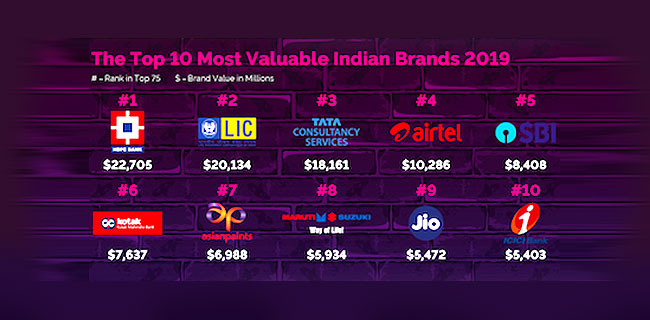
  • HDFC stays as #1 in BrandZ ranking


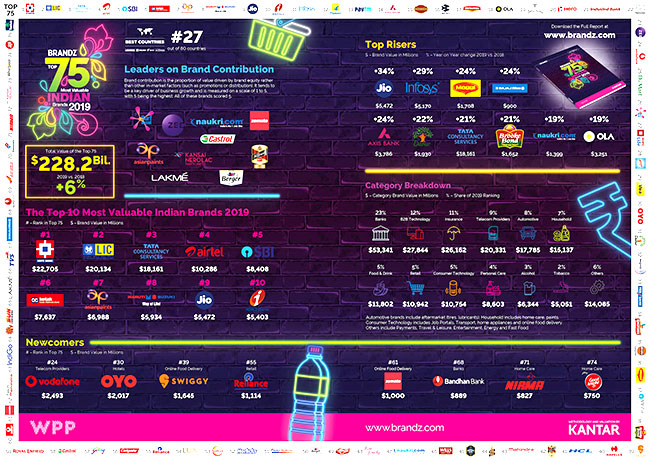
    The BrandZ study, which is the only brand valuation ranking to combine companies’ financial data with consumer insight and opinion, shows that trust is key to develop the stability required for long-term success; highly trusted brands in the Top 75 are worth 129% more than less trusted ones.


    BrandZ Top 10 Most Valuable Indian Brands 2019

    Rank 2019 Brand Category Brand Value 2019 ($M USD) Brand Value Change
    1 HDFC Bank Banks 22,705 +5%
    2 LIC Insurance 20,134 +2%
    3

    Tata Consultancy Services

    Technology 18,161 +21%
    4 Airtel Telecom providers 10,286 -10%
    5 State Bank of India Banks 8,408 +7%
    6 Kotak Mahindra Bank Banks 7,637 +15%
    7 Asian Paints Paints 6,988 +14%
    8 Maruti Suzuki Automobiles 5,934 -14%
    9 Jio Telecom providers 5,472 +34%
    10 ICICI Bank Banks 5,403 +11%


    Notable brands include ecommerce site Flipkart (No. 12), which increased its brand value 14% to $4.7 billion, while unicorn brands hotel booking site Oyo ($2.0 billion), online food ordering service Swiggy ($1.6 billion) and online restaurant marketplace Zomato ($1.0 billion) are newcomers to the ranking at No. 30, No. 39 and No. 61 respectively.


    The fastest riser in the 2019 ranking is telecom provider, Jio, which climbed one place to No. 9 with a 34% increase in brand value to $5.5 billion. Its disruptive business model has made internet access available to many Indians who were previously unable to afford it, thereby opening up access to digital platforms and services. Vodafone ($2.5 billion) meanwhile was the top-ranked newcomer at No. 24.


    Both digital and offline brands such as D-Mart (No. 25, $2.4 billion) have found success as a result of the rise of ‘middle India’; the growing number of people in the country’s second, third and fourth-tier cities and towns that are changing India’s traditional urban-rural divide.  These previously poorly-served segments increasingly have access to a variety of online services, with Swiggy and Zomato building much of their growth on this shift.


    Said David Roth, CEO of The Store WPP EMEA and Asia and Chairman of BrandZ: “As India flexes its muscles on the world stage, it faces increased macroeconomic headwinds which have combined with a rise in global trade tensions to create a challenging environment.  Successful Indian brands are adapting to these challenges and recognising that longevity requires them to do more than just disrupt the status quo; long-term brand building requires new strategies that major on stability.”


    Added Preeti Reddy, CEO South Asia, Insights Division, Kantar: “Consumer trust is a common thread among successful brands. However, it is concerning that only a few have succeeded in growing trust over the last five years. Those who done so, have done it through open and honest conversations with their customers. Brands would do well to consciously work at building consumer trust – it is the shield that gives a brand the resilience to face headwinds in uncertain times.”


    Said Vishikh Talwar, Chief Client Officer, Kantar Insights Division: “The rise of ‘middle India’ combined with rapid growth of the mobile internet is providing unprecedented opportunities for brands.  But, with an almost overwhelming choice of products and services to buy, consumers are increasingly discerning; the Indian psyche requires that brands cater for local needs with offerings that genuinely improve daily life. Today that’s as much about providing comfort and reliability as it is about generating new experiences.”


    Key trends highlighted in the BrandZ Indian Top 75 study include:

    :: Mobile internet access:Smartphone user numbers in India increased by 18% in 2018 (the fastest rate of growth in the world), mainly due to a combination of Jio’s own low tariffs and the renewed competition causing other telecom providers to reduce their rates.


    :: Buying power:Retail is the second fastest growing category, with online and offline both growing strongly. New entrant Reliance Retail (No. 55, $1.1 billion) opened  nearly 500 new stores and used Jio’s service to connect retail shops with grocery deliveries, while D-Mart ($2.4 billion) focused predominantly on offline, rising two places to No. 25.


    :: The Amazon effect: Amazon and Flipkart compete with many Indian brands across several sectors, with Amazon also opening its largest campus yet in India.  This has increased competition and driven brands to step up their operations to ensure they are meeting customers’ needs.


    :: A confident country: The success of unicorn brands such as Swiggy, Zomato and Oyo is fostering a new-found confidence in India. This is augmented with the increasingly global outlook of these new brands as they actively seek to expand their operations outside India.


  • Oyo launches campaign to redesign facades of 1000+ hotels

    By A Correspondent


    Budget hotel network Oyo has announced the rollout of a nationwide campaign ‘City Vibes’, starting with Bengaluru. As a part of this campaign, Oyo will use street artist Kafeel Ahmed Ansari’s (Painter Kafeel) rendition of ‘Bengaluru the Bengaluru Way,’ featuring top hotspots of the city on the facades of  100+ its hotels in Bengaluru. This campaign will see different renditions of the theme City Vibes as it moves to 25+ cities and over 1000 hotels in India.


    Said Burhanuddin Pithawala, VP – Conversions at Oyo: ‘’As a brand, we value the experience of our guests and want to put a smile on their face whenever they are staying with us. Recently, we conducted a survey amongst a select group of our guests in Bengaluru, where 53% of them felt that a good-looking and well-painted exterior is an important factor while booking a hotel. Over 57% of them stated that they may not go ahead with their booking in case a hotel’s exterior doesn’t match their expectations, while over 37% said they will definitely cancel their booking on this ground. With this in mind, we chose to design a colourful facade depicting the top hotspots of Bengaluru, which form the city’s heart and soul. These supergraphics are painted by Painter Kafeel, a street art maestro who hails from a small town in Uttar Pradesh.”


  • #NikalChalein tempts travellers to explore more this weekend

    By A Correspondent


    OYO has launched a new TV campaign “#NikalChalein”. With the 13–15 August long weekend just around the corner, the TVC which rolled out on 5th August, showcases a plethora of emotions of individuals staying in OYO properties. The 15-second ad encourages all to make travelling plans.


    Talking about the TVC, Ritesh Agarwal, Founder and CEO, OYO said, “In our demanding lifestyles today, one hardly gets time off from work and other commitments. The underlying idea of this TVC is to inspire people to make full use of little breaks like the coming long weekend to unwind and explore. Spending a couple of days away from the hustle-bustle of city-life can be incredible for the body and mind. This Independence Day we invite everyone to step out and savour of feeling of Aao Kahin Nikal Chalein.”


    He further adds, “Keeping this in mind, we have launched this campaign, focusing on places that are ideal for short trips. We have more than 200 properties in Udaipur and Shimla, which are amongst the topmost leisure destinations on long weekends. We experience high demand during this period, and as August 15 approaches we are expecting a further spike in bookings.”


    Conceptualised by the in-house team, the commercial is produced by DZU Film Company and directed by Daniel Zenas Upputuru.