The India Today group’s commitment to the media is known. But, then much as emotions and gut influence the way media business and specifically P&L projections are made, Â it’s finally the colour of money or the bank balance that’s the final decider.
We know how it works, albeit in a small, small way.
Last week, we learnt of the news that three editions of the India Today magazine were being shuttered. The Tamil, Telugu and Malayalam were reported to be suspended due to indifferent financial conditions. Sad, not just for the India Today group, but also for print journalism (and journalists) in these three languages where news television seems to be booming.
In radio, last Thursday, the stock exchanges were informed of a “non-binding” MoU being signed between Entertainment Network (India) Ltd, a Bennett, Coleman and Company Limited-promoted company, and TV Today Network Limited, an India Today group-promoted companies. Both ENIL and TVTN are listed in the stock exchanges.
Here’s what the announcement said:
Entertainment Network (India) Ltd has informed BSE that the Committee of Directors of the Board at a meeting held on February 13, 2015, noted that the Company has entered into a non-binding memorandum of understanding with TV Today Network Limited (TVTN), in relation to the proposed purchase of seven radio stations from TVTN, subject to fulfillment of the contractual obligations (which may be agreed between the parties) and receipt of all necessary regulatory approvals including permissions from the Ministry of Information and Broadcasting, Government of India.
Simply put, ENIL, the owners of the Radio Mirchi brand, have agreed to buy Oye FM, the seven-station FM radio network of TVTN, subject to some contractual obligations and government approvals.
Oye 104.8 FM, it may be remembered, had undertaken a high profile relaunch in 2010. It was earlier called Meow FM, working under the same frequency. Meow was a women-centric talk radio station. The TV Today group once also owned Red FM. It exited that venture in 2006.
Two years after making a personal investment in the Aroon Purie-controlled Living Media India – widely known as the India Today Group – for a minority stake, Kumar Mangalam Birla may be planning to cash out. Multiple sources aware of the development said Birla, the chairman of the diversified Aditya Birla Group, has roped in Bank of America Merrill Lynch to help him find a buyer for his minority stake.
In May 2012 Mr Birla picked up a 27.5 stake in the New Delhi headquartered company that straddles the entire media chain, from television to magazines and a tabloid. Living Media Ltd is the holding company and also owns 57.2 per cent in TV Today Network – a listed company that controls the group’s broadcasting assets such as Aaj Tak and Headlines Today – besides the publishing ventures, including flagship India Today.
As per the 2012 agreement, Mr Birla’s holdings were not frozen but were linked to certain financial milestones that the group had to achieve. Currently, the sources cited earlier said, Mr Birla owns a larger equity stake, believed to be around 34-35%. They add that discussions with both strategic and financial investors like private equity funds have been ongoing for a while now. Several leading business groups now have investments in domestic media corporations and more are keen to get a foothold, making this an interesting opportunity.
The option of selling the stake back to the Purie family is also a possibility. Neither Mr Birla nor the India Today Group have ever disclosed the quantum of investment. While some say so far Mr Birla has pumped in Rs 700 crore, others speculate that the amount is half that, around Rs 350-Rs 400 crore. A Birla Group spokeswoman refused comment on what she termed as “market speculation”. The Bank of America Merrill Lynch spokesperson also declined comment.
Even though Mr Birla’s decision has come as a surprise to many, people familiar with his thinking say Mr Birla feels that the government might impose restrictions on media ownership by corporate houses. “Owning media assets can be a double edged sword for corporates.
Governments or political parties can misconstrue the strategic intent of the investment and any criticism or critical coverage can get the corporate owner in trouble. So even if a corporate gets into it, in most cases it would be either through indirect ownerships or personal investments as they would want to derisk the main businesses,” said a person familiar with the thinking behind Mr Birla’s investment. He spoke on condition of anonymity because of the sensitivity of the matter. “It was always a personal investment and there was no business angle to it. There was never any interference into editorial matters or with the management,” added another person, aware of Mr Birla’s investment philosophy with regard to Media.
Mr Purie’s publishing empire, controlled through Living Media, also includes Business Today, a business magazine, and a clutch of licensed magazines such as Cosmopolitan, Good Housekeeping, Men’s Health, Harper’s Bazaar, Travel Plus and Harvard Business Review, among others. It also has a joint venture with German media house, Axel Springer AG, for an auto magazine and an online shopping portal: Bag it today. Additionally, a joint venture with UK-based Daily Mail brings out the tabloid Mail Today.
TV Today has four news channels – Headlines Today, Aaj Tak, Tez and Delhi Aaj Tak – and radio stations under the brand Oye FM. In the June FY14 quarter, TV Today posted a profit of Rs 32.7crore on revenue of Rs 137 crore. It’s current market capitalisation is Rs 908.7 crore.
Interestingly, the Anil Ambani controlled Reliance Capital has been selling down its 7 year old exposure in TV Today.
From a peak equity holding of 14.9%, it has slowly reduced its stake, the latest such sale being in the first week of this month, when it offloaded nearly 4,80,000 shares for Rs 7.38 crore in the open market. With this, R-Cap’s stake in the company has fallen to five per cent.
After a stint of a little more than two years with Oye! FM as the National Programming Head, Vehrnon Ibrahim has decided to call it quits. While his next destination is not known, it is more or less clear that Mr Ibrahim will continue in the radio industry.
Although it is not known who would replace Mr Ibrahim as the National Programming Head, it is learnt that Mr Virag Mishra, the National Content Head at Oye! FM has taken over the mantle for now.
Speaking to MxMIndia, Mr Ibrahim said: “I am leaving behind one of the best teams I have ever had. I know that Oye! FM will continue to grow from strength to strength and will one day be the number one FM radio station under the guidance of Virag Mishra, National Content Head. I wish them all the best for the future.”
“I am looking forward to my new assignments in the radio field which is very exciting and challenging” he added.
At Oye! FM Mr Ibrahim reported to Mr Joy Chakraborty, CEO, TV Today Network. His last working day at Oye! FM was on May 31. Prior to Oye! FM, Mr Ibrahim was the Vice President at Radio One for two years; before his stint at Radio One, Mr Ibrahim was the National Programming Director at Red FM where he worked for seven long years.
Radio is said to be a medium that has been re-born. With the FM Phase III rollout anticipated this year, radio is expected to penetrate further into the country, as a result not only will there be an increase in revenues but, also the fact that newer revenue streams will open up. Multiple frequencies, allowing news and current affairs, sports broadcasting will also bring more innovations in radio, new genre radio stations and great amount of differentiation in content.
Radio’s share of media spends, according to industry estimates, is expected to rise from 4 per cent to 5 per cent in two years. Among categories that advertise on Radio, Real Estate, Telecom, Retail, Education and TV channels are the ones advertise the most.
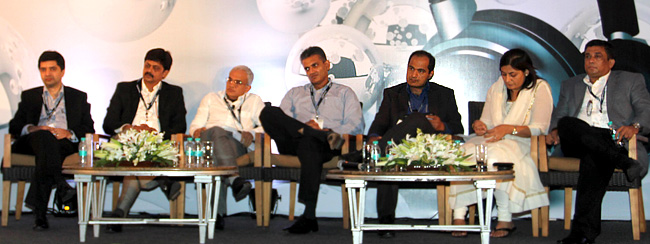
What radio players say?
Harshad Jain
Joy Chakraborthy
Apurva Purohit
B Surender
So, does radio still need to be evangalised? Is radio still insignificant to for advertisers? The India Radio Forum (IRF) 2012 discussed these issues. According to Mr Harshad Jain, Business Head – Radio and Entertainment, HT Media: “From a client standpoint, radio is still an insignificant medium. It all boils down to value addition of the medium – how can radio, as a medium, ensure value addition to its advertisers? The entire orientation has to be more than just vanilla FTCs. Radio is still an under-penetrated medium and has still a long way to go.”
Mr Joy Chakraborthy, CEO, TV Today Network (which includes Oye! FM) pointed out that the Indian radio industry needs to stand united, not only on issues related to government regulations, but also for business related issues. “There needs to be some amount of unity among the radio fraternity. For the industry to survive we must stand together, not just for regulatory issues but even for businesses. Today radio is the most underpriced medium and unity within the industry will help us drive our sales.”
Ms Apurva Purohit. CEO, Radio City was of the view that radio is still at an infancy stage and like any other medium, it will also take some time to evolve. She was quick to point out that television took many years to be what it is today. “Today the ad pie of radio is 4 per cent, the geographical coverage of radio is merely 30 per cent but, with Phase III the geographical coverage will see tremendous increase. Every year the number of advertisers on radio has only been growing, what we need to do now is to encourage these advertisers to spend more on radio and reach out to newer advertisers.”
Mr B Surender, Senior Vice President and National Sales Head, Red FM said: “In the last two years radio saw tremendous growth. With the launch of Phase III also expected soon, the future of radio is certainly bright. Even radio stations outside metros saw tremendous growth, innovations in smaller towns and cities were high and in the next two years radio’s advertising pie is expected to reach 6 to 7 per cent.”
The client perspective:
Few years ago, radio was seen as a supplementary medium for advertisers wherein they would spend only the left over media spends on radio. This is said to be changing, slowly and steadily as advertisers are beginning to take radio seriously. There has also been an increase in the number of on-ground activations which has more or less become complementary for radio stations as a value addition to their clients. However, digital media, which was at one point in time an even smaller medium than radio is today, said to have become an even larger and a more powerful medium than radio and a possible reason could be because Internet, unlike radio, is a highly measureable medium.
Giving a critical view on radio as an effective local medium, Mr Vinay Bhatia, Customer Care Associate and Senior Vice President Marketing and Loyalty said that radio has a very low share of mind and share of value medium to advertisers today. Digital on the other hand, which started off from 2 per cent of advertising share has a much higher share of mind and share of value. “To maximize assets, radio has to deliver business. Radio needs to world closely with clients, it can also look at which area of a city or town works better for clients. It can also partner with retailers to play radio in stores while customers are shopping. Radio is a response medium, therefore it allows a lot of engagement and interaction with listeners. However, there needs to be more innovations for advertisers on radio because clients love innovation and as a result innovation will bring more money for the radio station.”
Arpita Menon, Head-Media Planning & Buying, Star India Pvt Ltd
Premjeet Sodhi, COO, Lintas Media Group
Harshad Jain, Business Head- Radio & Entertainment, HT Media
Mr Shubhranshu Singh, Marketing Director-India and South Asia, Visa explained: “As far as Visa is concerned, radio has delivered us handsome returns. Radio, I believe, is economical and one can expect higher returns, it is certainly a cost effective medium. However, radio must come to clients as an industry and not as one single radio channel – it should be bolder in its approach towards clients and thus stay on top of mind of clients.”
Mr Kartik Sharma, Managing Partner, Maxus had a slightly different take on the medium. He was of the view that radio is the oldest form of social media platform, it allows great amount of interactivity and engagement with the listeners. “Radio is in the business of producing great contents and so are the brands, I believe that both radio and digital can depend on each other. Radio is in the business of providing great content, the power of radio is sound and creativity therefore the mindset to learn this medium is very different.”
Ms Shubha George, COO, MEC noted that in order to maximize radio’s asset and gain share of market spends, it needs to market itself more. She stated that radio today is sold and not marketed, what it needs is more marketing. She also pointed out that the industry must find ways to monetize every single phone calls and SMSes it receives and market them extensively.
The Indian radio industry still needs a lot of evangelizing or marketing of the medium. Radio needs more nurturing, it needs to probably find newer ways of achieving better ROIs and thus increase greater share of media spends. More innovations in radio will also bring in more money and help it stay on top of advertisers’ minds. Radio needs to partner their clients and find newer ways to generate better ROIs for their clients. Radio needs to vigorously market itself to the advertisers and explain the power of the medium so that it becomes a primary medium for marketers.
TAM Media’s Radio Audience Measurement (RAM) – which covers four key metros, Mumbai, Delhi, Kolkata and Bengaluru – released its latest radio listenership figures for wk 13 to wk 16, 2012 (Last week of March to first three weeks of April, 2012). According to the latest RAM data, for listeners of 12 years of age and above, all places of listening, and according to radio channel shares, RadioCity, Radio Mirchi, Fever FM, Big FM, Red FM, Radio One, Oye! FM continue to be the top FM stations in the big four metros.
Mumbai:
Radio Mirchi emerges as the number one FM station in Mumbai with a market share of 15.3 per cent, followed closely byRadioCityat 15.2 per cent. The two FM stations are closely competing for the top spot, but what remains to be seen is which of these two FM stations retains the top spot. AIR FM2 Gold, Fever FM and Big FM make the top five FM stations in Mumbai. The other FM stations in the Mumbai market include Red FM, Radio One, Oye! FM, AIR FM1 Rainbow, Vividh Bharati and Akashavani.
Delhi:
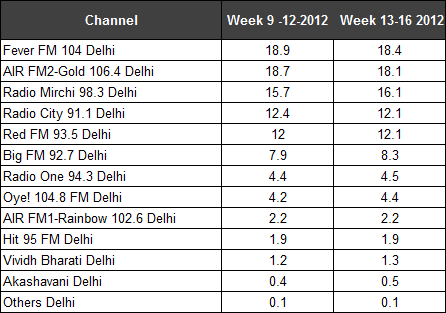
Fever FM continues to be the most popular FM station in Delhi with a market share of 18.4 per cent, its nearest rival is the AIR FM2 Gold which is comfortably placed at number two with 18.1 per cent market share. Ranked three is Radio Mirchi followed by RadioCity which is ranked four and Red FM as ranked five in theDelhimarket. The rest of the FM stations in Delhi include Big FM, Radio One, Oye! FM, Hit FM, AIR FM1 Rainbow, Akashavani and Vividh Bharati.
Bengaluru:
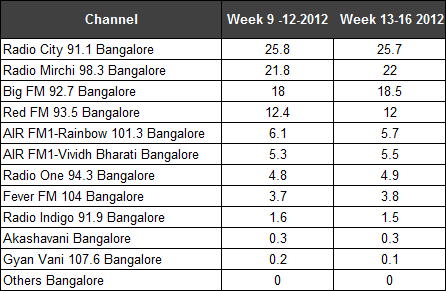
RadioCity continues to maintain its leadership position in the city. RadioCity, Radio Mirchi and Big FM are the top three most popular FM stations in Bengaluru. RadioCity received a market share of 25.7 per cent whereas Radio Mirchi and Big FM received a market share of 22 per cent and 18.5 per cent respectively. Ranked four is Red FM with 12 per cent and the fifth most popular FM station is AIR FM1 Rainbow with 5.7 per cent. The other FM stations in Bengaluru include AIR FM1 Vividh Bharati, Radio One, Fever FM, Radio Indigo, Akashavani and Gyan Vani.
Kolkata:
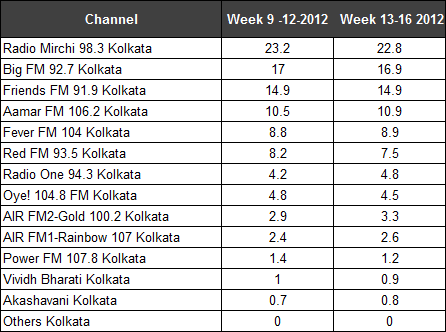
Radio Mirchi is the clear winner in Kolkata with a market share of 22.8 per cent. The top three FM stations in Kolkata haven’t changed as Radio Mirchi continues to be the number one FM station of the city followed by Big FM with a share of 16.9 per cent and at the number three FM station of Kolkata, Friends FM received a share of 14.9 per cent of the share. Ranked four and five are Aamar FM and Fever FM with a share of 10.9 per cent and 8.9 per cent respectively. The other FM stations in the city are Red FM, Radio One, Oye! FM, Power FM, AIR FM1 Rainbow, AIR FM2 Gold, Vividh Bharati and Akashavani.
TAM Media’s Radio Audience Measurement (RAM) – which covers four key metros, Mumbai,Delhi, Kolkata and Bengaluru – released its latest radio listenership figures for Wk 8 to Wk11 (Last two weeks of February 2012 and first two weeks of March 2012).
According to the latest RAM data, for listeners of 12 years of age and above, all places of listening, and according to radio channel shares,RadioCity, Radio Mirchi, Fever FM, Big FM, Red FM, Radio One, Oye! FM were some of the top FM stations in the big four metros.
WhileRadioCityretained its leadership position in Mumbai and Bengaluru, Fever FM and Radio Mirchi also continued to remain the leading FM stations inDelhiand Kolkata respectively.
Mumbai:
RadioCitycontinues to be the most popular FM station in Mumbai, as the FM station has maintained its leadership position in the city. Ranked second is Radio Mirchi followed by AIR FM2 Gold, Fever FM and Big FM which are ranked third, fourth and fifth respectively. These top five FM stations and Red FM, ranked sixth have secured their listenership share in double digits. The other FM stations in the city include Oye! FM, Radio One, AIR FM1 Rainbow, Vividh Bharati and Akashavani Mumbai.
Delhi:
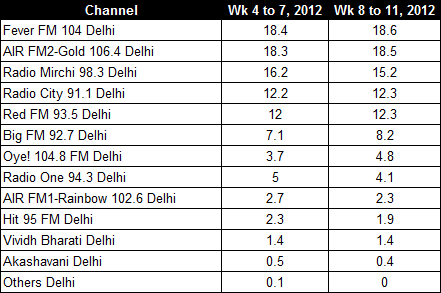
According to the Wk8 to Wk 11 RAM data, Fever FM has once again retained its leadership position inDelhiwith a listenership share of 18.6 per cent followed by AIR FM2 Gold which garnered a share of 18.5 per cent. Although Fever FM is the number one FM station ofDelhi, the government owned AIR FM2 Gold is a close second. What remains to be seen is whether Fever FM is able to widen the gap between the number one and number two FM station? Or will AIR FM2 Gold claim the leadership title? Once the undisputed leader ofDelhi, Radio Mirchi is now ranked three with a share of 15.2 per cent followed byRadioCityand Red FM with a share of 12.3 per cent respectively. The top five FM stations have received their station share in double digits. The other cluster of FM stations inDelhiincludes Oye! FM, Radio One, AIR FM1 Rainbow, Hit FM, Vividh Bharati and Akashvani Mumbai.
Bengaluru:
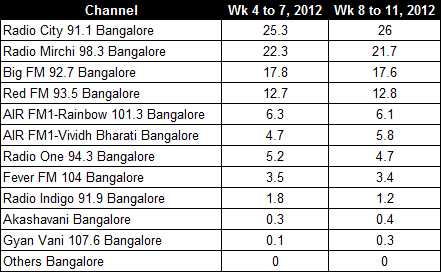
RadioCitymaintained its leadership position in Bengaluru with a share of 26 per cent, its nearest rival Radio Mirchi, on the other hand, received a share of 21.7 per cent. Ranked three is Big FM with a share of 17.6 per cent followed by Red FM which received a share of 12.8 per cent. While the top four FM radio stations in Bengaluru received a double digit share, AIR FM1 Rainbow which is ranked five received a share of 6.1 per cent. The other clusters of FM station in the city are Fever FM, Radio One, Radio Indigo, Gyan Vani, Akashavani and Vividh Bharati.
Kolkata:
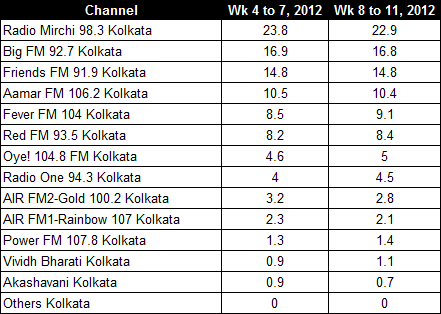
The top five FM stations of Kolkata continue to remain the same. Radio Mirchi is unanimously the most popular FM station in Kolkata with a whopping 22.9 per cent of the station share. Its nearest rival is Big FM which received a share of 16.8 per cent followed by Friends FM and Aamar FM which are ranked four and five respectively. Kolkata is the only RAM market which perhaps has not seen a change in the top four rankings in a long time. While Fever FM and Red FM are ranked five and six respectively, other clusters of FM station in Kolkata are Oye! FM, Radio One, Power FM, AIR FM1 Rainbow, AIR FM2 Gold, Vividh Bharati and Akashavani Kolkata.
TAM Media’s Radio Audience Measurement (RAM) – which covers four key metros, Mumbai,Delhi, Kolkata and Bengaluru – released its latest radio listenership figures for Wk 4 to Wk7 (Last two weeks of January 2012 and first two weeks of February 2012).
According to the latest RAM data, for listeners of 12 years of age and above, all places of listening, and according to radio channel shares,RadioCity, Radio Mirchi, Fever FM, Big FM, Red FM, Radio One, Oye! FM were some of the top FM stations in the big four metros.
Mumbai:
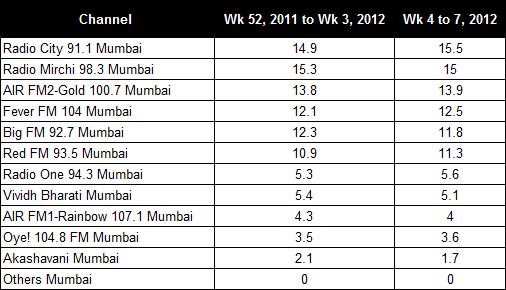
Radio City surged ahead of Radio Mirchi as the most popular FM station in the city with 15.5 per cent channel share from Wk 4 to Wk7, 2012 whereas Radio Mirchi’s channel share stood at 15 per cent. Ranked three is AIR FM2 Gold which more or less remained unchanged in listenership share from wk 4 to 7, 2012 as against Wk 52, 2011 to Wk 3, 2012. As compared to Wk 52, 2011 to Wk 3, 2012, six FM stations witnessed growth in their listenership share in Wk 4 to Wk 7, 2012 namely, Radio City, Fever FM, Red FM, Radio One, Oye! FM and AIR FM2 Gold.
Source : RAM
Market: MUMBAI
Demographic: All People 12+ Filter Demographic: None
Statistic: Share %
Daypart: Sun – Sat 12:00 AM – 12:00 AM
Place of Listening: All
Delhi:
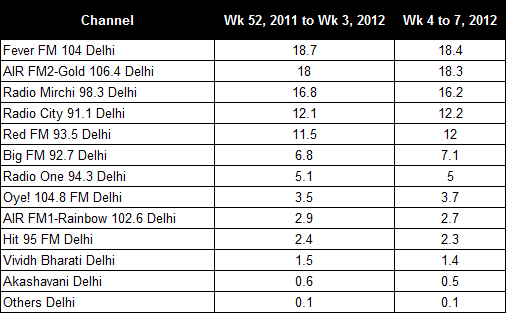
Fever FM once again manages to retain its leadership position inDelhi, its nearest rival in Delhi is Radio Mirchi, if the government owned AIR FM2 Gold is excluded. According to figures for Wk4 to Wk 7, 2012, AIR FM2 Gold is close behind Fever FM for the top spot. What remains to be seen is whether or not Fever FM is able to retain its leadership position inDelhi.
The Wk4 to Wk 7, 2012 RAM numbers reveals that in comparison to Wk 52, 2011 to Wk 3, 2012 only five FM stations witnessed any growth in the Delhi market. The FM stations to have seen growth in their listenership shares are Radio City, Big FM, Red FM, Oye! FM and AIR FM2 Gold.
The other FM stations in the Delhi market are Radio One, Hit FM, AIR FM1 Rainbow, Vividh Bharathi and Akashavani Delhi.
Market: DELHI
Demographic: All People 12+ Filter Demographic: None
Statistic: Share %
Daypart: Sun – Sat 12:00 AM – 12:00 AM
Place of Listening: All
Bengaluru:
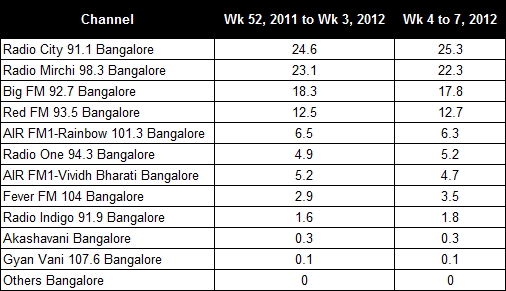
In Bengaluru too, Radio City continues maintain its numero uno position, the FM station has managed further grow its listenership share in Wk 4 to Wk 7, 2012 as against Wk 52, 2011 to Wk 3, 2012. The second most popular FM station in Bengaluru is Radio Mirchi followed by Big FM and Red FM, ranked third and fourth respectively. Ranked fifth is AIR FM1 Rainbow and Radio One is ranked sixth. The five of the eleven FM stations in the Bengaluru market which witnessed growth in listenership share areRadioCity, Red FM, Radio One, Fever FM and Radio Indigo.
Market: BENGALURU
Demographic: All People 12+ Filter Demographic: None
Statistic: Share %
Daypart: Sun – Sat 12:00 AM – 12:00 AM
Place of Listening: All
Kolkata:
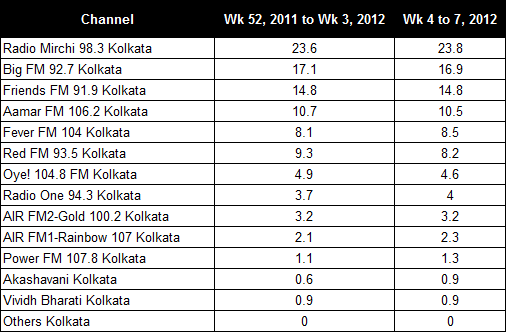
Radio Mirchi has not only maintained its leadership position in the city, but has also witnessed some growth according to the Wk4 to Wk 7, 2012 RAM data as against Wk 52, 2011 to Wk3, 2012. Kolkata is the only RAM market to have seen no change in atleast the top three rankings. Radio Mirchi, Big FM and Friends FM continue to be the top three FM stations in the city. Ranked four is Aamar FM, followed by Fever FM, Red FM and Oye! FM. Of the thirteen FM stations in Kolkata, six FM stations in the city have witnessed growth in their listenership shares: Radio Mirchi, Fever FM, Radio One, Power FM and AIR FM1 Rainbow. Although Friends FM remained stagnant in its listenership share, nevertheless it is comfortably placed at number three. The other FM stations in the Kolkata market include Radio One, Power FM, AIR FM1 Rainbow, AIR FM2 Gold, Akashavani Kolkata and Vividh Bharati.
Market: KOLKATA
Demographic: All People 12+ Filter Demographic: None
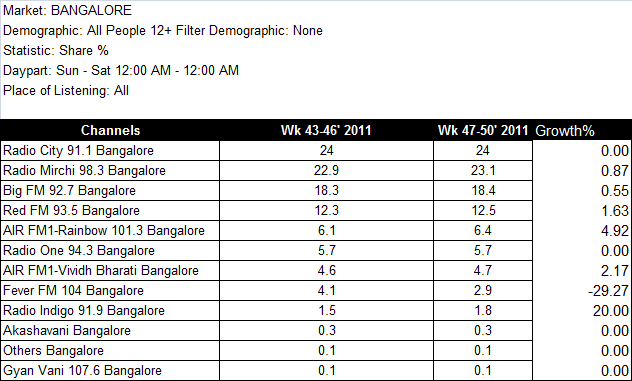
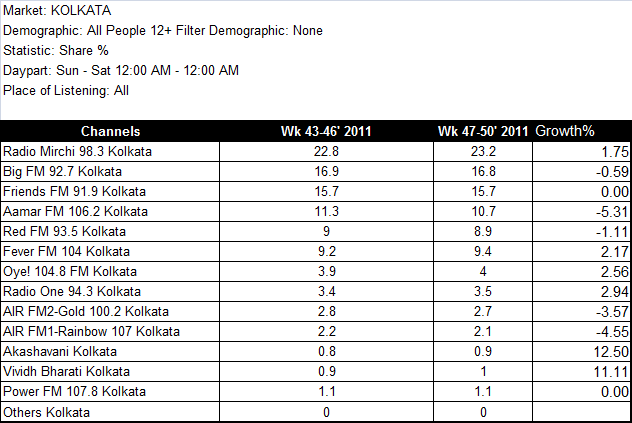
On Friday, January 6, 2012, Radio Audience Measurement (RAM) – which covers four key metros, Mumbai, Delhi, Kolkata and Bengaluru – released its latest radio listenership figures for Wk 43-46 (last two weeks of October and 1st two weeks of November 2011) Vs Wk 47-50 (Last two weeks of November and 1st week of December 2011).
According to the latest RAM data, for listeners of 12 years and above, and according to radio channel shares, Radio City, Radio Mirchi, Big FM, Red FM, Fever FM, Radio One, Oye! FM were some of the top FM stations in the big four metros.
Mumbai:
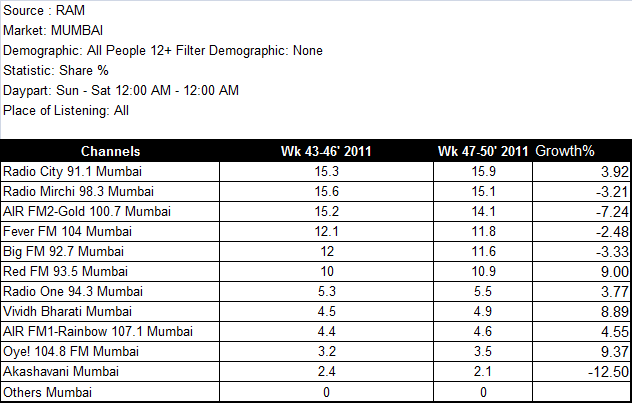
In Mumbai,Radio City further strengthened its leadership position in Wk 47-50 as against Wk 43-46 with a growth of 3.92 per cent in its channel shares. Radio Mirchi was rated the second most popular FM station in terms of channel shares followed by AIR FM2 Gold, Fever FM, Big FM, Red FM and Radio One. The other clusters of FM stations in the city are Oye! FM, Vividh Bharati, AIR FM1 Rainbow and Akashavani Mumbai.
Besides Radio City, Red FM, Radio One, Oye! FM, AIR FM1 Rainbow, Vividh Bharati and Akashavani Mumbai are the only radio stations to have shown growth.
Delhi:
Most radio stations inDelhiwitnessed growth in the channel shares in Wk 47-50 as against Wk 43-46. AIR FM2 Gold emerged as the number one FM station inDelhi, its channel share however remained stagnant. Fever FM slipped to the number two position in Wk 47-50 after its channel share saw a decline as compared to Wk 43-46. Fever FM and AIR FM1 Rainbow were the only two FM stations inDelhito have seen a decline in channel shares on Wk 47-50 as against Wk 43-46.
Radio Mirchi was the third most popular FM station followed by Red FM, Radio City, Big FM, Radio One, and Oye! FM. The other clusters of radio stations inDelhiinclude AIR FM1 Rainbow, Hit FM, Vividh Bharati and Akashavani Delhi.
Bengaluru:
There was no change in the station rankings in Bengaluru.Radio City continued to lead Bengaluru followed by Radio Mirchi and Big FM. While Radio City showed neither growth nor decline in its channel share, Radio Mirchi and Big FM saw marginal growth. Fever FM, however, was the only FM station that showed decline in its channel shares.
Kolkata:
Kolkata too saw no change in its station rankings. Radio Mirchi, Big FM, Friends FM, Aamar FM and Red FM were the top five FM stations in Kolkata in terms of their channel shares. Radio Mirchi, the most popular FM station in Kolkata has further strengthened its leadership position with a growth of 1.75 per cent in channel shares in Wk 47-50 as compared to Wk 43-46.
While Radio Mirchi’s nearest rival in Kolkata, Big FM came a distant second with a slight decline of 0.59 per cent in terms of its channel share, the third most popular FM station in Kolkata, Friends FM remained stagnant. Besides Radio Mirchi, Fever FM, Oye! FM and Radio One were the only private FM stations in Kolkata to have witnessed growth in channel shares.
 By A Correspondent
 Radio is said to be a medium that has been re-born. With the FM Phase III rollout anticipated this year, radio is expected to penetrate further into the country, as a result not only will there be an increase in revenues but, also the fact that newer revenue streams will open up. Multiple frequencies, allowing news and current affairs, sports broadcasting will also bring more innovations in radio, new genre radio stations and great amount of differentiation in content.