By Indrani Sen
 Ormax Media, a specialised Insights consultancy firm, was established in 2008. In its own words: “Over the last 13 years we have pioneered the usage of various testing, tracking and forecasting-based tools, designed to achieve higher profitability in films, television, streaming, print, radio and other categories in the Indian media industry… We are constantly innovating to introduce new tools and build knowledge that can help the Indian media & entertainment industry use consumer insights and data analytics to create businesses, brands, shows, films and campaigns that are both consumer-centric and profitable.”
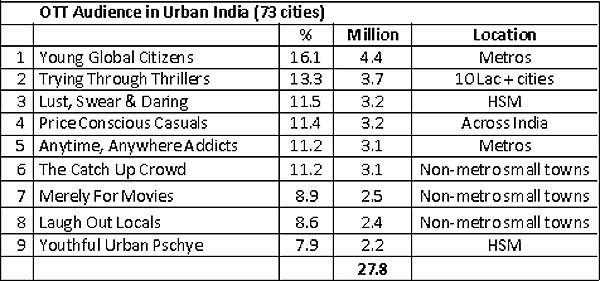
Ormax Media launched the first edition of its Ormax OTT Audience Report 2019 with a promise to conduct similar reports year on year. In its first report, Ormax analysed the viewing behavior by preference of content watched and divided the urban OTT audience into interesting segments of nine different types.
The onslaught of Covid-19 and the national lockdown forced them to miss the opportunity of conducting field research in 2020. But Ormax was back in 2021 with the 2021 report based on a 12,000 sample size across urban and rural India. As per that report, OTT audience universe in India in 2021 stood at 353.2 million (35.32 Crore) people. In other words, the penetration of OTT viewing was of 25.3% of the population, “which means that one in four Indians watched online videos at least once in the last one month”. The report was aligned to other syndicated media research and presented analysis of the universe by gender, age, NCCS, pop strata, states and cities. This second report elevated OTT from a niche medium to a mass medium with huge prospect for further growth. It was possible to calculate reach of the OTT medium in different target audiences for the first time. The report also revealed that in 2021 there were 353 million OTT users in India of which 40.7 million were paying (SVOD) audiences accounting for 96 million active OTT subscriptions. In other words, each unduplicated paying audience member was subscribing to 2.4 OTT subscriptions on an average. This SOVD audience were dominated by male members who constituted 66% of 40.7 million.
Last month, Ormax Media released The Ormax OTT Audience Report 2022, which has some interesting insights related to viewing habits of OTT audiences including content watched in different languages. The latest report is based on a sample size of 6,000 SVOD and AVOD audiences in urban India, and is probably India’s largest profiling study of the streaming /OTT audience.
The report has revealed that Indian SVOD viewers use the dubbing and subtitling options on their OTT platforms and watch content in four to five languages on an average, while AVOD viewers watch in at least two languages, primarily due to less content options available to them. AVOD viewers watch a lot of content on YouTube where no dubbed content available.
Content in the four South Indian languages have a large audience outside their home states, 88 per cent Malayalam SOVD content viewers and 82 per cent Tamil SOVD content viewers are respectively from outside Kerala and Tamil Nadu.
This research also has highlighted the difference in preferences for content between SOVD and AOVD audiences. The latter do not prefer to use web series instead they want more of shorter formats, like comedy scenes, songs, knowledge videos, including recipes, education and health, and films.
The research has predicted that the next level of growth of SOVD viewers would come from small towns as 60-70 per cent of the top six metros’ population has already converted to SVOD audience, making the metros a near-saturated market. The male domination of the SOVD audience segment continues which may be due to other socio-cultural reasons and not just financial independence of women.
On the whole, The Ormax OTT Audience Report 2022 has opened up a new vista of opportunities for content strategy and content creation for the Indian OTT platforms. It is interesting to note that Ormax media so far has not repeated any research on OTT audience in India, but has looked at a new concept for research every year to provide the users in the industry with either better estimates or in-depth insights.

 Over the last seven weeks, following Sushant Singh Rajput’s death, allegedly by suicide, a murky Bollywood story has been playing out in the media. It started with a nepotism narrative, and has eventually snowballed into a larger controversy that’s an incoherent concoction of various sub-narratives, including nepotism, clique culture, allegations of a botched-up police investigation, celebrities using Rajput’s death to make their presence felt, and journalists using his death to get some primetime traction. There’s neither class nor grace in any of this, and one only wishes that chapter is resolved and closed soon within the legal framework.