Tag: online media

  • Could Indian mags go the Newsweek way?


    By Ananya Saha


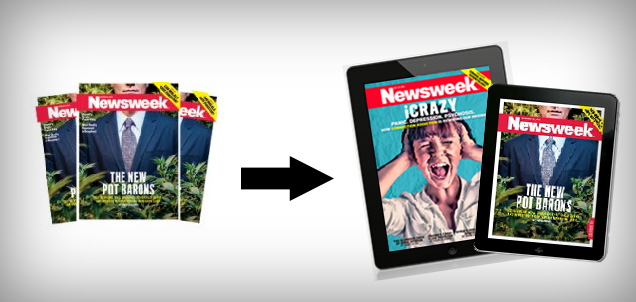
    Newsweek, founded nearly eight decades ago, is moving to a digital-only product from 2013. According to editor-in-chief Tina Brown, it cost $42 million a year to manufacture, print, distribute, and manage the circulation of Newsweek.


    Newsweek is in the best position to go completely digital due to their strong online presence through Daily Beast. But the news has sounded an alarm bell for print magazines all around the world. As news becomes a 24/7 affair and people prefer online access, the readership of news magazines is on decline the world over. It is no wonder then that magazines are reaffirming their presence in the online space too. With Kindle usage on the rise, e-magazines are creating waves.

     

    Tarun Rai

    Even as Indian print industry continues to see new launches, the readership is on the decline (though a minor slide), as recorded by recent IRS figures. “I am not very surprised at the decision. I believe the issue for Newsweek is the nature of the magazine it is. As a result, the relevance of a weekly ‘news digest’ has diminished. It is not a question of print or digital – it is a question of the nature of some magazines that may not be as relevant today. The same cannot be said for lifestyle and special interest magazines,” opined Tarun Rai, President of the Association of Indian Magazines and CEO, Worldwide Media.


    Suggesting that print media still has a bright future, Paresh Nath, Editor and Publisher, Delhi Press said, “It is more of a failure of a publisher than the sunset of an industry. Printed books and material will continue to be relevant as they were in the last several hundred years.” Agreeing that the digital market for Newsweek may have matured earlier than the publishers expected, Pradeep Gupta, chairman and managing director of CyberMedia, said, “In the market they are operating in, digital is growing very rapidly and therefore Newsweek has moved in that direction.”


    The predicament of the dawn of the digital era has been repeated often in the Indian context.


    “I am happy to say that magazines are already re-inventing themselves for the digital world. Abroad as well as in India. All our magazines are available in their digital versions. We are also aggressively developing various magazines’ apps and will be launching them soon. We see an opportunity in reaching a new younger audience through our digital initiatives,” said Mr Rai.


    Even while most magazines have moved towards digital and print versions simultaneously, the print version remains important for reaching the wider audience of readers and advertisers. Time magazine also has responded with their online version adaptable to any platform and any size, particularly for mobile reading. Varghese Chandy, Chief General Manager, Marketing Advertising Sales at Malayala Manorama said, “Reinventing needs to be done not only for news magazines, but every single product for its survival.”


    According to Anilkumar Sathiraju, AVP & Head, DDB MudraMax – Media, South, revenue will still come from print version since revenues from digital in India are still at a nascent stage, even though digital penetration is increasing rapidly. Going forward, he predicted that revenues will still be higher from offline magazines.


    Magazine have the most engaging format with the deepest touch points according to various international surveys. The growing numbers of tablets reassert the fact that this is the platform that gives the closest magazine-reading experience. Mr Chandy said, “However, monetizing the digital platform will be a greater challenge even for Newsweek.”


    While the industry believes that magazines should be ready for the digital era, Mr Nath holds an interesting view: “Magazines do not need to reinvent themselves due to the digital onslaught. Digital delivery of content is like delivering content in Times Square by shouting when hundreds of voices are simultaneously trying to convey the same or similar things. When crowds assembled in Tahrir Square, Cairo, it was thought that the digital media is a powerful weapon, as sentiments were whipped up not by newspapers but by digital media. What is the end result? Muslim Brotherhood that conveys thoughts through printed material ultimately got into power. Very little original content is created on digital media. It only copies and pastes and does so millions of times over. Magazines or print versions of newspapers do not know how to overcome the shouting match where noise and not seriousness is the basic currency. When the time of reckoning comes, people will have to go to the print version, and magazines and newspapers will remain relevant. Magazines have to find out how to outgrow the noise.”


    Delivery is still an issue – from readers visiting libraries in the past for content consumption, to wanting the content delivered to them. “Print brands have given up the will to fight and are trying to join the digital crowd that has weapons stolen from print itself. Yes, the world of delivery has changed, not consumption of content,” said Mr Nath.


    But with readers wanting immediate access to content, 24×7, digital is only going to grow. It is time that that magazines move faster towards the digital era, according to Mr. Sathiraju.


    The way forward

    “In India, spend on magazines continues to grow because of an increase in literacy, increase in disposal income and lower internet penetration. Therefore, Indian publishers are embracing digital formats. Print advertising is currently 10 times the digital advertising in India. Over the next five years, the penetration of digital will increase. And that is why CyberMedia has reoriented its strategy around creating of a media mesh,” predicted Mr Gupta.


    Mr Nath said that the question of digital versus print comes from the English-educated class in India. He said, “Long ago in India, content used to be created and consumed under the banyan tree. Now it is in front of a screen but the quality of this content is poor, one-way, where hundreds speak and no one listens. In India among the English educated there is a problem as this class cannot enjoy English content (is there any English Indian serials or English Indian movies or English Indian music?) whether in print or on digital media. This class keeps shouting that print is dying as it does not know how to ‘read’ in any language.”


    The view might hold true but the increased consumption of magazines on digital platforms cannot be ignored.


    “It’s anybody’s guess as to when the digital versions of magazines will become bigger than the printed ones. I firmly believe that the lifestyle and special-interest magazines space will continue to grow in both. It is the sunrise sector of Indian media. And both the print as well as the digital versions will grow, allowing our content to reach an even wider audience,” said Mr Rai.


    As Mr Chandy concluded, “The Indian print industry needs to be ready for the future. Currently online penetration is single-digit. This is likely to change in the near future, especially in the metros.” Thus, publishers need to be platform-agnostic and essentially become content managers. Their primary task will be to reach the audience through whichever platform is relevant.

     

  • Digital, the efficient earner: B N Chandrakanth, Theorem

    By Robin Thomas


    Theorem, a technology company focused on digital marketing or online media operations, started at a mere number of four, and today has over 1000 people  with offices in the Americas, Asia Pacific, Europe and the Middle East. The company provides a broad suite of digital solutions in areas ranging from creative services and media operations to reporting and analytical services. In conversation with MxMIndia, Chandrakanth B N, Co-Founder and Managing Director, Theorem India, spoke at length about the company’s journey over the last ten years since its foundation in 2002. He also spoke about his India plans, specifically post Rs 100 crore investments in India, and much more.


    Q: From mere 4 people in the organisation, today Theorem is said to be more than a 1000 in just 10 years, over 150 clients… What are the key drivers that have led to this success?

    We are more of a technology player in this domain. One of the biggest growth drivers for Theorem has been the growth of the digital media over the last 10 years. Even in mature markets like the US, the overall ad spends going to digital was only 7 percent; the digital ad pie has of course doubled over the years. We set up our company with the vision to focus on the digital media operations domain. What we brought was the strength of the strong Indian IT service business ie efficiency and technical knowledge, while keeping the costs low for our clients. This became very attractive to our clients in the west, and so our team achieved better quality service delivery than their own teams based in New York or San Francisco etc. Hence, it was very attractive for companies in the digital media space whether it is an agency or publishers or technology companies to work with us because we brought in both domain expertise plus we brought in the scales of operations and very importantly the technical knowhow and skills required. These are some of the factors that I believe helped us grow in the last 10 years.


    Q: What would you say are some of the learnings so far in the last 10 years?

    Digital offers the most cost-effective way of communicating or advertising. Not just cost-effective, but it is very effective in terms of reach as well. When we started, display and email were two big key drivers for digital marketing. Right after we started, Google took off, which basically brought in search marketing and so search became a key element of the digital marketing eco-system. We adapted to these changes and then obviously social media came along and mobile came along. So we have seen an evolution of different media vehicles within the digital sphere. We also saw a lot of technological innovation happen within this domain. The evolution of this space has been very fast and there has been so much technology coming in, and there has been much more efficiency too.


    Q: So, has there been a change in the way the marketers have approached digital media over the years?

    Absolutely. Since we have largely worked with western markets, we have definitely seen that change wherein marketers or brands are adapting to digital a lot more. We can see that in the numbers ie doubling of the digital ad spends from 7 to 14 percent. There is a lot more awareness about the effectiveness of digital advertising in the western markets and marketers are also a lot more demanding as far as their requirements from the media are concerned. It is a fairly mature market today.


    India on the other hand is still an evolving market. Marketers here need a lot more education to understand the benefits of the digital media, its effectiveness in delivering better ROIs, how digital is going to be different from the traditional media, and so on… So, there is still a fair bit of education that is required. We are seeing changes and I believe a company like ours can play a huge role in educating the Indian marketer. I still believe that there is a lot to be done in the Indian market.


    Q: What are your India-specific plans? Theorem will be investing Rs 100 crore in India over the next 3-4 years… What is the nature of these investments?

    We have a large facility and teams based out of India, supporting our global clients right now and so we are looking at expanding on that. In Mysore we have our own campus and we are looking at expanding that. More importantly though we are looking at India as a market and how we can take our domain expertise and add value as opposed to being a large-scale IT support organization. We are also trying to be in the forefront of the marketing itself and help with more innovation. So, yes in the next four to five years we are looking to expand our operations from both facilities and team perspective which is potentially a Rs 100 crore investment.


    Q: You have two offices in India, Mysore and Bangalore… Any expansion plans within India?

    Yes, as the industry evolves further this is definitely a possibility. It is nevertheless early years for us, but we are definitely looking at probably newer cities, newer regions. The operation centers are in Bangalore and Mysore right now so that may continue to grow in these regions but, if we see the need we may even look at other regions.


    Traditionally US has always been a very large market for us, UK would be the next largest and then Europe but, where we are really seeing growth is in regions like Australia and Middle East. In India we have to do a lot of work in terms of creating solutions and that is what we are working on right now. India as a market is very interesting for us, and we are definitely seeing growth in some of the non traditional markets as well.


    Q: What is the business model you follow? Which of your services bring bigger share of revenue – creatives, media operations, analytics, consulting? Any newer services we would see you introduce this year or in the near future?

    Right now we are an IT services company supporting the digital marketing world. Largely we provide experienced or trained resources to support online media operations. So, this is really our business model, it is a traditional IT services model but, then we are obviously trying to move up the value chain and provide more high-end services for some of the local markets.


    Our revenues are spread evenly across our services, our media operations have been a big portion of our business and all the other services are also growing quickly as well. We are working on some new solutions and products, a couple of which we will launch soon. Some time later this year we will be launching another product and some time next year we aim to bring in some more innovative solutions to the market.


    Q: What rich media services does Theorem provide?

    Theorem provides end-to-end rich media services including creative development, trafficking and QA (quality assurance), across a range of media including mobile, email, banner ads, landing pages and micro sites. Furthermore, our expertise spans technologies including MediaMind, DoubleClick Studio, Eyewonder, PointRoll, and Flashtalking among others. Theorem strength and key differentiation lies in its depth of knowledge and breadth of services in providing rich media QA that’s extremely complex and highly evolved. In fact, we are one of the very few firms globally that offer this service to our clients.


    Q: And what do you think are the biggest concerns or challenges that Indian markets face, as far as rich media ads are concerned?

    Bandwidth issues in India are a big concern as the internet infrastructure needs to mature a lot more for the mobile rich media ads to become more popular. I believe it has to evolve, the infrastructure needs to get better and I think once we see our infrastructure improve rich media ads will also get more popular.


    Q: We have been witnessing some consolidations in the digital industry, with a lot of mergers and acquisitions lately… What is your take on these developments? Good signs for the industry?


    I believe it is a sign of maturation for the digital industry in India. I personally think it is a good sign; there is a lot of focus on India. So, as the market matures, our internet infrastructure gets better, and we are able to convince the marketers that digital is a more effective medium for them to start leveraging. We have a huge youth population and they are all going to get on the internet and the easier it gets to log onto the internet, obviously the larger the population you will have to market to. Therefore all our tier II and tier III cities need to get better bandwidth and internet infrastructure.


    Q: And are we going to see Theorem too acquire some agencies soon …?

    Potentially yes. There is always a possibility of this as we grow …


    Q: What kind of impact did the global economic conditions have on your international and India business? Did it have any impact on the industry?

    Interestingly, we never saw never saw a slowdown in the last 10 years. In fact 2008-09 were one of the biggest growth years for us. During the slowdown we have been hiring and giving raises. So digital provides a cost-effective means of communication and advertising. During the years of slowdown more people look at cost benefits of digital advertising. Although the overall spends may shrink, the piece of the pie is definitely going to increase for digital during these times.


    Q: What are your growth targets and goals over the next one or two years?

    We are looking to double by the end of 2015…