
Tag: Omnicom Group

  • 22feet in talks with Omnicom Group for an acquisition deal

    By Shephali Bhatt


    22feet, a digital agency founded by Brijesh Jacob, Deepak Nair, Vineet Gupta and Vinod Moolacherry, is rumoured to be in talks with Omnicom Group (India) for an acquisition deal.


    Sources with knowledge of the discussions say TribalDDB, the digital unit of DDB Mudra Group, will be dismantled, and 22feet will become the Omnicom Group’s digital unit after the acquisition is complete. (Omnicom is the holding company that owns DDB Mudra.) Both Brijesh Jacob, founder of 22feet, and Madhukar Kamath, Group CEO & MD of DDB Mudra Communications, were unavailable for a comment at the time of filing this report.


    With a roster that includes Fastrack, Axe and Red Bull, 22feet has been a target for acquisition for a while now. This comes close on the heels of another similar development: the imminent acquisition of the Indian operations of Saatchi & Saatchi by independent agency Law & Kenneth.


    The common factor among both Tribal DDB and Saatchi & Saatchi is they are established global brands that have not been able to make too much of an impact in the Indian market.


    In a shift in trend, instead of acquiring key talent, holding companies like Publicis (which owns Saatchi & Saatchi) and Omnicom are considering handing the operations over to homegrown set-ups that have managed to make an impact. If both these deals come through, it is most likely to give a fillip to independent agencies across categories and specialisations.


    Source:The Economic Times

    Copyright © 2013, Bennett, Coleman & Co. Ltd. All Rights Reserved

    Licensed to republish


  • Rajesh Mani joins Commonwealth as ECD

    By A Correspondent


    Rajesh Mani has come on board Commonwealth as Executive Creative Director at the Mumbai office. Mr Mani has moved to Commonwealth from Leo Burnett and has 12 years of experience in creating distinct and memorable work.


    He co-created, with Rajiv Rao, the hugely popular Blackberry Boys version 1 and also wrote the much loved song for Blackberry Boys. He has also done some acclaimed films like Hutch callertunes, Vodafone 60P/minute film and was also part of the core team that launched the Zoozoos. His other internationally acclaimed work was for the global launch of Lenovo X300 laptops with a film that was showcased during the Beijing Olympics titled ‘The Flying Sumos’.


    Mr Mani, or Mani as he likes to be called, said: “Leo Burnett was a leap of faith. At Ogilvy, I worked on one of the best brands in the country, Vodafone. Commonwealth offered an exciting prospect of working on one of the biggest car brands in the world at a global level and a rare opportunity to interact and imbibe from the best in the business – Prasoon Joshi, Jeff Goodby, Linus Karlsson and Washington Olivetto. On a global platform like Commonwealth, it is important to understand the finer points of cross-cultural communication challenges and pegging ideas on simple human truths that are geography agnostic.”


    Prasoon Joshi said: “Am really pleased that Rajesh Mani is a part of Commonwealth. He has tremendous experience and talent which will further strengthen the operation. I am positive that Rajesh will be instrumental in creating and delivering stellar quality work.”


    Commonwealth is a first-of-its-kind 50-50 joint venture, combining San Francisco-based Goodby, Silverstein & Partners, an Omnicom Group company, and New York-based McCann Erickson Worldwide, an Interpublic Group company. In forming the joint venture, Commonwealth combines a wealth of creative talent, extensive global automotive experience and strategic business leadership that is unique in the industry.


  • Global ad biggies like Omnicom, Publicis & Dentsu in hectic parleys to buy Taproot

    By Neha Dewan & Ravi Balakrishnan


    In 2011, when Taproot snatched two big-ticket assignments, PepsiCo and Airtel – both JWT clients – the joke was that JWTstood for Just Went to Taproot.


    Now JWT may just have to be shuffled around to become TJW – or Taproot Just Went – now that a clutch of global ad networks are in hectic parleys with the founders of the five-year-old independent Indian agency. Those in the fray, said a person familiar with the negotiations, include the Omnicom group, Publicis and Dentsu.


    Agnello Dias, chairman and co-founder, Taproot India, said: “There are three or four groups talking to us and Dentsu is one of them. It doesn’t have any head start and we are no closer to signing a dotted line (with Dentsu than with any other network).”


    A Dentsu spokesperson was unavailable for comment. Nakul Chopra, CEO, Publicis South Asia, said: “We don’t comment on acquisitions of any nature.”


    Taproot’s co-founders Dias and Santosh Padhi are clearly testing the market and checking out valuations, said an agency insider. But this may not tantamount to an immediate sale.


    “The global groups are speaking not just to Taproot but also to other independent agencies like Creativeland Asia. We are open to talking to anybody but at the end of the day it may not be Dentsu, Omnicom or anybody. We would just like to get an idea of how much we are worth and valued at,” is how the insider who requested anonymity put it.


    The agency, which had a slow beginning in 2007, eventually moved on to big clients. Campaigns such as ‘Har Ek Friend Zaroori Hota Hai’ (HFZ) and ‘Change the Game’ for Pepsi got popular acclaim as well as industry  accolades with HFZ winning seven medals at Goafest this year.


    At Goafest, considered the premier local ad festival in India, Taproot was runner-up to Ogilvy India, clinching 34 metals and beating top agencies such as Leo Burnett, DDB Mudra, Grey and JWT. Besides this, the agency had won the Grand Effie award last year for the ‘Change the Game’ campaign.


    In its fifth year, the agency runs a tight ship with 35 people on board. A senior official at a leading ad agency says that Taproot has had to turn down a lot of projects in the past year.


    “Funding via a sale of equity will help them increase their capabilities,” he said. For now though, a more interesting game is afoot with Dias and Padhi playing their cards very close to their chest.


    Source: The Economic Times
    Copyright © 2012, Bennett, Coleman & Co. Ltd. All Rights Reserved


  • Maatra to be rebranded Gutenberg Networks India

    By Ravi Balakrishnan


    Following close on the heels of shopper marketing specialist TracyLocke and brand consultancy Interbrand, a third specialised offering from the Omnicom group comes to India via DDB Mudra – Gutenberg Networks. Maatra, a company that exists within DDB Mudra will be rebranded Gutenberg Networks India.


    According to Madhukar Kamath, group CEO and managing director, DDB Mudra Group, Maatra is the first attempt by an Indian marketing communications group to hive off the functions usually performed by an in-house studio into a separate successful brand.


    Its offering includes premedia services, translation, website localisation and film adaptation. Maatra’s offerings sync well with those of Gutenberg Networks, which has 1,200 employees globally and counts Philips, Pepsico Tropicana and Volkswagen among its clients.


    Source:The Economic Times

    Copyright © 2012, Bennett, Coleman & Co. Ltd. All Rights Reserved


  • TBWA\India wins creative mandate for Peninsula Land

    By A Correspondent


    Peninsula Land Limited, a leading real estate company inIndiahas appointed TBWA\India (www.tbwaindia.com) as its creative partner.


    Rated among the top 100 companies in India by ET, the Peninsula Land Limited is a part of the Ashok Piramal Group, a leading business conglomerate with diversified business interests in textiles, real estate, engineering, family entertainment and sports.


    For TBWA, the win comes on the back of a multi-agency pitch that was held in Mumbai. The pitch saw the participation of several of the country’s leading agencies. The Mumbai office of TBWA will handle the business.


    Confirming the win, Mr. Rajesh Jaggi, Managing Director Peninsula Land Limited said: “We are happy to have TBWA as our lead agency. They bring a unique dimension to creativity by using the Disruption thought process. The PLL brand has always been very distinct in the market place and our association with TBWA will further go in positioning our brand.”


    Nirmalya Sen, Managing Director of TBWA\India, commented: “Peninsula is a story waiting to be told; a story of long years of commitment to ethics and high quality. We are delighted to have been chosen as Peninsula’s lead agency. There are few categories as steeped in communication conventions as the real estate category. Disrupting them is a challenge we are looking forward to.”


    This is TBWA\India’s fourth win on the trot. Over the last few weeks, the agency has won business from Sify, JG Hosiery and Jyothy Laboratories.


    TBWA Worldwide creates Disruptive ideas expressed through Media Arts for global clients. TBWA is ranked as a Top-Ten worldwide advertising agency, and was recognized by Advertising Age in 2010 as the “Best International Network of the Decade”.


    TBWA is part of Omnicom Group Inc, a leading global marketing and corporate communications company. Omnicom’s branded networks and numerous specialty firms provide advertising, strategic media planning and buying, digital and interactive marketing, direct and promotional marketing, public relations and other specialty communications services to over 5,000 clients in more than 100 countries.


  • Goafest 2012: Innovation is the magic of ideas: Tim Love

    By A Correspondent


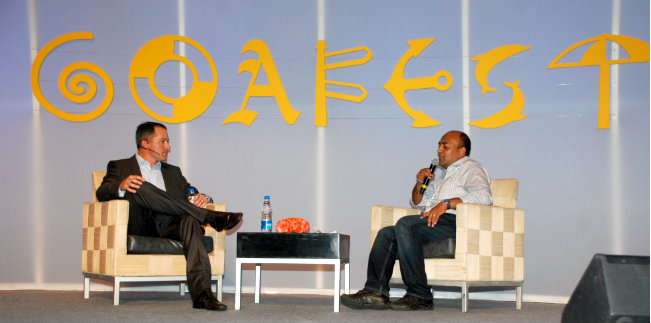
    Tim Love, CEO, APIMA, Vice Chairman, Omnicom Group talked about how the world we live in today has become interdependent especially because of technology during his address on ‘The Magic of Ideas – Our Language Impediment’. He was of the opinions that one thing the financial crises have taught us is that we are all inter-dependent.


    Mr Love spoke about how “Digital is not a channel but, the air we breathe and communicate with each other,” giving the example ofIndiabeing the fourth largest internet user population despite its internet penetration being merely 8 per cent. He also talked about how language is a technology and how we have underestimated the effect language has on human misunderstanding.


    Besides talking about the importance of verbal communications, Mr Love also spoke about the importance of nonverbal communications. He said that just as verbal or spoken communications, nonverbal communications like sign language, although universal, differs from culture to culture; but no matter what the stream of communication, technology will always flow through.


    During the Q&A session moderated by Ms Kainaz Guzdar of P&G, when asked to give a few suggestions or advertisers and marketers on how to come with great ideas on language impediment, Mr Love explained that one must be more cognisant in languages, and show some sensitivity to different languages verbal or nonverbal. He added that ideas are best communicated from individual to individual. He also pointed out that one needs to be careful with languages in different cultures, as it could have different meanings in different cultures, and how we have always minimised the importance of language.


  • Goafest 2012: ‘Need for old & wise to guide youth’

    By A Correspondent


    Keeping in line with the theme, ‘Ideas that impact the full circle’, a panel discussion moderated by Anuradha Sengupta, Features Editor, CNBC TV18 and including panelists like Tim Love, CEO, APIMA, Vice Chairman, Omnicom Group; Jonathan Mildenhall, VP, Global Advertising Strategy and Creative Excellence, Coca-Cola; Jayant Murty, Director of Strategy, Media and Integrated Marketing, Asia Pacific Region, Intel Corp and Jean-Yves Naouri, COO, Publicis Group discussed the need to present their agencies differently; the loss of long-term relations between the clients and the agencies and the need for multiple agencies to build a brand.


    Tim Love observed that advertising is actually an education and noted that while the advertising industry is all about ideas and thus need young rebellious minds, there is also a need for the old and the wise to guide and direct the youth.


    Jean-Yves Naouri, on the other hand, insisted that creative agencies are here to respond to business and gain the trust, mind and presence in their client’s life. “Keep the dialogue between brand and consumer alive. Engage consumers as there will be people who will be inspired by the brands and this is what matters the most.”


    Speaking on the agency-client relationship, Jonathan Mildenhall said that it is easy to maintain one relationship better that ten different ones, and therefore he would reluctantly look outside his roster agencies for creativity. However, he felt that brands may scout for multiple creative agencies if they find the need for specialist agencies that could help them reach out to their clients more effectively. He was also quick to point that although digital is showing robust growth in India, it needs to boost its creativity in this space. “Majority of UK spends on digital, however the internet reality is bigger than the creative ambition in India.”


    Click here to view all Goafest 2012 stories

  • Day 1 @ the Dome: ‘Innovation is the magic of Ideas’


    By A Correspondent


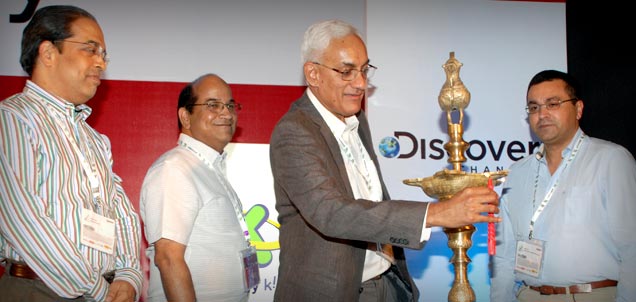
    Goafest 2012 kicked off with the lighting of the lamp by the industry dignitaries, Mr Arvind Sharma, Chairman Goafest 2012; Mr Nagesh Alai, President, AAAI; Mr Shashi Sinha and Mr Ambi Parmeswaran, ED and CEO, Mumbai Draftfcb Ulka Advertising. Mr Sharma said that he was thrilled as Goafest 2012 over 3,000 participants, including representatives from Sri Lanka and Bangladesh.


    Mr Parmeswaran said that he was ecstatic about the event this year as there was a restructuring of knowledge sessions. Mr Sinha observed that with more metals and more categories at the awards than last year, more participants, representatives from foreign countries, exciting prices for the audience, Goafest 2012 is aiming to give participants an experience with qualitative improvement every year. And unlike previous years, presentations by speakers were followed by the Q&A sessions moderated by industry veterans.


    The first session, ‘Magical Ideas Come when You Harness the Power of Many People’, commenced with a flash mob from YouTube, taking everyone by surprise and perhaps sending a message that it was one way of using consumers to building your brand.


    Mr Lucas Watson, Global Vice President, YouTube spoke about how passionate consumers can help one build brands and how online videos can help even startups spread awareness and the reach needed in a very cost effective and efficient way. “Just get started online, you don’t have to be a big brand, all you have to do is gain trust among your consumers and you will be surprised how passionate people are to participate in the brands they love. The magic of YouTube is available for all to see, as it allows everyone to participate and that too in a cost efficient manner.”


    The first session was moderated by Mr N Rajaram of Airtel. When asked about the scope of co-existence between television and online videos, Mr Watson said: “Like many industries, we too are going through a transformation. There are brands which are afraid to disrupt their current mode of functioning and there are brands who want to try new and better ways of reaching out to their consumers. So I believe there will be some co-existence, nevertheless there will be winners and losers as well.”


    Gerson da Cunha, stage and film actor, social worker and author dedicated Ad Katha, a book that tracks the history of Indian advertising to the late Bal Mundkur, founder of Ulka. Mr da Cunha gave the audience a glimpse of the Indian advertising right since it started through the present day advertising. He also pointed out that advertising bloomed in India from print media and that in 1991 it even opened doors to the global economy.


    Mr Jonathan Mildenhall, Vice President, Global Advertising Strategy and Content Excellence, Coca-Cola spoke on the use of creativity and content and how Coca-Cola moved from creative excellence to content excellence. He also explained that there is a need to encourage consumers to express their stories and how a brand must move to dynamic storytelling. “A brands story must show that it’s committed to make world a better place. There is a need to converse and not just listen to our consumers but to create inspiration and provocation.”


    In the session moderated by Sanjay Behl, CEO, Reliance Digital, when asked about a marketer’s role in the future and the consequences of negative conversation on a brand, Mr Mildenhall said: “Brands have to be a lot more transparent, if you inspire good conversation, it manages itself and I believe good eventually wins over evil. Brands, therefore, need to rethink the creative story they are telling their consumers. A 30 second media spot is valuable and it should be a gateway for brands to reach higher grounds.”


    Mr Tim Love, CEO, APIMA and Vice Chairman, Omnicom Group spoke about ‘The Magic of Ideas- Our Language Impediment’. He was of the view that innovation is the magic of ideas and that language is a technology. Mr Love also pointed out that as internet penetrates further in India, language communication will be going to new heights.


    The session (all of them held at what’s called the ‘Dome’) on Language Impediment was moderated by Kainaz Guzdar of P&G. When asked for his suggestions on how marketers and advertisers can come up with great ideas on language impediments, Mr Love said that they will have to be more cognizant in language and respect the sensitivity of various people. He also said that ideas are best when communication is from one individual to another.


    Mr Charles Wright, MD of Wolff Olins shared his insights about how consultancies are equally important to creating and building brands. He spoke about how by combining rigour with magic, one can solve complex business problems and how a Wolff Olins experience of branding may be completely different from an advertising agency’s experience despite working on the same product or brand. “In order to build brands that succeed, it is important that one understands what is important to the customers. We are all living in a world of perception but branding is all about changing the way people behave, and simply making promises is not important but, delivering on those promises is far more important.” He added: “Design, as a language, can help change people from hating a particular brand to making them like the brand and then probably even love that brand.”

    Click here to view all Goafest 2012 stories


  • Ad Conclave Takeout #1: Technology is the new tool for creativity!


    By Robin Thomas


    ‘Ideas that impact the full circle’ is the theme for Goafest Advertising Conclave 2012, expected to be attended by over 3,000 members of the media, advertising and marketing fraternity from not just India, but various south Asian countries as well. Yes, this year’s edition of Goafest is billed as the biggest ever in the history of the event and will include delegates from Sri Lanka, Pakistan, and Bangladesh.


    The Goafest Advertising Conclave 2012 held on Thursday highlighted the fact that the next few years are going to be transformational as far as creativity in the industry is concerned. We live in an era where young people are growing up in a digital era, they spend more time on social network and brands are targeting their consumers on social networking sites. India is restless and what the country needs is not traditional creativity, but radical creativity. Technology is the new tool for creativity and India must immerse into it.


    Tim Love, CEO, APIMA, Vice Chairman, Omnicom Group spoke about how the world has become not only interconnected but also inter-dependent due to digitization and globalisation. He was also quick to point out living in an era of digitization, there is plenty of information available, but there is a need to know how to use that data effectively.


    Jonathan Mildenhall, VP, Global Advertising Strategy and Creative Excellence, Coca-Cola pointed out that there are two types of creativity – traditional creativity and radical creativity. What India needs today is not traditional creativity but, radical creativity. “We need to develop ideas and hence we need to integrate technology with creatives. We need to move away from 30 minute television storytelling to dynamic storytelling,” he clarified.


    Mr Mildenhall also explained that brand stories must add values and significance to the consumers’ life. The stories must engage the consumers and make them feel connected to the brand. “We need bigger creative thinking in our heart and we need online dialogue as well as engagement with our consumers. Nevertheless, we need to iterate our content and not replicate them.”


    While speaking on ‘Building brands in an era of multiple degrees of freedom’, Jayant Murty, Director of Strategy, Media and Integrated Marketing, Asia Pacific Region, Intel Corp  observed that most often brands bribe their consumers to get involved, but they fail to understand that the consumers do not want to be bribed. He added that brands must be remarkable and different. “Immerse in technology because technology is the new tool to creativity and find partners that understand the use of technology,” he further added.


    Keeping in line with the theme of ‘Ideas That Impact The Full Circle’, a panel discussion moderated by Anuradha Sengupta, Features Editor, CNBC TV18 and including panellists Tim Love of Omnicom Group, Jonathan Mildenhall of Coca-Cola, Jayant Murty of Intel Corp and Jean-Yves Naouri, COO, Publicis Group focussed on the need to present their agencies differently; the loss of long-term relation between the clients and the agencies and the need for multiple agencies to build a brand.


    Mr Love observed that advertising is actually an education, also noting that while the advertising industry is all about ideas and thus the need for young rebellious minds, there is also a need for the old and the wise to guide and direct the youth.


    Mr Jean-Yves Naouri, on the other hand, highlighted that creative agencies are here to respond to business and gain the trust, mind and presence in their client’s life. “Keep the dialogue between brand and consumer alive. Engage consumers as there will be people who will be inspired b the brands and this is what matters the most,” he counselled.


    Speaking on the agency-client relationship, Mr Mildenhall said that it is easy to maintain one relationship better that ten different ones, and therefore he would reluctantly look outside his roster agencies for creativity. However, he felt that brands may scout for multiple creative agencies if they find the need for specialist agencies that could help them reach out to their clients more effectively. He was also quick to point that although digital is showing robust growth inIndia, it needs to boost its creativity in this space. “Majority of the UK spends on digital, however the internet reality is bigger than the creative ambition inIndia.”


    KV Sridhar aka Pops, NCD, Leo Burnett talked about how advertisements look in a world of censorship. He was of the view that though advertising is a serious subject, it is nothing less than entertainment. Therefore, if one puts restrictions on advertisements, it may lose its enjoyment. Pops highlighted that there are two types of people in advertising, the ones that care and the ones that don’t care and therefore the industry must be sensitive to the sentiment of various people. He also said that while the industry should be governed by creativity and not regulations, there is also a need to keep a check of the contents as it is in our hands.


    Industry expectations are high, especially after the conclave on Thursday as was summed up by a variety of delegates. Said Niloufer Dundh, Head- Integrated Media, Hungama Digital Media Entertainment Pvt Ltd: “The advertising conclave was fabulous. Great speaker line-up and the points raised finally focused on digital. The international speakers don’t treat digital as an extra or add-on; it is part of their communication strategy. Jonathan Mildenhall’s speech on Global Advertising Strategy and Creative Excellence was awesome!”


    Another delegate who did not wish to be named said he was looking forward to getting the ”real” lessons from marketers. “I am glad Goafest is giving us this opportunity.” But, he said, the only problem is the “awful” heat. Now you can’t get all things in the world your way, can you?


    Click here to view all Goafest 2012 stories


  • Radhika Das to join DDB Mudra Delhi as Vice President

    By A Correspondent


    DDB Mudra has roped in Radhika Das as Vice President and she will be in-charge of some of the major clients handled out of theDelhioffice such as Dabur Jaypee, Nestle and Mother Dairy.


    With over 13 years of experience, Ms Das comes to DDB Mudra from Ogilvy & Mather/Brand David where she worked as Director, Client Services. Prior to this, she worked with Publicis Communications and with Hakuhodo Percept. She has worked on some of the world’s most well-known brands such as HP, RBS, Costa Coffee and Maruti Suzuki to name a few.


    Commenting on this new appointment, Vandana Das, President, DDB Mudra Group, said: “It gives me great pleasure to welcome Radhika to join us in DDB Mudra Group,Delhi. As part of the exciting journey ahead, I see Radhika as a key player in theDelhiteam to nurture client relationships, build brands and also to help us grow.”


    On joining DDB Mudra Group, Ms Das said: “I’ve worked with Mudra in my earlier years and given the extremely enriching experience I had, I’m absolutely delighted to be back again. I’m looking forward to a long innings and being a part of the evolution, the organization is witnessing.”


    The DDB Mudra Group, a part of the Omnicom Group, is India’s largest integrated marketing communications and services network. The group comprises eight agencies – DDB Mudra, DDB MudraMax, Mudra, DDB Health &Lifestyle, RAPP, Tribal DDB, Water and Maatra.


    The DDB Mudra Group’s scope of services run the gamut through Advertising, Media Planning & Buying, Digital & New Media, Data-driven Marketing, Health & Lifestyle, OOH, Retail Design and Visual Merchandising, Navigation Solutions, Experiential Marketing (Promotions, Events, Rural), Trade Marketing, Youth Marketing, Localisation Pre-Media Services, Content Creation, Strategy and Design Consultancy.


    DDB Mudra Group operates out of its offices in 15 leading cities and is represented in more than twenty other locations, giving it a comprehensive presence across the length and breadth of the country.


  • 10 Days to Go-Goafest! It’s all about celebrating ideas: Arvind Sharma


    As the countdown begins for Goafest 2012, Arvind Sharma, Chairman Goafest 2012 and Chairman, India Sub-continent, Leo Burnett, speaks to MxMIndia’s Tuhina Anand on the festival this year and why it is truly the celebration of creativity at its best.


    What can one expect from Goafest 2012? How will it different from last year?

    The Festival will stay true to its fundamental vision. It is a platform for celebrating creativity and a source of inspiration. Most importantly for the entire fraternity comprising young and not-so-young, Goafest is the preparatory ground for the industry to gauge where and how to go forward. I feel that the core, sometimes, is forgotten in the bid to do something new.


    I mean, we live in a world which is changing rapidly, so having something new is inevitable. If you look at successful festivals around the world 90 per cent remain the same. Similarly, at Goafest, we have defined categories and 95 per cent remain the same in terms of predictability of entering, judging, Awards Governing Council and Goafest Committee. There is consistency in that format and our effort of providing conversations. All this is same as what one had last year.

    Having said that about the predictability factor, let me also add that moving forward is equally important.


    So, what’s new?

    This year we are looking at ways to involve clients in a meaningful way. The fact is that, there would be no advertising if there were no clients. The business of advertising is about partnering with the marketers. We, at Goafest, believe in evolving vision that doesn’t really mean evolving identically, but in evolving together. We look at bringing in more opportunity for conversations and that’s the reason why we have brought clients this time into the seminar.


    There is a slight change in the format. So far, there have been series of international speakers, while some of these presentations have been received well, some weren’t, and there have been questions on the relevance of those to India. Changing that, we have brought in senior Indian clients to raise questions after the presentation. So there will be 30-35 minutes for the speaker followed by 10-15 minutes of Q&A led by a senior Indian client. He or she will be the voice and mind of the audience and bring in the Indian perspective to the entire presentation by agreeing, challenging, bringing contextual light and interpreting the whole presentation.


    We have also brought the Marketing Wizards to Goafest. This is calling the under-30 staff of the marketing community. We have had a good response and we expect overall 70 to 80 major advertisers to participate, which include team of two people representing to some even registering team of 30 people even though we have a limit to numbers.


    Why this whole idea of bringing in Grand Prix to all verticals?

    Grand Prix, traditionally, has been awarded in Print, TV and Integrated. This year, we have expanded the Grand Prix to cover all the 9 verticals. This was not an easy decision and the step was debated. We believe that the time has come for specialists in area to move to the centrestage. I don’t really know if the jury will find works worthy enough for Grand Prix in each of the vertical, but this would help in finding worthy advertising and celebrating it around India and even around the world.


    For a young designer who is always on the periphery of an agency, winning gold is good but winning the GrandPrix might help in moving the same person to leadership position. We hope that the move will catalyze long term fundament change in the way we create advertising.


    We hear this year there are entries from other South Asian countries?

    Yes, we have entries from Sri Lanka and Pakistan and we will have delegates from Sri Lanka and Bangladesh. In South Asia, we have different cultures but there are more similarities than differences within those cultures and we can learn a lot from each other. Unfortunately, the politics of the subcontinent is more difficult. We had planned a road show in various countries but our passports got stuck and this could not happen.


    Can you throw some light on the conclave and the seminar?

    We have put together an enviable list of names and these are speakers who really are worthy of listening. Jean-Yves Naouri, COO Publicis Group spends almost 150 days in flight. He knows what is happening in the business around the world and will share his valuable insight. Tim Love has been involved with theCannesand he played important role in the shaping of the future of Omnicom Group. Jonathon Mildenhall, VP of Global Advertising Strategy and Creative Excellence, CocaCola promises to be stimulating session. Steven King, CEO, ZenithOptimedia will also be on panel. Anuradha Sengupta, who loves throwing challenge, will be part of the session.


    On the seminar speakers, Amir Kassaei, Chief Creative Officer, DDB Worldwide, Rishad Tobaccowala, Chief Strategy and Innovation Officer, VivaKi and Prof John Philip Jones, Emeritus Professor at the Newhouse School of Public Communications,Syracuse University,New Yorkwill be speakers. While the world is talking video as the future, Lucas Watson, Vice President, Global Sales and Industry Marketing, YouTube will tell us how and Simon Wardle, Chief Strategy Officer, Octagon will be worth listening to for all the planners in the industry. Erik Vervroegen, International Creative Director, Publicis Worldwide will give his take on creativity. We will announce one more name in this list soon. From the Indian marketers side who will be part of Q&A, we have Sanjay Behl from Reliance, Kainaz Gazder from P&G, Viral Oza from Nokia, Gayatri Yadav from Star India and Hemant Bakshi from Unilever.


    Awards have been under the scanner, do the controversies surrounding it mar the event in anyway?

    Awards show will have criticism. What is driving us is the celebration of creativity and look at this Fest as a platform to prepare ourselves for the way industry will go forward.


    Why did the Goafest Committee decide the theme – Magic of Ideas?

    Everything that happens at festivals is ideas. While advances in technology and database is important, but what we celebrate is ideas. If we add everything on an excel sheet, we will see that when a brand gets a lot of traction or if it is ignored, it is all to do with ideas. No client launches a product with the intention of not succeeding, so getting it right is important. For a product to be embraced, it has to connect with people and this cannot be reduced to a formula but has to do with the magic of ideas.


    The awards have been leaked in the past, losing some of its credibility, how do you ensure that this doesn’t happen this year?

    We believe that awards will not be leaked. In this, the media as well as the organizers have a role to play. There is a symbiotic relation. We do our best to avoid any such incident. Some information has to be shared with the media beforehand, but there is an embargo on release information and last year journalistic fraternity showed a sense of responsibility. I will add that the media has equally a big stake in the Fest.


    What will you say to the agencies that have decided to stay away from the fest?

    Whether to participate or not is an agency’s decision. We on our part, including the AGC, have been ensuring that our job that includes category, rules, audit and the jury does their job well. Let creative minds debate as for us touch wood, thing are going as per planned.


    If you have to send a formal invite to the industry for the Fest what would you say as to why must the fraternity attend?

    You will get to see the best of work and see the best creative minds judging what they think is worthy of awards. You get to interact with seniors and bright creative minds which many times is impossible in the busy schedules that we lead. Besides you will get to hear exceptional speakers’ line-up.


    Goafest creates the space for debate with peers and youngsters, which includes large group discussions and one-on-one interaction. We are expecting around 2,500 people to attend Goafest this year. Not to forget that Goafest is not heavy-handed like training sessions but good learning place where you also have loads of fun.


    Personally for you, how has it been plugging all the gaps before the festival?

    We have a very big team working across agencies. There is a sense of joy and shared sense of purpose to make Goafest a success. We are in it together and there still is a fair bit of work to be done. However, it’s been an enjoyable experience.

    Click here to view all Goafest 2012 stories
     

  • Betting big on shopper insights


    By Johnson Napier


    At a time when brands – led by their able marketing chieftans – are still grappling with the insight and consumers are still clueless about the experience that the discipline offers, it is turning out to be an opportune time for agencies making a beeline in building their expertise around the rather unexplored phenomenon of Shopper Marketing.


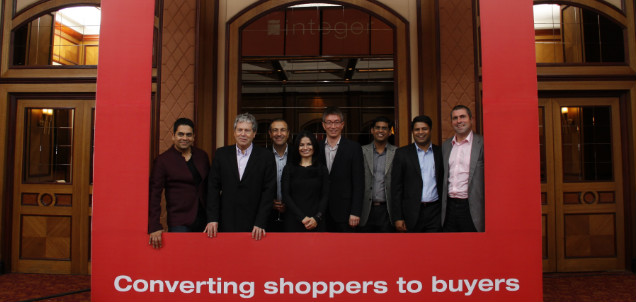
    The initiative, which is being pursued with hot interest by agencies to offer their services, has found a new and able beneficiary in Integer Group, one of the world’s largest promotional, retail, and shopper marketing agencies.


    A group company of TBWA (an Omnicom Group agency), Integer enters India with Mumbai as its hub and the sixth such market for the group in Asia Pacific. It has already blazed ahead with its offerings in other established markets like the US, Australia, Europe, the Middle East, and North and South America.


    Commenting on the launch of the property in India, Shiv Sethuraman, CEO, TBWA India said: “Integer is going to be an important part of our strategy and is one of the fastest growing units within the marketing communications mix. We are very happy to be investing in the division early enough than most others.”


    On the choice of India as the next market for launching the division, Dan Paris, Regional Managing Director – APAC, Integer said: “India, as a market, is accelerating fast and retail as a major driver is picking up drastically in India. From our POV, we wanted to launch at the right time and with the right assets and people. We thought the most important thing to do would be to invest in a serious study and the findings have revealed that this is an opportune time to be launching in this country.”


    Integer’s shopper marketing expertise utilizes extensive global research data on shopper behaviour, retail insights, and unique tools to develop strategic marketing solutions for clients interested in engaging and motivating shoppers. In India, the unit would be headed by Sreejit Nair, MD, Integer who comes to the agency after having worked for FMCG majors like PepsiCo and P&G. Sharing his vision and how Integer would work in the Indian context, Mr Nair said: “Coming from the client side of the business, I know what retailers go through. Especially modern retailers, who are struggling with basic issues like ensuring fill rates, getting space at a fairly good rental, and so on, but what’s happening is that they have actually become obsessed with price. Shopper marketing gives a lot of opportunity for them to differentiate. If you go to the client with an effective plan, I am sure modern retailers would accept this practice.”


    According to Mr Nair, the issue with brands is that they get obsessed with themselves; they don’t want to see what’s there for the retailer and the shopper. “If I am going to talk only about my brand, then it is like trying to push something to the retailer and that won’t work. And even if it works, it won’t succeed,” he affirms.


    Sharing the agency’s core focus in India, Mr Paris affirmed that it would be around four verticals, namely promotional marketing, shopper marketing, channel marketing and digital. “As per reports, retail is estimated to grow to 6 per cent until 2016. Given that there is no slowdown being witnessed here and the fact that India delivered an average 3.9 per cent growth in retail, we expect a modest growth in this segment,” said Mr Paris.


    “Also, the growth will be led largely by digital as the number of consumers who use online and mobile for research and shopping has gone up dramatically. Our study indicates that more than 60 per cent of the online consumers do research, comparisons and shop online and through mobile and this is quite a high figure. With e-commerce expected to grow by 3 per cent and with more than 123 million mobile payment users expected by 2012, these are exciting times for players to be in retail in India and around the world,” he added.


    When quizzed on how Integer India would be different from what the other players in the space have to offer, Mr Nair said: “We would differentiate from the others through our insights. What’s happening is that everybody wants something sexy in retail and it starts and stops with that. We don’t want to be in that particular pool of agencies; we want to start with insights, focus on a lot of inputs on understanding the shopper first and tailoring solutions around his need. We don’t want to be seen as someone who makes flashy collaterals for retailers.”


    Adding on, he said: “Personally, I believe that there is a lot of opportunity in traditional trade – that is an area that needs to be tapped. How much do companies know about traditional trade shopper? Hardly anything. That’s where the opportunity lies for us.”


    Sharing a similar sentiment, Mr Sethuraman added: “I don’t think there is a clear understanding of what shopper marketing is actually about. Most people confuse it with BTL, activations and other such initiatives. The challenge for all agencies offering this service is to get the meaning behind this term well defined, get marketers to believe in this property and treat it as a proper discipline and not just another version of doing BTL. Having said that, I think there is room for all the players to grow healthily for a long time to come; it is still a very nascent category.”


    Prior to launching the service in India, Integer India had undertaken an extensive study across India to map the shopping behaviour of consumers. Titled Check Out India, the study was designed to understand motivations and attitudes, rituals, and factors that influence shopping. The study was conducted across three geographical segments -Urban A – metro with a population of more than 1 million, Urban B – cities with population of less than a million and Rural India. The respondents included male and female shoppers in the age group of 18 to 55. The study threw up interesting findings around the frequency, priority and communication as seen by urban and rural shoppers. Going forward, the objective would be to keep conducting the study twice a year and present it to the marketers for deeper understanding into the mindset of the consumer.


    As for its initial client list on board, Mr Nair said: “Right now we are just working on some projects with PepsiCo and P&G, but we don’t intend to go all out with this unit. We have just launched this study and will have to see how we could present the study in a relevant manner to the clients. I must mention that this is a category neutral study; we’ll have to go on a category level and find about more about the shopper relevant to that category so as to make it really relevant to a particular marketer. We are currently pitching to a few brands and should be able to make an announcement in 2-3 months time.”


    On the growth that Integer is expecting from India, Mr Sethuraman said: “It is still a nascent market and we can easily look at a growth of 60-70 per cent in year one itself. But while a percentage growth may sound impressive, we have to say that the base is still small. The bigger task is to get clients to get used to this novel idea called shopper marketing and make it a genuine part of the communication mix.”