By Avik Chattopadhyay
 Twenty twenty-two has not started the way we expected. The tentacles of the pandemic remain, in fact in newer forms. While we are coming to terms with the Omicron variant, countries like France have moved on to the IHU variety while Israel battles with Florona and the US with Delticron.
Fanciful names for a killer!
The WHO could have kept it simpler like Version A, Version B and so on but that might have taken the drama away. Just see the names of the hurricanes, cyclones and twisters and you will get the drift. Guess “I know what you did last summer” would not have sounded sinister enough if it were simply called “Revenge”.
There is an art to naming and creating terms. It is an age-long craft. Axis sounded ominous while Allied seemed reassuring. New phenomena are explained and referenced better when given an interesting name or term. Conversations become easier when you refer to the group as BRICS rather than saying ‘Brazil-Russia-India-China-South Africa’ every time. Imagine calling the Cold War as the Russo-American Conflict! What would Bond do?! The uninitiated might think that DINK is the third option after DIY and DIFM. Such is the lure of naming.
The pandemic over the last 22 months has thrown up certain names or terms that have caught my fancy. Reading them across platforms and hearing them on innumerable video calls and webinars have certainly made me wiser as I entered 2022. Some did appear pre-Covid but gained traction in terms of usage and ubiquity once the virus hit us becoming buzzwords for brands and businesses.
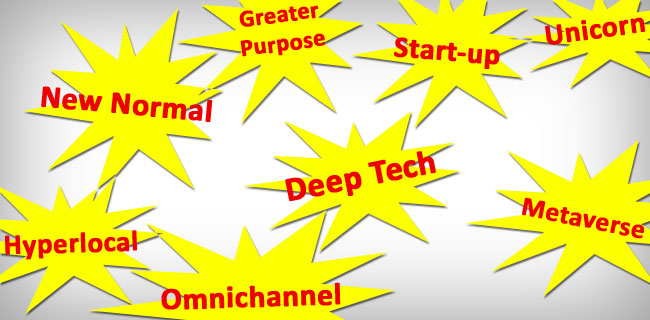
New Normal
This one became a rage in the first 12 months and has now somehow paled in popularity. I could never understand the construct. If it was ‘new’, how could it be ‘normal’? Maybe it was devised as a trick term and that is what made it the subjects of innumerable articles, webinars, and debates. It became a prefix to everything around us…new normal life, new normal work, new normal eating, new normal manufacturing and so on. Guess when we realised that normalcy was taking longer than our comfort levels, we switched to ‘post-Covid’ and this term lost the race. However, an interesting buzzword indeed,
Omnichannel
This was the consultants’ blue-eyed term to explain what tomorrow’s strategy would have to be. Enough white papers were written to rephrase another favourite buzzword of the yesteryears – 360-degree-engagement. I took the pains to read through a few of the papers and realised it was as creative as the NDA government renaming existing schemes and programmes as new!
Hyperlocal
Basically, “kirana” stores were given a makeover when marketers and consultants [again!] termed them so. For years the local vegetable vendor and the ‘paan’ shop had been doing exactly what the wise men in the metros suddenly realised as the holy grail of consumer connect.
Greater Purpose
This was the poster-boy of terms that became a symbol of corporate maturity and relevance. Almost all brands talked about having revelations of their ‘greater purpose’ due to the pandemic and how that has transformed them. Those that never ever bother with fundamental purpose of business now espoused the wisdom of greater purpose. Sadly, the longevity of this fad will be just as long as the effectiveness of a vaccine shot!
Start-up
This is my personal favourite. It just makes everything before the birth of this term seem prehistoric. It is as if all businesses that happened before did not start up but stalled up. It is as if nothing previously started as a new idea or from scratch. Every business since ancient times has had to start up before it was built up. It is like saying earlier we had motorcars and now we have automobiles! Massive disruption indeed.
Unicorn
Close on the heels of the start-up is this amazing term for businesses that have been evaluated as being worth at least a billion USDs. I understand you need to recognise such stalwarts by giving them a name but why ‘unicorn’? It is a mythical character that could be anything from a bull, goat, wild ass to a horse. Leonardo Da Vinci wrote, “The unicorn, through its intemperance and not knowing how to control itself, for the love it bears to fair maidens forgets its ferocity and wildness; and laying aside all fear it will go up to a seated damsel and go to sleep in her lap, and thus the hunters take it.” I rest my case.
Deep Tech
This is a relatively new one and makes you question if there is something called “shallow tech”! I have always believed that all technology is inherently and necessarily deep if it is to be useful and sustainable. The sudden emergence of this term makes one feel that all previous developments and investments have only been the froth.
Metaverse
This is the latest as 2021 closed. It is not a new term at all, first appearing in Neal Stephenson’s science fiction novel Snow Crash in 1992 to describe a three-dimensional virtual world, very much like Second Life. Facebook rebranding itself as “Meta” also helped this term become a buzzword now to describe a converged virtual world where ‘avatars’ and ‘NFTs’ are the way to be. The mind boggles!
As the new year has broken, I have become eight buzzwords wiser. While I still ponder over a few, I am surely amused at the others as transient attempts to ‘brand’ behaviour and consciousness. How many start-ups will become unicorns in the metaverse using omnichannel deep tech to offer hyperlocal solutions in a new normal world that values greater purpose? Do I sound like a consultant? Terribly sorry…
 The Indian advertising industry showed a strong trend of recovery in the second half of 2021. The market became quite buoyant and industry experts began to predict a strong double-digit growth in advertising expenditure in 2022 with digital and TV driving the growth. Print, radio and outdoor were expected to recover their revenues faster than what was envisaged earlier. The experts making these predictions assumed that we would not have a Third Wave of Covid-19 in 2022 and there would not any major economic disruption.
 The Omicron variant of the SARS-CoV-2 has not surprisingly shocked the world, which thought it had seen the back end of Covid-19.