Tag: Olympic

  • Challenging the Disparity in Our Reverence for the Paralympics

    Sanjeev KotnalaThe recent 2024 Paris Summer Olympic Games were a grand spectacle that captivated the world, where athletes from every corner of the globe pushed the boundaries of human capability. Nations celebrated their victories with exuberance, their stories of dedication and sacrifice lauded by everyone, and their achievements etched into the nation’s sports history annals. With their extraordinary performance, many of these names fulfilled the nation’s desires and dreams and became household names. Shreyesh and Manu Bhaker, Neeraj Chopra and Sindhu are examples of this.

    But there’s a darker side to this celebration of the human spirit–a glaring inequality that is almost racist in its subtlety and pervasive in its impact. There is a disparity in how we address and react to the Paralympics, as if the challenges are somehow less, the medals are of a different hue, or the gold is of a lesser carat. Pat yourself if you know Bhagyashri Mahavrao Jadhav and Sumit Antil and their sports: the flagbearer for India at the Para Olympics 2024. Or if the names of sportspersons like Nitesh Kumar (Badminton), Avani Lekhara (Shooting), Bhabina Patel ( Table Tennis), Yogesh Kathuniya Mariyappan Thangavelu and Preethi Pal (Athletics), and sound familiar to you. I did not know many of these names before I started writing this article.

    Like the Olympics, the Paralympics are a stage where athletes represent their countries, strive for excellence, overcome incredible odds, and inspire millions. Yet, the enthusiasm, pride, and recognition accompanying Olympic victories are noticeably dimmed when it comes to the Paralympics. This disparity in perception is not just unfair–it’s unjust.


    Double Standards in Recognition

    Consider the emotional wave that swept across the country when Manu Bhakar won the bronze or the emotional tsunami that cut across the nation when Vinesh Phogat lost her chance because she was a few grams overweight. These were moments of collective pride and charged emotions of national unity, where the athlete was hailed as a hero.

    Compare this to the reaction when a Paralympian achieves the same feat. Fortunately, nowadays, they make it to the sports page and the front page like Avani  Lekhera and Mona Agarwal did for their win in shooting. However, the applause is fainter and lasts that much shorter. The media coverage is sparse, and the recognition is fleeting. It’s as if their gold is not as golden, and their victory is not as victorious.

    This disparity reveals a troubling double standard. Paralympic athletes train just as hard, if not harder, than their Olympic counterparts. They face the same pressures, gruelling schedules, more demanding physical challenges and most often, a challenging sponsor and monetary gap. Yet, the world seems to view their achievements as lesser, as if the effort required to overcome physical disabilities diminishes the value of their triumphs. This is not just a failure to recognise individual merit; it’s a failure to acknowledge the full spectrum of human potential.


    The Need for a Paradigm Shift

    This almost dismissive attitude towards Paralympic achievements reflects a more profound societal bias that equates physical ability with worth. This bias sees disability not as a different ability but as a deficiency, something less than a whole. This mindset is changing but at a pace that is too slow for comfort. It must change now.

    The Paralympics should be celebrated with the same enthusiasm, pride, and respect as the Olympics. Paralympians, too, represent the countries. Their dreams are just as big, their efforts just as intense, and their victories just as hard-earned. They deserve not only equal recognition but also equal respect.


    Steps Toward Change

    A concerted effort on multiple fronts is needed to address this issue. Fortunately, media coverage of the Paralympics has improved—though still far less than that of the Olympics. Educational campaigns should be launched to raise awareness about the Paralympics, highlighting the athletes’ stories, the challenges they overcome, and the significance of their achievements.  Touch your heart, and you will know how much you have celebrated your para Olympians. How have the brands, corporate sectors, and government short-changed them? We talk of equality in sports. Can we start with equality of support, funding, sponsorship, and recognition for Paralympians?

    Most importantly, we as individuals need to change our perceptions. We need to challenge our biases and recognise that the value of a medal is not in the physical act of winning it but in the courage, determination, and spirit it represents. The colour of the medal, the carat of its gold, is the same whether it is won at the Olympics or the Paralympics. We must feel the same pride and maybe more when our athletes win in Para Olympics. We must celebrate- but more importantly, we must watch them perform the way we watched and chased our summer Olympians. That may pull the money into the sports, trigger a new wave of recognition and push para-sports.


    A Call to Action

    It’s time for us to change the narrative. It’s time to celebrate Paralympians not as athletes with disabilities but as athletes. It’s time to give them the recognition they deserve and to be as proud of their achievements as we are of any Olympic victory.

    The Paralympics are not a sideshow but a testament to the indomitable human spirit. Let’s honour that spirit with the respect it deserves.

    In doing so, we uplift Paralympians and ourselves as we move towards a more inclusive, equal, and just society. Let the pride in our hearts be as strong, the cheers as loud, and the recognition as enduring for every champion—Olympic and Paralympic alike.

  • Paris Olympics 2024: Faster, Higher, Stronger… and more data-driven

    Paris Olympics 2024: Faster, Higher, Stronger… and more data-driven

    By Andy Miah

    For the first post-Covid Olympics, there are some major changes now in place at the Paris 2024 Games. First of all, there are no physical tickets for visitors. All tickets are digital, but spectators can separately purchase an additional paper souvenir ticket for their event. While this is significantly a Covid legacy, it’s also a sign of the times, as more of the Olympic Games moves into the digital world.

    If we dig deeper, we see how the DNA of this transformation is a story about data and its expansion – and how the ability of the Olympics to grow economically relies on it being harnessed and exploited. As AI steadily changes the strategic positioning of all aspects of life, the sports world has rapidly begun a similar journey. AI is now playing a key role at the Olympics across many areas, including performance analysis, doping checks, security threats, athlete comfort, sports reporting, and broadcasting.

    The Olympic Games have been quick to respond to the rapidly developing technological environment. Gone are the days where the International Olympic Committee (IOC) talked about its impact in terms of television viewing figures. Now, it’s all about the live views across all channels, and a looming presence at Paris 2024 is the prominence of TikTok, which itself is driving a huge amount of Olympic athlete content. It is even an official partner of Team GB.

    At a session before the opening ceremony, the IOC unanimously supported the creation of the Olympic Esports Games, due to take place for the first time in Saudi Arabia in 2025, building on five years of developing esports in the Olympic programme. It will consist of competitions in familiar computer games formats such as Fornite, along with some new gaming titles which are aligned with traditional sports, including taekwondo, in virtual reality.

    This new event ends speculation about whether esports will ever make it into the Olympic Games. Planned to happen every two years – when the Olympics and Winter Olympics aren’t taking place – it signals a major step change in how the sports world interacts with gaming and esports.

    Underpinning a number of these changes is the IOC’s realisation that the economic model underpinning the Games needs to evolve. With 61% of the income generated from television rights, and TV’s future looking ever more uncertain, the IOC is betting on gaming and streaming platforms becoming a major feature of its future economy.

    Another major innovation this year was the creation of a ticketed experience in Imax cinemas in the US for the opening ceremony, following the model of national theatres around the world.

    These new kinds of audience experiences may signal the end of the traditional family-viewing-at-home era. Instead people are more likely to either watch on their own on a personal computer device, or collectively in large groups. Similar shifts are taking place more widely in other major events, from Eurovision to the Euros.

    Over nearly two decades, this shift in audience experiences has been driven by the rise of social media and, perhaps more critically, mobile viewing experiences. With platforms such as YouTube, Instagram and Meta driving a vast amount of activity to mobile audiences, the Olympic movement has become increasingly reliant on their platforms to grow their audiences.

    In the run up to this year’s Olympics, some athletes used social media platforms to share the beginnings of their journey to Paris. It’s the kind of content that many fans wanted to see – but never could until now.


    Will AI squeeze out the human element?

    The IOC launched its Olympic AI Agenda in June. In Paris, AI is being used to assist in performance analysis, raising questions also about whether it could further be used to judge sports. For instance, might AI be more able to scan a dive and assess its quality? These are some of the applications being discussed at these Olympics, but there is some division over its use, with fears that AI may replace human judgement in the field of play.

    AI has also been used to design personalised bedding for athletes in the Olympic village, add colour to old black-and-white archival footage of Olympics past, and create new forms of sports reporting – such as using AI-generated results stories and commentary.

    While so much of this change is driving greater openness and awareness about the Olympic Games, there is also a deeper question we face about the role of professional journalism in the making of sports history.

    As more brands become concerned about anything negative surrounding their industry, and the numbers of journalists on news payrolls diminishes, there are worries that the elevation of technology-driven reporting could lead to a loss of independent, investigative journalism. This could have a serious impact on securing a fair record of events like the Olympics.

    The extension of this into AI could exacerbate these fears, jeopardising the traditional view of journalists as necessary witnesses to historic events. These matters become increasingly worrisome when this means that officials who oversee such events are not sufficiently interrogated to ensure accountability.

    Yet, the motto of IOC president Thomas Bach over the past four years – during which he has driven his reform agenda to ensure the Olympic movement modernises and remains a world-leading community in the 21st century – has been “change or be changed”. It is a mindset that must shape how we think about the future of entertainment as we see new formats of experience being created.

    It may not be too far off that viewers will be able to watch Olympic athletes as digital avatars – highly precise computer-generated animated versions of themselves – and this might create new and younger audiences who have grown up on computer games.

    Alternatively, active esports are leading to new hybrid sports, where athletes compete in virtual worlds against each using full body tracking technology, competing from anywhere in the world all linked up through the Cloud, which was tested with great success during the COVID restrictions.

    The advent of AI occurs at a defining moment in Olympic history, as it becomes an event embracing new technologies. Its major worldwide partners are companies driving new standards in technological innovation – the economic powerhouse underpinning the Olympic industry and shaping the character of the Games in the 21st century.The Conversation


    Andy Miah is Chair in Science Communication & Future Media, University of Salford. This article is republished from The Conversation under a Creative Commons license. Read the original article.

  • Before there was diving and relays, there was the Poetry Olympics…

    Before there was diving and relays, there was the Poetry Olympics…

    Jonas Åkerström’s 1790 work, Session of the Accademia dell’Arcadia on August 17 1788.
    Nationalmuseum/Cecilia Heisser


    By Katrina Grant

    Ever wondered whether you’d have a better chance at winning an Olympic gold if you could fling words rather than a javelin? Or maybe you could beat down your opponents with comedic wit? If so, you may have been a strong contender at the Poetry Olympics, held in Rome around 1700.

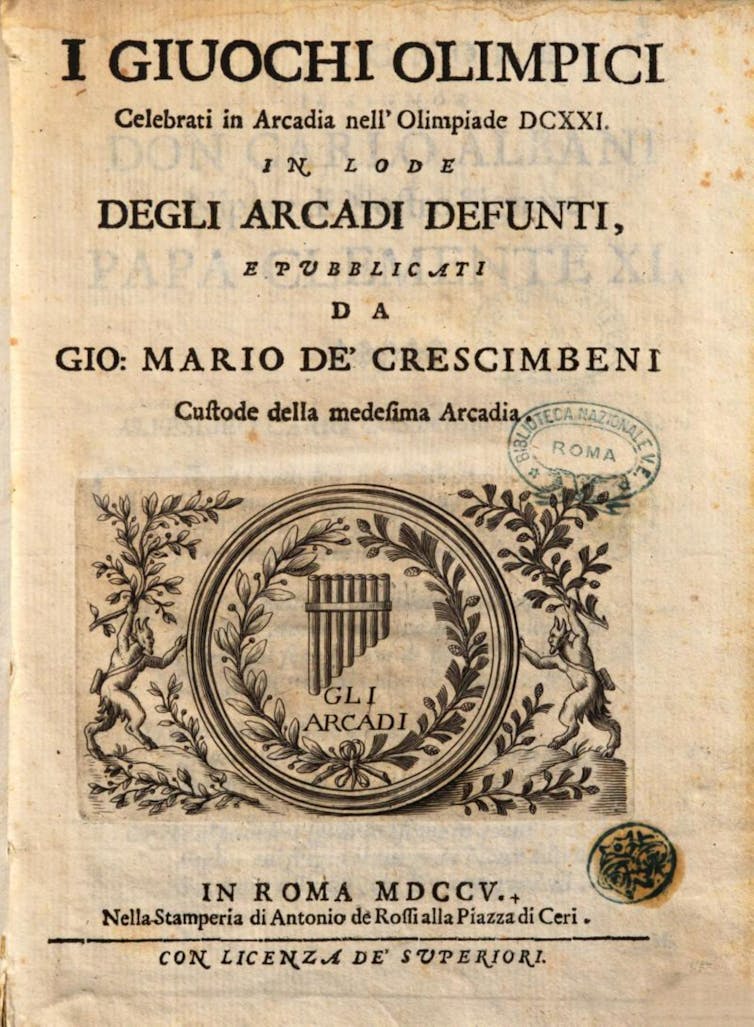
    Some 200 years before the modern revival of the Olympics as we now know it, a group of poets met in a garden in Rome to revive the ancient games in their own way. Their Giuochi Olimpici (“Olympic games” in Italian) was based not on speed or strength, but on one’s ability to string together a poem or win a debate.


    An ode to the mythical pastoral poets

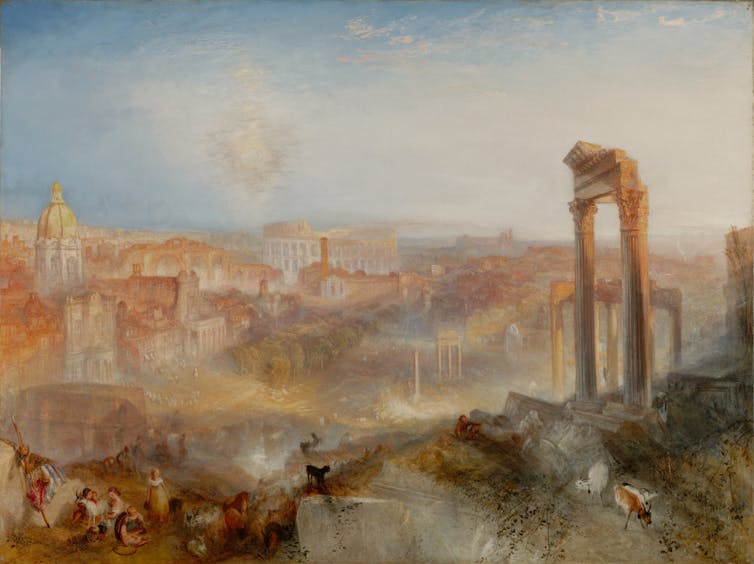
    The first of these new games was held in 1693 and they ran semi-regularly into the mid-18th century. The group met outdoors in places including the Farnese Gardens, a lofty site on the Palatine Hill in Rome overlooking the ruins of the Ancient Forum.

    Joseph Mallord William Turner’s 1839 oil painting, Modern Rome – Campo Vaccino, shows Baroque churches and ancient monuments in and around the Roman Forum.
    Getty Museum Collection

    They was a mix of (mostly male) poets, writers, lawyers, clergymen, nobles, artists and musicians. All were members of the Arcadian Academy, a group named for the region of ancient Greece – Arcadia – that was regarded as the “home of poetry” in Early Modern Europe.

    In 1504, the writer Jacopo Sannazaro had published a poem called Arcadia that presented an ideal vision of a world in which shepherds lived in harmony with nature.

    This idea took hold of writers and artists, who came to view such an idyllic landscape as a necessity for poetic invention. They imagined shepherds and shepherdesses roaming with their flocks and conversing in poetry with nymphs and satyrs – an image that was further popularised in 17th-century paintings by Nicholas Poussin and Claude Lorrain.

    These later 17th-century writers longed to inhabit this world of mythical pastoral poets. When they met, they cast aside their real names to use pseudonyms as shepherds or shepherdesses. They pretended the garden they met in was an Arcadian wood. The garden they built in Rome is still called “Bosco Parrasio” or Parrhasian Wood (Parrhasia was a region in ancient Arcadia).

    They described their meetings as “democratic” gatherings, which was highly unusual in Rome at the time, as all aspects of daily life were governed by social hierarchies and strict etiquette. But the naturalistic setting of the gardens and the playful disguises as shepherds or shepherdesses allowed for a bending of the rules.

    The title page of one of the published editions of poems composed during the Poetry Olympics held in Rome in 1705.
    Internet Archive

    It was in this setting the poetic revival of the Olympic games took place. It was one of a few revivals in 17th-century Europe, with several sporting competitions in England also calling themselves “Olympicks” or “Olympiads”. But the Olympics in Rome was the first to focus only on poetic and literary performance.

    Later on, poetry also became an official part of the first of the modern Olympic games – and remained so until 1948.


    Intellectual combat

    The Poetry Olympics took the ancient pentathlon, but replaced the five sporting competitions with five new games based on poetic composition and intellectual debate. A description from 1701 lists these as “the foot race, the javelin, the discus, the wrestling and the long jump”. Each was intended to showcase skill in poetry, wit or song.

    The foot race became a game called “the oracle”, in which a debate was held on a topic set by the custodian of the games. The javelin became a game of dispute, in which the “shepherds” took part in friendly poetic disagreements. They were encouraged “to sting and prick each other with verses” to dispel any “bitterness that may have occupied their minds”.

    The third game, the discus, became a game of wits in which the poets bested each other in composing witty songs.

    Wrestling changed to a “game of transformation”, drawing from the myth of the metamorphosis of the ancient Arcadian King Lycaon, who was transformed into a wolf by Zeus after he sacrificed his son (one origin of the werewolf myth).

    The poets presented sonnets about transforming into inferior things such as animals and plants, and then considered the virtues of these new states. In one poem that was recorded in one of the short books published after the event, a competitor imagines becoming an industrious bee, going from petal to petal and creating sweet honey to help them bear the “bitterness of the world”.

    In the fifth game, called “the garland”, the winner was the person who could weave together the most beautiful poem in praise of nature. This was the only game in which women could compete.

    While this may seem exclusionary, it was actually very permissive for Rome around 1700. Most women at the time received less education and were expected to live relatively cloistered lives. The more relaxed social structure of the academy and the games allowed women to participate in poetic performances and socialise beyond their immediate households.


    A way to build bridges

    The 300-year-old gathering of poets in a garden in Rome might seem very distant from athletes converging in Paris for the 2024 Olympics, but we can draw some parallels.

    Structured play, with its clear rules of engagement, is often regarded as a way of mimicking more serious types of social confrontation. The “play” of games at the Olympics – whether poetic or physical – allows all of us (spectators included) a chance to move through the emotions of combat, disagreement, disappointment and elation in a friendly way.

    Gathering for play also encourages us to envision new and better ways to come together as people. Roman poets in 1700 used wit and metaphor to push against the limits of courtly society. In 2024, leaders can point to the Paris Olympics and ask us to imagine a world that comes together in friendly competition, rather than conflict and disagreement.The Conversation


    Katrina Grant is Research Associate, Power Institute for Arts and Visual Culture, University of Sydney. This article is republished from The Conversation under a Creative Commons license. Read the original article.

  • Koo launches ‘Voices of India’ Report

    By Our Staff


    Microblogging platform Koo has released a ‘Voices of India’ Report offering insights into how Indians across linguistic diversities think, feel and express themselves online on topics most relevant to them. The report is representative of user sentiments on the multi-lingual platform, which has witnessed 20mn+ downloads since its inception in March 2020.

     

    On the Koo App – #Covid19, #Tokyo2020, #IPL2021, #UPElections2022, #LakhimpurKheri trended the most among users. The platform had launched a slew of initiatives during the lethal second wave of the coronavirus to make it easier for people to find leads for hospital beds, oxygen cylinders, etc. and users alerted their communities and shared several precautionary measures.


    Politics and sports also garnered in much traction on the platform with #UPElections2022, #Tokyo2020 and #IPL2021 trending – as users shared their thoughts and opinions across languages. Virat Kohli and Olympic gold medallist Neeraj Chopra were among the most mentioned celebrities on the platform, as fans sent in their love and support to their sporting heroes.


  • ICICI Pru ropes in medalist Lovlina for digital campaign

    By Our Staff


    ICICI Prudential Life Insurance has announced its association with Olympic medalist Lovlina Borgohain, to launch a new digital campaign – “Agar taiyaari sahi ho, toh jeet pakki hai”. Through this digital campaign, the Company intends to communicate the importance of how the right kind of preparation can give an individual the power to overcome any challenges in life.


    Said Manish Dubey, Chief Marketing Officer, ICICI Prudential Life Insurance: “We are honoured to partner with Lovlina Borgohain, an athlete whose determination and perseverance has made the country proud. At ICICI Prudential Life Insurance our purpose is to empower people to achieve their goals and enable them to provide financial security to their families. For an individual to accomplish this, it is important to focus on being financially well prepared for the future. We believe there is a natural synergy between our purpose and Lovlina’s journey which exemplifies the pursuit of dreams and goals that require a disciplined approach, dedication, focus and preparedness. The digital campaign reinforces the power of life insurance for an individual to be prepared for any uncertainties in life. We need to bear in mind that for each long-term financial goal to achieve fruition, there is a need for astute planning, appropriate product selection and commitment to stay invested.”


  • Tata AIA signs Neeraj Chopra

    By Our Staff


    Tata AIA Life Insurance has announced the signing of a multi-year brand partnership with Indian athlete and Olympic gold medallist Neeraj Chopra, as its brand ambassador. This association also marks the very first brand partnership to be signed post his Olympic gold.
     

    Said Venky Iyer, Executive Vice President and Chief Distribution Officer, Tata AIA Life Insurance: “As a VSM awardee in the Army and a National Icon today, Neeraj symbolises incredible passion for excellence and a great commitment to serving the nation. For us at Tata AIA, his sports journey echoes greatly with our vision of enabling dreams and inspiring healthier and happier lives. And quite like we observe in Neeraj’s journey, Passion for Excellence, and an Obsession to do the best for our consumers, the people of India, are among the core values at Tata AIA. We are delighted to partner with Neeraj and welcome him warmly into the Tata AIA family.”


  • Shyam Steel signs medallist Lovlina & Manpreet as brand ambassadors

    By Our Staff


    Shyam Steel, producers and manufacturers of TMT Bars, has appointed Olympic medallists Lovlina Borgohain and Manpreet Singh as its brand ambassadors. As a part of the association, the two will be included in Shyam Steel’s print and digital campaigns pan-India.


    Commenting on the association, Lalit Beriwala, Director, Shyam Steel said: “We are proud to welcome Lovlina and Manpreet into our Shyam Steel family. Their journeys are epitomes of perseverance, strength and determination, which are also affiliated with our core brand philosophy. We at Shyam Steel are optimistic that their personas will surely create a positive impact on the brand ‘Shyam Steel, reinforcing the values that the brand stands for.”


  • Adidas signs Olympic medallist Mirabai for campaign

    By Our Staff


    Adidas unveiled its latest product innovation designed to keep more menstruators in sport: the new TechFit Period Proof tights, featuring an absorbent layer to help protect against leaks when worn with a tampon or pad.

     

    Talking about the new campaign launch, Sunil Gupta, Senior Director, Brand Adidas, India said: “It is our commitment to revolutionise our product offering and services to better support the needs of our diverse women community. Our ambition with this product is to keep women in sport by giving them the confidence to train during their period.”


  • Olympian Mary Kom has a message to save the planet this year

    By A Correspondent


    Acclaimed director Nabarun Banerjee has directed a short film for IBSD Manipur titled ‘Let’s save our planet’. The film features Olympic boxer Mary Kom.


    Speaking on the film, Banerjee said: “It’s great to be associated with a cause, and we have worked on the intricate details just to pass this beautiful message via this film.”


  • Ranjona Banerji: Crazy, like a fool; what about Daddy Cool?

    Ranjona Banerji

    By Ranjona Banerji


    If you are an aging tennis star in India, one element vital for your success is a Daddy. Without a Daddy, you can win on the tennis courts. But as we all know, that is not where wars are won, that is where minor skirmishes are fought. The big fight is in the media. You need a Daddy to defend you, speak for you, put forward your point of view – do all the things you are incapable of or couldn’t be bothered to do yourself.


    Which is why in the fight between Leander Paes and Mahesh Bhupathi, it is the Daddies who have taken centre court. Why is Bhupathi behaving like such an ass? Out pops Daddy Bhupathi to explain. What is Leander actually going to do? Only Daddy Paes can attempt to answer that.


    There are plenty of theories put forward about how men and their fathers operate and many experts use the Oedipus tragedy (son kills father to marry mother) to explain the tension between sons and daddies. But not for the old men of Indian tennis, all this psychobabble poppycock. Compete with their Daddies? Whatever for, when their Daddies are their biggest allies, wiping their botties, filling up their juice bottles, putting on their bibs and interpreting their baby babble for the public.


    In women’s tennis, daddies are usually more famous for teaching their daughters some hubble-bubble tennis based on their own crackpot theories and then stealing all their money. Heaven forbid that the Daddies of India’s most famous male tennis players could ever be accused of such reprehensible behaviour. Instead, here they are, speaking up for their adult sons who threaten, bully and sulk their way to the Olympic Games – or not.


    What a fine example of India’s famous familial feeling we have here – and dare we say it, India’s long traditions of patriarchy. Birds you know are quite cruel to their babies and push them out of their nests so they can learn to fly. But these tennis Daddies are not wicked birdies – they love their sons and will do whatever the sons want.


    I know many daddies who would give such sons two put-puts on their large almost 40-year-old botties and make them fight their own battles. Er, maybe if we had such grown-up, speak-for-themselves tennis stars and less protective Daddies, we might not find ourselves in this Olympic mess?