Tag: Olympic Games

  • Challenging the Disparity in Our Reverence for the Paralympics

    Sanjeev KotnalaThe recent 2024 Paris Summer Olympic Games were a grand spectacle that captivated the world, where athletes from every corner of the globe pushed the boundaries of human capability. Nations celebrated their victories with exuberance, their stories of dedication and sacrifice lauded by everyone, and their achievements etched into the nation’s sports history annals. With their extraordinary performance, many of these names fulfilled the nation’s desires and dreams and became household names. Shreyesh and Manu Bhaker, Neeraj Chopra and Sindhu are examples of this.

    But there’s a darker side to this celebration of the human spirit–a glaring inequality that is almost racist in its subtlety and pervasive in its impact. There is a disparity in how we address and react to the Paralympics, as if the challenges are somehow less, the medals are of a different hue, or the gold is of a lesser carat. Pat yourself if you know Bhagyashri Mahavrao Jadhav and Sumit Antil and their sports: the flagbearer for India at the Para Olympics 2024. Or if the names of sportspersons like Nitesh Kumar (Badminton), Avani Lekhara (Shooting), Bhabina Patel ( Table Tennis), Yogesh Kathuniya Mariyappan Thangavelu and Preethi Pal (Athletics), and sound familiar to you. I did not know many of these names before I started writing this article.

    Like the Olympics, the Paralympics are a stage where athletes represent their countries, strive for excellence, overcome incredible odds, and inspire millions. Yet, the enthusiasm, pride, and recognition accompanying Olympic victories are noticeably dimmed when it comes to the Paralympics. This disparity in perception is not just unfair–it’s unjust.


    Double Standards in Recognition

    Consider the emotional wave that swept across the country when Manu Bhakar won the bronze or the emotional tsunami that cut across the nation when Vinesh Phogat lost her chance because she was a few grams overweight. These were moments of collective pride and charged emotions of national unity, where the athlete was hailed as a hero.

    Compare this to the reaction when a Paralympian achieves the same feat. Fortunately, nowadays, they make it to the sports page and the front page like Avani  Lekhera and Mona Agarwal did for their win in shooting. However, the applause is fainter and lasts that much shorter. The media coverage is sparse, and the recognition is fleeting. It’s as if their gold is not as golden, and their victory is not as victorious.

    This disparity reveals a troubling double standard. Paralympic athletes train just as hard, if not harder, than their Olympic counterparts. They face the same pressures, gruelling schedules, more demanding physical challenges and most often, a challenging sponsor and monetary gap. Yet, the world seems to view their achievements as lesser, as if the effort required to overcome physical disabilities diminishes the value of their triumphs. This is not just a failure to recognise individual merit; it’s a failure to acknowledge the full spectrum of human potential.


    The Need for a Paradigm Shift

    This almost dismissive attitude towards Paralympic achievements reflects a more profound societal bias that equates physical ability with worth. This bias sees disability not as a different ability but as a deficiency, something less than a whole. This mindset is changing but at a pace that is too slow for comfort. It must change now.

    The Paralympics should be celebrated with the same enthusiasm, pride, and respect as the Olympics. Paralympians, too, represent the countries. Their dreams are just as big, their efforts just as intense, and their victories just as hard-earned. They deserve not only equal recognition but also equal respect.


    Steps Toward Change

    A concerted effort on multiple fronts is needed to address this issue. Fortunately, media coverage of the Paralympics has improved—though still far less than that of the Olympics. Educational campaigns should be launched to raise awareness about the Paralympics, highlighting the athletes’ stories, the challenges they overcome, and the significance of their achievements.  Touch your heart, and you will know how much you have celebrated your para Olympians. How have the brands, corporate sectors, and government short-changed them? We talk of equality in sports. Can we start with equality of support, funding, sponsorship, and recognition for Paralympians?

    Most importantly, we as individuals need to change our perceptions. We need to challenge our biases and recognise that the value of a medal is not in the physical act of winning it but in the courage, determination, and spirit it represents. The colour of the medal, the carat of its gold, is the same whether it is won at the Olympics or the Paralympics. We must feel the same pride and maybe more when our athletes win in Para Olympics. We must celebrate- but more importantly, we must watch them perform the way we watched and chased our summer Olympians. That may pull the money into the sports, trigger a new wave of recognition and push para-sports.


    A Call to Action

    It’s time for us to change the narrative. It’s time to celebrate Paralympians not as athletes with disabilities but as athletes. It’s time to give them the recognition they deserve and to be as proud of their achievements as we are of any Olympic victory.

    The Paralympics are not a sideshow but a testament to the indomitable human spirit. Let’s honour that spirit with the respect it deserves.

    In doing so, we uplift Paralympians and ourselves as we move towards a more inclusive, equal, and just society. Let the pride in our hearts be as strong, the cheers as loud, and the recognition as enduring for every champion—Olympic and Paralympic alike.

  • Before there was diving and relays, there was the Poetry Olympics…

    Before there was diving and relays, there was the Poetry Olympics…

    Jonas Åkerström’s 1790 work, Session of the Accademia dell’Arcadia on August 17 1788.
    Nationalmuseum/Cecilia Heisser


    By Katrina Grant

    Ever wondered whether you’d have a better chance at winning an Olympic gold if you could fling words rather than a javelin? Or maybe you could beat down your opponents with comedic wit? If so, you may have been a strong contender at the Poetry Olympics, held in Rome around 1700.

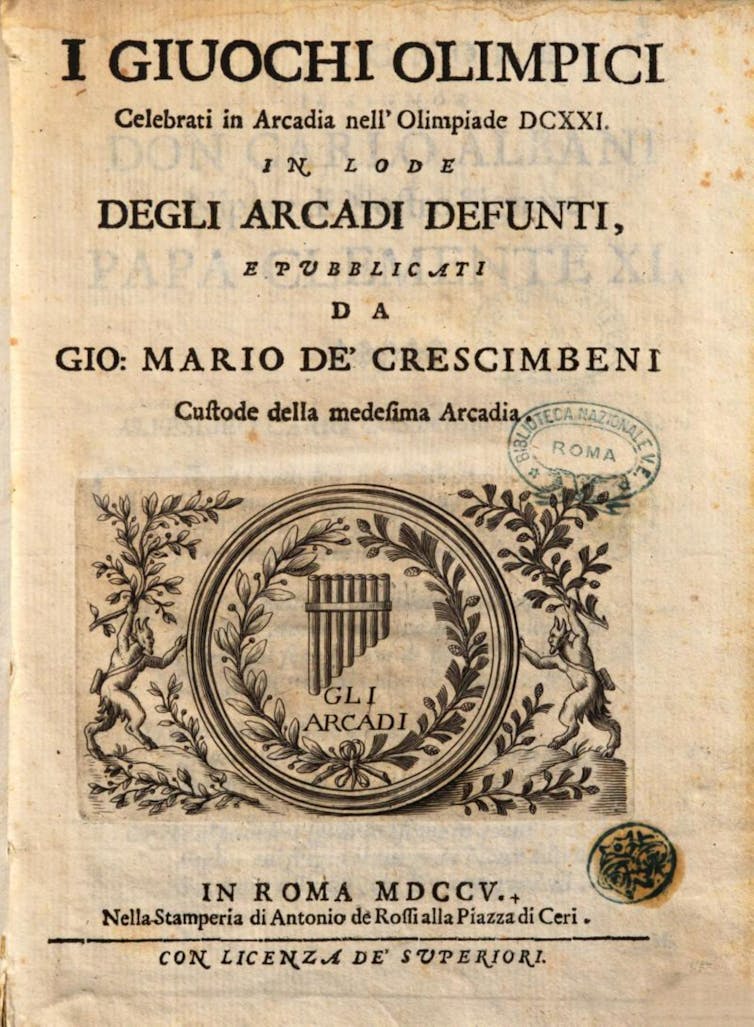
    Some 200 years before the modern revival of the Olympics as we now know it, a group of poets met in a garden in Rome to revive the ancient games in their own way. Their Giuochi Olimpici (“Olympic games” in Italian) was based not on speed or strength, but on one’s ability to string together a poem or win a debate.


    An ode to the mythical pastoral poets

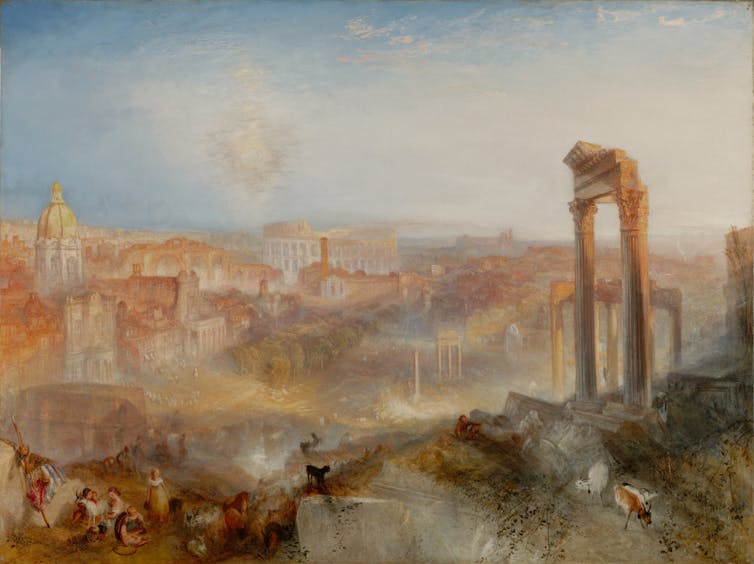
    The first of these new games was held in 1693 and they ran semi-regularly into the mid-18th century. The group met outdoors in places including the Farnese Gardens, a lofty site on the Palatine Hill in Rome overlooking the ruins of the Ancient Forum.

    Joseph Mallord William Turner’s 1839 oil painting, Modern Rome – Campo Vaccino, shows Baroque churches and ancient monuments in and around the Roman Forum.
    Getty Museum Collection

    They was a mix of (mostly male) poets, writers, lawyers, clergymen, nobles, artists and musicians. All were members of the Arcadian Academy, a group named for the region of ancient Greece – Arcadia – that was regarded as the “home of poetry” in Early Modern Europe.

    In 1504, the writer Jacopo Sannazaro had published a poem called Arcadia that presented an ideal vision of a world in which shepherds lived in harmony with nature.

    This idea took hold of writers and artists, who came to view such an idyllic landscape as a necessity for poetic invention. They imagined shepherds and shepherdesses roaming with their flocks and conversing in poetry with nymphs and satyrs – an image that was further popularised in 17th-century paintings by Nicholas Poussin and Claude Lorrain.

    These later 17th-century writers longed to inhabit this world of mythical pastoral poets. When they met, they cast aside their real names to use pseudonyms as shepherds or shepherdesses. They pretended the garden they met in was an Arcadian wood. The garden they built in Rome is still called “Bosco Parrasio” or Parrhasian Wood (Parrhasia was a region in ancient Arcadia).

    They described their meetings as “democratic” gatherings, which was highly unusual in Rome at the time, as all aspects of daily life were governed by social hierarchies and strict etiquette. But the naturalistic setting of the gardens and the playful disguises as shepherds or shepherdesses allowed for a bending of the rules.

    The title page of one of the published editions of poems composed during the Poetry Olympics held in Rome in 1705.
    Internet Archive

    It was in this setting the poetic revival of the Olympic games took place. It was one of a few revivals in 17th-century Europe, with several sporting competitions in England also calling themselves “Olympicks” or “Olympiads”. But the Olympics in Rome was the first to focus only on poetic and literary performance.

    Later on, poetry also became an official part of the first of the modern Olympic games – and remained so until 1948.


    Intellectual combat

    The Poetry Olympics took the ancient pentathlon, but replaced the five sporting competitions with five new games based on poetic composition and intellectual debate. A description from 1701 lists these as “the foot race, the javelin, the discus, the wrestling and the long jump”. Each was intended to showcase skill in poetry, wit or song.

    The foot race became a game called “the oracle”, in which a debate was held on a topic set by the custodian of the games. The javelin became a game of dispute, in which the “shepherds” took part in friendly poetic disagreements. They were encouraged “to sting and prick each other with verses” to dispel any “bitterness that may have occupied their minds”.

    The third game, the discus, became a game of wits in which the poets bested each other in composing witty songs.

    Wrestling changed to a “game of transformation”, drawing from the myth of the metamorphosis of the ancient Arcadian King Lycaon, who was transformed into a wolf by Zeus after he sacrificed his son (one origin of the werewolf myth).

    The poets presented sonnets about transforming into inferior things such as animals and plants, and then considered the virtues of these new states. In one poem that was recorded in one of the short books published after the event, a competitor imagines becoming an industrious bee, going from petal to petal and creating sweet honey to help them bear the “bitterness of the world”.

    In the fifth game, called “the garland”, the winner was the person who could weave together the most beautiful poem in praise of nature. This was the only game in which women could compete.

    While this may seem exclusionary, it was actually very permissive for Rome around 1700. Most women at the time received less education and were expected to live relatively cloistered lives. The more relaxed social structure of the academy and the games allowed women to participate in poetic performances and socialise beyond their immediate households.


    A way to build bridges

    The 300-year-old gathering of poets in a garden in Rome might seem very distant from athletes converging in Paris for the 2024 Olympics, but we can draw some parallels.

    Structured play, with its clear rules of engagement, is often regarded as a way of mimicking more serious types of social confrontation. The “play” of games at the Olympics – whether poetic or physical – allows all of us (spectators included) a chance to move through the emotions of combat, disagreement, disappointment and elation in a friendly way.

    Gathering for play also encourages us to envision new and better ways to come together as people. Roman poets in 1700 used wit and metaphor to push against the limits of courtly society. In 2024, leaders can point to the Paris Olympics and ask us to imagine a world that comes together in friendly competition, rather than conflict and disagreement.The Conversation


    Katrina Grant is Research Associate, Power Institute for Arts and Visual Culture, University of Sydney. This article is republished from The Conversation under a Creative Commons license. Read the original article.

  • JSW film on Indian athletes at Olympics

    With the Paris 2024 Olympic Games around the corner, Ogilvy has created for JSW Group has launched a new film that delves into the mindset of the athletes who will represent India on the biggest sporting stage in less than two weeks from now.

    Launched by Olympic champion Neeraj Chopra on Wednesday, the campaign includes a longer version for digital platforms and a shorter TV commercial to be broadcast on popular channels before and during the Games.

    Conceptualised by Ogilvy and directed by Shashanka Chaturvedi from Good Morning Films, it features a mix of well-known and emerging athletes from various Olympic disciplines, including Neeraj Chopra, Nishant Dev, Preeti Pawar, Manu Bhaker, Manika Batra, and Muhammed Anas, among others. Celebrity film star Ajay Devgn has lent his voice to the film.

    The campaign also celebrates JSW’s association with the Indian Olympic Association for the Paris Olympics 2024.

    Sharing his views on the campaign, and the film, Parth Jindal, Founder, JSW Sports, said, “Rukna Nahi Hai as a JSW Group campaign, has now entered its third Olympic Games, and it has grown from being a slogan to now being an emotion, a belief that Team India and all of us will take to Paris. The film captures the essence of the athletes’ relentless pursuit, perfectly. For us, they are already champions. I am certain this film will inspire the contingent in Paris, and every single Indian who will be backing the athletes throughout the journey of the Games.”

    Speaking on the launch of the TVC, Sukesh Nayak, Chief Creative Officer at Ogilvy, said, “The concept of #RuknaNahiHai is compelling and inspiring. We are proud to be a part of this journey with JSW and our athletes from day one. This campaign brings alive the true essence of rukna nahi hai, by portraying the mindset of our athletes. For whom victory and setbacks are chapters and not the end of story. It honors their relentless pursuit which makes our country shines bright.”

    In addition to the film, the campaign will be amplified through a comprehensive 360-degree media plan, leveraging TV, Digital, OTT, Digital innovations, OOH, on-ground activations, and print.

  • Olympics 2024: what new social media guidelines mean for athletes and their sponsors

    Olympics 2024: what new social media guidelines mean for athletes and their sponsors

    Representative pic: person taking a selfie. Courtesy: pickpik.com (Creative Commons Licene)


    By Layckan Van Gensen

    Cellphone cameras are ubiquitous at modern sporting events. Whether it’s a school swimming gala, the local rugby club squaring off against their bitter rivals or a national team fighting for tournament glory, every moment is a potential photograph.

    The Olympic Games are no exception. More than 10,000 athletes from 200 countries or regions are set to compete in 32 sports in this year’s host city, Paris, giving fans ample opportunity to fill their camera rolls with images of their favourite sporting heroes.

    And participants, too, will be able to memorialise their time in Paris – far more freely than ever before. This comes after the Games’ governing body, the International Olympic Committee (IOC), unveiled new social media guidelines in December 2023.

    Most of the guidelines are aimed at athletes; some relate to “accredited individuals other than athletes” such as coaches, technical staff and countries’ Olympic committee representatives.

    As a legal scholar specialising in sports law, with a focus on image rights, I’ve been closely following the IOC’s stance on athletes’ use of social media – especially photographs and videos. Image rights are a broad bundle which may include rights over the use of the individual’s still, moving and animated images, name, signature recorded voice, catch phrases, associated iconic acts, logos, trademark and brands.

    These rights can be worth a lot of money. For example, Indian cricketer Virat Kohli can earn anything between US$2 million and US$2.7 million per social media post.

    Overall, it appears that the IOC has tried to strike a balance between protecting the media rights holders while still recognising the value of a participant’s image rights. It allows them to show more content than before and, more importantly, to acknowledge their personal sponsors, who play an important role in commercialising their images and building their brands. Loyal fans will get a fuller picture of their favourite athletes’ Olympic journeys than they’ve been able to before.


    Social media at the Olympics

    Vancouver’s 2010 Winter Olympics have been described as “the first social media games”, marking the first time that the IOC created social media guidelines. These were refined for the London 2012 Summer Olympics.

    At the last Summer Olympics, hosted by Tokyo in 2020, athletes were not allowed to:

    • share any content from accredited areas used for a sporting competition or ceremony
    • post about their personal sponsors.

    These restrictions were designed, the IOC said at the time, to protect media rights-holders such as TV stations and other big media organisations.


    What’s changed

    Under the new guidelines accredited participants can share their experiences far more freely on social media platforms during what the IOC calls the “game period”, from 18 July to 13 August.

    They may:

    • take photographs and record audio and video inside and outside the accredited areas
    • share photographs on their personal social media platforms up to one hour before the start of the competition they’re taking part in, and after they have left the doping control areas
    • share posts from the training and practice areas, the opening and closing ceremonies and the Champions Park, where athletes gather after their competitions to meet and interact with fans.

    Of course there are still some restrictions.

    Videos may not be live streamed, may not be longer than 2 minutes and may not include actual competitions. So, coaches can’t film an athlete in action and then share the video or photos. Athletes also can’t record another athlete training, or post highlights from their personal competition on social media. They can only share such images or videos from official media rights-holders’ accounts.

    Perhaps most intriguingly, photographs and videos that use artificial intelligence may not be shared. It’s unclear how the IOC intends to police this rule.


    Not for commercial purposes

    Media rights-holders aren’t left completely unprotected by the new guidelines. Participants are not allowed to post for commercial purposes throughout the game period.

    A post will be regarded as “for commercial purposes” if its purpose is to generate financial profit or promote any third party or products or services.

    One of the main goals of the new social media guidelines is to balance the rights of media holders and those of the participants. This attempt at a balancing act can be seen in the new rules for non-Olympic partners – those who don’t sponsor or have official merchandise licensing contracts with the IOC.

    Brands or companies in this category may run generic advertising during the game period as long as it hasn’t been especially designed for the Olympics and has already been in the public eye for at least 90 days before the tournament starts. Advertisements in this category can’t be run more frequently during the Games than they have been previously. The IOC will apply these rules flexibly to enable “business-as-usual” campaigns.

    Participants are allowed to provide one “thank you” message to each of their non-Olympic partners during the games period but it may not include a personal endorsement.The Conversation


    Layckan Van Gensen is Junior Lecturer in Mercantile Law, Stellenbosch University. This article is republished from The Conversation under a Creative Commons license. Read the original article.

  • Between a rock and a hard place!


    By Avik Chattopadhyay


    Avik ChattopadhyaySunday, July 11, was quite a tumultuous day in London. While in Wimbledon, Novak Djokovic fought his way to his sixth title on grass, just 8.8 miles away, Wembley was preparing for the Euro 2020 finals between England and Italy.

     

    Wimbledon was prim and proper, with people enjoying the game seated comfortably at centre court or relaxing on the lawns outside watching on large screens. Everything was very ‘English’ in its casual elegance and sportsmanship was displayed by one and all.


    Wembley was the epicentre of a gathering storm, with people drunk on the streets damaging public property, smashing car and shop windows, uprooting potted plants and dancing on police barriers. Everything was very ‘English’ in its feared hooliganism and total lack of social propriety towards one and all.


    What happened outside the stadium after the English lost in the penalty shootout has been shared across the world, with most English media embarrassed to cover and capture it in its brutal entirety.


    A popular social media message doing the rounds is, “Wimbledon is what England wants the world to see it. Wembley is what England actually is.”


    Screen captured from bbc.com


    So, what really is “England” as a brand?
    Is it actually Wimbledon with Wembley as an aberration?
    Or is it actually Wembley with Wimbledon as an elitist diversion?
    Or is it both in equal measure?
    Or is it a larger macrocosm with these sporting events as little parts?


    A more fundamental question that emerges is – is it England or London as a brand? Do Londoners believe they are distinct from the rest of England just like New Yorkers or Parisians do? Do they consider themselves just different or ‘better’?


    “Places as brands are some of the most complex to both understand and work on”, Wally Olins, one of the world’s last brand gurus, had told me in 2010 when he was working on the London brand as part of the oncoming 2012 Olympic Games.


    “Most place branding exercises end up being tourism campaigns,” he continued, “projecting an incomplete picture to the world at large and, more importantly, its citizens.”


    So, while the world was debating the racist hooliganism of London, there were these electric buses traversing the city carrying pithy messages in typical English humour. If one were to judge London by just a single event of either a Wimbledon, a Wembley or a London Bus, one would be very far from the total picture that depicts the city in her entire form and mind.


    Place brands are the closest to individual human brands in their complexity, mood swings, and multitude of manifestations. Their constituents make them so. Corporate and product brands are far simpler in contrast as there is greater ‘control’ on how the constituents behave.


    It is nearly impossible for place brands to be opaque to the world outside, be it a tourist, an investor, or an immigrant. Each stakeholder is well aware of all aspects of the place before experiencing it, investing in it or even wanting to be a part of it. It is not that the place willingly shares all its manifestations, but the actions of its constituents ensure this level of transparency. London would love to have wished away what happened before and after the football game, but a place does not have control over each of its constituents. And one can end up being a total embarrassment even if miniscule as today’s open world captures, amplifies and critiques it even before you can finish singing your national anthem!


    Just see what one virus from a bat did to brand China! All the hard work over the last three decades in building its ‘power and prosperity’ image came tumbling down because some constituents handled the situation so badly that it will take another three decades to restore any semblance of credibility and bonhomie with the larger world. In retrospect, it could not have been worse timed ahead of the 100th anniversary celebrations of the CPC!


    At the same time, place brands are also subject to stereotyping by the rest of the world. There are riots currently happening in South Africa but then discussion and outrage in social media circles is far lesser even though more than seventy people have already died. That is because a larger part of the world actually expects such happenings in that place. This is the other aspect of place branding that it cannot turn away from.


    Places and their citizens are stereotyped on historical records and their interpretations. A large part of this stereotyping is a post-colonial outcome with most ex-colonies taking considerable time to come out of the images cast upon them by their occupiers. The general narrative created is the deterioration of an ex-colony in quality of life, law and order and culture once it gains independence. Close to 70% of the world has spent the last half century in destroying these narratives primarily through action and credible demonstration rather than mere advertising.


    Hence whether Kerala is truly “god’s own country” will not be determined by only the tourist boats on the backwaters but also on people enjoying “beef fry and parotta” irrespective of faith and ensuring every child gets high-quality education.


    That makes place branding a slightly easier task!


  • [MJR] Wanted: sponsors to cover the Olympics!

    Ranjona Banerji

    By Ranjona Banerji


    The biggest sporting event in the world (no, not the FIFA World Cup) is due to begin in a couple of months. So how many Indian newspapers are going to send someone to cover the Olympic Games in London? This is where Indian sportspersons are hoping to make a breakthrough after Abhinav Bindra won the first individual gold medal by an Indian in Beijing. The Indian hockey team did very well in the qualifiers, leading to expectations that they will shine again in a sport which has won us eight gold medals but no one in India really watches.


    So what’s the grouse? The reluctance of Indian newspaper managements to spend money on newsgathering. The Olympics are not just any old event. They represent an ideal – of human endeavour, of a global spirit and a desire to push back boundaries of achievements. Editorials will declaim with thundering authority about the significance of “citius, altius, fortius” but when it comes to actually reporting on the efforts to get there, everything depends on a “sponsor”.


    That is, a newspaper or journal will often only cover an event like this if the marketing department can get someone to cover its expenses. One can understand the reluctance in the days when foreign travel was prohibitive and foreign currency limited by the government (yes, I know it almost seems like we’re back in those times!) but in today’s world, depending on agency feed is nothing short of laziness and taking your reader for a ride.


    Yet strangely, in the olden days (that is, when I was young), the idea of “junkets” was anathema and people I know lost their jobs for accepting favours. Over the years, managements realised, “why pay for something when someone else can be convinced to do it”. This is why so many sports pages – like The Times of India’s for instance – are so full of “sponsored columns” that there is hardly any place left for actual news.

    One doesn’t know yet of course how many newspapers are going to go for the easy route to the Olympics, but one hears rumours…


    Meanwhile, the entire film journalism community appears to be in Cannes for the film festival, where given the quality of our cinema, almost nothing makes it even within shouting distance of a tin palm, let alone a golden one. But visits to Cannes are now de rigueur on the junket circuit, so no dip in the newspaper’s bank balance there. And credibility? Well, we stopped worrying about that a long time ago.


  • Amul to sponsor India at London Olympics

    By A Correspondent


    The year 2011 saw Amul sponsoring theNetherlandscricket team in the ICC Cricket World Cup and Switzerland-headquartered Sauber F1 team at the inaugural Indian Grand Prix. In 2012,Asia’s largest milk brand will now be sponsoring the Indian contingent at the London 2012 Olympic Games.


    Mr. RS Sodhi, Managing Director GCMMF said: “Amul is committed to strengthening the Olympic movement in India and encourage young generation from all corners of the country to take up Olympic sports.”


    Explaining the rationale of this association, he said that milk is nature’s original energy drink and plays a pivotal role in building the physical and mental strength of the athletes. Nutritious dairy diet is an important part in the diets of athletes around the world. India is the largest producer of milk in the world and Amul is not only India’s but Asia’s largest milk brand.


    To leverage this association, GCMMF has created a TVC which shows a girl made of milk performing the sports which are part of Olympics. Liquid simulation was extensively used for generating realistic animation of milk to form the body shape and movements of the girl.


    “How many people are aware that milk is actually the world’s original energy drink…. completely natural and loaded with nutrients. The commercial effectively communicates that, while making the connection between Amul and Olympics,” said Nitin Karkare, Chief Operating Officer, Mumbai, Draftfcb Ulka.


    The TVC is scripted by Haresh Moorjani, Group Creative Director, Draftfcb Ulka. Mr Moorjani said: “As the official sponsor of the Indian team for the 2012 Olympics, Amul’s commitment to health is best defined by its signature product – milk. The film demonstrates the potency of the world’s original energy drink by its lusciousness as it transforms into the ‘milk girl’ making milk magical and appetizing for both, kids as well as adults.”


    The new campaign will be aired on more than 50 television channels. It has already started getting very good feedback in social media.


    Gujarat Cooperative Milk Marketing Federation is India’s largest food products marketing organization. It procures 4 billion litres of milk annually from 3 million milk producers in more than 16,000 villages, twice a day, and processes and markets its product range comprising butter, cheese, ice cream, fresh milk, yoghurt, milk powders, UHT milk, flavoured milk, ghee, paneer etc in 3000 cities and towns of India and 40 countries around the world. Its annual sales turnover in 2011-12 was US$ 2.4 billion.


    Credits:

    Agency: Draftfcb Ulka

    NCD: K. S. Chakravarthy

    Creative team: Haresh Moorjani, Mehul Patil

    Client Servicing: Nitin Karkare, Ruta Patel, Rohan Patil, Ruchi Agrawal

    Account Planning: Vidyadhar Wabgaonkar, Mubina Quraisshi

    Films Coordinator: Alpa Jobalia, Stanley Christian, Ganesh Iyer

    Production House: Famous House of Animation

    Producer & Director: Jayant Hadke