By Labonita Ghosh
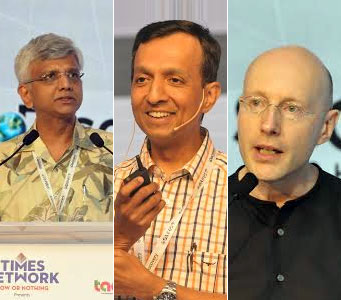 What makes for a good agency-client partnership? The question that plagues both the marketing and the advertising world, formed the subject of discussions on Day 1 of Goafest, the annual, big-ticket event jointly hosted by the Advertising Agencies Association of India and the Advertising Club. The answer was delivered by the three main speakers of the day, Chandramouli Venkatesan, Managing Director of Mondelez Foods (makers of Cadbury), Samar Singh Sheikhawat, Senior Vice President, Marketing at United Breweries, and Oliver Maletz, head of connections planning, media and international communication at Volkswagen.
If a client-agency partnership has to be successful, it must be like the partnership of Jai and Veeru, the protagonists from the film Sholay, said Venkatesan. “It should be a study in contrasts,†he said. “A client and an agency, who are two different entities, coming together to create magic. Not two entities who think in a similar manner.†Indeed, client-agency meetings are often like a Bollywood potboiler, fraught with emotion, drama and even tragedy. But what works, in an overarching manner, is when two very different styles at play come together to complement their strengths; have a shared purpose and passion, as well as a trust and friendship that allows them to challenge each other continuously to do better. The last bit is really important, said Venkatesan giving examples of successful campaigns that Cadbury entrusted its agencies with, and backed them on. Some years ago, when there was a quality issue with chocolates in the UK, and the company had to recall hundreds of bars, the agency came up with the hugely-successful Gorilla ad, showing an ape beating a drum. The company was puzzled. Instead of addressing and firefighting on quality issue, the agency was suggesting that they go in completely different direction. Cadbury trusted the agency view, and it led to one of the most memorable campaigns for the company. Given such a situation, there are things agencies can do to forge better partnerships, according to Venkatesan, and this  involves generating trust, earning that trust and putting better processes in place.
Sheikhawat had a slightly different take on client-agency partnerships. “Agencies need to get to know the business,†he says. “They don’t spend enough time understanding the business.†Sheikhawat said he facilitates brewery visits for agency reps working with his organisation, just as he had to – early on in his career – spend time in the offices of advertising stalwarts like Roda Mehta, to understand how the agency world works. Agencies should also get to know the consumer – a big challenge in a rapidly-changing country like India, when consumer choice plays an increasingly large role in the success of brands and products. One sureshot way to do this, says Sheikhawat, is to get into the marketplace and see for yourself. Get behind the counter at a department store or a liquor shop to gauge things for yourself. And once agencies get past the barriers of understanding the business and knowing the consumer, they need to be the solution for their clients. Sheikhawat cited an interesting example to illustrate this. Experience shows that women don’t like to drink beer. So trying to market a product which doesn’t appeal to half the (potential) population of India, is bound to be a problem. That’s when a 24-year-old representative of the agency UB was working with some years ago, came up with a unique (though initially incredible) solution. She suggested creating a beer-based drink that would be fruity, which led to the Kingfisher Buzz, in flavours like lychee.  It just goes to show, Sheikhawat said in conclusion, that while solutions can come from anywhere, agencies should be the first to generate them. Oliver Maletz of Volkswagen, in his session, outlined that agencies need to be true business partners to clients; be innovators, though not just for the sake of innovating and aim to deliver meaningful value to a meaningful number of people.
In its eleventh year, Goafest 2016 edition has seen participation from over 2300 delegates, and that number is expected to exceed 2500 with spot registrations.