Tag: Ola

  • What business are the aggregator apps in?

    What business are the aggregator apps in?

    With apologies to none at all

    By Vikas Mehta

    Vikas MehtaA few weeks back I had written on the decline in the services of aggregator apps and related my personal experiences with a few apps. You can find the article here.

    Some of you readers wrote back and asked me for the reasons of this decline. As one put it, usually new offerings with new technology get ironed out over a period of time. So, why should the aggregator apps be an exception to this? Fair question and it set me thinking.

    Before I continue, I would like to convey my thanks to Hamsini Shivkumar, Brand Consultant and Semiotician par excellence. It was she who nudged me into thinking deeper and we had a fair exchange of ideas. Much of what I write today is the result of her thoughts.

    Let’s look at this decline in quality, first by looking at the Indian consumer.

    Most of the aggregator apps like Ola, Uber, Swiggy, Oyo; when they came on to the scene, they offered a new service, promising higher standards of delivery at cheap rates. I am using the word cheap deliberately. The transport aggregators offered cabs at your doorsteps within minutes and their rates were lesser than a traditional ‘kaali-peeli cab’. They offered not only the convenience of quick service but also avoided the hassle of looking for a cab and the cabbie declining to take you to your destination.

    Food service apps suddenly provided one with the comfort of home delivery from various restaurants at no extra cost.

    Oyo provided cheap hotels with a minimum quality assurance.

    Make My Trip offered everything one needed to travel including air schedules and bookings across airlines, railways and gradually also bus service. Hotels, cab pick-up and drop-offs and even guides for tourist places were gradually added on. And there was hardly any extra charge in the beginning.

    And almost all of them started peddling discount coupons and more offers to make the deal even sweeter.

    That’s why I used the word cheap. New services, new comforts and new conveniences were available cheaply.

    All these were targeted at the Indian middle class. And the Indian middle class still confuses value with cheap. Typically, value could be defined as same for less. Or more for same. Or more for more. Or even less for less.

    Same for less means cheaper, discounts. More for same means you add some more benefits. Buy one get one free or 200 gms extra in a pack of 500 gms at the same price of 500 gms. More for more would be pay only Rs 500 extra for buffet breakfast with a room. Less for less would be a star hotel giving you a room but not allowing you the facilities of a gym or a swimming pool.

    The Indian middle class as a generalisation picks up more for same or same for less. Give them a room at a discounted price and they are happy. Free airport drop and pickup is accepted. But adding buffet breakfast at a marginal cost may not be appealing. No extra money shelling out. Period.

    This is not to say that the middle class is not quality seeker. But they want best quality at low prices. They are not even looking at more for more. That’s why howls of protest arose throughout the country as transport aggregators started charging peak hour or rush hour or traffic surge surcharge. So much so, that public opinion forced some states to ban these surcharges by law! The typical middle class consumer has no problems accepting discounts but when charged extra due to high demand it demurs!

    More for more works for the luxury good or premium service seekers. These may not be the typical middle class. So, a Vistara charges you higher fare as they give wider seats, more leg space and free food and it has its premium users. Or these are people who will not want an anonymous biryani but a biryani from Paradise or Shah Ghouse in Hyderabad. The premium- or luxury-seekers are fine with these.

    And such people are few in numbers compared to the vast middle class who mostly is looking for more for same or same for less. The focus is solely on the price.

    Therefore, when the aggregator apps were launched and everything was same for less or more for same, these were lapped up. Cabs available at your location without any extra fees and maybe even cheaper than metered kali-peeli cabs were a hit. Food delivered in fast time without any delivery charge was a success. Hotel rooms available at much cheaper price with a promise of cleanliness and sanitation were lapped up.

    Now let’s see this picture from the viewpoint of the aggregator. Understanding the propensity of the middle class, they offered value but focussed on price. For the aggregator, it was hot food offered at the comfort of home at no extra cost but for the consumer it was about food at some discount too. It was not about cabs available quickly at your location without the fear of being declined by the cabbie but about great rates. It was not about an alternative available between 3-star and hole-in-the-wall shady hotels but about shady hotels available cheaper. To be honest, for both the cab aggregators and hotel aggregators, the story about cabs without declining and hotels with a standardised hygiene version were played up but these advantages were soon frittered away.

    Their partner service providers had been acquired also on the lure of substantial earnings. Hotels and restaurants were promised big incremental revenues. The delivery riders were promised lucrative, per ride fees. Transport aggregators too were giving the drivers big monies. And as word spread about easy money, more partners accrued.

    Discounts and price-cuts and subsidising of partners lasted for some time. And soon the aggregators were under pressure to improve margins. Move towards profitability. VCs wanted IPOs to cash out.

    The partners became disenchanted when aggregators cut the big incentives, subsidising of vehicles and even helping spruce up the hotel property. Rider fees were slashed. And delivery charges crept in. Travel aggregators included convenience fees. The situation became piquant as the consumer suddenly realised that the free or discounted does not make sense as extra charges were levied. So, s/he demanded more accountability. The brunt of this was faced by the partners such as delivery riders, hotels, cab drivers, airlines etc. In turn, these partners resorted to all sorts of jugaad. This led to service standards declining.

    And the jugaad mindset led to ingenuity of the partners. Cabbies, not wanting to travel short distances, would deliberately arrive late. Forcing the customer to call them. And on enquiring the destination, they would cancel the booking or say that they did not find the customer. Thus, not only causing major unhappiness but also destroying the advantage of ‘no declining’ as in traditional cabs. Restaurants realised that they could, in their own areas, do their own delivery. Hotels started asking regular visitors to book directly and gave them equal if not more discounts.

    The aggregators tried to control the partners with technology. OTPs, rating points, incentives based on ratings were introduced. But service is an interesting concept. It can be aided with technology but it cannot replace the human touch. The aggregators, under cost and margin pressure did not accentuate the human touch. Nor did they expand technology to aid the human touch. In fact, the reverse happened. It used to be difficult to get through customer service numbers. Now the customer service numbers just disappeared. Bots supported by AI came in. Social media sites were flooded with complaints. This spooked the investors who put more pressure on the aggregators. Things just went downhill.

    Another thing about service is that it becomes increasingly difficult to deliver consistent service online. In offline, service expectations differ according to customer segment and their location. Someone with a premium service mindset in Gurugram cannot be treated in the same way as a discount-oriented customer in Saharanpur. But in online, we have a single set of guidelines. We have one operating SOP. And this fails to deliver. No attempt has been made into moving into customisation of service.

    And because most aggregator apps have not defined their target group but want to engage all possible users, they are dealing with different set of users. This results in trying to keep all segments happy without aiming at anyone in particular. To use a mathematical analogy, this results in service systems which cater to the lowest common denominator, LCD. And not HCF, the highest common factor.

    Offline service standards are tweaked depending upon the location and your target customer. That’s why service companies do attain good standards, offline. But online, heavy investments are required to make it reach the customized HCF level. A luxury which the under-pressure aggregators cannot afford.

    And that’s why, all these aggregator apps, while realising that they are in different business must also realise that by being an aggregator, their core is about service. Transportation, food delivery, rooms, travel is the second level of tangible benefit. The most important tangible benefit is service.

    I think Amazon is the only aggregator which has focused on service. It openly declared that it isn’t in the business of ecommerce or entertainment. But it is in the service business. This has helped it achieve higher customer satisfaction and loyalty than other aggregators. And Flipkart which had the first-mover advantage in India, is today owned by Walmart, a discount store brand. Maybe therein lies a tale.


  • Arun Srinivas to helm Facebook’s Global Business Group

    By A Correspondent


    Arun Srinivas

    Facebook has announced the appointment of Arun Srinivas as Director of Global Business Group to lead the strategy and delivery of the India marketing solutions charter that is focused on large advertisers and agencies. He will have the company’s key business vertical teams, agency teams, and business solutions teams reporting into him.


    Srinivas comes with 24 years of experience in senior sales and marketing roles at companies such as OLA, Unilever, and Reebok. He also did a stint at investment firm WestBridge Capital Partners where he led the consumer vertical. His last assignment was with Ola, where he was Chief Operating Officer (COO) and Global Chief Marketing Officer (CMO) at Ola Mobility. Srinivas started his career with Reebok and then moved to Unilever where he spent more than 15 years across food, beverages, skin care, and personal care categories. He is an alumnus of Indian Institute of Management, Kolkata.


    Said Sandeep Bhushan, Director and Head of Global Marketing Solutions, Facebook India: “Facebook is committed to enabling economic opportunities for businesses, and this charter is more important than ever before as we navigate Covid-19 and the economic crisis. Large businesses and agencies play a crucial role in the country’s digital economy and are critical to driving ecosystem standards for media. I am thrilled to welcome Arun as he joins our team as Director GBG, and leads the mandate to shape the role the Facebook family apps can play in enabling businesses, supporting India’s economic recovery, and building the digital advertising ecosystem of the country.”


  • Ola’s latest ad film urges fans to never miss a World Cup match

    By A Correspondent


    Taking a fresh spin to the campaigns around the 2019 Cricket World Cup, Ola unveiled its latest music video that embodies the enthusiasm of cricket lovers to watch the tournament promising them a reliable ride to their destination to catch the match.


    Conceptualised and developed by Leo Burnett Orchard, the campaign emphasises on what is most important to fans – the sheer pleasure of watching cricket at their preferred location.


    Speaking about the campaign, Anand Subramanian, Senior Director, Marketing and Communications at Ola said: “This video reiterates Ola’s versatility and its long term commitment to meet the dynamic needs of Indian consumers. An extension of the brand’s promise, the campaign highlights how easily and seamlessly Ola gets you to your preferred destination. With the World Cup being one of the most watched cricket tournaments in the country, this campaign is bound to strike a chord with cricket buffs, ensuring they’re able to get to where they want to be to cheer for their favourite team.”


    Added Amod Dani, ECD, Leo Burnett Orchard: “We were looking for a unique and innovative way to capture the synergy between cricket and music. With this video, we not only showcased the emotion, zeal and excitement of cricket fans to watch the matches but also demonstrate how Ola is the ideal solution to fulfilling the commuting needs of Indians. This was a great opportunity for us and are pleased to have created this campaign with Ola.”


  • Ola ropes in Orchard and Indigo to lead marketing mandate

    By A Correspondent


    Cabride-hailing aggregator Ola has roped in Leo Burnett Orchard and Indigo Consulting to lead the mobility brand’s marketing services mandate in the country. The mandate includes brand strategy, new launches, content strategy, and digital communications, and was awarded post a competitive multi-agency pitch. The account will be managed by the agency’s Bengaluru office. It was handled earlier by the Bengaluru-based Happy Mcgarrybowen


    Said Dheeraj Sinha, Managing Director – India and Chief Strategy Officer – Asia, Leo Burnett on the win: “Ola is one of the few brands born in India that are defining the fundamentals of how we live. The brand is changing the rules of mobility for India, while enabling respectable livelihoods for over a million driver-partners. As an agency, we are really chuffed about this mandate, as this is an opportunity to take the story of a revolutionary Indian brand into their next stage. We are thrilled to partner with Ola and leverage the strengths of Leo Burnett Orchard and Indigo Consulting teams to build a unified brand platform.”


    Added Anand Subramanian, Senior Director, Marketing Communications at Ola: “We look forward to this partnership with Leo Burnett Orchard in our mission to build mobility for a billion people. Over the past eight years, the Ola brand has evolved to become one of the world’s largest mobility platforms, impacting the lives millions of customers and partners alike. We are confident that this new partnership will help resonate the brand’s voice amongst Ola’s 150 million+ users and beyond.”


  • Ola launches new brand campaign for Ola Rentals

    By A Correspondent


    Ola has launched a nationwide integrated campaign focusing on Ola Rentals. Starring actor and writer Sumeet Vyas, the video campaign highlights Ola Rentals as the go-to weekend ride.


    Conceptualised and developed by Happy mcgarrybowen, the TVCs show Sumeet as an empowered Ola Rentals customer who isn’t worried of getting tired of driving for long hours in heavy traffic. Instead, he enjoys a day out with his wife and back-to-back outings to meet relatives since he gets to relax at the backseat like a boss.


    Said Pallav Singh, Senior Vice President at Ola: “Since its launch in 2016, Ola Rentals has been a favourite among corporate customers and working executives who move from one meeting to another during the day. Through this latest campaign we want to highlight the convenience of having a cab on disposal for diverse needs like shopping trips, meeting friends, visiting relatives, local sightseeing etc. I am glad to share that the TVCs are garnering great response, which goes to show that customers today value convenience and experience. They don’t want to tire themselves driving in heavy traffic, instead would like to be driven around as they relax and enjoy their day off.”


    Added Samarjit Choudhry, Chief Operating Officer, Happy mcgarrybowen: “Ola Rentals is a very unique category. Unlike a point-to-point cab, this one is meant to take you to multiple places. It takes away a lot of pain points like parking or having to book another cab, not to say the pain of driving on congested roads. Keeping all this in mind, we decided to take weekends as a plank for communication because a large number of the people get out on weekends and face the stress of weekend traffic and finding parking spots. The ease of the product offering had to be conveyed and hence we came up with the campaign thought of #NoStressBoss.”

  • Ola pushes for grassroots sporting talent via #RoadToGold

    By A Correspondent


    Ola has launched a nationwide crowdfunding campaign to develop grassroots sporting talent - #RoadToGold. The campaign aims to support India’s collective dream to increase the chances of winning Gold medals at major global sporting events.


    Speaking on this initiative, Pallav Singh, Senior Vice President, Ola said: “We are proud to introduce #RoadToGold, a nationwide initiative towards supporting exceptional sporting talent in the country. The right encouragement complements sports professionals’ immense talent to win accolades at a global stage and together with a small contribution of INR 1, we can strengthen India’s chances of winning Gold medals globally.” He further added “We are glad to partner with JSW Sports and Excel entertainment who have been staunch supporters of sports in India through infrastructure and entertainment. Together, we share the dream to identify high calibre talent and turn them into medal winning performers.”


    Added Mustafa Ghouse, CEO, JSW Sports: “At JSW Sports, we have supported talented Indian sportspersons over the past few years and have seen the kind of impact that proper training and facilities can have on performances. Through our institute, we are attempting to take this initiative even wider by providing young talent across India access to world class infrastructure and sports science to help them realise their potential. We are proud to partner with a company like Ola to foster sporting talent and spearhead a generation of exceptional sportspersons.”


  • Ola hires Starcom as its Media AOR

    By A Correspondent


    Starcom India has been awarded the media duties of ride-share major Ola. The Publicis Media agency will oversee the account’s media planning and buying across both traditional and digital media. The mandate is for India, as well as for upcoming international markets that Ola will operate in. The account, pegged in the region of Rs 200, was earlier held by GroupM agency Motivator.


    Deepak Sharma

    Said Deepak Sharma, Managing Director, Starcom North: “Ola was impressed with our strategic planning skills, led by the Human Experience (HX) approach, as also with our strong data and analytics-led capabilities. They are on an incredibly exciting journey and we look forward to being a part of their growth and expansion plans.”


    Added Mudit Shekhawat, Senior Director, Marketing at Ola: “We are excited to partner with Starcom. Their teams were able to demonstrate strong insights on the category and brought in fresh ideas and thinking on the brand. Their expertise in integrated communications strategies and smart execution will help in further consolidating our leadership in this industry. We are excited to work with them.”


  • Ola appoints Viraj Chouhan to head comms


    Viraj Chouhan

    Ola has announced the appointment of Viraj Chouhan as its Chief Communications Officer (CCO). Chouhan was most recently, Executive Director of Corporate Communications at MTS India.


    As Chief Communications Officer, Chouhan would be reporting to Ola Co-founder and CEO, Bhavish Aggarwal. Anand Subramanian, who was leading the Communications mandate thus far, will be moving into a new role within Ola.


    Bhavish Aggarwal, Co-founder and CEO at Ola, said, “I’m excited to welcome Viraj onboard to lead Ola’s Corporate Communications efforts. I’m looking forward to working with him to share the Ola story and vision across customers, driver partners, employees, and the nation and world at large! Our aim is to build Ola as a brand and organisation that every customer  identifies with and takes pride in.”


    Viraj Chouhan, on his appointment as CCO, Ola said, “I am thrilled to join Ola and be part of this growing internet conglomerate. Ola has not only positively elevated India’s mobility experience, but is also a key driver of our country’s digital economy at large. Ola’s mission of building mobility for a billion people will have a lasting impact on our nation’s development. And that is what makes the Ola story so inspiring and deserving, to be taken to every stakeholder and citizen. I’m eager to join the Ola team in this mission!”


  • MSL bags communications mandate for Ola

    By A Correspondent


    Communications firm MSL has bagged Ola’s communications mandate. Ola has engaged MSL for its end-to-end communications mandate starting November 1 2017. MSL India comes on-board post a multi-consultancy pitch that lasted over two months. Earlier, MSL has also held the communications mandate for Uber.

     

    Said Amit Misra, CEO, MSL India: “We take immense pride in being the communications partner for Ola, India’s very own technology company that’s transforming the concept of mobility with hyperlocal innovations. With a clear understanding of Ola’s narrative and priorities, we are conscious of our role as strategic advisers, and look forward to supporting Ola in its mission of building mobility for a billion Indians.”


    Added Anand Subramanian, Senior Director, Marketing Communications, Ola: “The Ola brand is naturally aligned to India’s development by deeply impacting lives of millions of customers across the length and breadth of the country as well as livelihoods of hundreds of thousands of driver partners. These are exciting times for Ola and we are confident that our new communication partners, MSL will help us get our mission of building mobility for a billion Indians to resonate with every stakeholder. We look forward to an exciting journey together.”


  • Airtel and Ola join hands to roll out integrated digital offerings for customers

    By A Correspondent


    Bharti Airtel announced a strategic partnership with Ola to offer a range of digital services to customers. Airtel and Olawill bring together their respective platforms and reach to co-create a comprehensive ecosystem to address India’s growing communication and mobility needs. In addition, Ola will leverage Airtel’s integrated suite of enterprise services to power its operations, while Airtel will leverage Ola’s vast network of hundreds and thousands of driver partners.


    Said Gopal Vittal, MD & CEO (India & South Asia) Bharti Airtel: “At Airtel, we are constantly innovating to build products and partnerships that accelerate the development of India’s digital ecosystem. We are delighted to partner Ola to enable a seamless digital experience for customers. Both companies have strengths that complement each other and this offers massive scope to co-create exciting products and solutions for customers. Ola will also benefit from Airtel’s extensive retail network and our integrated suite of world-class connectivity solutions for businesses that help them drive growth through better efficiency.”


    Added Bhavish Aggarwal, CEO and Co-founder at Ola:“At Ola, we are always focused on innovating and building on the mobility experience for customers as well as driver partners. This first-of-its-kind partnership brings a host of offerings from two massive ecosystems together. Airtel will integrate its offerings across payments, content, PoS networks, and more with Ola’s offerings for its large customer and partner base. We see this as a win-win for partners and customers of both brands, bringing increased convenience and access to mobility as well as connectivity at the same time.”


  • Can Republic TV kill Competition?


     By Pradyuman Maheshwari [updated]

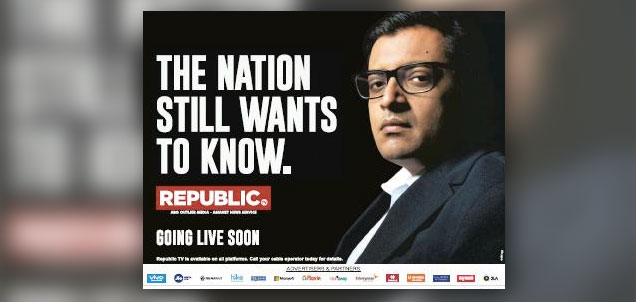
    For a television channel that’s determined to fight for the need for transparency in public life and government, its launch date appears to be a closely guarded secret. But now it’s confirmed: Tomorrow, May 6. Why a Saturday, one may ask. Because that’s the first day of the week (Week #19 of 2017) as per BARC measurement. And Goswami, as he must, keeps a close watch on his viewership numbers.

    Before we had  confirmation on the date, we did have word from the Star India Corporate’s PR agency that Republic TV would start streaming on the OTT platform with effect from tomorrow. No time stated.

    Having said that, Republic is on a roll in terms of marketing across media. It has a healthy set of advertisers: Vivo, Jio, Renault, Hike, Yes Bank, Microsoft, Ravin, Nestaway, Future Group, Havell’s, Gionee, Lloyd, Raymond and Ola. Star India, we are told by sources, will continue to be an advertiser, though its logo is missing from today’s Mint ad.

    We asked ChromeDM, specialists in research on connectivity to give us a report on the availability of Republic TV, for, distribution along with content and revenues will eventually speak about the success of the channel.

    And this is what Pankaj Krishna, Founder & CEO, Chrome DM said: “Currently, on an average, an English News Channels has an availability of 45.1% among Urban Homes in India. With its soft launch, Republic has 18.4% Urban India availability (as per Chrome OTS or Opportunity to See, 3rd May 2017). In Mega Cities, Republic is currently available in 32% of the Households.”

    Note this is for data as of May 3. A distribution industry expert we spoke with said that the availability will leapfrog once the channel goes on air, as even though the deal is inked, some discerning networks do not like to air test signals. So the expert we spoke with said the ChromeDM data as of now may not be the right measure to look at right now.

    However, MxMIndia is a neutral observer and it’s important that you know facts as they are. Also, according to the ad, distribution deals have been inked with all platforms. Other than Hotstar, Republic will be available on Jio, Ditto and we are sure other platforms too.

    “There’s a buzz around Republic TV, and even if deals aren’t inked, viewers will want to watch it and will ask for it… at least for the first few weeks. Moreover, it’s free-to-air, so the pull factor increases,” said one distribution network owner.

    A media buyer and marketer we spoke with requested to speak on anonymity. Here’s what both echoed.

    1. That the buzz around Arnab Goswami has increased after he quit his previous employer.
    2. The legal notice which Goswami spoke about making an emotional appeal touched a chord, and there is a certain amount of sympathy for him.
    3. The issues with Pakistan are raging, and that’s a topic Goswami is passionate about
    4. There are enough inefficiencies across the country which Goswami will definitely dwell on

    Meanwhile, other channels are also getting their act together. Both India Today and CNN-IBN have launched shows at 7pm and also relooked at the rest of the primetime programming. Extension of primetime to 7pm will expand the viewership in all.

    As per BARC ratings for Week 17 (April 22 to 28), Times Now was the leader followed by India Today, CNN-News18, NDTV 24×7 and BBC World News. NewsX and WION didn’t figure in the Top 5. This data is for urban and rural viewership from amongst males of 22 years and above.

    MxMIndia also spoke to industry captains and while all of them wish Republic TV and Arnab Goswami the very best, they do acknowledge that it’s not going to be an easy ask. There are comparisons made to how CNN-IBN (now CNN-News18) scored a march over NDTV 24×7 when Rajdeep Sardesai started the channel, but those were early in the history of English news television in India. Times Now didn’t exist and Headlines Today (now India Today) was near-inconsequential.

    And what is our view? Well, who doesn’t like a David outwits/ outshines/ kills Goliath story. We all love it. But then we are going to be as neutral as it’s possible. We report on the business regardless who gives us business.

    However, there are issues which are beyond just R&R… in this case ratings and revenues. It’s the kind of journalism we will see on Republic TV. And hence across all channels. Will channels talking about the noise be contributing to the noise in their own way? Will the new style of television journalism – nationalism and raising questions against it – actually damage situation on the ground, even though the viewership of English news channels is limited.

    It’s our third ‘Big Story’ on Republic. Or fourth? We’ve lost count. But, then, it’s possibly one of the biggest media launches in the last decade.

    The last question to ourselves (and as in the headline): Do we see Republic TV killing Competition?

    Our response: We don’t know. Yes, we do care and we will be delighted to report on the numbers. We will await the BARC ratings over the next few weeks quite how in the old Hindi films the old parents would wait for the ‘daakiya’ for an update.

    Our normal end-line would’ve been: May the best channel win.

    But here, we will say: May good (and smart) journalism win.

    Now don’t say who cares!


  • Happy mcgarrybowen, Ola invite people to #SpeakIndian

    By A Correspondent


    Ola, India’s most popular app for transportation, hoisted the Republic Day flag with special fanfare. The company unfurled a campaign it calls ‘Speak Indian’. Described as an initiative to promote local languages, it was launched with a web film on the country’s 68th Republic Day.


    Conceived in partnership with creative agency Happy mcgarrybowen, the campaign is a reflection of India in 2017: cosmopolitan, yet rooted to its cultural sensibilities.


    “Through its cutting edge technology, Ola is proud to have created a platform that allows hundreds and thousands of people from different backgrounds and cultures meet each other every day. Through various innovations and customizations in its products, Ola has been able to create an environment where customers and drivers are embracing the local cultures and in the process creating new memories and experiences. Our #SpeakIndian campaign demonstrates this, reminding every one on how Ola is acting as an unifier of people from different cultures.” said Raghuvesh Sarup, Chief Marketing Officer at Ola.


    The film features a nuanced set of moments from across the country’s urban and suburban landscape. Tamilians speaking Hindi, Punjabis trying their hand at Kannada, Malayalis making conversation in Bengali…which is a heartwarming and humorous take on contemporary India.


    The initiative rides the extra mile with educational content on Social Media, delivering essential phrases and sentences in different languages. “Nothing makes India more beautiful than the cultural mix that we are as a nation. Ola would be amongst the few brands that gets to experience this day-in day-out across the country. Speak Indian is just an effort to celebrate the uniqueness of every local language and culture,” said Kartik Iyer, CEO of Happy mcgarrybowen.


    The film, propagated through social media channels, saw a positive response and was one of the most shared videos, with users chiming in on its relatability and praising the brand’s effort in the direction.