Tag: obituary

  • RIP, G Kasturi, Editor, The Hindu (1965-91)

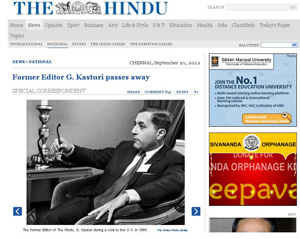
    Screengrab of The Hindu report announcing the passing away of G Kasturi

    By A Correspondent


    Mr G Kasturi, veteran journalist and Editor of The Hindu from 1965 to 1991 passed away last Friday (September 21). He was 87.


    Reports The Hindu: “The end came peacefully at 2 a.m. on September 21. He had been unwell for some time, but was alert and active till the last. The cremation took place on Friday afternoon at the Mylapore crematorium. He is survived by his wife of 64 years, Kamala, sons K. Balaji and K. Venugopal, daughter Lakshmi Srinath, and five granddaughters and two great-grandchildren.”


    Links to coverage on Mr G Kasturi:

    Report in The Hindu and former Editor-in-Chief N Ram’s comment:

    http://www.thehindu.com/news/national/former-editor-g-kasturi-passes-away/article3919690.ece


    Photo feature in The Hindu

    http://www.thehindu.com/news/national/a-photo-feature-on-g-kasturi/article3919952.ece?homepage=true&ref=slideshow


    Links to various tributes in The Hindu

    http://www.thehindu.com/system/topicRoot/G__KASTURI__1924-2012_/


    Mahesh Vijapurkar on G Kasturi in Firstpost

    http://www.firstpost.com/india/what-made-g-kasturi-different-from-other-editors-464693.html


    Sans serif: Hindu’s longest serving editor G. Kasturi: RIP

    Hindu’s longest serving editor G. Kasturi: RIP


  • Obituary – Bal Mundkur: Slogans, spice and a bite of ‘song’

    By Vidya Heble


    “Bal Mundkur has passed away.” It seemed an impossible thing to believe, but the fell hand had indeed taken him, on the morning of January 7, 2012.


    It was on a winter day many years ago when I first met Bal Mundkur at his home, Surya, on the banks of the river Mandovi in Goa. He was, of course, a legend and I trembled inwardly at actually meeting him, albeit in a personal capacity.


    His career as a naval officer and aviator had been followed by an illustrious innings in advertising, which he had famously given up to retire in Goa. ‘Retire’ was only figurative, because he proceeded to put his unrelenting energy into designing and building his house, and then lending his prodigious talent to projects which he felt would benefit society, including restoration of a fort and setting up of a museum. He even found his way into an offbeat little film (http://wn.com/rare_indie_goa,_ma_cherie_part_1) which is quintessentially ‘Bal’.


    “For the Royal Society for Asian Affairs, where he contributed an article on ‘Incredible India: The Inconvenient Truth’, he described himself “as neither an activist nor a frustrated journalist but as a dispassionate commentator”.


    People in Goa looked on him with awe, and he was known as a man of exacting standards and uncompromising expectations. Even my “Hello”, I felt, would be subjected to scrutiny. But he was delighted to meet a fellow Konkani, and dwelt pleasurably on the joys of Konkani food, much of which he was not allowed to eat by then. Pickle, chutney and spicy food was out of bounds, but Uncle Bal, as I called him, managed to sneak teekha stuff onto his plate now and then. When he discovered that I can cook, he extracted from me a solemn promise to make him some standard Konkani dishes, among them potato ‘song’ – a simple dish of cubed potatoes cooked in well-sauteed onions, tamarind and a lot of chilli. I made a mental note to tone down the chilli for Uncle Bal, who of course read my mind and said, “Don’t forget, lots of chilli!”


    But Uncle Bal had so much else on his plate that he never did find the time to come over for a Konkani meal. With time and circumstances, I didn’t meet him again for some years. But being in the business of media news meant, inevitably, that our paths would cross professionally. When I rang him up after a long interval, to ask for an interview on Ulka’s anniversary, he remembered the long-promised ‘song’, and once again we assured each other that I would cook and he would eat, one day.


    As always, however, Uncle Bal had too much going on in his life. One never knew where he would be next – dashing between Goa and Mumbai, scooting off to Europe or South-East Asia or somewhere else – or what project he would take up. Perhaps fittingly, his last offering was the history of Indian advertising, Ad Katha, which was released at Ad Asia 2011 in New Delhi.


    But those who know him, know that he would not have rested after this. That fertile brain would have been working on something else, and he would have been ringing people up with exhortations to participate, to donate, to sponsor. His zeal was unwavering and his passion, perpetual. Somewhere he might even have found time to stop for a bite of ‘song’.


    We will all remember Bal Mundkur in different ways. I’ll recollect him with a dash of spice.


  • Remembering Bal Mundkur


    By A Correspondent


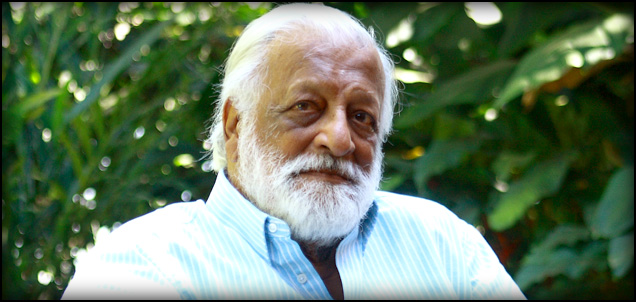
    Founder of Ulka Bal Mundkur, 86, passed away on the morning of January 7, 2012 of heart failure at his residence, ‘Surya’, in Reis Magos, Goa, overlooking the Mandovi River.


    The agency, now Draftfcb + Ulka, celebrated its 50th anniversary last year and is ranked the third largest advertising group in the country.


    Mr Mundkur was originally a naval officer, and later a commercial airline pilot. A modelling offer from his brother, who worked at Levers, marked his entry into the world of advertising which he joined in 1951. Ten years later Mr Mundkur founded Ulka, which means shooting star, and the agency’s career was indeed starry. In a span of 10 years, Ulka became the fourth largest agency in the country, and by far the largest independent Indian start-up.


    A release from Draftfcb + Ulka says, “An avid collector of all things rare and beautiful, Bal’s prized chess set starred in Satyajit Ray’s celebrated Shatranj Ke Khiladi. Bal was not just a businessman, but he was also an extremely passionate crusader for a wide range of causes, from a building for a cerebral palsy hospital to bringing the choir of Trinity College, London on a tour across India.


    “In the nineties, Bal retired… and moved to Goa, where he continued working for causes close to his heart – which included helping set up Asia’s very first Museum of Christian Art in Goa.


    “Bal remained full of energy and enthusiasm till the end – at 85 he set up the Centrum trust, which recently published Ad Katha, the story of Indian Advertising over the decades.


    “Bal has moved on, but he will live on in the hearts of those who knew him.”


    Read:

    Obituary – A dash of spice

    http://www.mxmindia.com/2012/01/obituary-bal-mundkur-slogans-spice-and-a-bite-of-song/


    Tributes – Warmly remembered

    http://www.mxmindia.com/2012/01/bal-mundkur-man-and-memories/


    Mediaah!: RIP, Bal Mundkur

    http://www.mxmindia.com/2012/01/mediaah-rip-bal-mundkur/


    Photograph: Shreta Arora/O Herald O

  • Steve Jobs – The Vision and the Conviction

    By Prasanto K Roy


    It’s a well-worn cliché to speak of the end of an era when someone well known has passed away.

    Today, however, it does feel like something has changed forever in the world of tech.

    The brilliance and clarity of vision, the courage of conviction, the fiery intolerance for imperfection.

    I really don’t see another individual impacting technology in anywhere near the same way, in our era, as Steven Paul Jobs did.

    He wasn’t just the guy who made the world’s coolest gadgets. Oh, well, that too. I don’t know of any other company for whose products buyers queue up for three days, ahead of launch.

    Steve Jobs created markets and product categories. He changed how we consume information and entertainment. He redefined leadership.

    I can’t think of another person whom I have been so proud to have merely met, once, for a few minutes, or sat through as many as two of his “oh, and one more thing” launches. When he pulled that first iPod out of his jeans pocket, we all stood up, and I didn’t even notice when my new notebook slid from my lap and cracked its display. It was a small price to pay to be a part of a piece of history, to experience the famous Jobs near-field distortion. “The Force is strong with him”, an elderly, pony-tailed journo sitting next to me said, perhaps to console me.

    There’s so much about Steve Jobs that marks him out from the many tech visionaries that dot Silicon Valley and the rest of the world. His never-say-die reinvention of himself and the companies he started, repeatedly turning adversity into advantage, described most famously in his Stanford address. His candor about shamelessly stealing the best ideas he came across, and then turning them into life-changing gadgets. His violent intolerance for ‘good enough’, making life hell for his design and execution teams, but turning out extraordinary products.

    Can you think of another person who would have had the vision to take his company into uncharted waters like a mobile phone with no keypad, which no market research had showed any demand for, and then change the world with that? Or who’d have the courage to bet upon and live with one, just one, model to take on the world’s phone vendors… and then to edge them out, with the world’s most brilliant, and most profitable smart phone? Or have the vision and execution to back great design with the amazing apps and accessories ecosystem that led to the re-invention of the tablet?

    This is a eulogy from a non-fanboy, and indeed something of an Apple critic. Though my first computer was an Apple IIc and my home is today dotted with iPads and iPods, I am no fan of Apple’s closed-garden approach, its secrecy and indeed its arrogance, or its historical lack of interest in India.

    I know that all of these largely derive from Steve Jobs, despite his old ties with India, which famously made a big impression on him as he backpacked through it (or when he went for his meals to a Hare Krishna temple in California).

    But we lived with all that that, and still bought Apple products. The secrecy and arrogance were an inseparable, even necessary part of the picture of Steve Jobs and Apple, especially if you go by results: stunning, life-changing lifestyle devices.

    With every chapter that ends, there is a new beginning.

    Of course the world, and Apple, will produce more outstanding, life-changing products. But yes, something has changed in the world of tech today, leaving (for Star Wars fans) not just a disturbance, but also a major discontinuity, in the Force.


    Prasanto K Roy is the chief editor of CyberMedia’s ICT group, and can be found at http://www.pkr.in/ or found on twitter.com/prasanto