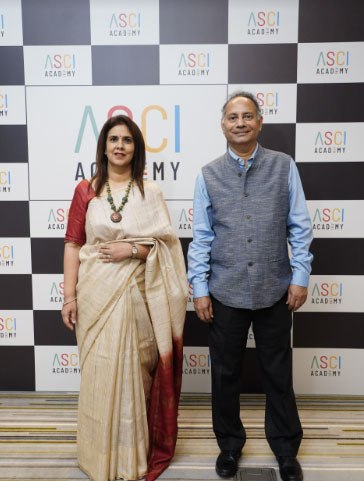
Saugata Gupta, Managing Director and Chief Executive Officer of Marico Limited, will be the new Chairman of the ASCI Board of Governors. This was announced following the board meeting that followed the 37th annual general meeting last week. Gupta’s association with ASCI spans several years; two years on the Board of Governors and four years as a special invitee on the Board of Governors.
Partha Sinha, President, Response, Bennett Coleman & Company Limited, was elected Vice Chairman, and Sudhanshu Vats, Deputy Managing Director, Pidilite Industries Ltd., was appointed Honorary Treasurer.
In his role as ASCI’s new Chairman, Gupta said: “Leading ASCI at this juncture is a privilege. We are in the midst of an extraordinary opportunity to reimagine what responsible advertising means and how consumers need protection in the digital age. ASCI is at the very forefront of this effort as it collaboratively shapes the industry. With the advent of the ASCI Academy, we are active architects shaping a more responsible future. Our mission is to instil the principles of self-regulation into the very heart of the creative process. I eagerly look to take further the ambition we have drawn for ourselves. With the support of my board colleagues and ASCI’s exceptional team, we are all set to raise the standards of responsible advertising.”
Recalling his tenure at ASCI, the outgoing Chairman, NS Rajan said, “Leading ASCI over the past year has been an immensely fulfilling journey. I am proud that, as a collective team, we have strengthened our abilities to be ready for the future. The launch of the ASCI Academy is a significant event that I am sure will yield positive results.
(L-R) Manisha Kapoor, CEO and Secretary General and NS Rajan, Chairman, ASCI at the Academy Launch
The Advertising Standards Council of India (ASCI) has unveiled the ASCI Academy, an initiative poised to amplify the advertising industry’s capacity to create more responsible and progressive advertising campaigns.
The Academy has over 50 founding partners and supporters including Cipla Health Limited, Coca-Cola India Private Limited, Colgate-Palmolive (India) Limited, Diageo India, Hindustan Unilever Limited, Mondelez India Foods Private Limited, Nestlé India Limited, PepsiCo India Holdings Pvt Ltd., Procter & Gamble Home Products Private Limited, several leading universities and colleges, prominent Civil society organizations such as Mumbai Grahak Panchayat, Consumer Voice, CUTS, CMS and others, and, industry bodies like the ISA, AAAI, IAA and ISWAI, as well as research insight organizations.
Said Rohit Kumar Singh, Secretary, Department of Consumer Affairs: “I congratulate ASCI on the launch of the ASCI Academy. In the digital age, preventive actions need strong impetus and encouragement, and the training of industry professionals – current and future is an important systemic intervention. The Department of Consumer Affairs is supportive of such efforts by the advertising self-regulator to foster a culture of responsibility in the advertising industry. We hope that the advertising industry engages deeply with the Academy programs to make their teams better trained and educated on the aspects of advertising regulations.”
Added Vikram Sahay, Joint Secretary, Ministry of Information and Broadcasting, who is part of the ASCI Academy’s Apex Council: “Many congratulations to ASCI on the launch of the ASCI Academy. The Ministry of Information & Broadcasting has always supported self-regulatory mechanisms in the media and entertainment industry. We hope that the resources and support by the Academy would be extremely useful for the online advertisers and platforms.”
Addressing the opening of the academy, NS Rajan, Chairman, ASCI, said: “While ASCI has always had a strong corrective mechanism, we also wanted to harmonise the dynamic interplay between creativity and responsibility and address the broader consequences of advertising on society at large. The ASCI Academy is a big step in this direction which will facilitate a preventive footprint and shape an advertising ecosystem to help the industry to get it right.”
Added Manisha Kapoor, CEO and Secretary General, ASCI: “With short campaign durations, it is important that attention is directed at the point of creation of ads, not just after they are published. When the only ads to hit the market are responsible and compliant, it is a win-win for both consumers and industry. Over the next three years ASCI Academy aims to train 100,000 current and emerging professionals through self-learning and on-campus workshops and sessions, besides programs for research and consumer education. This is a new chapter in self-regulation in India, and we are grateful to all our founding partners for supporting this vision. We hope to add several more believers in this agenda- this is just the beginning”.
The Advertising Standards Council of India (ASCI) released its annual complaints report for 2022-23 which contains several startling observations, especially those pertaining to advertising in the digital space. During the period, ASCI reviewed 7,928 advertisements across different media, including print, digital and television. ASCI has stepped up its scrutiny of ads nearly 2 folds over the last 2 years. TV and print advertisers continued to be highly compliant at 94%, however the overall compliance is lower at 81% due to digital. Hence, digital ads emerged not just as a leading violator, with 75% of ads processed being from the digital space, but also as the least compliant. This raises serious concerns about the safety of consumers in the online space.
As per the report, the real-money gaming industry surpassed the education sector to emerge as the most violative sector, moving from fifth to first place. An astounding number (92%) of gaming advertisements reviewed by ASCI for FY 2022–23 did not adhere to the guidelines for real money gaming and failed to inform consumers about the risks of financial loss and addiction. The sector also gained the dubious distinction of being the least complaint, with only 50% of ads being modified voluntarily after they have been called out. It may be remembered that ASCI had released its guidelines for the Real-Money gaming sector in December 2020, and the Ministry of Information and Broadcasting had thereafter released an advisory asking all parties to comply with the guidelines.
The report also revealed a sharp increase in the number of misleading ads featuring celebrities. ASCI processed 503 such ads, as opposed to 55 the previous year, a growth of 803%. In 97% of these ads, the celebrities failed to provide evidence of due diligence as mandated by the Consumer Protection Act. This again is a serious issue as ads featuring celebrities have a high impact on consumers.
In addition, influencer violations stood at 26%, with 2,039 complaints being processed against them. Categories, including personal care, food and beverage and fashion and lifestyle, topped the list of influencer-related violations.
ASCI’s adoption of artificial-intelligence-based tracking has bolstered its ability to scrutinise digital media effectively, despite challenges such as the pace of advertising and the sheer number of ads to be processed. This goes to show that the self-regulatory organisation remains steadfast in its commitment to promote responsible advertising practices and protect consumer rights.
The ASCI Annual Complaints Report serves as a wake-up call to advertisers, platforms, and regulators, urging them to join forces and create a secure environment and foster trust among consumers.
NS Rajan, Chairman, ASCI, observed: “The digital advertising landscape is truly challenging us all and ASCI is no exception. Stepping up our surveillance through AI based tools and a robust complaint management system has ensured that ASCI is keeping pace with this dynamic environment. Updating our codes to reflect newer consumer concerns makes sure the ASCI codes remain contemporary. We will continue to act as the conscience keeper of the Indian ad industry with transparency and future-facing expertise.”
Manisha Kapoor, CEO and Secretary General, ASCI, added: “The complaints analysis for 2022–23 clearly shows that the digital medium is leading in terms of violative ads. This raises significant concerns around online consumer safety and trust. Advertisers, content creators and platforms must come together to address this issue on an urgent basis to protect consumer interests. In addition, the sharp increase in the number of violative gaming ads needs serious attention from the industry.”
At the board meeting of the Advertising Standards Council of India (ASCI) held last week, public relations industry veteran NS Rajan was unanimously elected Chairman. Rajan, Director, August One Partners LLP, was Founder and Managing Director of Ketchum Sampark. Sampark is an agency that Rajan set up with his wife Bela which was later acquired by the Omnicom group. Rajan was Vice Chair of ASCI over the last two years, and was an active participant of the weekly complaints meetings that the Council conducts for complaints redressal. Excerpts from a quick interview over email.
ASCI has reinvented itself over the last few years. What next for the self-regulator?
ASCI has reinvented itself to keep pace with the nature of the new and emerging advertising ecosystem. Besides upgrading our complaints systems and processes to become more agile and responsive, we have also invested in monitoring technology. As we go ahead, we will strengthen the preventive side of our work to become more robust and mainstream. ASCI Academy through training, outreach, and thought leadership is an important pillar of taking ASCI into the future. I look forward to advancing the agenda of the Council to rapidly increase ASCI’s awareness among consumers so that they engage more readily and in greater numbers, voicing their concerns, anxieties, and questions about what they experience in the form of thousands of ads per day.
Has the ghost of the Central Consumer Protection Authority (CCPA) usurping ASCI’s status/role vanished?
It is a common misconception to think that regulation and self-regulation compete. Both these mechanisms are part of the ad regulation ecosystem and, they are complimentary in nature. Self-regulation is the first line of defence that looks at voluntary compliance and education and essentially this is an inexpensive and quick method to resolve issues related to advertising. It comes at no cost to the taxpayer. ASCI has a very robust infrastructure setup to resolve consumer grievances as well as take suo-moto cognisance and action. Across the world, self-regulation and regulation co-exist and work together in complementary ways. When the advertiser refuses to undertake voluntary compliance, ASCI works with regulators to resolve the issue. It is also important to note that the CCPA advertising guidelines and ASCI’s guidelines on misleading ads are very similar. We will continue to work with the government together on this common agenda. It is also pertinent to note that the Consumer Protection Act deals with misleading ads, but the ASCI code also looks at indecent, unfair, and unsafe ads in addition.
How has the prevention offering worked? The pre-approval process that was announced with much fanfare.
We would like to clarify that there is no pre-approval offering. ASCI has s a voluntary due diligence exercise that advertisers or endorsers can avail of. They can seek advice from ASCI at the pre-production stage. Many brands have used this service both for technical and non-technical claims before major campaigns. We also have some companies signing up for an ongoing subscription and this shows that the culture of preventive responsibility is taken seriously. In time, we expect this to become a more mainstream practice. So far, about 30 ads have undergone a pre-production scrutiny at ASCI.
What’s your view on influencer complaints. Are advertisers and influencers gaming the system?
Honesty and transparency are the bedrock for any system that wants to be sustainable. As with any category, there will be a set of people who will always try to game the system and undermine it. However, by and large, we have seen a very positive response around the influencer guidelines and increasing awareness about their responsibility when it comes to promotions. We are also keeping a close watch on this category, and 30% of the complaints that we looked at last year have been from influencer advertising. As influencers become more aware of their responsibilities, we see a more long-term honesty-based orientation. Compliance is at 86% in the first year itself. We will continue our efforts to educate advertisers and influencers as to the importance and benefits of honesty in advertising.
The awareness levels of self-regulation appear pretty low. What are ASCI’s plans for outreach across the trade?
While ASCI’s awareness has seen an increase, it is still lower than desired.Our outreach budgets are low; however, we are happy to note an increase in our interactions with industry, government, domain experts, consumer organisations and other stakeholders. Now, with the soon-to-launch ASCI Academy, we look forward to interacting even more with young industry professionals, students, influencers, endorsers consumers as well as non-industry stakeholders.
Tell us more about the AI-driven engine that ASCI has development for complaints redressal
ASCI has been upgrading its complaints system ‘TARA’ to offer a seamless experience to both consumers and advertisers in the management and resolution of complaints. TARA will offer features like real-time tracking of complaints, dashboard views, automatic updates etc. In the second phase which we are embarking on now, the system will allow for a rich access to its archival data and cases.
Public relations veteran NS Rajan has been unanimously elected Chairman of the Board of Governors of industry self-regulator Advertising Standards Council of India (ASCI). Rajan was earlier Founder and Managing Director of Ketchum Sampark, an Omnicom Group Company, and is currently Director, August One Partners LLP.
Saugata Gupta, Managing Director & CEO, Marico Limited, was elected Vice-Chairman, while Shashidhar Sinha, Chief Executive Officer at IPG Mediabrands India, was appointed Honorary Treasurer. Subhash Kamath, the outgoing chairman, will now be a part of the Consultative Committee of the board, which, among other activities, mentors the new initiatives of the organisation. Virat Tandon, Group CEO of Lintas India, and Arun Srinivas, Director, GMS India (Meta), were newly inducted onto the board at the same meeting.
Talking about his new role as the ASCI Chairman, Rajan said: “It is indeed a privilege to take up the role of ASCI Chairman. Our thought leadership initiatives, industry reports and ASCI Academy are important pillars of taking ASCI ahead into the future. I am looking forward to advancing the agenda of the Council to rapidly increase ASCI awareness among consumers so that they engage more readily and in greater numbers, voicing their concerns, anxieties, and questions about what they experience in the form of thousands of ads per day. That number, on average, in India is anywhere between 7000-10000 ads per day! I would also focus on ASCI’s efforts more towards prevention, in addition to the robust corrective mechanisms we have built over the decades. This we would do by using the several initiatives already in play – whether advice, guidance, training, or self-regulation.The third pillar would be to keep ahead of the fast-expanding and fractionalising digital domain to ensure that responsible advertising principles are followed equally across all media and consumer engagements by advertising in every form. A lot has been done by ASCI over the last several years, and I am committed to seeing that the momentum generated by all past efforts is kept alive or even pushed forward with greater speed.”
A key initiative announced at the AGM by the Kamath, the outgoing chairman, was the soon-to-be-launched ASCI Academy for training and awareness creation of various stakeholders in the prevention of objectionable ads.
Speaking about his two-term tenure as ASCI Chairman, Kamath said: “The past two years have been truly transformational for ASCI. Our vision of making ASCI more future-ready by taking on the challenges of a digital world and a fast-changing communication landscape, and by adding value to the industry through more agility, responsiveness, services, and thought leadership, has started showing results. I’m sure ASCI will continue to grow from strength to strength in the coming years. It’s been a privilege to serve as its chairman and I thank the board, the CCC members and the wonderful secretariat team for making it possible.”
The Advertising Standards Council of India’s (ASCI’s) Board has elected Subhash Kamath for a second consecutive term as Chairman. NS Rajan, Director, August One Partners LLP, was re-elected Vice Chairman of the Board.
Said Kamath: “I thank the Board for its support and trust. We have flagged off important initiatives in the digital space, such as the influencer guidelines and the monitoring of promotional content. We are becoming future-ready in this ever-changing marketing and media landscape. The second term will allow me to push further with these initiatives, which are showing immense promise. As we expand our presence, we are engaging more with consumers as well to increase awareness of their rights.”
Subhash Kamath, Chief Executive Officer at BBH & Publicis Worldwide, India, has been unanimously elected chairman of the Board of Governors of the Advertising Standards Council of India (ASCI). The vote was held at the Board meeting that followed the 34th Annual General Meeting on Thursday, September 10, afternoon.
NS Rajan, Managing Director, Ketchum Sampark was elected Vice-Chairman and Shashidhar Sinha, CEO, Mediabrands India P. Ltd was reappointed as honorary treasurer at the same meeting.
The Board of Governors includes: Abanti Sankaranarayanan, Co-Chairman & Board Member, ISWAI; D Shivakumar Group Executive President, Aditya Birla Management Corporation P. Ltd; Girish Agarwal, Director, Dainik Bhaskar Group ; Harish Bhat, Director, Tata Consumer Products Ltd; KV Sridhar, Chief Creative Officer (Global), Nihilent Ltd; Madhusudan Gopalan, CEO, Procter & Gamble Hygiene and Health Care Ltd; Rohit Gupta, President – Network Sales & International Business, Sony Pictures Networks India P. Ltd; Prof SK Palekar, Centre For Developmental Education, IFIM Business School; Priya Nair, Executive Director Beauty and Personal Care, Hindustan Unilever Ltd; Prasun Basu, President – South Asia, Nielsen (India) P. Ltd; Sivakumar Sundaram, President Revenue, Bennett Coleman & Co. Ltd; Umesh Shrikhande, CEO, Taproot India Comm. P. Ltd.
Said Kamath: “It’s a genuine privilege to accept this role as Chairman of ASCI. Having served ten years on the board, I have had the honour of working and learning from very senior and experienced leaders of the industry. More importantly, I have learned the immense value of self-regulation and the far reaching impact of the work ASCI has done over the years. Our industry today is at a crucial stage. With the digital revolution influencing brand messaging and engagement with consumers, advertising is evolving rapidly. And with the recent formation of the Central Consumer Protection Authority constituted by the government, self-regulation will be even more crucial in promoting consumer confidence and trust. As I have always said, with great creative power, comes great responsibility. So I look forward to working closely with the ASCI team to continue the good work set up by my predecessors and to introduce some newer, more future-facing initiatives as well.”
Recalling his year-long tenure at ASCI, outgoing chairman Rohit Gupta added: “I thank all my colleagues, ASCI members and everyone who was part of this incredible journey. I am glad I was given an opportunity to drive the body that spearheaded important changes in the advertising industry. This year has been the most eventful for ASCI as we tackled several challenges. The pandemic saw many misleading ads, which were dealt with immediately. The Ministry of AYUSH reached out for help in flagging misleading advertisements regarding prevention and treatment of Covid-19. We also signed up with TAM to monitor 3,000 digital portals for misleading claims. We successfully met the three objectives we had set: increasing our consumer base, monitoring the digital space and working closely with government bodies. I wish Kamath and the board the very best.”
At the AGM, veteran mediaperson Roger Pereira presented a tribute to Brahm Vasudeva, non-executive chairman of Hawkins Cookers and the first chairman of ASCI, who passed away in July. ASCI members missed his presence at the AGM where Vasudeva would always come up with pertinent and well-researched questions.
Ketchum Sampark has been awarded the strategic communications and PR mandate from Intellect Design Arena, a global leader in financial technology for the banking and insurance sector. Ketchum Sampark will be responsible for increasing awareness of Intellect as a pioneer in harnessing design thinking to create cutting-edge suite of products for the banking and insurance sectors.
Said Debal Dutt, Executive Vice President and Chief Marketing Officer, Intellect Design Arena Ltd: “We are delighted to have Ketchum Sampark as our strategic communications partner due to their strong capabilities across verticals. I am confident that our partnership will lead to an overall appreciation of our brand reputation as well as brand equity.”
Added NS Rajan, Global Partner and Managing Director, Ketchum Sampark: “Intellect is the world’s first full spectrum Banking and Insurance technology products company, which is addressing the digitalisation needs of the fintech sector globally. We are excited to partner them for integrated marketing communication to showcase Intellect’s commitment towards Design Thinking for continuous and impactful innovations.”
Continuing with the feature we carried on July 2 (Link: http://www.mxmindia.com/2012/07/the-half-year-that-was/), we bring in more views from the industry on the six months gone by. This half-yearly report card is again a mixed bag – while some have had an excellent run, others had few hitches on the way. Here’s bringing views from some leading players of the industry.
Broadcasting:
Rohit Gupta
Rohit Gupta, President, Sony Entertainment Television
So far, it’s been an excellent year for Sony network. And I’m sure it’s been same for the industry, at large. The industry is still growing and there have been no cuts in spends. People are still putting their money in the medium. I’m sure there is no gloom surrounding this industry. Even the 2008 slowdown didn’t affect us. So, there is nothing to worry about too.
Sunil Lulla
Sunil Lulla, MD and CEO, Times Television Network
I would say, it has been testing six months for the broadcast industry. The biggest set-back has been the extension of the digitization implementation. The IBF ran a very good campaign for it but since MSOs couldn’t fulfill the requirements, unfortunately it has to be postponed. My advice to the ministry now would be to take strict actions and make sure the new deadline is met. It is important for the industry since it will shape the industry and help us understand it better too.
By and large, important events in the broadcast industry like IPL, Indian Idol did well and a new show like Satyamev Jayate was launched. However, there is still a gap between how a show performs and what the viewers really want. Hence, I think TAM needs to be more clear and needs to increase its sample size too.
But what really shocked the industry was the new adult timings and ‘A’ restrictions on television. What happened with Dirty Picture’s telecast was regrettable. Nevertheless, after the self regulation imposed by various channels – news and GECs – the quality of content has improved.
As from the business point of view, from January till April, it was good; but May onwards the marketers have had a watchful attitude. It might not impact the industry at large, but a certain sections might get affected. Also, given the current economic climate, one will have to keep a very watchful eye for the near future.
The last six months have been eventful for the broadcast industry. First it was the whole discussion regarding digitization – from notifications to it finally getting delayed. Hopefully, the new deadline will be met as it is positive for the broadcast industry. Also, the new advertising guidelines set by TRAI will make sure that the market doesn’t get diluted.  Such moves will only benefit the industry and help it grow.
However, there has been a slowdown in ad sales and revenue generation. Everyone knows what happened during an event like IPL. It is a slow phase right now, but the costs of purchasing rights are still high. So, it won’t be wrong to say that testing times are ahead.
K Sriram
K Sriram, GM, Vijay TV
The last 6 months in the Tamil GEC space has seen a dramatic change in programming. KBC travelled into Tamil Nadu and with actor Suriya donning the role of anchor. The barrier between the big screen and television was truly breached for the first time. KBC Tamil ensured that prime time television in TN was redefined, as it not only cut across audiences, but also surged ahead of the power cuts and the IPL fever and eroded into SUN TV’s prime time shares. Vijay TV saw a growth of 41 per cent in the year in a market which was otherwise declining. Content came to the fore.
Tamil television also saw the movie acquisition game being taken to another level with Nanban, the hit Tamil adaptation of 3 idiots, being screened within 100 Days on Vijay TV. Another path breaker given that A+ titles before were insulated for a year. Loud and clear in the Tamil GE space – the game just got bigger and in the last 6 months there was only one player playing the game. Competition is sure playing catch up.
Marketers:
Harkirat Singh
Harkirat Singh, MD, Woodland
The overall market in the branded retail segment has been seeing growth. The biggest change that one sees in this segment is that now the growth comes from smaller towns. In the earlier phase, the growth came from metros; and if one ventured into smaller towns in branded retail say a decade back, most likely, things would not fall in place. Now the risk factor in venturing into the smaller towns is much less and there are many players in branded retail who are turning towards these cities knowing that growth opportunity lies there.
For Woodland, last six months have seen steady growth and we intend to open 60 stores this year, though the rider is to expand but be selective. The market, I would say, has been slow. But that is the trend I would say during a particular time of the year where each year business is slow and picks up only later. As for retail, I think the market is vibrant and the sector has been seeing activity and is slated to see increased activity with FDI in retail being relaxed.
Vikas Jain
Vikas Jain, Executive Director and Co-Founder, Micromax
For the mobile phone industry there has been no concern about consumption, as the demand for new sets continues to be on rise. The change being that now the customers are well-educated on the mobile sets they want to buy and with change in technology there have been change in the preference on the type of mobile sets. The key, therefore, is to recognize and anticipate the product in demand and meet the needs of consumers. The players need to create a roadmap of the products to be launched rather than get carried away by technological changes. Keep an eye on the changing trends and tweak the launches accordingly.
On the flip side, the devaluation of rupee has put pressure on the margins and Micromax being a player that vouches for being cost effective will not yield to increasing prices of the phone sets. As for following any trend on cost cutting on the marketing and communications front, we have not done any. We continue to be associated with Bollywood and Cricket and would associate if any good opportunity came to us.
Media Agencies:
PM Balakrishna
PM Balakrishna, COO – Allied Media
I think the months of April-May were on par but June was not so great. The feeling is that of a slowdown for sure. But an advertising perspective there is cause for worry. It’s a reflection of the economy not looking good in the past few months with petrol prices seeing a hike, inflation seeing a rise and other such factors. These factors play a part in the way media spends pan out.
Where television is concerned there were some properties that did well like the Euro Cup recently and also the IPL before that, but then there are signs of slowdown with advertisers not being too keen to be associated with properties and also with the rates coming down. With Print, which sees ads from sectors like Real Estate and so on, there was a sudden upsurge that was seen in June with most property dealers advertising a lot in dailies and magazines. But that may be a sheer sign of desperation because transactions are not really happening or consumers are not really picking up stocks. There has not been a surge from other sectors as well and they are treading cautiously. So if one were to do a quarter to quarter analysis, one would see that there has been a decline in April-June this year compared to the same quarter last year.
As for the revival, what I have observed recently is that clients have been drawing up plans which they might want to unveil soon, probably around the festival season. But I think overall, the growth will meander along in the next quarter also. Probably the last four months of this year may turn out to be good but whether it is enough to offset the slow-burn over the first six months – I am not too sure.
Anamika Mehta
Anamika Mehta, COO – Lodestar Universal
Although we are six months into the year, I do not think the industry will record the original projections that were forecasted. We are just into the first quarter and therefore we cannot conclude much but overall some categories are seeing a slowdown. Sectors like real estate and finance have seen a slowdown in the spends but FMCG companies are yet to go slow. They are playing a cautious game though.
Also, much of the growth is also the result of the current economic conditions which do not look good at the moment. But it will not be all gloom and doom as is being witnessed in Europe but it will also not be a great story as was being propounded forIndia. Also, one cannot predict the exact figure beyond a point but the approach is going to be that of caution.
Sundeep Nagpal
Sundeep Nagpal, MD, Stratagem Media
I would say the media industry in India is already feeling the effects of the economic gloom that has been in the works for some time now. From what I have been given to understand the first quarter of this fiscal has been reasonably difficult. In fact nothing can be said about the trend that will emerge in the next six months as there is some amount of scepticism in the industry. Unfortunately, in our industry fluctuations are happening faster than what we have witnessed before – whether up or down. It takes a lot of deeper understanding and attention to details if one has to figure out what the current media scenario correlates to. Frankly, even I do not have an answer to that. It’s very easy to say that it is dependent on the overall global or Indian outlook but that is too macro a view to attribute to. If I was a media planner, I would be looking at ways to look out for the early signals and accordingly find out the relevant methods to adopt. Overall, the industry may just about see a decline in its growth numbers for 2012 than what was originally anticipated.
Advertising:
Arvind Sharma
Arvind Sharma, Chairman, Indian Subcontinent, Leo Burnett
As the GDP numbers have been showing a slowdown, one can see that it is getting reflected in the advertising spends too. While at peak the advertising industry was showing a growth of 25 per cent, it would be somewhere around 7 per cent in the first half of 2012. At individual agency level, while we have seen a growth on 40 per cent in 2010 and 25 per cent in 2011, in the first half of 2012 we would see a growth of around 15 per cent. But I think at an individual agency level we still can manage fairly good growth as India has close to Rs35,000 crore advertising expenditure hence the need of the hour is to get aggressive and lay claim to the bigger pie from that budget. This will happen from organic growth from current clients to acquiring new businesses. This growth will also come from making our offering robust.
If one were to look at growth, then in our case, I would say that we have seen growth from our existing clients but growth from new clients or from new major initiatives have been significantly less. However, I would say that the mood currently is to be cautious.
PR:
NS Rajan
NS Rajan, Managing Director, Ketchum Sampark
While we have grown by about 20 per cent in the first half, we are witnessing headwinds gathering across various sectors which can in turn affect growth in these segments and consequently the PR business in the second half.
Also margins could be under pressure in the coming months as the increased cost of servicing may not be compensated by incremental revenues unless the economic environment changes significantly which can lift up sentiment.
NS Rajan, the public relations evangelist inIndia, has been inducted in the Hall of Fame by PRCI at the recently concluded Global PR Conclave 2012.
Every year the Public Relations Council of India (PRCI) looks at eminent professionals from the public relations discipline inIndiaand selects the chosen ones for inclusion in the Hall of Fame.
NSR, as he is fondly called, has been nurturing and re-defining the public relations industry inIndiawith his strong belief in consulting and advisory approach at a time when the industry didn’t have these words in its dictionary. Grit, passion and innovation are the three cornerstones of NSR’s illustrious career spanning over two decades.
“I dedicate this recognition to each of my colleagues, past and present, who have contributed to make what Ketchum Sampark is today,†said NSR, Managing Director – Ketchum Sampark.
A postgraduate in Business Management, NSR is widely credited for bringing in ethics, moral values and a sense of pride to the public relations industry inIndia. NSR started his career with the Associated Cement Companies (ACC), followed by Essar Group where he headed its Corporate Communications Team. He successfully guided all communications related to Essar Group’s metamorphosis into one ofIndia’s largest industrial houses with interests in steel, oil, shipping and telecom – including helping the group raise several billion dollars from the capital markets.
Under his stewardship Sampark, started in 1994, has developed and executed distinctive, high-impact global communications campaigns for several global and Indian brands like DSP Merrill Lynch, ICICI Prudential, Fitch Ratings, ICICI Venture, Bajaj Auto, Tech Mahindra, Hutch Vodafone, ABB, Exide, Lafarge and others.
H K Dua, Member of Parliament and former Editor-in-Chief of Times of India, KÂ Subramanyam, Director General of Police,Maharashtra, Dr. N. Prabhu Dev, Vice-Chancellor of Karnataka University, and CV Prasad, CEO, Gradatim, Chennai, M B Jayaram, Executive Director KPCL and Chairman Emeritus PRCI and Mr. ND Rajpal, President, PRCI graced the occasion.
In 2011, Ketchum Inc. a leading global communications firm acquired a majority stake in Sampark PR Pvt. Ltd. after a four long year preferred partner relationship. The joint alliance Ketchum Sampark Pvt. Ltd., part of the Omnicom Group significantly expands Ketchum’s presence inSouth Asia, complementing Ketchum’s strong network in the Asia-Pacific region.
Public Relations Council ofIndia(PRCI) is a national body of Public Relations, Corporate Communications, Advertising and Media Practitioners, Event Managers and also academicians. Established in 2004 PRCI strives to enrich the professional development of media practitioners and provides networking opportunities to further the course of the profession.













 By A Correspondent