Tag: NP Sathyamurthy

  • Vikram Sakhuja to Chair IRS TechCom

    By A Correspondent


    MRUC has announced the appointment of Vikram Sakhuja, Group CEO, Madison Media and OOH, as Chairman of the IRS Technical Committee (TechCom). Sakhuja takes over from NP Sathyamurthy, Executive Director, DDB Mudra, and President, OMD Max.


    Commenting on the development, Ashish Bhasin, Chairman, MRUC, said: “We are very excited at the prospect of Vikram leading the IRS TechCom as we take stronger strides in the direction of further improving the study and making it more robust.  IRS surely is in excellent hands. On behalf of the Board, I would like to thank Sathya for his excellent tenure”


    Added Sakhuja: “IRS has been the definitive baseline study for readership and other media measurement for the advertising and marketing industry for decades. It is an honour to chair the Technical Committee of this body. Will be my endeavour to ensure the data is valid, reliable and beyond reproach.”


  • Rejoice! IRS2017 is out!


    By A Correspondent


    There has been much sense of anticipation about IRS2017 since a few months when the finishing touches and validations were being conducted. And when the toplines were unveiled finally in the presence of around 250+ media professionals and over 10,000 others over a live webcast facilitated by MxMIndia and 24FramesDigital, there was a deep sense of relief.


    There were some who were dismay as they didn’t do very well in the basic data that was revealed, there were some others who were wondering why the MRUC and RSCI weren’t rolling out the bubbly.


    So first let’s read the official press release that we were given post the unveiling:

    The Readership Studies Council of India (RSCI) and Media Research Users Council (MRUC) are pleased to announce that the Indian Readership Survey (IRS) 2017 Report has now been released.


    For the record, the IRS 2017 Report covered a full year sample of 320,000 households – the highest ever in the history of any readership study in the world. The large sample size was backed by a meticulously designed methodology, which saw the use of 100% Dual Screen CAPI followed by a tighter scrutiny process via continuous backchecks, accompaniments, use of audio recordings, and third-party field audits. These enhanced levels of Quality Control deployed by the IRS TechCom has ensured veracity of data capture for all quarters. The robustness of capture of media consumption across all media has been significantly enhanced due to the increased sample size and better representation across all pop strata.


    All key stakeholders had been actively engaged by RSCI and MRUC all through the fieldwork period to keep them updated and aligned on the progress.


    Some exciting new features have been included in this round of the IRS.


    Reach analysis across all media types has now been brought to a common platform with the introduction of 1-month penetration numbers for all media types. This will now enable an apples to apples comparison across media types.


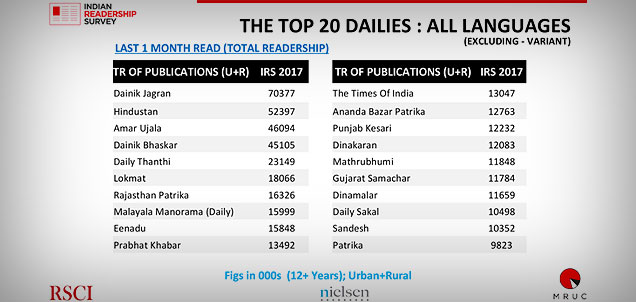
    The IRS 2017 Report also offers new readership metrics. Apart from the standard and well-established Average Issue Readership metric, one can now look at data from the perspective of Total Readership (TR), and Readership of publications by time frames of Last 7 days and Last 3 days.  These new metrics have been introduced to provide a true representation of the changing consumption habits among Newspaper readers.


    Another interesting development has been the capture and reporting of readership for the Main issue of Newspapers versus their Variants. Each of them are now reported separately in IRS 2017.


    Commenting on the release of IRS 2017 Report, Ashish Bhasin, Chairman, MRUC and Chairman and CEO – South Asia, Dentsu Aegis Networks, said: “According to the findings of the Report, 39% of Indians (12+ years) read newspapers, and 20% of all newspaper readers in 50 Lakh plus population towns read newspapers online. These numbers most definitely tell us that there is a bright future waiting for the Print industry. I’m also hoping that we will now begin to see advertisers and media agencies taking Print more seriously. Increased readership numbers for newspapers and magazines will pave the way for publishers to increase their revenues, which would in turn help increase the size of Print as a medium.”


    Bhasin further said: “The support we have received from across constituencies for bringing out this Report was phenomenal and it was very pleasing to see the key stakeholders contributing in many ways to improve the study that has been in existence since more than two decades.”


    Noted Shashi Sinha, RSCI Managing Committee Chairman, and CEO, IPG Mediabrands: “I’m delighted to share that the findings of the IRS 2017 Report mirrors the market reality in terms of media reach and the performance of individual media channels be it newspapers, magazines and broadcasters.  The methodology deployed to capture data quarter-on-quarter was the very best for a study of this scale and kind, and the sheer focus on Quality Control makes this Report a reliable one and a real stand out.”


    Said NP Sathyamurthy, Chairman – RSCI Technical Committee and Executive Director, DDB Mudra Group: “The IRS 2017 Report is the outcome of great minds from different streams working together toward a common and shared goal to come out with a research that sets the highest standards globally. Absence of readership data for four years meant that we had to work that much harder and smarter to bring the study back in action and in line with the market truths and expectations.”


    Sathyamurthy further noted: “From 2016, when we began the fieldwork, up till last month when we completed the validations for all four quarters, the journey wasn’t easy, and had its own special twists and turns. Furthermore, we have strengthened the Report with additions such as TR, readership numbers for 7 days and 3 days and the separate reporting of newspaper variants. IRS 2017 marks a new innings for this trusted Industry study.”


    There were murmurs against the return of Total Readership (TR) as a currency. At least two publishers and a former member of the thinktank rubbished the decision of using TR and alleged that it has been done at the behest of some powerful newspapers who want to project a healthy picture for the industry. When a senior functionary associated with IRS2017, he/she retorted that it was the Board’s decision to use TR, and not the whim of an individual.


    Another senior media agency professional told MxMIndia, that there is a crying need for an apples-to-apples comparison being thrown by audience measurement studies.The professional told us about how in the case of television audience measurement too, the metric deployed in public is impressions. Similarly, he/she told us that there is merit in a metric that will help planners make more informed decisions will help the agency fraternity considerably. Meanwhile, an advertiser who MxMIndia spoke with, underscored the need for a realisation that there is need for a good, solid currency for all media. “It’s time media owners realise that we will only put money, when we can be sure of performance… We are not in the business of charity.”


    Indeed.


    Meanwhile, the data is set to roll from the second half of today. However, it will be downloadable only if users agree to a Code of Conduct/Usage. What this Code contains, the heads of RSCI and MRUC didn’t tell us at the launch on Wednesday, but there are indicators that the Code could make it difficult for publishers to fool around much with the way they slice and showcase data.


    IRS 2017 Launch toplines

  • Is Delhi upstaging Mumbai in A&M?


    By Ananya Saha


    Chalo Dilli, as Ad Club drops Bombay


    Jaldi 5 with Shashi Sinha: “The idea is not to emerge as the only Ad Club in India”


    Anil Thakraney: Delhi ad guys less cynical than Mumbai frat


    At first it may not sound like a big deal. What’s in a name? And what’s in just the shedding of a part of the name? A lot, we think. For, in the context of the Advertising Club Bombay dropping the Bombay from the name, it’s indicative of the changing times.


    The attempt  to be more all-inclusive is a welcome sign no doubt. But as the Club’s president told MxMIndia: “Delhi is a key market for the advertising industry with big agencies being housed there and also some big clients too based there. This is definitely one of the main reasons for us bringing Delhi under our purview.”


    So is this move a firm indicator that Delhi is emerging as a more challenging player than Mumbai in Advertising and Marketing?


    Rahul Kishore

    According to Rahul Kishore, Senior VP – Priority Projects at Mogae Media, does not believe in this creative demarcation and would rather see Delhi (“Gurgaon actually”) and Mumbai sharing an equal pedestal.


    Mr Kishore said, “I am totally against this Delhi v/s Bombay tussle that keeps happening on and off. It should just be The Advertising Club. As I said there are agencies that are present all across the country but just because a few are headquartered in Mumbai it doesn’t give Bombay to be the leader of sorts. I don’t think that’s a true representation; I think there’s a lot more business that happens out of North India. I can tell you that in North India.”


    Satbir Singh

    Satbir Singh, Managing Partner & Chief Creative Officer: Euro RSCG India, echoes this view. He believes that Delhi has an edge over Mumbai especially when it comes to clients. He said, “The rate of growth that Delhi has had over Mumbai has been phenomenal, especially over the last four-five years. Delhi has largest spenders: whether it is auto sector, telecom or large scale FMCGs like Reckitt Benckiser, Dabur, Pepsi, Coke etc.”


    “Mumbai still scores with financial sector and the fact that large-spending media clients like GECs are based out of Mumbai. One spender that can perhaps tip scales in favour of Mumbai is Hindustan Lever since it equals the large spenders that Delhi has,” Mr Singh added.  “But that apart, the sheer number and concentration of large spenders is very heavy in Delhi and this will continue for a long time. Earlier, most of the senior people were based out of Mumbai. But increasingly we see more senior people either based out of Delhi or flying to the capital for meetings and decisions.”


    Delhi has the edge, no doubt. Mumbai, though, still has a dominant edge when it comes to creativity – in areas like advertising films etc thanks to the presence of Bollywood and the best post production facilities – but here too the gap is narrowing.


    Lloyd Mathias

    Lloyd Mathias, Director, GreenBean Ventures, Former President & CMO, Tata Teleservices is originally from Mumbai, but has worked extensively in Delhi and for a bit in recent years in Mumbai too. “I would not say dominant, but Delhi is rapidly moving to equal Mumbai in the advertising and marketing space,” he said. “In certain sectors, such as mobile phones, consumer durables and automobiles, Delhi has already pulled ahead of Mumbai. Given Mumbai’s historical dominance as India’s commercial centre it had the edge with a more professional approach to work; but the with the emergence of MNC’s over the last decade in the Gurgaon/Delhi/NCR region , the gap has narrowed down to a large extent,”  he added.


    An industry analyst with a leading consulting firm who did not wish to be named, said, “There has been a massive increase in Delhi , definitely. Delhi team is more efficient at negotiation, is the finding. The Delhi team thinks bigger. They do not approach clients as space-vendors; rather they go as concept-sellers and are able to get higher rates from advertiser.”


    Sathyamurthy NP

    What has possibly helped Delhi is the increasing professionalism and an improved work ethic. The industry analyst further said, “What has become a norm is that the foreigners come and set up base in Delhi. An MNC set-up brings in systems and processes of evolved advertising markets to Delhi . When you sell to those guys, you sell fancier ideas. All that gets a premium. Advertisers in Delhi are savvy, wherein Mumbai guys are more focused on bottom lines and rates. That is why we also think of servicing a client out of Delhi , for the Delhi team can present better concepts and thus, crack better deals.”


    Prathap Suthan

    Sathyamurthy NP, President & Head – DDB MudraMax reasoned that we should not be making too much of the move by the Advertising Club. “Though Mumbai will continue to be the advertising hub of India, it’s time we hear the voice of Delhi too,” he told MxMIndia, adding:  “When it comes to being professional, Delhi is as good as Mumbai.”


    The move by the Advertising Club to be more inclusive is decidedly in the right direction. But will it help the industry to keep politics aside and show more participation, only time can tell. Meanwhile, the Mumbai v/s Delhi debate is endless. And, as veteran adman Prathap Suthan told MxMIndia, “intercity rivalry is healthy, positive and must be sustained”.

    with inputs from Tuhina Anand and Johnson Napier


  • Rumour Central: N P Sathyamurthy (Sathya) to head media across Mudra

    By A Correspondent


    Veteran media analyst and planner N P Sathyamurthy is reportedly moving on from Lintas Media Group (LMG). Sathya, as he’s popularly known in the trade, has been COO with LMG and CEO with Karishma Initiative and has worked with the media agency since October 2007.


    Although an official spokesperson at LMG vehemently denied the development, MxMIndia learns that Mr Sathyamurthy may have in fact accepted an offer from the Mudra group. The role at Mudra, it is believed, is a more challenging one and will require work across media and the diverse interests of Mudra.


    Prior to his current assignment, Mr Sathyamurthy was exec director at carat and director-general with MRUC from March 2003 to September 2005. He has also worked with Euro RSCG-MPG, O&M, Mudra, Cadilla Labs and a four-year stint at Heinz.


    While he is known to be a master at dissecting numbers, Sathya (Sathyamurthy Parthasaradhy Namakkal being his full name) is educated to be a zoologist. An MSc from Annamalai Univ, he has done his bachelor’s at the University of Madras having studied at the Presidency College in Chennai.


    Although his last day at LMG is not known, sources inform that he is likely to join by Mudra next month or latest by February 2012.