By Shruti Pushkarna
 Whether it’s Valentine’s Day, International Yoga Day, World Braille Day or International Women’s Day, I don’t believe in tokenism. A cause or community needs attention, acceptance and accolades round the year. One day can never be enough. But maybe an annual observance has a sense of association and awareness that can permeate through the societal mindset.
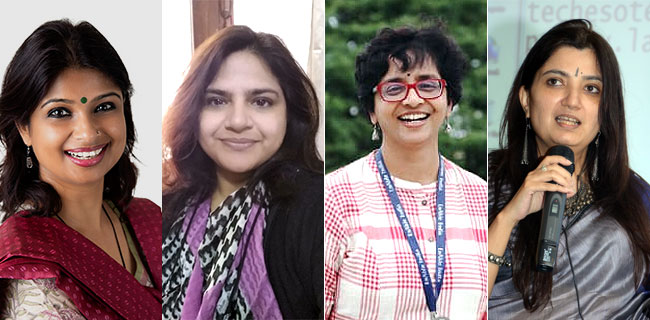
Earlier this week, when the world was celebrating International Women’s Day on March 8, I decided to speak to four powerful agents of change. Each of these women, armed with their passion, commitment and instinctive leadership, are transforming the way we look at disability and inclusion.
Richa Bansal, Founder and Managing Director of Saarathee CRM Private Limited, is a social evangelist on a path to influencing an inclusive corporate culture, by being the driver of an equal opportunity workplace.
Shalini Khanna is Country Head at discovering hands gUG (haftungsbeschänkt), Director of NAB India Centre for Blind Women and Disabilities Studies, and a rehabilitation specialist with a corporate background in market research.
An Electronics Engineer by degree, Shanti Raghavan is the Co-Founder of Enable India, an Ashoka Fellow and Schwab Social Innovator of the Year 2020.
A serial entrepreneur with a passion for technology and disability, Shilpi Kapoor is the founder of BarrierBreak and 247 Accessible Documents that focus on digital accessibility. Shilpi was recognised as one of the Top 15 Women Transforming India by Niti Aayog in 2019.
I posed five questions to these Visionistas, do read their responses below.
1. Why did you choose to work in the space of disability/ accessibility/ inclusion?
Richa Bansal: My first brush with disability happened in 2009 when I drove a pilot project to include persons with vision impairment in tele-calling teams of our external channel partners at Vodafone. We mobilised 20 women at National Association for the Blind (NAB), Hauz Khas. The pilot was extremely successful, however the initiative could not sustain due to lack of consistent rigour and persistent focus. Coming from a Sales and Marketing background, I realised how important brand image was for companies, and the frontline sales and customer service people played a critical role in either enhancing or destroying it. I realised that disabled people bring some innate qualities which are difficult to find in the job market- Empathy, Commitment, Simplicity, Eagerness to learn and Prove the world wrong. This was a ready package for a corporate job, all it needed was an upskilling, grooming, conducive environment and nurturing. I wanted to do something of my own which was impactful and sustainable. I started Saarathee, to address the problems faced by brands and a solution to the employment issues plaguing the disabled.
Shalini Khanna: Disability or inclusion is a creative field which gives you opportunity to apply your ideas to make vocations accessible and opens doors for those who need it the most. And opening new arenas for the visually impaired women was even more challenging compared to many other disabilities. The field needs more professionals and every bit of your work creates a step ahead into an untrodden path.
Shanti Raghavan: I chose to work in the space of disability because of personal experiences with my brother, who started losing eyesight at the age of 15, and through working on his rehabilitation. I felt that there are so many others who are like my brothers and sisters, and that’s how the work on disability inclusion started.
Shilpi Kapoor: My first encounter with disability was with my boss when I was working as a Security Analyst for US based website. One day, I discovered he was a paraplegic, paralysed below the neck. He used a sip-and-puff device to operate his computer. This changed my life dramatically and I realised the role assistive technology can play in the life of people with disabilities. I started the first ever computer-training centre for the blind/ visually impaired in Mumbai but soon realised that even after ample training, there were no job opportunities for the disabled in India. In an age where technology has become a way of life, disabled people have been ignored to a large extent. There are approximately there are 1 billion disabled people in the world and about 70 million in India alone. So, I founded BarrierBreak with a strong belief that technology can empower them to live independently.
2. As a woman, has it been harder to challenge stereotypes?
Richa: I don’t think so, may be because I have never been stereotyped in my life either by my family, my partner or colleagues. I also believe if you don’t consider yourself equal, the world won’t consider you so.
Shalini: Not so much in the urban regions, but in the rural sector it was a little challenging as the travel and reach was not so easy. One had to negotiate with the lack of appropriate accommodation and sanitation. In my 15-year career in market research, I travelled far and wide to rural, sub urban areas but with adequate facilities paid for. With limited resources in the non-profit sector, travelling and working deep into the rural parts is not easy and safe as a woman.
Shanti: Not really, because of the strong foundation set by my very ‘include-able’ parents. ‘Include-ability’ is a competency which normalises differences, pushes a person’s boundaries of strengths, not focusing on a person’s differences. The way I was raised, I didn’t even know I was a female or a woman, there was no differentiation. I could go anywhere, I could do whatever I want, so I never even noticed when others behaved differently towards me. There may be one or two times when somebody looked at me and said, “Oh she is a woman”, but that didn’t affect me.
Shilpi: Most women do not identify themselves as entrepreneurs and many hesitate to get into this leadership role due to self-doubt, lack of mentoring, limited understanding of customers/market, difficult access to finance and/or lack of family support. Luckily for me, I’ve had my family supporting me and mentors guiding at every stage. I can surely say that being a woman has been an asset for me. I have worked closely with the government in India, building policies around disability and accessibility and have always been invited to the table. I always wanted to be an entrepreneur because I wanted to make a difference. It was tough, not because of gender stereotypes, but due to the stigma around disability.
3. Do you think women bring a multi-faceted approach and they can be more innovative in solving the problem at hand? (in the context of issues related to disability)
Richa: Oh yes! You will notice that most initiatives to drive change in the society are taken up by women. It’s not a coincidence, it’s who we are. We bring in the perfect blend of empathy, courage and grit. Persons with disabilities come with a lot of insecurities as well as a sense of entitlement. To deal with both at the same time is a difficult task, but being a woman, I have always felt that I come armed with the ability to work with such challenges.
Shalini: Totally. As a woman, I have an added advantage in the empathy and comfort I offer to the disabled women I work with. Again in the rural sector, when you have to convince parents of disabled girls to get them trained, being a woman helps as they are likelier to believe me. Women definitely bring more sensitivity to the issues at hand and a realistic approach, when it comes to education and training in the disability field.
Shanti: I feel that a woman, especially the mother, has more responsibility in general. And because of that, she is constantly thinking of solutions or trying to find ways out. We’ve seen a lot of mothers who have done a tremendous amount of work to get their children to the next level. Also, in the NGO world, I see so many women leaders and they are a force to reckon with. I don’t want to say that women are better than men or anything, but I would simply say that the women leaders I’ve met are a class apart.
Shilpi: I personally feel women with disabilities bring along a unique insight into problems. They are passionate to prove themselves to the society, and this makes them more productive and innovative in solving the problem at hand. The desire to achieve beyond the normal fuels them. 57% of BarrierBreak’s team comprises women. We see them bring ownership and integrity to the table.
4. In your personal experience of working/ interacting with persons with disabilities, how are disabled women different? Do you think they can contribute a lot more than the society imagines or realises?
Richa: 36% of the total disabled population is in active workforce. Given the disparity that exists amongst women and men in the workforce, you can imagine how poor the numbers are for disabled women. This pushes disabled women who find employment to stretch their boundaries further and deliver their best. If given a chance and a conducive environment, they can do wonders. They simply have to come out of their shells.
Shalini: Disabled women are a lot more courageous, resilient and determined as their support system is almost non-existent. Women with disabilities face exploitation within their homes too. But their sense of commitment and discipline is evident in training or employment. In my experience, they push themselves harder towards self-reliance as that’s their only security since their deprivation is much larger. I’ve been fighting for opportunities and independence of blind women as they face discrimination by parents, educational institutions and employers. Fear of parents and caregivers for their safety keeps them confined and untrained, leading to lifelong dependency in many cases. When given a chance, even at a later age, they strive with their full might to carve a life for themselves.
Shanti: I just look at women with disabilities and feel so proud. Each one has broken barrier after barrier, done what it takes. I think when it’s so difficult to get something, to have access to things or how people perceive you, the interest level and the capacity to absorb is so high; the want, the need is so palpable. It’s like saying, ‘I’m going to make the best of what I have’. There is an extraordinary focus and mental strength coupled with the willingness to take action.
Shilpi: 57% of BarrierBreak employees are women, of which 35-37% are disabled. I see them prove themselves as equals and that might be why so many of them are a part of my senior management and leadership team. Frankly, I think it’s time to take away some of these conversations about women or men, disabled or not. In fact, I can say I do not see any difference working with any of my employees. I think it is time for organisations to give opportunities and provide workplace accommodation and embrace women with disabilities in the workforce.
5. This year’s Women’s Day theme was #ChooseToChallenge. As a woman working towards creating an inclusive world, what do you choose to challenge in 2021?
Richa: I #ChooseToChallenge the HR leads in corporate India to take a leap of faith and include more women with disabilities, you will be surprised how beautiful your organisation will turn!
Shalini: I choose to challenge the concept of diversity in India and discrimination by employers and educators between different disabilities and genders.
Shanti: I choose to challenge things at the level of the population. The issues of disability cut across every facet of life, be it education, health or employment. In 2021, I’m looking to work at a societal platform level, (societalplatform.org) addressing the size of the problem with respect to disability.
Shilpi: Women entrepreneurs need recognition. I chose to start a for profit business model for disability. I choose to give women a chance, I choose to give them a seat at the table, I choose to let them be themselves.
Like these women, I too grew up with no differentiation. I made my own choices, vociferously shared my opinions and contributed financially. But in the workspace, whether it was in my journalistic avatar or in the non-profit sector, I realised not all women were as fortunate. Yes, things have evolved over time, mindsets are beginning to alter, but a mere celebration of Women’s Day will do little to include women with disabilities into the mainstream. They need opportunities to step out and overcome the barriers of gender, education and economics.
Shruti Pushkarna heads operations of the New Delhi-based Score Foundation where she works as Director-Programmes & Communications. She is a former journalist (part of the founding team of MxMIndia) who has moved full-time to the social sector. Shruti writes for MxMIndia every other Thursday. Her views here are personal. She can be reached via Twitter at @shrutipushkarna