Tag: Nitesh Jain

  • Print media revenue to grow ~20% new fiscal: Crisil

    By Our Staff


    Accordiing to Crisil, Print media revenue to grow ~20% next fiscal, but newsprint prices will tear 300-350 bps off operating profitability. India’s print media sector could log ~20% topline growth next fiscal, driven by recovery in its two major revenue streams — advertisement (ad) and subscription — albeit on a low base.


    However, higher newsprint prices will tear as much as 300-350 basis points (bps) off the operating margin, shows an analysis of print media companies rated by Crisil Ratings, accounting for ~40% of the sector’s revenues. Ad revenue should rebound as economic activity improves, given their high correlation, while reopening of offices and people moving back to work locations should shore up subscription revenue. Next fiscal, revenue could climb to ~Rs 27,000 crore from ~Rs 18,600 crore seen in fiscal 2021. But that won’t be enough to reclaim the pre-pandemic highs of over ~Rs 32,000 crore (refer to Chart 1 in annexure).


    Said Nitesh Jain, Director, Crisil Ratings: “Ad revenue, which accounts for ~70% of the sector’s topline, recovered sharply after the second wave of the pandemic, supported by the festive season and state elections. The impact of the third wave was milder and limited to January. Next fiscal, we expect ad revenue of print media companies to grow ~25% on a low base, in alignment with economic activity. Ad volumes are expected to rebound fully to the pre-pandemic level next fiscal, but ad yield will recover only gradually.”


    Subscription revenue — accounting for the balance ~30% of the topline — has recovered to a large extent for Hindi and regional language newspapers, but remains impacted for English dailies. This, too, is expected to grow ~10% next fiscal, led by resumption of offices and migration of working population back to metros. However, the increasing shift in reading preference to digital media would continue to keep subscription of physical newspapers below pre-pandemic levels. Interestingly, lower subscription volume of physical newspapers has helped print media companies sail through the pandemic as it kept a leash on the volume of newsprint consumed (key raw material that accounts for 30-35% of the total operating cost for print media companies). Newsprint prices have risen a whopping ~60% (refer Chart 2 in annexure) in the past one year because of shortage of new and recycled newsprint, rise in freight rates, depreciation of the rupee, and fall in supplies following closure of manufacturing capacities.


    Added Rakshit Kachhal, Associate Director, Crisil Ratings, “Operating margins of print media companies is seen contracting to 6.0-6.5% next fiscal from 9-9.5% this fiscal (refer Chart 3 in annexure), because of elevated newsprint prices. This is despite rationalisation of newsprint consumption and expected increase in cover prices. India imports more than half of its total newsprint demand. Russia is a major exporter, so its war with Ukraine could affect the demand-supply situation and impact newsprint prices.”


    While the credit risk profiles of large print media companies will be cushioned by healthy liquidity and strong balance sheets — most of them are net debt free — liquidity management will be crucial for the smaller ones because of the rise in newsprint prices, as their interest cover is estimated to be 2-2.5 times as on March 31, 2022. The base-case assumption is that newsprint prices will peak over the next few months and soften by the second quarter of next fiscal. Any continued rise in prices, or prolonged geopolitical issues, or further waves of the pandemic impacting India’s economic growth, will bear watching.
     

  • M&E revenue to rebound 27% next fiscal


    By Our Staff

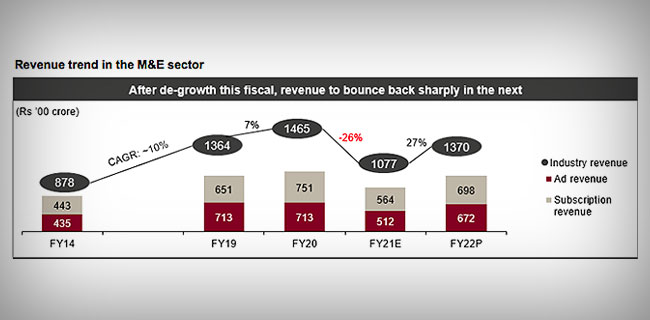
    Revenue of India’s media and entertainment (M&E) sector should script a strong 27% rebound to ~Rs 1.37 lakh crore in fiscal 2022, after contracting ~26% this fiscal. Optically, the de-growth this fiscal and growth expectation next fiscal may sum up to a full rebound. But that won’t be true because the 27% growth will be on a much lower base. Industry revenue next fiscal will still be lower than that in fiscal 2020 (refer to Chart above).

    The time to bounce-back to pre-pandemic levels will be relatively shorter for segments such as digital and television (TV), while print, films, outdoor, and radio would take longer

    Credit profiles of large media companies would be unaffected due to strong balance sheets, liquidity and the revenue rebound, while mid-sized and small ones could see stress, an analysis of over 80 of them rated by Crisil Ratings shows.

    Said Nitesh Jain, Director, Crisil qually to the overall M&E sector’s topline, but since the former correlates strongly with economic growth, the pandemic has had a bigger impact on it. Next fiscal, with strong economic rebound on the cards, ad revenue should grow 31% on-year and subscription revenue ~24%.”

    The TV segment – contributing around half of the sector’s topline – has recovered fully and will report healthy growth next fiscal. Ad revenue saw a sharp contraction initially, but recovered swiftly thereafter, aided by airing of new content, sports events such as the Indian Premier League and a buoyant festive season.

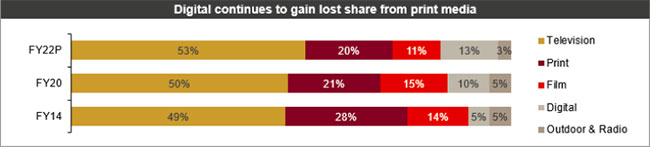
    As for subscriptions, TV was resilient even during the peak of pandemic as people remained indoors. The print segment – contributing a fifth of the M&E sector topline – is recovering, though at a much slower pace, and should be able to rebound fully only by the end of next fiscal. Print is losing share in ad revenue mainly to the digital segment (refer to chart 2. Circulation too, especially for English language, could see a loss of 8-10%, because of increased preference for e-papers in metros.

    However, print companies are rebooting their cost structure and accelerating digital adoption to stay relevant. Films – contributing a sixth to the sector topline – is one of the most impacted segment. But occupancies in theatres should improve with the vaccination rollout and a strong pipeline of content. However, this segment is likely to remain impacted even next fiscal due to social distancing norms and fear of closed spaces.

    Other traditional media – radio and outdoor – are seeing persisting pain, and will likely take much longer to recover (Radio and outdoor segments don’t have any subscription revenue). This is because commuting as well as ad budgets for micro, small and medium enterprises – the key drivers for these segments – will remain restricted even in fiscal 2022.

    Added Rakshit Kachhal, Associate Director, Crisil Ratings Ltd: “Digital has emerged as the medium of choice. The pandemic accelerated adoption of over-the-top (OTT) platforms, online gaming, e-commerce, e-learning, e-papers and online news platforms. This has meant the focus of advertisers has shifted from traditional to digital media. We expect the digital segment revenue to grow 14-16% annually over the medium term. Its share of M&E sector revenue is expected to double to ~20% by fiscal 2024 compared with last fiscal.”

    Given the sharp impact on revenue, cash accruals this fiscal will weaken for all M&E companies except TV distributors. Credit profiles of the large companies are cushioned by strong balance sheets (with most of them net debt-free), while those of small and mid-sized media companies have weakened. More downgrades among the latter led to the Crisil Ratings’ credit ratio (upgrades to downgrades) for the sector sliding to 0.33 in the first nine months of the current fiscal from 0.75 in fiscal 2020.

    Liquidity pressure may intensify for them if recovery in ad revenue is delayed. That said, there is a silver lining to this cloud, too. M&E companies have adopted aggressive cost rationalisation initiatives. Besides, the pandemic-led change in consumer behaviour has accelerated monetisation opportunities for these players through integration of digital media into their traditional businesses. Some of these aspects can lead to structural changes in business models of the M&E sector over the longer term.