Tag: Nimisha Jain

  • Facebook-BCG report on new path-to-purchase

    FB-BCG Guidance bo Brands based on Report Findings


    By A Correspondent


    Facebook India in association with Boston Consulting Group has released a report titled ‘Turn the Tide’ that focuses on how Covid-19 has dramatically changed consumer behaviour and altered the path-to-purchase. The report also shares actionable guidance for brands to build for the new consumer journeys in times of Covid -19 and beyond.

     

    Sandeep Bhushan

    Said Sandeep Bhushan, Director and Head, Global Marketing Solutions, Facebook India: “As business after business joins the dots to understand consumer shifts in both mindsets and behaviours as a result of COVID-19, we have invested in studying the new paths to purchase in continuing our commitment to enabling growth for businesses both large and small. The ‘Turn the Tide’ report outlines the opportunities that businesses need to embrace in the context of new consumer journeys and category needs. In response to consumers embracing the digital medium, brands need to focus on solutions that are relevant for the new normal such as hyper-localization, creating virtual experiences, re-looking at the media-mix to build efficiency, or building messaging around new habits such as DIY and the increased focus on health and hygiene.”


    Facebook and Boston Consulting Group are also expected to share vertical-specific insights to help businesses gain almost real-time insights, enabling them to ‘Turn the Tide’.


    The report delves into key consumer-shifts based on three societal-truths that have emerged as a result of the pandemic – social distancing, increasing focus on health and hygiene, and increasing income uncertainty. Within each of these shifts, the report finds that there are three kinds of behavior change movements that are being observed – reversal of past trends, acceleration of existing trends, and formation of new habits.

     

    Nimisha Jain

    Added Nimisha Jain, Managing Director and Partner, Boston Consulting Group: “We are experiencing unprecedented shifts in consumer attitudes and behaviors – 80%+ consumers will continue to practice social distancing and are bringing the outside inside, over 40% of consumers are dialing up on health and wellness spends, e-commerce adoption has already advanced by 2-3 years – to name a few. These aren’t just temporary surges, and many will last longer and become more defining traits. Our analysis reveals that only one in six companies emerged stronger in past crises – players who show the agility to reinvent their value propositions, go-to-market plans and business models to address these demand shifts will be the ones that set themselves apart from the pack”


    The reports especially calls out the massive acceleration in digital led by social media, the emergence of micro-market opportunities, an increase in value consciousness leading to more utility-led shopping, consumers embracing digital even in historically offline categories such as education, health, and fitness, the increase in spend on e-commerce in the coming months even for traditionally offline categories, a definite increase in spends on health, hygiene and wellness, and a rise in do-it-yourself (DIY) trends.


    Executive Summary of Turn The Tide report

    The COVID-19 outbreak has proven to be a global pandemic of an unprecedented scale impacting people, communities, and businesses across nations. In India, as with the rest of the world, the first few weeks of the lockdown saw the industry in a wave of panic and uncertainty as the disruption in business continuity threatened to potentially destabilize the economy.


    Facebook has always been committed to developing and sharing industry-leading full-funnel solutions for brands across all categories. As India opens up to limited business activity, this joint collaboration with the Boston Consulting Group  – a consumer sentiment survey, titled  ‘Turn the Tide’ – aims to serve as a reference point on consumer insights, trends, and guidance for the industry, brands, and agencies as they begin to negotiate the commencement of operations.


    What’s different about this report is that it’s not just a research study but that it also provides actionable guidance that brands can deploy right away. It brings together the expertise of BCG’s deep insights and years of consulting experience with Facebook’s experience across thousands of campaigns run on its platforms.


    Covid-19 has impacted lives in 3 big ways:

    :: Social Distancing

    :: Health & Hygiene

    :: Income Uncertainty


    Key points:

    :: Consumer journey has altered; brands need to urgently identify opportunities to build for new consumer journeys.

    :: COVID-19 has fueled the digital medium in an unprecedented manner. Some of these consumer trends are here to stay.

    :: Brands are already leveraging social media platforms to build for the new consumer journeys.


    Consumer Behavior has fundamentally changed: Emerging Trends (11 Uber themes)

    A. Reversal of Past Trends

    1. Bringing the outside inside: 79% people are not going out of house, except work

    2. Trust in Brand above all else: 63% people are paying more attention to origin of product

    3. Trading Down and Bargain Hunting: 43% people are expecting decrease in overall spend in next 6 months

    4. Shopping for Utility: Purchase triggers expected to become more “functional”


    B. Acceleration of Existing Trends

    1. Embracing digital services & experiences: 51% consumers saw an increase in payment via digital wallets

    2. Accelerated adoption of e-commerce and O2O: 50% of all consumers expect to increase e-commerce spend in next 1 month

    3. Strive for Health & Wellness: +40% may increase spend on Health and Wellness

    4. Rise of Smart Shoppers: Informed purchase decision; High salience of digital research


    C. New Habits:

    1. Remote way of living: The new normal

    2. Do It Yourself: Spike in new hobbies and habits

    3. Superior Hygiene and Clean Living: 91% Indian households washing hands more often
     

  • Bulk of white goods sale will be digitally influenced by 2023


    By A Correspondent


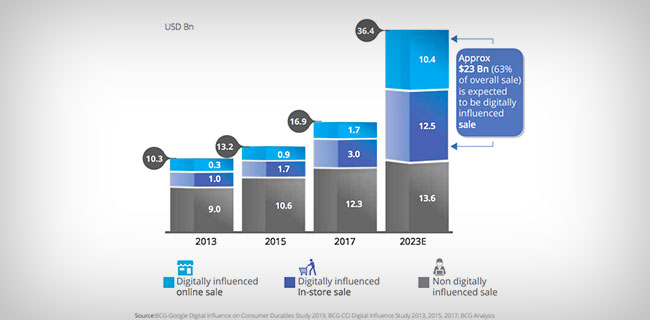
    Capturing the growth of digital influence and key consumer insights in the consumer durables sector in India, Boston Consulting Group (BCG) and Google India released a report titled ‘Digital Powers Consumer Durables: A $23 billion Opportunity by 2023’. Projecting a healthy growth rate for consumer durables, the report states that overall industry will see a growth of 13 per cent to reach $36bn by 2023.


    The report defines a sale as a digitally influenced sale, if the buyer uses internet during any stage of purchase cycle. Today 28 per cent of consumer durable sales is digitally influenced and this is estimated to reach 63 per cent of total sales, amounting to $23bn by 2023. $10bn of this will be online sale.


    Capturing rise in number of digitally influenced urban consumers, the report states that digital is increasingly playing an important role in consumers’ decision to buy a product, and number of digitally influenced consumers have doubled over last four years. Digitally influenced consumers have increased 5X in tier 2 and tier 3 cities and digitally influenced women consumers have increased 10X over last four years.


    Decoding the digital consumer further, the report also highlights important consumer insights as buyers traverse through multiple online and offline touchpoints before making the final purchase. In the pre-purchase phase, approximately 80 per cent of digitally influenced consumers are undecided about their choice of brand when they start their research and spend typically 2-3 weeks on research before making the final purchase. Search, social media, blogs and online videos are the key sources for online research. The report suggests that nearly 2 out of 3 digitally influenced consumers rate online reviews as a significant influencer in their purchase decisions.


    Speaking about the key insights, Nimisha Jain, Managing Director & Partner, The Boston Consulting Group, India said: “18Bn of consumer durable sales will reside with digitally influenced consumers who are undecided on their brands in 2023. Companies will have a short 2-3 week window to influence them and ability to timely & efficiently influence them will determine the winners of the future.”


    Calling specific actionable insights for the consumer durables players to seize this opportunity, Vikas Agnihotri, Country Director – Sales, Google India said, “Consumers are creatures of habit, and with growing access and connectivity, we are seeing consumers research online before they arrive at their purchase decisions for almost everything. And while businesses have started to build their digital presence, there is a need to take a holistic approach to digital as the scale of its influence has grown rapidly going well beyond top metros. Businesses need to create an always on digital strategy and create personalised interventions to tap different consumer demographics across all markets to achieve their business goals.”


  • $100bn digital consumer spending potential by 2020: Google, BCG Report

    By A Correspondent


    Capturing the growth of digital influence and key consumer insights that will drive the next phase of digital consumer spending in India, Boston Consulting Group (BCG) and Google India released a report, ‘Digital Consumer Spending in India: A $100 Bn Opportunity’. The report projects that the potential for digital spending is expected to grow 2.5 times from ~$40bn to ~$100bn by 2020 led by sectors such as e-commerce ($18-45bn), travel and hotel ($11-20bn), financial services ($12-30bn) and digital media ($200-570mn). The report also finds that women, new users from non-tier 1 cities and 35+ years, shoppers will drive this growth.


    The report states that with deeper penetration of mobile phones and affordable data plans, the number of online spenders will not only increase over the next few years but there will be a dramatic change in the users’ profile. It also estimates that by 2020, the women shoppers will increase 2.5x and older shoppers will increase more than 3x compared to today. With the improvement of infrastructure, online shopping will take off in India from cities beyond metros and together it is expected to comprise more than 50 percent of the total online shopper base by 2020.


    Speaking about the key findings of the report, Nimisha Jain, Partner & Director, The Boston Consulting Group, India said: “There is a clear evolution as consumers move from awareness of online platforms to their first purchase and further down to become more frequent buyers – triggers and barriers to online purchase evolve with each stage. Very different actions are needed to unlock growth and move consumers from one stage to the next.”
    The report highlights that there are 75-80 per cent internet users who do not spend online currently. This underscores that even though the digital media has gained ground over the last few years, the actual digital spending is still in evolutionary stages in India. The BCG-Google report also outlays the key triggers and barriers at each stage of online consumer evolution with an aim to help drive digital spending. The report draws out implications for companies across each stage, with nuances highlighted to give a category perspective of relevant implications.


    Speaking about the key findings of the report, Nitin Bawankule, Industry Director, Google India said: “Digital spending in India are at a cusp of significant wave of change, while we have seen enthusiastic response to adopting newer forms of digital payments in the last few years, the base is still relatively small. The ecosystem needs to focus on creating a very targeted value proposition for different segment of users and across different categories to drive larger adoption. For example, in Food & Grocery category, convenience becomes a key trigger for frequent shoppers while discounts are important for occasional shoppers and quality is a key barrier among offline shoppers.”