Tag: Nielsen study

  • Online FMCG will outpace offline in 5 yrs: Nielsen


    By A Correspondent


    Growth in the online FMCG sector has been outpacing offline FMCG growth, with e-commerce sales growth all set to get past traditional retail sales growth within the next five years, according to a new report released by Nielsen, the What’s Next in E-Commerce Report. While total FMCG retail sales growth currently sits at around 4% per annum, total retail e-commerce is predicted to grow by 20%, or an additional $2.1 trillion, by 2020.


    The latest trends in consumer purchasing online within the FMCG sector point to strengthening growth in online adoption and spend around the world according to the report. The report illustrates that while FMCG has historically trailed many other categories such as electronics, mobile goods and travel when it comes to online spending, that trend is set to change in the coming years.


    As many of the existing barriers to e-commerce adoption are overcome, such as retail infrastructure and supply, environmental and cultural factors like credit card fraud, and logistics to support the ‘last mile’, e-commerce is set for exponential growth. These factors are being compounded by surging consumer demand for anywhere, anytime convenience.


    The Nielsen report highlights four key influencers significantly impacting e-commerce growth trends around the world:

    • E-commerce is growing rapidly, but the growth factors are not uniform:Connectivity and accessibility to cheaper data and handsets play a key role in shifting consumer behaviour, and to a large extent smartphone reach is an early indicator of potential e-commerce growth. However, connectivity alone isn’t sufficient to drive e-commerce penetration. Supply factors and cultural nuances also influence consumers’ online purchase behaviour.


    • Drivers and barriers are similar, with one exception:The number one driver across most countries for e-commerce purchases is convenience, with the exception of the U.S. where consumers are more motivated by deals. Conversely, there are three key considerations when examining barriers to e-commerce. Firstly, the desire to examine an item before buying it – from grocery to apparel. Secondly, the lack of trust that retailers will meet expectations around freshness. And thirdly, concern over the level of quality of products bought online vs. in-store. Retailers need to alleviate these barriers to drive their share of the consumer e-commerce wallet.


    • The ability to win the elusive food basket will be key to success in retail e-commerce:The food basket, due to its reptitive purchase pattern, is the Holy Grail for retailers, however, food items remain largely absent from e-commerce sales. Winning the food basket is critical to succeeding in the online FMCG sector.


    • Wooing the omnichannel consumer:When it comes to retail e-commerce, Convenience, Price/Value, Assortment and Customer Experience are the highest-ranked considerations driving consumers’ online purchasing decisions. In order to develop a winning e-commerce strategy, retailers need to ensure they are prepared to over-deliver against each of these four drivers.


    For an in-depth look at e-commerce trends around the world and the factors driving growth across the online FMCG sector, download the Nielsen What’s Next in E-Commerce Report.



  • Amazon, Flipkart & Snapdeal have highest brand equity amongst e-comm sellers, notes new Nielsen study


    By A Correspondent


    Amazon, Flipkart and Snapdeal have the highest brand equity amongst e-tailing websites. The three e-comm majors ranked first, second and third amongst sellers as per Nielsen’s newly launched E-commerce Sellers study Q1 2016 (Jan-March2016). Familiarity, which had come up as the top driver for building equity in the category, is demonstrated by top-of-mind recall. The top three players among the first brand spontaneously recalled were Amazon (25%), Flipkart (21%) and Snapdeal (20%). In terms of overall awareness, Amazon (86%), Flipkart (82%), and Snapdeal (75%) were leading among the others. Intent to sell on the e-tailer is also an important parameter to demonstrate familiarity where the leading brands were Flipkart (58%) and Amazon (55%).


    “This study outlines the need gaps in the eco system, and opens avenues for E-commerce platforms  to support sellers.  E-tailers can play a big role in helping sellers develop their category and build businesses – thus also becoming a preferred brand for sellers,”  said Dolly Jha, executive director, Nielsen India.


    The findings from the study indicate that 39 per cent online sellers explore two or more e-commerce website as an option to sell products on and grow their business.


    The Nielsen study launched aims to understand the inclination and experience of selling products on e-tailing platforms. The study also gauges the brand equity of e-commerce websites amongst connected online sellers, and of those who intend to sell their products online in the next few months. The first wave of the study was conducted in 16 markets with a population of more than one million, and a sample size of over 1100 respondents.


    “With the e-commerce industry growing in double digits, there is surge in demand by customers, and an evolving online seller category that is fuelling supply on portals. To ensure the equilibrium of demand and supply, it is essential for e-commerce portals to focus on developing an inviting platform for online sellers in India. Sellers are also increasingly discerning when it comes to reaching their customer and meeting business needs,” said Jha, adding: ”Considering the juncture at which the category is, it is now very critical for e-tailers to understand push and pull factors that make sellers pick one website over the other. The study will also help understand the impact of marketing activities.”


    A high level of familiarity along with indepth  knowledge of an E-commerce website is the most important factor that drives brand equity, notes a Nielsen communiqué. Other key factors that impact brand equity are certain perception of the e-tailers: “They help the sellers stay relevant and ahead of competition” , “Provide new market opportunity”  and “Help minimise costs to reach out to more customers” .   At a micro level, other important attributes include potential of reaching out to customers from the same locality , ensuring publicity for the shop, and those websites used by peers and competition. Helping sellers save on in-store and inventory management, as well as a platform that would be most profitable to sell products on are critical when looking for new opportunities and markets. The ability of reaching out to a pan-India customer base, savings on logistics and requiring minimal investment are other considerations sellers look for while choosing e-tailers.


  • How much does the ‘Made in…’ tag matter?


    Around the world:

    An extract from a Nielsen study on perceptions about brand origins and how they shape purchase intentions


    • Nearly three-quarters of global respondents, on average, say brand origin is as important as or more important than nine other purchasing drivers, including selection/choice, price, function and quality.


    • There are exceptions to every category and in every country, but preferred brand origin for major product categories are generally grouped as follows:


    GLOBAL

    ::   Baby diapers

    ::   Personal/beauty care

    ::   Carbonated beverages

    ::  Cars and electronics

    ::  Cigarettes


    LOCAL

    :: Fresh foods

    :: Packaged foods/snacks

    :: Carbonated beverages

    ::  Juice/water/milk


    MIXED

    :: Baby food/formula

    :: Home-cleaning supplies

    :: Alcoholic beverages

    :: Pet food


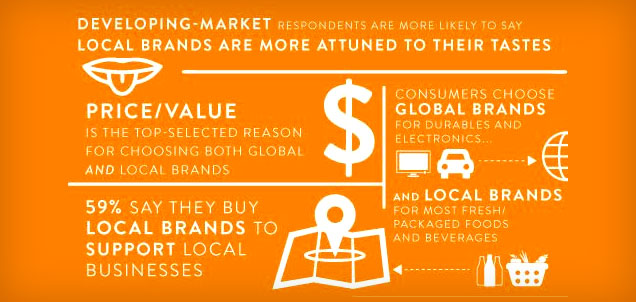
    • The top reasons for choosing a brand are the same for both global and local brands: better price/value, positive experience with the brand, safer ingredients and processing, better product benefits, and sales/promotions.


    • Nearly six in 10 global respondents (59%) say they buy local brands because they support local businesses, with sentiment highest in North America (65%). Developing-market respondents are more likely than their developed-market counterparts to say that local brands are more attuned to their personal needs/tastes and that global brands offer the latest product offerings/innovations and are of better quality.


    • When it comes to online shopping, global respondents are more likely to seek out global brands for durable and electronic products and local brands for consumable products.


    Over the past few decades, companies in search of new growth opportunities expanded beyond their borders to find a world of new consumers eager to try their brands. French retailer Carrefour, for example, started with a single storefront in 1958 and now operates stores in more than 30 countries, including Brazil, China and Indonesia. Likewise for U.S.-based Walmart, which now has stores in 27 countries. And some companies reach consumers in virtually every corner of the world: U.S.-based Procter & Gamble sells brands in more than 180 countries, and Japanese automaker Toyota sells vehicles in more than 170 countries.


    The entry of multinational companies (MNCs) into new markets—while a boon for local consumers who gain access to a greater range of products—can sometimes cause the demise of local companies, which are suddenly faced with daunting foreign rivals that have an array of advantages, including vast financial resources, diverse talent pools and sophisticated technology infrastructures, supply chains and operating practices.


    But just as David slew Goliath (not the other way around), many local companies have not only survived the multinational competition, but thrived. Indeed, some local companies’ flexibility and agility, as well as their superior grasp of the domestic operating environment, have propelled them past their global rivals. For example, in the Philippines, Jollibee has a greater share of the fast-food market than McDonald’s and has expanded to become a multinational company, operating restaurants throughout Southeast Asia, the Middle East and the U.S., while Mexico-based Bimbo not only edged out other on-the-ground rivals but expanded beyond their border to become the largest baking company in the world. And in China, whose Haier has long been the world’s leading manufacturer of a range of large appliances, not only is Huawei gaining share in the country’s midrange and high-end smartphone market, its telecommunication devices are gaining a stronger foothold in the global market.


    All of this cross-border expansion, however, has greatly complicated traditional definitions of country of origin. Some iconic “local” brands are actually manufactured abroad, while some foreign brands have built a manufacturing presence in local markets. And some global brands have been in a market so long that many consumers actually perceive them to be local. Nonetheless, brand origin can be an extremely valuable asset for both global and local companies.


    “One of the more surprising findings from the survey is that country of origin is as important as—or even more important than—other purchasing criteria such as price and quality,” said Patrick Dodd, president, Nielsen Growth Markets. “In a crowded retail environment, brand origin can be an important differentiator between brands, but sentiment varies by category and by country, and leveraging a powerful brand presence needs to be managed carefully regardless of whether it is global or local. Ultimately, the brands that deliver on a strong value proposition and connect personally to consumers’ needs will have the advantage in any given market.”


    The Nielsen Global Brand-Origin Survey polled more than 30,000 online respondents in 61 countries to understand consumer sentiment about product origin across 40 categories, from consumables to durables. We examined whether consumers prefer goods produced by global/multinational brands (defined as those that operate in many markets) or by local players (those operating only in a single market—the respondent’s home country). While respondents were asked to consider these definitions in their selections, preexisting notions about brand origin could prevail—a global brand might be so pervasive in a local market that a respondent may think it is a dominant local brand. We also explored the factors driving brand preference and the role of the Internet in purchasing decisions for local and global companies. Finally, we examined what local and global players can learn from each other, so we can offer insights into how each can succeed in the changing retail landscape.