Tag: Nielsen India

  • Nielsen India predicts the scope of e-commerce sector in India

    By A Correspondent


    Nielsen India expects the fast-moving consumer goods (FMCG) sales coming from the e-commerce channel to grow to $4 billion by 2022. The channel contributes 2 per cent to the current FMCG market. These are insights from Nielsen’s recently launched E-Trak Index – a measurement solution that tracks the FMCG E-Comm industry.


    Metros lead the e-omm FMCG race with a 6 per cent contribution from the channel to total FMCG sales. Amongst these, Foods is the biggest contributor with 44 per cent; then it is personal care (40 per cent) and household care (13 per cent).


    India’s first such solution is created using aggregated ePOS (electronic point of sale) data from cooperating E-commerce players and data science backed estimation for non-cooperating E-commerce players in India. The index adds a crucial element to the Retail Measurement Services that Nielsen provides by adding a view of the FMCG E-Comm space for All India Metros currently – with monthly read for Total FMCG, Super-categories, Category level for about 20 categories and for 11 categories at a top manufacturer level. Manufacturers and marketers get data, information and insights that can be further used to hone their E-Comm channel sales strategy to help shape a smarter market.


    Announcing the launch of E-Trak, Prasun Basu, South Asia Zone President, Nielsen Global Connect, said: “Measurement is necessary. Measurement is difficult. Best possible measurement.” Explaining this further he added “Data and insights from Nielsen’s Retail Measurement Services continue to provide an essential foundation for manufacturers and marketers to understand their market. In this rapidly evolving world of commerce, India’s FMCG industry is now making its presence felt in the E-Comm channel – appealing to consumers’ need for convenience, and in sync with increasing smartphone and internet penetration. To give a truly complete picture of the changing marketplace, we are happy to announce that Nielsen India has launched a specific E-Trak index that will now measure FMCG consumer offtake in the E-Comm space – marrying this with trends seen in modern and traditional trade to get a read on omnichannel in the country.”


    Added Sharang Pant, Head-Retail Measurement Services and Retailer Vertical, South Asia, Nielsen Global Connect: “While the foundation is taking shape, E-comm’s dynamic nature has made it a disruptor in the marketplace. E-Comm has seen a transformative journey and is now a $1.2Bn Industry growing from 0.5 per cent contribution in 2016 to a 2 per cent contribution in 2019, and slated to be 5 per cent in 2022 – this is in half the time that brick and mortar retail took to evolve. That said, these channels are not cannibalizing each other, and all continue to grow with E-Comm outpacing modern trade and traditional trade. The view that Nielsen presents on understanding channel, category and consumer trends will directly help players understand the right strategy in terms of assortment, pricing and positioning to win with the evolving consumer”


    Said Nitya Bhalla, Head- Data Science, South Asia, Nielsen Global Connect: “Given the significance of the channel from both a current as well as future perspective, Nielsen has built a unique state of the art hybrid model for estimating this dynamic and growing channel. The methodology involves leveraging data from key collaborating E-tailers in the FMCG space. We then use crowd sourced data coupled with machine learning techniques from a panel of 200K+ consumers to estimate the Ecommerce sales for FMCG products.”


  • Urban Singles will shape the future of India, notes Nielsen

    By A Correspondent


    Nielsen India has published its Featured Insight on the rise of a new premium consumer category – wealthy urban singles. Urban Singles are defined as Indians aged between 28-45 years – living alone in an urban location and includes people who are unmarried, separated, divorced, single parent with kids or in long distance marriage – having monthly earnings of more than Rs. 50,000.  This consumer profile accounts for close to seven million people.


    As per the Nielsen Insight, these consumers have the potential to shape the future of Indian markets given their spending power as well the penchant for being first movers. This consumer segment has emerged as a trial market for companies as keen to test revolutionary designs and ideas which simplify lives while simultaneously helping consumers reflect their personalities.


    Commenting on the featured insight, Arjun Urs, Executive Director, Nielsen South Asia said, “Globally urban singles are considered to be the preferred customer segment for premium and innovation driven brands. In India, being single is still considered to have negative undertones – often linked to depression, unhappiness and loneliness. However, our findings on the segment presents a contrarian picture – comprising of segment which is educated, focused, hardworking and ambitious. This segment is not only fast emerging to be super consumers but also, influencers and early adopters to revolutionary products and ideas. These are global citizens having global views and preferences.”


    The report explores broad behavioral insights relating to consumption, lifestyle, food habits, spending, housing, hobbies, travel, gadgets, appliances, food and health segments, among others. The report was compiled through a survey conducted across Delhi, Mumbai and Bangalore with a sample size of 700 people.


  • Mobile to fuel apparel & accessory buys


    By A Correspondent

    India has emerged as one of the world’s fastest growing fashion markets over the years. Traditional brick-and-mortar brands are increasingly adopting digital channels for engaging with and selling to Indian consumers while maintaining their competitive positioning. In order to help these brands understand and eliminate reasons for consumer drop-outs in their path to purchase of apparel and fashion accessories, late last month, Facebook released the next installment of the research report under its Zero Friction Future programme titled “Eliminating friction in Fashion path to purchase”. The third in the series, the reports are authored by KPMG, based on primary research and insights basis the survey conducted by Nielsen for various industry verticals, across different cities in India.


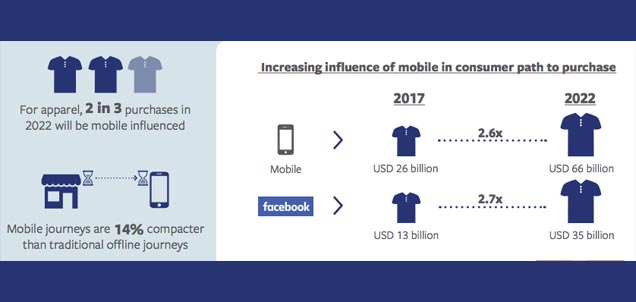
    According to the findings of the report, friction accounts for 19% of consumer dropouts, in apparel category, and more than two-third of this friction is caused by media. In accessories category, friction accounts for 22% of consumer dropouts, and around two-third of this friction is caused by media. It further highlights that by 2022, seven in ten fashion accessory purchases in 2022 will be mobile influenced, nearly half of which will be driven by Facebook, amounting to a USD 110 billion sales opportunity. Additionally, mobile will influence two in three apparel purchases, amounting to USD 66 billion opportunity for brands, half of which will be driven by Facebook.


    Commenting on the launch of the report, Pulkit Trivedi, Director, Facebook India, said: “Fashion spectrum in India has evolved so considerably, that the apparel and accessory market is projected to reach USD 102 billion and USD 155 billion individually, by the year 2022. Today, mobile has become central to the way brands market and sell their products and engage with customers end-to-end. With our Zero Friction Future report, we aim to help fashion brands adopt relevant marketing strategies and reduce friction in consumer journeys across multiple touch-points, leading to improved conversion rates and increased revenue opportunity.”


    The study reveals that mobile enabled purchase journey is 14% and 25% shorter than offline journeys of apparel and fashion accessories respectively. The friction faced by consumers can be reduced with the higher use of mobile in the media mix, creating ~USD 14 bn worth of potential revenue for fashion brands by 2022. It also suggests that mobile can reduce media friction by 3 percentage points for apparel category and 4 percentage points for accessories, allowing the brands to tap into ~USD 5 & 9 billion market opportunity respectively.


    Speaking on the report findings, Sreedhar Prasad Partner & Head –E-Commerce and Internet, KPMG in India remarked: “The fashion consumption story of India is evolving and demand for quality fashion products is on the rise. This phenomenon is not limited to Tier 1 markets, but also Tier 2 and below towns, on account of growing per capita income, mass urbanization and increasing access to digital content. Rising affluence of the middle income group is creating demand for aspirational brands. In order to capture a larger share of mind, time and wallet of their target customers, fashion and e-commerce brands should continuously evaluate their marketing mix to ensure presence where the customer is. The report aims at exploring the customers’ path to purchase and associated friction throughout their journey.”


    Added Ashish Karnad, Executive Director – Marketing Effectiveness, Nielsen India: “We wanted to measure the influence and impact of media touch-points on consumers’ path to purchase route – right from the time they have a need to buy an apparel or fashion accessory, to finally buying it. We designed the study to get a zoomed-in view on how buyers are now interacting with various media touch-points. Unsurprisingly, mobile is playing a key influencer in the entire journey. While other touch points have their own roles to play in a buyer’s journey, Mobile helps in reducing friction at each stage. We hope this study will give a strategic view on the opportunities being missed by marketers due to media friction and bring in further optimization.”


    According to the research, top friction areas for different demographic cohorts vary and hence marketers need to customize their marketing strategy accordingly. Some key consumer friction areas across touch points include:

    :: Gender based: Both men and women display different drivers for entering the purchase funnel. Men seek clear next steps after watch and advertisement. On the other hand, women are more susceptible to ignore ads if they fail to either capture their attention or provide relevant information. As they both ahead in the purchase journey, credible information and better ‘value for money’ become important decision making parameters for both men and women. While buying fashion accessories, women are more sensitive to price and lack of trust at point of sale. Men, however, are more likely to ignore an advertisement at top of the funnel, but seek lucrative offers and detailed information for evaluating their shortlisted products.

    :: Age specific: 35-49 year old are more sensitive to inaccurate targeting of ads, or lack of clear call-to-action. However, younger age group of 18-24 year old have a higher propensity to drop-out at the intent stage. Highest friction is accessory purchase across age groups is observed at the top of the funnel. Across age groups, more than 1 in 3 consumers shopping at retail stores are likely to change their purchase decision. Consumers from all age groups discontent for lack of options to compare and choose from, lack of attractive offers and expectation mismatch at point of sale. This creates an opportunity for e-commerce players to deploy full-funnel marketing strategies by addressing these friction points. Brand’s communication strategy implemented in tandem with e-commerce strategy could capture leads at top of the funnel and facilitate their movement through the purchase funnel.

    :: Socio-economic: Both NCCS A and NCCS B consumers display comparable tendency to enter and complete the apparel purchase journey. However, more than three fourth of prospects abandon apparel purchase at either awareness or intent stage. NCCS B consumers are more likely to abandon an accessory purchase after entering the purchase funnel as compared to NCCS A, and half as likely as NCCS A to transact online. Contextualization of content and call-to-action mechanism could extend the proposition of online medium to NCCS B consumers.


  • Radio attracts second highest ad attention, notes MBL-Nielsen study

    By A Correspondent


    In terms of ad effectiveness, radio ads are the second-most effective in driving purchase intent, with TV being the most effective medium. This and some other findings have been produced in a recent research report commissioned by Music Broadcast Ltd (Radio City), and titled “Power of Radio”.


    The report conducted by Nielsen India on behalf of Radio City surveyed a sample comprising working males, females, homemakers and students between the age of 18-45 from multiple income groups, demographics and listen to the radio at least once a week. Among other findings, the report highlights the efficacy of radio in its role in driving purchase intent among females, 25+ individuals and NCCS (New Consumer Classification System) B & C.


    Commenting on the report, Apurva Purohit, President, Jagran Prakashan and Director Music Broadcast Ltd. Said: “In India, radio was largely limited to state programming until the 1990s but with the private sector entering the industry, it has grown exponentially over the last decade or so. The industry clocked an 18% growth compared to other markets in 2016 and with the Phase 3 expansion into new geographies increasing FM’s reach dramatically, the industry will only grow faster in the years to come.The findings of the study cement our belief in the power of radio, and I firmly believe that radio will re-emerge as a formidable choice for advertisers. The medium’s demonstrated ability to strike a personal connect with users, and the fact that it is seen as the most trusted medium and credible for information is heartening to see.”


  • Nielsen Digital Ad Ratings launched in India

    By A Correspondent


    Nielsen India announced the launch of its flagship digital advertising measurement solution – Nielsen Digital Ad Ratings – in a move that will advance digital advertising accountability in the country.


    Nielsen Digital Ad Ratings provides the media industry with a highly accurate method of measuring online advertising audiences, delivering reach, frequency and gross rating point (GRP) metrics as well as demographics such as age and gender to determine the effectiveness of digital advertising campaigns. The solution uses a patented process combining Nielsen’s online data with aggregated, anonymous demographic information from third-party data providers.


    Prashant Singh

    “Nielsen Digital Ad Ratings is a true industry game-changer,” said Prashant Singh, Managing Director, Nielsen India region. “Digital is fueling growth in brand advertising and Digital Ad Ratings stands to transform the advertising landscape by bringing standardization and accountability, and helping advertisers and agencies gauge return on investment for every rupee they spend online.”


    Currently, in markets where Digital Ad Ratings is not available, advertisers and agencies wanting to track the reach of their digital campaigns tend to use metrics such as click-through rates, conversion rates and cost per video views, all of which lack the people metric. Powered by database from Facebook, Nielsen Digital Ad Ratings will enable publishers to more accurately deliver advertising messages to audiences, helping advertisers to ensure their brand messages reach the right people to maximize ROI; and supports agencies in optimising campaigns in-flight to deliver peak efficiency and effectiveness.


    “Where advertisers, agencies and publishers stand to gain most from Digital Ad Ratings, is its ability to provide a true picture of your actual online audience – not just cookies and impressions. You can now analyse your brand’s online ad campaign just like you would for TV, and print,” says Dolly Jha, Executive Director, Nielsen India and Marketing Effectiveness practice area lead. “Moreover, Digital Ad Ratings allows for overnight measurement for campaigns that will make it possible for clients to apply in-flight changes to their media plan,” she added.


    Compared to all advertising mediums, digital is witnessing the fastest year-on-year growth of nearly 30 per cent. While there’re marketers who have allocated over 20 per cent of their marketing spend on digital, nearly all brand marketers are looking at spending more on digital, given the fast growing internet user base, creativity and innovation possible on the digital medium thanks to different ad formats, and finally the ability of this medium to better reach consumers.


    “It’s all about measuring people, not devices. Our integration with Facebook allows us to provide unique audience by counting people and not just the devices they consume content on. This provides the ecosystem with an accurate measurement of reach and frequency in the digital world, which was absent so far, added Prashant Singh.


    The benefits of Digital Ad Ratings are many – the main being that it enables agencies and marketers identify who it is they’re actually reaching online and also helps them evaluate unique reach and frequency across campaigns and within each publisher.


  • India leads in Global Confidence Index, notes Nielsen study

    By A Correspondent


    Consumer confidence findings from Nielsen, a leading global provider of information and insights into what consumers watch and buy has found that India continues to lead the global confidence index for the quarter with a three point increase from last quarter followed by Indonesia and Philippines. The Consumer confidence in urban India rose to a score of 129 in Q4 2014 – a three point increase from last quarter (126 in Q3 2014), and a 14 point increase from the last year’s index, same quarter (115 in Q4 2013). India is followed by Indonesia and Philippines with a score of 120 each.


    In the latest online survey, conducted Nov. 10-28, 2014, over four in five (82 per cent) urban Indian respondents indicated the highest level of optimism globally on job prospects in the next 12 months, followed by Indonesia (73 per cent) and Philippines (73 per cent). In the same quarter last year 70 percent (Q4 2013) were optimistic about their job prospects.


    “The urban online consumer in India ended the year far more optimistically as compared to last year, and even last quarter and ends on an encouraging note. The increased consumer sentiment is also aided by lower inflation rates and the positive economic environment and development initiatives led by the new government that have been instrumental in driving the India growth story,” said Piyush Mathur, president, Nielsen India Region. “This uptick in confidence is echoed across sectors – the fast moving consumer goods is industry is looking to grow by double digits in CY 2015, credit card penetration is rising, home loan disbursement in higher than in the third quarter, auto sales are also improving”.


    The Nielsen Global Survey of Consumer Confidence and Spending Intentions, established in 2005, measures perceptions of local job prospects, personal finances and immediate spending intentions among more than 30,000 respondents with Internet access[1] in 60 countries. Consumer confidence levels above and below a baseline of 100 indicate degrees of optimism and pessimism, respectively. The latest results reflect an outlook of cautious optimism, as every region’s consumer confidence score improved compared to the previous quarter.


    Discretionary Spending & Savings

    Over three in five (61 per cent) online respondents polled indicated this is a good time to buy things they want and need, two percent rise from last quarter (59 per cent in Q3 2014). From the same time last year good time to buy things they want and need has gone up by 12 percent (49 per cent in Q42013).


    When it comes to investing spare cash, 62 percent indicated it is a good time to put spare cash into savings. Half of respondents polled purchasing new technology products, up 11 percent from Q4 2013.


    “There is a stark increase in the sentiment amongst urban affluent consumers from last quarter last year, to the same time period this year. If we focus on 2014 – we notice a steady uptick in discretionary spending buoyed by the lower inflation. The consumer however continues to be cautious and is looking to close the year on a balanced note”, said Mathur


    Personal Finances, Concerns

    Seventy-eight percent urban Indian respondents indicated that the state of personal finances was good or excellent in the fourth quarter of 2014, six percentage points up from the same time last year (71 per cent in Q4 2013). The top concerns are job security (21 per cent), sustaining a work-life balance (12 per cent), followed by state of the economy (10 per cent).


  • Happy New Year awaits FMCG companies

    By Sagar Malviya


    The FMCG industry in India is set to return to double-digit growth rate next year after a gap of two years on the back of improved consumer sentiment and lower inflation rates, according to leading market tracker Nielsen. Nielsen expects the fast-moving consumer goods market to grow 7 per cent in 2014, 10 per cent in 2015 and about 12 per cent in 2016.


    “While India’s GDP might not revive drastically and could stay below 6 per cent, we still don’t see it weighing down the overall FCMG growth due to better sentiment and lower inflation,” said Ranjeet Laungani, vice president at Nielsen India. “Nearly half this growth will be volume-led, indicating favourable real consumption growth,” he said.


    India’s FMCG market has normally been immune to macro-economic pressures, but sales have fallen to single-digit growth since 2013. Worse, volume consumption remained flat and nominal growths came from price increases driven by inflationary pressure. However, the quarter ended September saw a bit of a revival at 7.2 per cent growth compared to 5.2 per cent in the previous quarter. Marketers say things have started looking up since the last two months.


    Source:The Economic Times

    Copyright © 2014, Bennett, Coleman & Co. Ltd. All Rights Reserved

    Licensed to republish


  • IRS will see a technology leap: Prashant Singh, MD-Media, Nielsen India


    By Johnson Napier


    Nine months since RSCI began the process for shortlisting the most bankable partner, it was jubilation time for the team at The Nielsen Company in India, having won the coveted contract of research work for the Indian Readership Survey. The victory is sweeter following as it does the controversies of the past few weeks.

    While the industry is still taking in the news of the appointment, for Nielsen India it is a chance to prove its authority in the print measurement space. And what better metric than IRS. The company plans to centre its focus on newer mediums – with increased dependence on technology – that will help ease data collection and analysis and more importantly bring about consistency in the readership numbers.


    MxMIndia interacted with Prashant Singh, Managing Director – Media, Nielsen India to gather his views on being appointed the new partner by RSCI for IRS. Though it is still early days, Mr Singh dwells on what the future will look like for readership studies in India and how they are geared for the big challenge that’s being watched closely by all concerned. He even had some words of comfort regarding the controversy that it is currently embroiled in thanks to its joint ownership of TAM Media but he assures that it won’t have any impact on how they continue to do business going forward. Excerpts:


    Q: This isn’t the first time the Nielsen Company has done a readership survey in India, though it is after a gap. How have things changed since then (other than the size of the population and hence sample size)?

    Things have changed within the market research industry itself. With the advent of technology there is so much that is available to us to tap into. Today, the scenario is such that any market research can be elevated to a level where one can get a much better read of the market without going through the peeves that are associated with it. For example, Nielsen is actively deploying Computer Aided Personal Interviews (CAPI) instead of the regular pen-and-paper format that was practised for market research. What that does is that while there is an interviewer who goes and interviews the person instead of using pen and paper, the person uses a computer/tablet/palm-device to capture responses. As I said, the entire market research industry has gone through a significant change in the past 5-6 years. With MRUC, we hope to bring significant technological upgrade even on the IRS.


    Q: What is it that you think won you the bid (we know it didn’t go to the lowest quote, because yours was higher)?

    I have no idea. This is something that you should ask MRUC. We are just happy that we bagged this prestigious project.


    Q: Do tell us what you are going to be doing from now to when your part of the study will start? When does work start for you?

    The MRUC and Nielsen teams will sit down and discuss what the plan will look like going forward. The first step for us is to sign the contract and start with those proceedings. Probably MRUC is the right body to talk about future plans, which we will do sometime in the near future.


    Q: For the benefit of the industry, what are a few of the salient differences between the IRS we see now and the IRS that we will see when you’ll be there?

    Multiple innovations in technology features are being brought in. Some of them would be visible to the users while some will be visible to MRUC. But at this point it is not fair for me to talk about the specifics of the proposals. There will be more clarity on what are the things that are coming to the fore in the near future.


    Q: Do you see any challenges cropping up with Nielsen planning to lay increased emphasis on technology?

    Where market research is concerned, with technology we’ve been fairly confident that there are benefits and not challenges. In fact there are challenges in doing market research in India whether it is about how you show inputs to respondents or about how you make sure that the right interviews are happening at the right time and place…and technology actually enables us to do a better job at it. In the last 3-4 years, we have taken multiple steps to embrace technology wherever we can right from data collection to data reporting, etc. So we see technology as an enabler and not a challenge.


    Q: One of the problems that any such vendor contract arrangement is about what do you do when the contract is not renewed? For instance, even after 8 years of working on, Hansa (and Ipsos) lost the contract to Nielsen?

    We do a good job and keep our clients happy; there is no reason that the contract will not be renewed. It is about how you deliver to the promises made. If one doesn’t deliver then obviously the contract could go away from you.


    Q: Will you hire some of the talent from Hansa if rendered redundant due to the loss of contract, later in the year?

    I cannot comment on this.


    Q: Media measurement is a tricky business these days and most often a thankless job. Your take on this?

    Not just media measurement but market research anyway is challenging. In India there are multiple challenges including sociological, geographical… and every market research agency has to understand these challenges and figure out ways to deal with them. Sometimes you can deal with them nicely and sometimes not so nicely. If we are open with our clients and talk to them about the challenges that there are then I think we should be fine.


    Q: One of the frequent peeves we’ve heard from the magazine sector is that IRSes don’t measure niche readership very effectively. How will you correct that?

    Again I cannot comment on that but it is part of the proposal and the RFP and you will hear more about that from us and MRUC together.


    Q: There have been some charges that while Nielsen is a specialist in television measurement, it isn’t with print readership?

    Globally, Nielsen is a specialist in television (measurement)…that’s what I can say. I cannot comment on what  others speculate. Yes, we do specialize in television measurement which does not mean that we do not do other things. People will speculate what we can and what we cannot but I cannot say much on that.


    To give you a higher perspective, Nielsen as a company globally looks at business in two key parts: we measure what people buy and we measure what people watch. Both the businesses are very significant in terms of revenue. So it’s not that Nielsen is just a ‘watch’ business we have a huge portfolio within the ‘buy’ side of the business too. It would suffice to say that we do a lot more than television.


    Q: One last question, and we know the matter is sub-judice: but we heard murmurs that Nielsen shouldn’t bag the contract because its name is stained in the TAM controversy. Also, a hitch with the retail audit earlier this month. Your comments.

    We are happy that the MRUC and RSCI have given due importance to the proposal that we submitted and have awarded the contract to us. We are working towards making sure that we do a great job in delivering IRS. As for the controversy, we have a policy of not commenting on issues that are under litigation and will stick with that. But I can say that it is business as usual for us amidst all that is happening around.