Tag: Nic Newman

  • As AI surges, tough times for news biz

    By Nic Newman

    News organisations are bracing for serious disruptions as a result of the increasing influence of artificial intelligence (AI) – both on the way that they work and the way their audiences consume news. As part of our latest journalism trends report, my colleagues and I at the Reuters Institute for the Study of Journalism found that less than half (47%) of 314 editors, CEOs and other digital leaders from more than 50 countries say they are confident about journalism’s prospects in 2024.

    The report details a tough period for the news industry over several years. A decline in online advertising, slowing growth in subscriber numbers and rapidly declining referrals from social media have fed into dramatic falls in revenue.

    Industry data shows that Facebook referrals alone fell by 48% in the past year, and many fear that search traffic will be next. Google and Microsoft, among other tech giants, are expected to roll out AI-driven, chat-based interfaces that have been trained on publisher content – mostly, or so the publisher of the New York Times alleges, without their permission.

    But it is not just internet search. We are also seeing a proliferation of conversational AI assistants built into computers, mobile phones and even cars that will change the way we discover and consume content of all types. Queries about the news are increasingly answered directly by the AI interface. Links to sources of the news on publisher websites, meanwhile, disappear into the background. As a result, far fewer audience eyeballs will find their way to each publisher’s site.

    Against that background, it is not surprising to find that some publishers such as AP and Axel Springer have already done deals with AI companies. The New York Times, meanwhile, is taking legal action over what it says was the unauthorised use of published work to train AI technologies.

    Many publishers hope that this time round, the outcome will benefit publishers of original and high-quality news and information. “There is an opportunity for the industry to work with AI players to design a symbiotic ecosystem and that’s an opportunity we must not squander,” says the chief operating officer of a leading UK news provider, who wishes to remain anonymous.

    Most publishers in our survey, however are not optimistic that this new phase of negotiations will work out well. More than one-third (35%) of respondents felt that only a few big media companies would benefit, while around half (48%) predicted that ultimately there would be little money available for any publisher.


    Publishers are not confident about funding from big AI companies

    Industry concerns are not just about money. More than two-thirds (70%) of respondents think that widespread availability of generative AI could reduce trust in the news. “The explosion of crap content definitely has the potential to shake the trust,” says Christoph Zimmer, chief product officer at German news company Der Spiegel.

    Zimmer highlights concerns about the use of deep fakes and other synthetic media, even as he hopes that the widespread availability of such second-rate content could also “allow [trusted] news media to differentiate ourselves more clearly”.

    Trying to adapt

    While the risks around business models, platforms and trust need to be managed, publishers know there are also significant opportunities to make their newsrooms more efficient. In our survey, we found the majority of publishers (56%) are focusing on back-end automation this year – using AI to help with copyediting, metadata creation and translation – with the next most common AI-related aim being identifying better ways to recommend content (37%).

    “The most compelling user case for AI in newsrooms is in the automation of routine tasks,” argues Ed Roussel, head of digital at The Times and Sunday Times. “We do not believe that AI is a substitute for reporting stories, which will continue to be done by journalists.”


    Which newsroom uses of AI will be most important in 2024?

    This focus on back-end automation is partly because news executives recognise the reputational risks in using AI for content. But that won’t stop others pushing ahead. Nordic publishers are routinely adding AI written summaries to their stories, while one German newspaper uses an AI robot to write 5% of its articles, albeit with human oversight.

    NewsGPT is the world’s first 24-hour TV news station created entirely by AI, and Channel1.ai, due to launch this year, promises a personalised news channel that can speak in any language.

    Rapid developments in AI are disrupting many industries, not just journalism, but news executives know they can’t just bury their heads in the sand. Rather than using AI to create volume, forward-thinking news organisations should be looking to build unique content and experiences that can’t be easily replicated by AI – think curating live news, deep analysis, and human experiences that build connection between audiences and the news provider.

    But they’ll also need to use AI technologies to make their businesses more efficient, as well as more relevant for audiences, in an era when many are turning away from the news.

    The impact of AI on the provision of online content in general is harder to predict. Much will depend on emerging public attitudes to the technology, but also on how responsibly the platforms that share this content behave. Equally important is the outcome of the legal cases around intellectual property, which could open up – or severely restrict – the way news content can be used for training AI models without proper compensation.

    We’re still at the early stages of the AI revolution but this is a year in which many of the rules and approaches are likely to be set. Against that background, journalists and news organisations need to proactively rethink their role and purpose with some urgency.The Conversation


    Nic Newman is Senior Research Associate, Reuters Institute for the Study of Journalism, University of Oxford. This article is republished from The Conversation under a Creative Commons license. Read the original article.

  • Why are young people abandoning news websites?


    By Nic Newman


    The crisis in journalism caused by the traditional news media’s struggles to cope with the digital revolution has been well documented over many years. But news organisations now face a much more fundamental change driven by generations who have grown up with and rely almost entirely on various digital media.

    Data published in this year’s Reuters Institute Digital News Report shows an acceleration in the structural shifts towards more digital, mobile and media environments. This is where news content is delivered via social media and now, increasingly video-led platforms such as TikTok, rather than via what to a new generation of media consumers look like the more formal and stuffy traditional of “legacy” media, including newspapers and television.

    Not only is consumption of traditional television news and print formats continuing to decline at a relentless rate, but online websites are also struggling to engage news users, despite the tumultuous times in which we live.

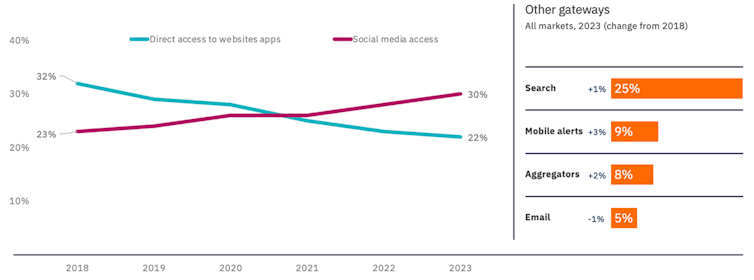
    One benchmark of this shift is a question we ask about key gateways that people use to access news. Using average data across all 46 countries surveyed in our annual report, we found that more people choose social media each year, mostly at the expense of direct access via a traditional news website or app. Access via search and other aggregators has also increased slightly over time.


    Use of news websites/apps versus social media to access news:

    Graph showing direct news website/app use decline and social news increasing.
    Which of these was the main way in which you came across news in the last week? Base: All who used a news gateway in the last week in each market-year ≈ 2000. Note: Number of markets grew from 36 in 2018 to 46 from 2021 onwards. Markets listed in online methodology.
    Reuters Institute for the Study of Journalism, Oxford University, Author provided


    These are averages, and it is important to point out that direct connection remains strong in some markets – mainly in northern Europe, where there is keen interest in news and relatively high trust. But elsewhere – especially in parts of Asia, Latin America, and Africa – social media or other aggregators are by far the most important gateways, leaving news brands much more dependent on third-party platforms for traffic.

    Generational differences are also a big part of the story. In almost every country we find that younger users are less likely to go directly to a news site or app and more likely to use social media or other intermediaries.

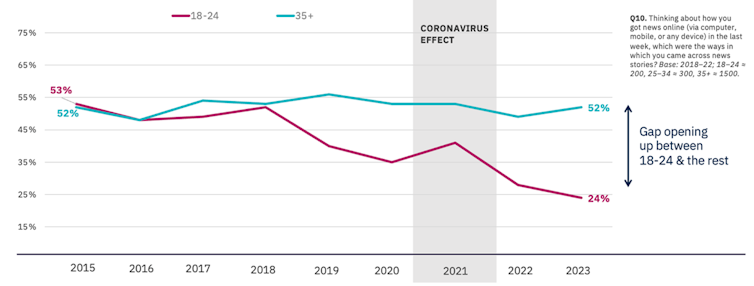
    The following chart for the UK shows that over-35s (blue line) have hardly changed their direct preferences over time, but that the 18–24 group (pink line) has become significantly less likely to use a news website or app.

    This is just one indication of how the generation that has grown up in the age of social and messaging apps is displaying very different behaviours as they come into adulthood.


    Percentage of people using a news website or app:

    Graph showing declining use of news websites and apps among 18-24 age group from 53% in 2015 to 24% in 2023 while 35+ group stayed around 52% (see previous two paragraphs).
    Thinking about how you got news online (via computer, mobile, or any device) in the last week, which were the ways in which you came across news stories? Base: 2018–22; 18–24 ≈ 200, 25–34 ≈ 300, 35+ ≈ 1500. Reuters Institute for the Study of Journalism, Oxford University, Author provided


    Dependence on social media may be growing, but it is not necessarily the same old networks. Across all age groups, Facebook is becoming much less important as a source of news – and by implication as a driver of traffic to news websites. Just 28% say they accessed news via Facebook in 2023 compared with 42% in 2016, based on data from 12 countries we have been tracking since 2014.

    This decline is partly driven by Facebook pulling back from news and partly by the way that video-based networks such as YouTube and TikTok are capturing much of the attention of younger users.

    Twitter usage is also reportedly declining following the chaotic set of changes introduced by Elon Musk, even if our survey shows relatively stable weekly reach overall.

    New platforms

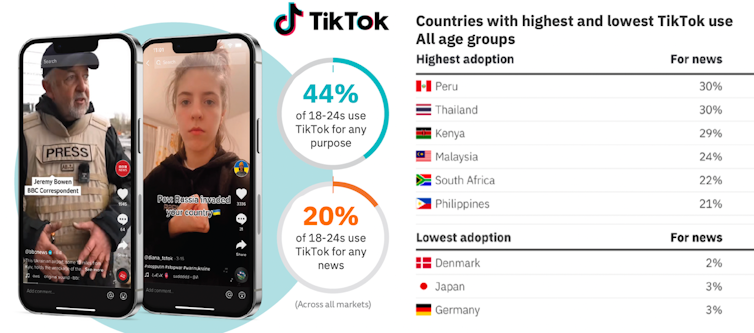
    TikTok is the fastest growing social network in our survey, used by 44% of 18–24 year-olds for any purpose and by 20% for news (up five percentage points compared with last year). Our survey results also show that the Chinese-owned app is most heavily used in parts of Asia, Latin America and Africa.

    Graph showing which platforms and websites people have used to access news.
    Which, if any, of the following have you used for news in the last week? Base: Total sample in each market ≈ 2000. Note: TikTok has been banned in India and does not operate in Hong Kong.
    Reuters Institute for the Study of Journalism, Oxford University, Author provided


    The report also provides evidence that users of TikTok, Instagram and Snapchat tend to pay more attention to celebrities and social media influencers than they do to journalists or media companies when it comes to news topics. This marks a sharp contrast with “legacy” – or more established – social networks such as Facebook and Twitter, where news organisations still attract most attention and lead conversations.

    Although news organisations have been experimenting with TikTok accounts, many are struggling to adapt to the more informal tone where creativity is the key to attracting an audience.

    These shifts are additionally challenging for publishers because they often require expensive bespoke content to be created and there are few ways to monetise short form videos, with limited linking opportunities back to websites or apps.


    Younger people less likely to read online

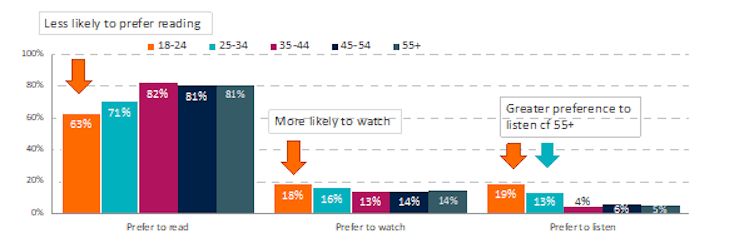
    These platform shifts are part of a wider move away from reading and towards watching or listening to news content online. While all age groups say they still prefer to read news online because of the speed and control if offers, younger groups are more likely to express preferences for watching or listening to news content, as the chart below shows. And this translates into greater consumption of short-form videos and podcasts by this group, according to our data.


    News consumption preferences by age and media:

    Graph showing young people are less likely to read and more likely to watch or listen to news.
    In thinking about your online habits around news and current affairs, which of the following statements applies best to you? Please select one. Base UK= 1740 (excl. DKs)
    Reuters Institute for the Study of Journalism, Oxford University, Author provided


    Our research over more than a decade has captured the way that all age groups have adopted digital media, alongside more familiar formats such as TV and print. But now we are seeing the emergence of a generation of social natives that are not bound by traditional definitions of news.

    As our previous research has shown, younger groups expect news to be engaging, participatory and to be available on their terms – in the networks and platforms where they spend their time. Trust is not a given, it needs to be earned – as much by journalists as by any other creator of content.

    For all the difficulties this entails – around trust, attention and business models – this is the media environment that the public is increasingly choosing for themselves. It is one where journalists and news media will need to carve out their place if they want to maintain their relevance and connection with the wider public.The Conversation


    Nic Newman is Senior Research Associate, Reuters Institute for the Study of Journalism, University of Oxford. This article is republished from The Conversation under a Creative Commons license. Read the original article.