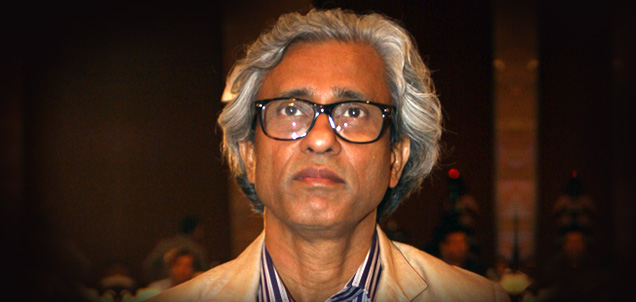
By Anil Thakraney
I have met Bhaskar Das on and off. (I once even secretly freelanced for him in my advertising days.) During my stint with Mumbai Mirror, I got to know him a little better. He has always come across as a cool, calculating and sharp business manager… but someone who’s smart enough not to build his own image over that of his company. In a long conversation inside his plush corner office (previously occupied by Pradeep Guha), Bennett Coleman’s president answers searching questions on his long career with the Times, the group’s ideologies and sometimes controversial practices.
The one new thing I discovered about Bhaskar during this discussion is that he’s a deeply spiritual person, and often, as he himself said to me, uses learnings from The Gita to ‘sanitise’ his various marketing strategies. Wonder what Lord Krishna would have to say on Media Net.
But I must say the man who heads the nation’s largest newspaper house retained his composure even when facing tough queries. Spirituality at work, I suppose.
Boss, when do you retire? You are 58.
See, retirement has two different connotations. For me, it’s ‘Retyrement’. Like re-treading tyres. And that means adding new capabilities. Coming specifically to Bennett, I have a flexible retirement plan. As per the company’s desire, I should stay as long as I am mentally, physically and intellectually fit. But I must add that I live by the day. So I am only bothered about the now.
You’ve been with the company for 32 years. Never got bored of the same place?
Boredom only happens when you don’t love your job. I have continuously rediscovered and redefined my space, so the journey has always been very exploratory. I don’t know whether the excitement would have been there if I had worked in a bank or in some other financial company. Newspaper is a 360 day product. Because of my personal liking for content, I have always been involved in it in some form or the other. Honestly, for me, 32 years feels like 32 days.
The flip side is some people would say Bhaskar is risk averse.
It’s not the question of being risk averse. By that logic if you continue in a marriage you are risk averse! I don’t believe in changing jobs for the heck of it. People use it as a spring board for becoming financially more solvent, and that has never occurred to me. For me, a job is a gateway to learning and it’s not for pay slips. Also, even if I have worked in the same company, I have done multiple roles in multiple markets. Our shareholders have always been great teachers. So, I have updated myself continuously, and I can challenge anyone in terms of my cognitive bandwidth on various industries.
Your biggest achievement in all these years?
I am proud of having been a part of the company when it re-invented itself. The process started post-1985, when our Vice Chairman took over the reigns of the company and subsequently the Managing Director. And finally, in the last six years, I have been able to drive the ambitions of the company to such great lengths, that today the company is the biggest media house in terms of both, turnover and profitability.
Bhaskar, the real challenge lies in turning around failed, small brands. Anyone can build on success.
That’s the classical model. For me, taking a giant brand and making it bigger and taking it to a different level also requires equal guts. And even for a loss making brand, we have done that. Mumbai Mirror, when we started, was making losses.
Today it is a Rs200 crore brand. This has become possible over a period of six years. And I have to add that I have taken many risks, in terms of launching new brands and making them successful. A number of big groups have also folded up, they screwed up. Success is its biggest enemy. When you are No 1, there’s only place for one person. To stay there requires more energy than reaching there.
How many years do you give newspapers to survive in India?
I am very optimistic about news per se. Today, we are leveraging the core and also investing in the embryonic and the emerging media, in terms of a news channel, websites, and so on. We are seeing ourselves as a complementary option as opposed to a substitutive option. Point is, TOI of 1830 and TOI of 1990 and TOI of 2020 will be a very different paper. We are constantly re-inventing to develop the complementary utility of the brand. We have become very futuristic, we are creating more and more niches. As for the newspaper itself, it is a matter of conjecture. I think in the Indian context, there’s a peculiarity, which is that English language is a big deal. Let me explain. To think of India as one nation is a mistake. There is a developing India, there is a developed India and there is an under-developed India. The developed India’s behaviour is more or less like the West, so there might be some erosion of the newspaper in this segment as they shift to Iphones and Ipads. But for the other two Indias, newspapers will continue to prosper for some time. For them, English is a gateway to career and growth.
Coming back to your question, I am not an astrologer, but I do agree with the gentleman who said that in 2040, the last copy of a newspaper will get printed.
Having said that, I do not suffer from format myopia, because that would kill a corporation. I think of news as a genre, not as a format.
There’s been some buzz of an IPO from your group. True?
This can always be on the agenda of any corporation, including ours. But as of now, nothing has been decided. I am not saying it will never happen, but not in the near future.
Do you admit that competition has been good for the TOI as a newspaper? Pre HT and DNA, the TOI in Mumbai had lost its edit focus. Now, the news coverage is remarkably superior.
I have always believed competition is good. Obviously, one has to respond, not react. If, while responding, the quality of the product improves, then that’s damn good. But it’s a part of the re-invention process. In Calcutta, we are the dominant force now. Or for that matter in Bangalore and Delhi, where we became the competition. But not all market leaders have responded positively. We are a dynamic group; it’s in our genetic core to re-invent.
What are the innovations Bhaskar Das has masterminded in the last five years?
I have not, it’s all a team effort. ‘I’ as a word does not exist in my dictionary. In our group we all work as a team. No individual is bigger than the team.
Private treaties, for which your group has been both, admired and dissed… it hasn’t eventually paid off, right?
It’s thriving; it’s a part of our deep strategy. We didn’t want to make money on these.
Whoa, the whole idea is to do a space and equity barter for revenue. And to encash on the acquired equity.
If we wanted to encash on the equity we would have gone to the stock market. Our strategic intent has not been understood, and we want it to remain not understood. It’s a demand-side innovation, and nothing else. Private treaties are now called Brand Capital out here, we have re-invented it and it’s doing extremely well.
Is Pradeep Guha your mentor?
I have had many mentors in my life, and he is one of them. He has been a great teacher for me.
Some years ago, in this very room, Guha said to me that for the group, the target audience is the advertiser. Do you agree with this ideology?
This kind of question cannot be answered with ‘one size fits all’ sort of a thing.
We have two customers: Readers and advertisers. Agreed, that our business model is so skewed that we are dependent on advertisers, but we have never forgotten that the reader is the franchise that leads to advertising revenue. The point is to get ad relevant audience… which means people who are culturally and financially solvent enough to engage with the advertisers. But for getting that also you need interesting content. So it’s both, Lakshmi and Saraswati.
In 2004, you were about to buy Mid Day. What went wrong?
Nothing went wrong. We wanted to buy and even Mid Day wanted to sell, but in any such deal both the partners have to have a buy-in on terms and conditions. That didn’t happen.
Regret losing out on Mid Day?
Now that Mirror has come, Mid Day is not required.
It’s generally believed Reponse calls all the shots in your group. True?
There’s no truth in this. I worked in Response for 30 years, and I have never seen any semblance of power. Only thing is, because of the business model, which is that advertising gives us 90 percent of our revenues, it’s perceived to be the most powerful. Every division plays its part. We have no say in the content. If that had been the case, the TOI wouldn’t face the maximum ban from clients (amongst newspapers). We have the Chinese wall, though we do Brand Capital. The editorial is completely independent.
Cross your heart and tell me. You have never gone to one of your editors to ask him or her to plug an advertiser?
I have never done it.
That’s very hard to believe.
Trust me. I cross my heart. When clients approach us, we ask them to approach the editorial director. Because it will never work if it goes through us.
Funny that happens in a media company that runs Media Net.
That’s because people haven’t understood Media Net. Others do it secretly, we are very clear we do it only for the entertainment publications, and with clearly defined protocols. Others do it as legitimate coverage.
Truth is, Media Net sowed the seeds of paid journalism in this country.
I don’t think so. There have been enough examples in the past, where, for financial and public issue ads, journalists always got a bad name. I would say it is much more transparent and protocolised out here.
Are you proud of MediaNet?
(Slight hesitation.) See, it’s not the question of being proud of it. Life is not black and white. It’s a part of the strategic process we have done. I feel what used to happen previously was more unethical, where, if you knew a journalist, you could get a plug. And we have openly announced these are promotional supplements.
You’ve kept a very low profile. Looks like you don’t want to repeat Guha’s mistake.
(Smiles widely) No individual can be like another person. I can’t be what I am not. I don’t think Mr Guha was high-profile; the job is such that you get noticed. Now, maybe there’s nothing noticeable in me! I always say that ultimately it’s the corporation that gives you the halo. And I have no personal halo.
I think you have decided to be clever about it.
That’s your conclusion. I did exactly what I believed in. That my work is to serve the company, which I do.
An Indian editor you admire. Someone not from your group.
Unfortunately, I can’t comment because I have not worked with them. Also, I don’t read competitive products.
You don’t read rival newspapers?
I don’t.
Don’t you want to know what the competition is doing?
For that my MIS reports are there. My brand team is keeping an eye on the competition, I don’t have to do it. I don’t have the time to read everything, it’s better to read a few publications in-depth.
Vir Sanghvi said to me that even if it was the last job in the world, he would still not work at the TOI.
It’s a democratic country, we respect individual opinion. These things don’t affect me at all. I am a spiritual person.
When did you become spiritual?
I have always been spiritual, it’s a journey. We are all expressions of god. And so you must love everyone and not be judgmental of others. When you are spiritual, you love everyone.
I think the Jain family’s spiritual beliefs have rubbed off on you.
It would have happened anyway, even if I had worked in any other corporation.
Photograph: Fotocorp
 By Ruby Bana
 By Anil Thakraney