By Avik Chattopadhyay
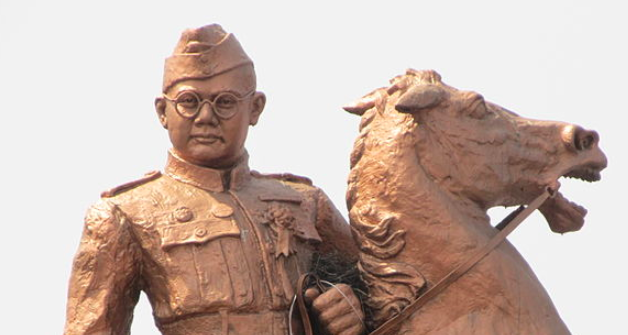
 On his 125th birth anniversary Netaji has become a ‘holographic projection’. Very soon that will be replaced by a magnificent statue in granite, as our respected PM emphasised on, for the nation and the world to marvel at.
Every time we erect a statue of a national leader in the national capital, we lock him or her up into the vaults of time, almost like being cursed to turn into stone as the mythological character Ahalya! That is the most convenient way of showing respect.
Bose has always been a character too rebellious and unconventional to be put into a box. The myth around his ‘end’ and the facts around his aura have prompted every political party to appropriate him, ending in failure. I had written about the same last year on 23rd January.
Is Brand Bose Too Hot To Handle?! « MxMIndia
Last year it was all about the elections in West Bengal. Round 1 went to the state.
This year was pay-back time. The centre was waiting for the right time to pounce. It came with the state wanting to make its Republic Day tableau on Netaji. No way said the jury that decides which tableaus to accept. The CPWD had already submitted the same proposal. No point having too much of Bose. The state erupted shouting “controversy” and “disrespect to Bengal’s son” and so on. The centre swung into action. The Republic Day celebrations would start henceforth from the 23rd of January every year. And the big one was the statue in the heart of the capital. That was the ace. But how would one come up in a few days? A holographic projection, for Bose’s sake!
Netaji has been appropriated! Or at least that is being projected [pardon the pun]. Round 2 to the centre.
And then the icing on the cake of nationalism came with the CPWD tableau at the Republic Day parade on 26th January dedicated to Netaji. I have taken grabs from the recording of the same rolling past. The last portion of the tableau showing INA soldiers holding up the flag is a straight copy of the iconic Iwo Jima photograph. Talk about originality and respect!


Brand Bose has always been too unpredictable. His narrative has been too dynamic to get a firm grasp on and spin stories for one’s individual benefit. The man was rediscovering himself with every step and move he made right from becoming an able student of Chittaranjan Das to being the mayor of Calcutta to the president of the Indian National Congress and finally in his role as Netaji.
His writings either in the form of letters to his siblings and friends or as articles show that this was an extremely restless mind. Nothing was taboo for him while nothing was sacrosanct either. He admired the Bolshevik Revolution but had serious reservations on the model of Communism put in place. He supported socialism but not at the cost of nationalism, one of the key points of dialectic conflict with Nehru. He believed in the forming of a constitution but after the ‘revolution’ and not before it, being a point of strategic conflict with the man he first called the ‘Father of the Nation’. He followed the tenets of Vedanta but despised the growing tentacles of fundamental Hindutva. He believed equally in silent protests as much as in violent struggles. He had solid differences of opinion with Gandhi and Nehru but respected their points of view and commitment to the cause. Just as Ramakrishna had said, “Joto mot…toto poth” [The paths are as numerous as the beliefs, but the goal is the same.], Bose believed that every type of strategy had to be applied to make the colonialist capitulate, hence all of them working in tandem were acceptable and supported by him.
There were only two principles on which he had a single line of thought with no deviations, distractions, and interventions.
First was that ‘Swaraj’ had to be “poorna” or complete with no half measures. “Freedom is not given, it is taken” were his famous words. Negotiations with the colonialist had to be for complete independence and not incremental and provisional steps. Che Guevara, a few decades later, was the perfect successor of Bose’s belief in perpetual revolution. Yet, when the Andaman & Nicobar Islands were occupied by INA and the Japanese, he declared a ‘provisional’ government and not a government-in-exile.
 Left: Pic of Netaji with INA and Japanese officials at Port Blair after declaring Arzi Hukumat-e Azad Hind or the Provisional Government of Free India – note the India flag with the Congress’ ‘charkha’!
Middle: A Japanese manga [graphic novel] on Bose against Churchill using the India flag – published in Manga Mainichi in 1945 – note the charkha on the flag.
Right: Asia Graph magazine, owned by Asahi Shimbun, with Bose on the cover – his popularity in Japan was far and wide.
Second was that there was no room for religious fundamentalism or state support in a Free India. in his “Free Indian and Her Problems” published in 1942, he states that the ‘Muslim Problem’ was a creation of the British and a free India cannot have any state religion. Always a rationalist, in “The Indian Struggle” written in 1938, he believes in the Aryan migration theory, admires the Harappan civilization for its uniqueness and eulogises the positive impact of the Mughal period on the India he had inherited.
These are the terribly uncomfortable aspects of Brand Bose that no ‘Netagiri’ can grapple with. When a certain group called ‘Itihasa Sankalana Samithi’ created a series of posts on Netaji with Savarkar, to imply the former’s closeness towards the latter, they forgot that Bose was as much a target of right-wing Hindutva as were Gandhi and the rest of the Congress. The cartoon below, published in Dainik Agrani in 1944 published by the Hindu Mahasabha gives it away.
 Cartoon in Hindu Mahasabha publication Dainik Agrani in 1944, edited by Nathuram Godse. Bose very much part of the 10 heads of Ravana to be destroyed by Veer Savarkar and Syama Prasad Mukherjee!
Though Bose had broken away from the Congress five years ago and was now Netaji with his Azad Hind Fauj, he was still a ‘LeLi’ to use today’s terminology!
In 2008-09 I had made an unsuccessful attempt to restore the Wanderer W124 in which Sisir Bose drove his uncle to Gomoh station from where Bose took an arduous journey on to Germany. In the due course of that effort, I interacted with a couple of people who had set upon the ‘mission’ to dig out the truth about Netaji’s death. I enquired as to why not work to keep his legacy alive rather than bother with whether he died in the air-crash and whether Gumnami Baba was him. I realised that like most of the nation, they too were obsessed more with Netaji’s death than with his life! That led me to create this social media post way back in 2010.
 Children wear Netaji uniforms.
Adults wear Netaji caps!
Legends make Netaji holograms!!
Brand Bose will always be too hot to handle!