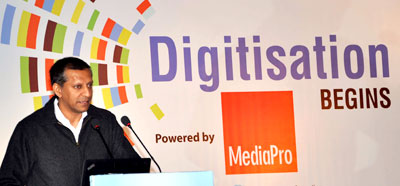
Tag: neeraj sanan

  • What next, now that digitization has begun?

    By Ananya Saha


    L V Krishnan

    The past two months, after the implementation Phase I of digitization, have been quite an incredible journey. From doubts about whether we would achieve 100 percent digitization at all to achieving it in Mumbai and Delhi. Of course the hiccups still remain. Probably Phase II will see less of these hiccups and more of successful implementation. This and many more issues about digitization were discussed at afaqs event in the capital titled ‘Digitization Begins’. The panellists not only discussed the ramifications of post-DAS scenario but also what the stakeholders should do to take advantage of digitization.


    Numbers game

    According to LV Krishnan, CEO, TAM India, the digitization onus is on marketing and programming. At the summit, ‘Digitization Begins’, culling facts from the data (based on eight weeks pre vs post DAS CS4+ in Delhi and Mumbai), Mr Krishnan said, “There has been 2.5 times growth in the availability of channels in the initial months but it does not match the viewing with 30 percent increase in incremental fragmentation.” He also noted how North and West markets in India are maturing faster than the Southern market when it comes to digitization. “Today channel-surfing behaviour is prolonged in digital homes, while direct landing is leading to increased reach for English entertainment, English movies, and the kids genre.” According to him, inter-genre surfing may also come down.


    Other findings that Mr Krishnan shared included: with sports channels becoming omnipresent, other sports will also get benchmarked; viewing is getting spread from primetime to other day parts, eg: youth music to the early morning band of 7-9am. However, he cautioned, “The biggest disadvantage is that DAS will hit single channels since the top seven channels garner almost 80 percent of audience in DAS-enabled Delhi and Mumbai.”


    Mr Krishnan, however, viewed digitization as a positive change and said, “The clear action step for the broadcaster to be present on distribution chain should choose between two cluster homes: home with kids, and home without kids. For the advertiser, they need to focus on cost of targeting, increase in co-creation of brands. Advertising will see a boost via paid media, and additional media budgets will get shifted from localized ground promotions to unique television content channels.”


    The next 6-8 months will also see a spike in free-to-air channels, according to Mr Krishnan, to cater to the bottom-end of the market.


    Chasing the momentum

    Roop Sharma

    Digitization was promised to bring in not only the set-top boxes (STBs) into the house of the consumer, but also digital services such as digital billing, services such as video-on-demand, broadband etc. Even though the seeding of STBs has been achieved, it is still a long way before we achieve digitization in the true sense.


    Vivek Takalkar, VP, Marketing and Business Development, MediaPro and Roop Sharma, President, Cable Operators Federation of India believe that post seeding of boxes, digitization has not achieved desired results while Ashok Mansukhani, Director, Hinduja Venture and President MSO Alliance asserted that the all the stakeholders of the digitization process should work together towards establish contact with the consumer.

     

    Sugato Banerji

    Sugato Banerji, COO, What’s-on-India, noted, “Content discovery will become important for operator to push channels. As digitization progresses, EPG in various languages will also be required.” While broadcasters and content creators might struggle with monetisation, the panelists were of the view that digitization will result in demand for more content.


    Giving the advertisers’ perspective, Anita Nayyar, CEO India and South Asia, Havas Media, initiated a discussion with Amit Tiwari, Country Head, Media and Digital, Philips India and Sunil Raina, Business Head, Lava International. Mr Raina emphasized content co-creation, while Mr Tiwari said, “Channels have to become brands. They have to think from a marketers’ perspective. Even though we have not changed our media plans, depending on digitization numbers, but I am sure that as digitization grows and sub-category of genres emerges, it will impact us directly. We will look at focused advertising.”

     

    Anita Nayyar

    Ms Nayyar noted, “When it comes to advertising, the brands prefer to go with what has been working in the past and their gut feeling. When the digitization process began close to Diwali, we did not have the numbers. But even then the brands advertised because it was the season and went with the gut feeling.”


    Even as marketers have not clearly changed their media strategy based on initial numbers, it is clear that as content becomes targeted, media preferences could change dramatically.

     

    Neeraj Sanan

    Neeraj Sanan, CMO and Head, Distribution, MCCS India said, “Good content will determine market share and role of distribution will reduce. Even as time spent on television has increased by 5 percent, the choice has also increased from 80 channels to 250 channels.”


    Even as business models will undergo huge changes, the panel believed that the future implications have not had any affect on their current strategies. And while DAS is believed to be a game-changer, the veterans think that more then the distribution equilibrium, it is the convergence that will have an effect on the consumption of content. As Mr Raina said, “It is important for us to integrate online and offline media to create impact. Plans are not going to change because of digitization but because of convergence. I would like to reach my consumer through the medium they prefer: it can be a television or a tablet. I have to be present where they are.”


    With competition rising, Mr Sanan noted, “There are going to be some wild implications of digitization including, local events can become content through MSOs; a good EPG search engine could take off; concept of broadcast UGC can happen; with triple play, MSOs can think of ad options with a clear-to-call action.” He also noted how MSOs will start competing with national channels for content rights.


    Though there is still a long way to go, digitization is throwing up interesting trends. How many of these will get converted, only time can tell.


  • [60 Days to D-Day] All stakeholders need to work together: Neeraj Sanan

    The Telecom Regulatory Authority of India (TRAI) issued new rules refurbishing the regulatory structure of the broadcasting, cable and DTH industry ahead of the digitization switch over in four metros, Delhi, Mumbai, Kolkata and Chennai from July 1. The order deals with issues such as channel availability, channel pricing, carriage fee and revenue sharing.


    Digitization is being seen as the game changer for the Indian TV industry, expected to bring a sea change for viewers, broadcasters and cable operators. The broadcasting industry is expected to see a growth in subscription revenue post digitization, as opposed to the present model where they depend largely on advertising revenue.


    As per the new guidelines, ‘The Broadcaster would enjoy ‘must carry’ provision from 1.1.2013 or 1.4.2013 as the case may be, for Hindi, English and channels in the regional language of the concerned area.’  In the order, TRAI has also addressed the much debated issue of carriage fee. The order states, “Keeping in view the fact that substantial investment for implementation of Digital Addressable Cable TV Systems is made by the MSO and the cost involved in carriage of channels, the Authority has decided that every MSO may fix the Carriage Fee. However, it should be published in the Reference Interconnect Offer and applied in a uniform, non-discriminatory and transparent manner. The Carriage Fee cannot be revised upward for a minimum of 2 years. The Authority would intervene in case it is felt that the Carriage Fee is unreasonable.”


    The regulatory has also prescribed the MSOs to increase their channel carrying capacity, stating that every MSO should have a minimum capacity to carry 200 channels by July 1, 2012.


    MxMIndia’s Shruti Pushkarna spoke to Mr Neeraj Sanan, EVP- Marketing and Distribution, MCCS to get his response on the Tariff Order and Interconnection Regulations for the Digital Addressable Cable TV Systems issued by TRAI.


    What’s your first response to the Tariff Order? Specifically the MCCS position?

    It is a reaffirmation of the government’s stated position and something that TRAI has been working towards for a long time.


    The TRAI observes that the Order will help profitability of channels. But carriage fee exists. Do you think your bottomline will be impacted in a positive way with this?

    The TRAI’s order will help all stakeholders move to a position of working in a structured manner. A well-run business can hope to get its deserved profit.


    Do you see the implementation happening in the four metros before July 1?

    I understand that a lot of intelligent people in well-run MSO and LCO organizations are working round the clock to make it happen. A key factor here will be for the government to continue to do what it has been saying. We shall all have to brace ourselves to a large surge in operational logistics at the last minute, but yes all this is surmountable.


    What are the marketing initiatives you are undertaking to ensure that you retain viewers?

    This is a challenge more for a distributor.


    Do you think the government is doing enough to promote the switch to digitization and explain the benefits to consumers?

    There is always something better we could do, but yes, government has been consistent in it’s thought. Now it is for all stakeholders, including all state governments to realize the prudence of digitization and work together to make it happen.


    Are there any areas of worry in the run-up to digitization (given that we have just 60 days to go)?

    No constructive business happens without risk and yes there are a lot of things that could go awry but if all players remain aligned, this is achievable. We should all realize that it is history being written everyday for distribution and we need to carefully tread this path.


  • 100 Days to D-Day…but where are the Set-Top Boxes?

    By Shruti Pushkarna


    Only 100 days to go for Digitization Day and the ground reality does not look too promising at this point. There is a mammoth requirement of set top boxes, Digital Addressable System (DAS) licences have not yet been issued to operators and several other issues remain unresolved as of now.


    To get a clearer picture of the ground reality from the cable operators’ end, MxM India spoke to Roop Sharma, President, Cable Operators Federation of India. Speaking of the ground level scenario, Ms Sharma said, “No DAS licences have been issued to the operators still. Until and unless the operator has the license, he can’t get a bank loan and unless the operator has the license, he will not want to order equipment which is worth no less than 1 crore. And more importantly there is no consumer demand for digital. This is only government’s demand because they want to curry favour to the broadcaster. There isn’t any incentive from the government either. They are only forcing a technology on consumers by mandating it.”


    But more than anything, the biggest problem as pointed out by Ms Sharma is the sheer unavailability of Set Top Boxes (STBs) in the market. She told MxM India, “You need a Set Top Box to go digital and where are the STBs? First there was talk of importing them from China but that will also take atleast four to five months. Now there are some vendors in India but for that too, the chip has to be imported from outside. There is a requirement of 30 lakh STBs for Delhi alone and this is counting only one TV per household. Also, where is the manpower to deploy all these STBs?”


    Another industry source told MxM India, “As per the declared number, there is a requirement of 10 to 12 million STBs but my experience says that the actual total count will be no less than 20 to 22 million, because they have only counted 1 TV per household. The boxes are just not there.”


    Ms Sharma feels that the government is pressurizing the smallest guy in the entire value chain, which is the cable operator. Talking of other unresolved issues, she said, “Even if the cable operator gets the STBs and gets the license, the government has not assured that every operator who gets the license will get the content. How can the operator make such a huge investment when there is no assurance of content? The government is only pressurizing the smallest guy in the value chain, they can’t pressurize the broadcaster, not even the MSO.”


    MxM India also spoke to Mr Neeraj Sanan, EVP- Marketing and Distribution, MCCS to learn of the state of readiness of channels and industry as a whole. Mr Sanan said, “In principle, the entire fraternity of MSOs, LCOs and DTH friends are united in supporting the lead taken by TRAI. In my view, Delhi and Mumbai are slightly ahead of Kolkata in digitization. Being a country where examinations to appraisals to income tax, everything happens at the last minute I see two things:  a huge last minute rush (that too provided TRAI holds it grounds) which will put operational pressure in implementation. I still hope that, in the larger interest of the community, that we see the sunrise of Digitization. Already we have taken a lead in creating consumer pull through tickers which have been running on MCCS’ three channels for a month now and if all players in the value chain do the same I am sure we can see a successful June 30 sunrise.”


    But as per another industry source June 30th seems quite unachievable, “There is a lot of resistance from LCOs and cable operators’ end. Their business is fragmented, that’s how they make their revenues, and digitization will put a stop to that. And moreover, none of the MSOs are really prepared because this requires a capital investment of 30 to 35 crore and they don’t have that kind of funding. The sheer size and the volume of the business is so large that you cannot do it even by December 31st. One thing is certain, it will create unforeseen situation on ground.”


    Ms Sharma feels that the deadline might seem possible only if STBs are made available. Listing out all issues that need to be addressed before June 30th, she said, “First and foremost, tariff needs to be in place. DAS licenses have to be issued. Interconnection agreements have to be in place. Revenue share has to be specified. STBs have to be made available in the market. And there have to be fiscal incentives given to the operators. Also, we need to have many consumer awareness programmes. All these problems have to be addressed if the deadline has to be achieved by the notified date.”


    She also added that the TRAI had only done one open house recently in Delhi but since the June 30th deadline applies to all the four metros, TRAI should have done an open house in each of these cities.


    What’s your view on Digitization? Do you think the four metros can meet the deadline? Email us at shrutip@mxmindia.com and editor@mxmindia.com.