Tag: National Geographic

  • NatGeo films series on Indian women entrepreneurs

    By Our Staff


    National Geographic has joined hands with Sequoia India to spotlight the inspiring journeys of Indian women entrepreneurs with its brand-new digital series – ‘She Builds’. The six-part series of short digital films will touch upon the lives of seven successful Indian female founders, who are defying the odds by taking risks, dreaming big, and driving innovation in India.


    The series, which will air over two weeks, will feature innovative and inspiring entrepreneurs like Neetu Yadav & Kirti Jangra, Animall, Ashwini Asokan, Mad Street Den, Ghazal Alagh, Mamaearth, Prukalpa Sankar, Atlan, Rashi Narang, Heads Up For Tails, Divya Gokulnath, BYJU’S.


    Said Kevin Vaz, Head – Network Entertainment Channels, Disney Star: “At National Geographic, it is our constant endeavour to bring stories that take our audiences on an immersive, inspiring and sympathetic journey. With ‘She Builds’, we are delighted to bring motivational stories of seven women entrepreneurs who have contributed in changing the narrative of women leadership in India. We understand that short-form content presented in an interesting manner are appreciated and preferred by our audiences, so we are bringing these stories in bite-size formats and premiering them on our highly engaged social media platforms.”


    The films were produced in collaboration with Guneet Monga, CEO & Founder, Sikhya Entertainment Private Ltd. and Executive Producer for an Academy award winning film, and directed by Vijayeta Kumar.


    Added Gayatri Yadav, CMO, Sequoia India and Southeast Asia: “At Sequoia India we have been privileged to meet ambitious and successful women entrepreneurs who challenge the status quo every day, building game-changing businesses to be the pioneering leaders they are. Their stories are inspiring, relatable, and incredibly uplifting. But they just don’t get told often enough. We are very grateful to our founders for giving us this opportunity – and sparking a flame that we hope will inspire many.”


  • Wouldn’t you want to Uncage your Books?


    By Sanjeev Kotnala

    Sanjeev KotnalaLockdown. Unlock. Partial lockdown. Night Curfew. You have experienced it all in the last year. And some of you are experiencing some form of it even now. You now know how it feels to be caged. Have you ever thought of the books caged neatly in the fancy cupboards, books racks and walls? An emotional testimony to your interest in a broad spectrum of subjects. Considering that they are not mere trophies on display. The books waiting for someone to take them out and help themselves to the knowledge that otherwise remained trapped inside. Many have never been referred to, and many will never have their pages flicked again. Some books have yellowed down with time. They silently cry and urge you to uncage the books.

    ANNUAL RITUAL

    Last week, I cleaned and dusted my bookracks. Checked the books I own. The books were spread all over and seemed like the old book bazaar of Daryaganj in New Delhi. And I realised it was time for my annual ritual:  UNCAGE THE BOOKS.

    Like every book lover, I love reading and keeping books. However, I know the books that I will never again refer to. They are just there in the book rack. I must help them find the new readers, who could be helped with the knowledge, smile, thoughts trapped within them. These books must be made to again feel wanted. I must UNCAGE THE BOOK. The books must be realise their potential instead of remaining buried in the open graveyard- the books rack and cupboards.

    Doctors, Lawyers and many other professionals are in a perpetual learning mode. They have many books they need to access with high frequency. New theories, processes and continued learning necessitate the need for new books and updated volumes. They cannot uncage the books.

    However, there are thousands of neglected books in other places. Books that have never been opened again. The pages that have not been flipped for ages. Books, with a negligible chance of ever being reread. Should they not be liberated- UNCAGED- so that someone else could benefit.

    Why not share them instead of keeping them caged? Why not pass them to people who may want to read them? Why not UNCAGE the books you no longer need?


    EVERYONE HAS BOOKS TO UNCAGE. 

    I am sure every house will find books that are waiting to be uncaged. Academic Books.

    Help books. Stories. Fiction. Non-fiction. Memories. Autobiographies. Thought leadership books. Professional books. Subject books Keys and kunjies. Exam preparatory books. Books that have served their purpose. Unless well maintained and kept like in a museum of pride, they will rot and one day- someday they will be discarded- may be sold to a raddiwaala.

    Why not just UNCAGE THE BOOKS, help someone, share the books. Extend their life. Share it with the person who wants it. Who is willing to pick it or pay at least for the delivery. Maybe for some needy people, you even pay for the delivery.

    MY EXPERIENCE TO UNCAGE THE BOOKS.

    I have been formally UNCAGING the books since 2016. The first time ever, it was challenging and emotionally draining. Now, I look forward to t. It is an annual ritual with me.

    At least more than 350 books of mine have found new readers and owners. When I uncage the book and send them on their journey to meet the new owner or reader, I take time to add a personalised message. I ask them to part of the chain. Request them not to cage the books they get from me, or they already have. I tell them to join the ‘UNCAGE THE BOOKS’ movement. Ask them too to uncage the books they no longer need. And to keep the book burial ground least populated.

    There is an added advantage. Uncaging the books is a cleansing ritual. While you select the books to uncage, you realise your interest and subjects that really interest and impress you. You create a gap, space, a void where books used to be. This acts as a push to go ahead and get more books. You become a lot more selective while picking new books.

    UNCAGE THE BOOKS 2021.

    This year too, I am uncaging more than 50 books. You can find the pictures of the books being uncaged in my weekly column ‘KotMartial’ on mmxindia.com and my social media accounts like Facebook, LinkedIn and Instagram.

    Some friends who know of the rituals have already blocked a few of the books. But a large number of books are open to the public.

    HOW TO GET THE BOOKS I UNCAGE.

    So, pick the book you want and let me know. Put a message on any of the social media account or this article. Please mention the books you would want along with your name and city. We will get to the address at a later date.

    I follow the ‘First Come First Served’ rule. But at times, I override it. As I wish to spread books and the UNCAGE THE BOOKS thought as wide as possible, I try giving away not more than four books to a person. This also helps to ensure these uncaged books are relay read and the purpose of Uncaging is served. YOU CAN FIND THE PICTURES OF BOOKS BEING UNCAGED IN 2021, ACROSS THIS ARTICLE.  All Chanakya books go to one place one reader – as I believe interested person should read them all.


    SPECIAL SET FOR ADVERTISING 

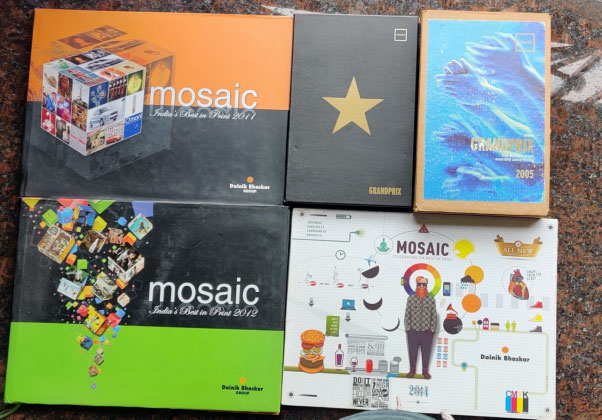
    Here is a particular set of books and CD. The three volumes of Mosaic that you see in the picture are a compilation of best print ads in and around 2008-1014. And the CD are the best TV ads making to Cannes in the early part of the century. I hope some agency, consultancy, and better, some institute will pick them. They go as a set, or they go to Raddi- the readers decide.
    And then there is this set of National Geographic  a and Traveller, which I think some library or resort should pick up.


    DON’T UNCAGE ALL BOOKS

    Keep the books you think you will refer to again. Check out the books that are dear to you and the ones you will not want to uncage. Don’t uncage the ones you plan to read again. I have my own set of books; I do not intend to UNCAGE.

    I understand the emotions people have with books and why they cannot come to terms with the concept of UNCAGE THE BOOKS. It is fine, I was like that before. Books shifted stations and house with me. Till 2014 when for the first time, I tried uncaging the books.

    DIFFERENT WAY TO UNCAGE.

    If you are a regular traveller, you could always carry the book you want to UNCAGE and leave it with a surprise note for the next passenger to find it. Come to think of it. You could be starting a chain reaction. Suddenly and surely, you will contribute to books finding more readers. I have in the past left books in the seat pockets of aircraft. I leave them with a cheeky note for the next passenger who may find it. Move on, share the books, un-cage them from their graveyard. However, in the current Covid-19 scare, one does not really suggest this pattern. In fact, my first book by Priya Kumar, I think I found in an Indigo flight.

    GIFTING IS NOT UNCAGING.

    Gifting books is a different game. There you consciously make a choice. You try matching the reader and the title or the message. I do that. I gift select books to people I believe will best benefit from them. I do that regularly. I find books a far better gift on occasions like birthdays, farewells, anniversaries etc.

    My favourite book to give away has moved and changed with time. Initially, the gift book would be THINK AND GROW RICH by Napoleon Hill, which later changed to TUESDAYS WITH MORRIE by Mitch Albom. For some time, I gifted  CATALYST by Chandramouli Venkatessan. I then moved to gifting his second book, GETTING BETTER AT GETTING BETTER. Then for some time, I gave the book SPRING- BOUNCING BACK FROM REJECTION by Ambi Parameswaran. My current favourite for gifting is ‘THE FIVE PEOPLE YOU MEET IN HEAVEN by Mitch Albom.

    IS THERE A START-UP IDEA IN ‘UNCAGE THE BOOKS’ 

    I have been trying to start a conversation. No, I have not really moved further on it. Last time, I did try to hint this to an industry association to encourages this sharing of knowledge. They have to make space available on their platform for people to share the books they want to uncage. Visitors could identify the book they want – know the delivery charges- pay them upfront, and get the book. Sounds silly. It could be a start-up idea. And if someone does see a possibility, I am willing to join hands and start it up.
     

  • Star network to showcase India’s mission to the moon

    By A Correspondent


    India will be carving a place for itself among the world’s space faring nations with ISRO’s Chandrayaan 2 landing as it attempts to become the fourth country to land on the moon after the former Soviet Union, US and China. The Star India channels National Geographic, Star Plus, Star Bharat and Hotstar have come together to telecast the Chandrayaan 2 landing to viewers across 100+ countries. The telecast will start from 11.30pm today (Friday, Sep 6)


    “This event will be a historic and immensely proud moment for India. What ISRO and the team of scientists have achieved is nothing short of spectacular. The Star network believes in inspiring its viewers with path breaking content and we are delighted to provide our audience with the chance to witness the historic moment live,” said Sanjay Gupta, Country Manager- Star & Disney India.


  • NGC’s upcoming film to showcase needs of skilled workforce

    By A Correspondent


    National Geographic will premiere India’s Mega Workforce, a documentary, which accentuates the need of skilled labour for a prosperous economy in India.


    Commenting on the film, Gayatri Yadav, President & Head-Consumer Strategy and Innovation, Star India said: “National Geographic is synonymous with delivering impactful and compelling stories across all consumer touch points. In line with our philosophy, we aim to educate the world about the dire need of required skillsets amongst youngsters for a flourishing economy. Through this film, the viewers will be provided with a balanced view on the topic – presenting all possible facets of the subject, the impact of technological advancements and the need to prepare our workforce for the new technology age.”


  • National Geographic to chronicle Indian general elections

    By A Correspondent


    National Geographic has announced a special documentary to cover the 2019 Indian general elections.


    Notes a communique: “The epic six-month, multi crew production shot in 37 locations across the length and breadth of the country tells the tale of the largest democratic exercise in the world. From the highest echelons of the Election Commission of India to the booth level officers (BLOs), from the topmost political leaders to ground level party workers, from first-time voters to 100-year-old voters, there is absolutely nothing that National Geographic’s cameras have not covered to bring the story of the world’s largest elections that has the entire world enthralled.”


    Commenting on the documentary, Sunil Arora, Chief Election Commissioner of India said: “Keeping voter convenience and simplicity at the helm of the electoral process is not only a challenging task logistically, but also an effective outreach programme to each voter. This is a testament to making the world’s largest election a success. It’s great to see a brand like National Geographic capturing the enormity of this exercise and showcasing this challenging journey to the viewers with an unbiased eye.”


    Added Gayatri Yadav, President & Head-Consumer Strategy and Innovation, Star India: “National Geographic is excited to tell a story of democracy that is relevant to the world over. For the first time, viewers will get to understand the complexities and vastness of the largest democratic exercise in the world and every Indian will feel proud of being a part of this incredible journey. This mammoth exercise in logistics and planning involves implementing the model code of conduct, voter awareness activities, the largest peacetime deployment of security forces and managing mind boggling numbers which makes for a very captivating story that National Geographic is proud to bring to the world.”

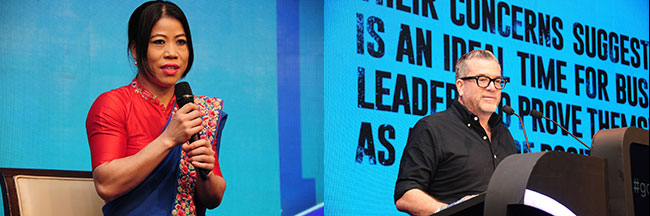
  • Day3 Goafest 2019: Mary Kom, CSR and social sector rule conversation

    By Rahul Chandawarkar


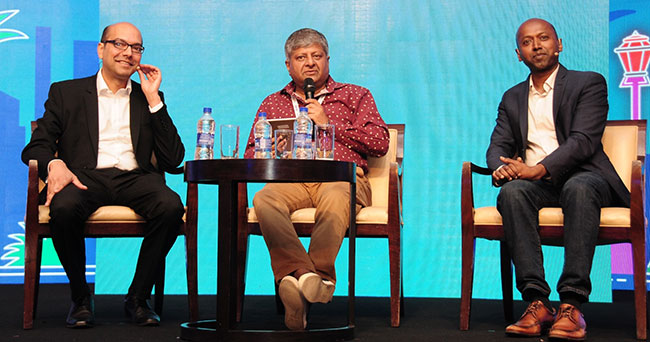
    Corporate Social Responsibility (CSR) and the social sector was the common thread that bound most presentations together on the final day of the third day of Goafest which concluded at the Grand Hyatt hotel in Bambolim, Goa on Saturday, April 13.


    Matt Eastwood, global chief creative officer, McCann Health who spoke in the National Geographic knowledge seminar in the afternoon said that while the world was going through tough times, it was also a time for advertising professionals across the world to be agents of positive change.


    Day3@Goafest2019: Key Takeaways

    :: Increased involvement by corporates in CSR projects had given rise to the concept of ‘return on doing good’ (RODG).

    :: Hi-end technology platforms like Artificial Intelligence (AI) were helping creativity reach new heights.

    :: The United Nations were keen that 50 per cent of its sustainability development goals (SDG) should emerge out of India.

    :: One of the speakers redefined the four Ps of marketing as purpose, people, passion and physical.


    Rahul Chandawarkar, a former newspaper editor, is a communications strategist and active triathlete based in Goa. He has been covering the Goafest for mxmindia.com since 2017. 

    Eastwood said that in a competitive world, business enterprises had realised that if they made a positive impact on society though the corporate social responsibility route, their brands stood to gain. Eastwood went on explain how increased involvement by corporates in CSR projects had given rise to the concept of ‘return on doing good’ (RODG).


    Citing an India example, Eastwood explained how the Kwality Dairy milk company had chosen to address the problem of Vitamin D deficiency among Indian school children through a very innovative CSR project.


    Kwality Dairy had managed to convince 50 schools in the Delhi region to shift their open-air assembly timings to 1130am, so that children could be exposed to peak sunlight for at least 20 minutes of the day. Several hundred more schools had shown interest in implementing this idea. According to Eastwood, this innovative initiative on the part of Kwality Dairy would directly benefit the brand, as the brand would have top-of-the-mind recall when parents made a decision to buy milk for their children.


    Among the several, international CSR examples that Eastwood shared with the audience, was the one initiated by Microsoft where, they created an information technology supported game which enabled physically disabled children to play video games. According to Eastwood, this ‘let everybody play’ philosophy of Microsoft would positively impact the brand.


    Earlier in the day, Ross Jauncey, Head of Create at Google spoke along similar lines in the Google keynote address and said: “The best time for creativity was now.”


    Jauncey was of the opinion that hi-end technology platforms like Artificial Intelligence (AI) were helping creativity reach new heights. Demonstrating this through a video clip, Jauncey showed how the recently launched Kupu app was helping people shoot photos on their android phone and learn the aboriginal, Maori language in New Zealand.


    Similarly, Jauncey pointed out to a Nike advertisement campaign on multiple digital platforms which supported the anti-racism movement by featuring several sporting champions across the various continents of the world.


    Society and the social sector once again resonated in the joint presentation made by Navi Radjou and Jaideep Prabhu, co-authors of the popular books, Jugaad and Frugal Innovation. Radjou and Prabhu who spoke in the Lokmat Knowledge Seminar maintained that while the spirit of ‘jugaad’ or innovative business practices was ingrained in the Indian business person’s psyche, the concept of doing business with less had spread across the globe.


    Citing some examples, the authors said that a major consumer clothing brand like Levis had recently launched their ‘wasteless jeans’ created from plastic waste. The company had also promoted their ‘go water-less’ campaign where they recommended that their jeans did not have to washed regularly and that you could even shower in your jeans, the next time you want them washed to drive home the recycle-reuse mantra.


    Turning their attention to India, the authors said that the United Nations were keen that 50 per cent of its sustainability development goals (SDG) should emerge out of India. The authors were confident that this was completely possible as they discussed chapters from their latest book, ‘Do better with less!” which showcased many an example of Indian innovative entrepreneurship (jugaad) across India.


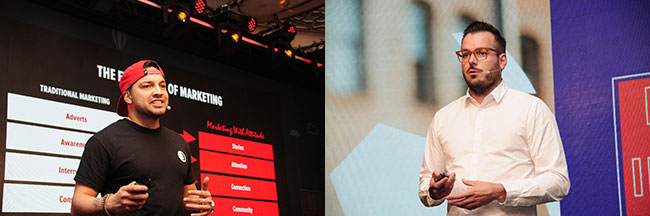
    Later in the early evening, Phil Kemish, co-founder of Disrupt Marketing speaking at the MTV knowledge seminar redefined the four Ps of marketing as purpose, people, passion and physical.


    Exemplifying some of these Ps, Kemish stated how UK’s new chocolate brand, Tony’s Chocolonely had launched their product by pointing out that they were against all cocoa farms in Africa which employed children. Kemish pointed out that the brand had mentioned their values and beliefs on their wrappers and had launched their product solely on the basis of word of mouth publicity.


    Finally, Ambarish Mitra, co-founder of Blippar who spoke at the Jagran Knowledge Seminar had the audience in awe as he introduced them to the relatively new, hi-tech concept of augmented reality (AR). Mitra did this by virtually creating a retail store on stage complete with garments etc which he could literally sift through. According to Mitra, AR and visual reality (VR) were the fourth and latest stages in the evolution of computing interface.


    The final day also stood out with India’s boxing icon, Mary Kom surprising everyone by giving a near-professional rendition of the popular, Alanis Morissete song, “What’s going on!”. Likewise, Bollywood singer Mohammed Irfan and actor Pankaj Tripathi entertained everyone with their songs and anecdotes respectively.


  • NGC to air series on planet earth

    By A Correspondent


    National Geographic is set to take viewers on a journey to witness life on planet earth through a new series titled One Strange Rock. Created by acclaimed filmmaker Darren Aronofsky, the series promises to be a journey that explores the fragility and wonder of planet earth. Hosted by actor Will Smith, this global event series will premiere on National Geographic across the world on Monday, March 26, at 9pm.


    Commenting on the series, Swati Mohan, Business Head, National Geographic & Fox Networks Group India said:“One Strange Rock comes at a time when we need people to appreciate our planet, its wonders as well as its vulnerabilities. The idea is to evoke a sense of wonder about our planet that audiences would perhaps have never experienced with anything they have seen before. The series is the coming together of the best of National Geographic elements – world class story-telling, talent, science and spectacular visuals – all working perfectly to unravel the mysteries of the world around us and take the viewers on this quest to understand our planet better”.


  • Creativeland Pictures debuts its documentary on Netflix

    By A Correspondent [corrected]


    The Legend of Jagannath, a documentary produced by Creativeland Pictures, the entertainment division of the Creativeland Asia Group, for National Geographic channel has now released on Netflix.


    Directed by Sajiv Kurup, Executive Director, Creativeland Asia Group, The Legend of Jagannath is a documentary which presents a comprehensive story of the famous Ratha Yatra – The Festival of Chariot, associated with Lord Jagannath, which takes place annually in Puri, Odisha. Hosted by actor Rajeev Khandelwal, the documentary takes a behind-the-scenes approach of the holy pilgrimage, which captures the ceremonies, colours and the essence of the festival.


    Said Kurup: “We’re extremely happy that The Legend of Jagannath is now available to a wider audience through Netflix. It’s a documentary that captures everything that goes behind creating and being a part of one of the world’s largest religious festivals. We are in the process of capturing and creating more such unique and engaging content such as this.”


    Added Sajan RaJ Kurup, Founder and Creative Chairman, Creativeland Asia Group: “Creating high-quality and refreshingly different content has always been in the DNA of Creativeland. I am delighted to see work from Creativeland Pictures debut on Netflix. We are ramping up our creative content production capabilities and are excited at the prospect of creating more such content for a wider audience.”


  • MM Publications launches Indian edition of NGC magazine

    By A Correspondent


    MM Publications has partnered with National Geographic to launch the Indian edition of National Geographic Kids magazine in India. The newest edition of National Geographic Kids magazine debuts with the April 2016 issue. The magazine will be available monthly on newsstands and by subscription.

     

    Aimed at children ages 6-12, National Geographic Kids magazine is a photo-driven publication that inspires young adventurers to explore the world around them. Each month, the magazine features stories about animals, people and places, interspersed with fun puzzles, facts and figures. It also includes the popular departments “Weird But True,” “Wild Vacation” and “Amazing Animals”.


    National Geographic Kids India will publish content from the English-language edition and will have a similar look.


    “We’re excited to work with MM Publications Ltd. to introduce the National Geographic brand to kids in India for the first time,” said Yulia Boyle, Senior Vice President of international media for National Geographic. “Our goal with National Geographic Kids magazine is to inspire kids to learn more about the world around them through visually rich, educational and highly entertaining content, full of immersive game, and incredible stories. In doing so, we hope to create the next generation of explorers who believe in the power of science, exploration and storytelling to change the world.”


    The price for the magazine on newsstands is Rs 50. A 12-month annual subscription costs Rs 500 and a 24-month subscription is Rs 900.


  • Star India is now part of 21st Century Fox

    By A Correspondent


    The Rupert Murdoch-owned News Corporation has been demerged. News Corp will now have publishing firms like The Wall Street Journal and Harper Collins and education firm Amplify, while 21st Century Fox will have Star, Twentieth Century Fox, Fox, Sky, National Geographic, Fox News, Fox Sports and FX.

     

    The old News Corporation announced yesterday that it has completed the previously announced separation of its business into two independent publicly-traded companies.


    21st Century Fox’s assets will span a global portfolio of cable and broadcasting properties, including Fox, FX, Fox News Channel, Fox Sports Network, National Geographic Channels, Star, Fox Pan American Sports, as well as film studio Twentieth Century Fox Film and television production studios Twentieth Century Fox Television and Shine Group. The Company’s assets also include leading pay-tv businesses Sky Deutschland, Sky Italia and its equity interests in BSkyB and Tata Sky.


    “21st Century Fox launches as a unique force bringing news and entertainment to more than a billion customers every day in over 100 languages,” said Rupert Murdoch, Chairman and CEO of 21st Century Fox. “Our success will continue to be rooted in a deep belief in originality and a commitment to empowering creative minds and entrepreneurs around the world. Our management teams are the best in the business and we will drive growth and shareholder value by expanding our existing assets and brands, while embracing new opportunities and technology.”


    While Mr Murdoch will be Chairman and CEO, son James Murdoch isDeputy Chief Operating Officer, Chairman and CEO, International. Chase Carey is President & Chief Operating Officer of the company.


    Meanwhile, the new News Corp will be a global network brands in news and information services, sports programming in Australia, digital real estate services, book publishing, digital education, and pay-TV distribution in Australia. News Corp’s global portfolio includes Amplify, The Australian, The Courier Mail, Dow Jones, Fox Sports Australia, Foxtel, HarperCollins, Herald Sun, The New York Post, News America Marketing, REA, The Sun, The Sunday Telegraph, The Sunday Times of London, The Times of London and The Wall Street Journal. Bedi Ajay Singh is Chief Financial Officer of News Corp.


    Robert Thomson, Chief Executive of News Corp, said, “We are continuing a proud tradition and fashioning a prosperous future in the new News Corp. We have a valuable collection of complementary companies and our task is to make the new News more than the sum of these distinguished parts. We have a robust balance sheet and a team of creative, energetic and passionate employees who are determined to make the company a resounding success and to make a positive difference in their communities.”


    “The new publishing company will be a test for investors and their appetite for print assets,” noted a Reuters report, adding: “While the company also has pay-TV assets and an equity stake in a real estate classified site in Australia, it is coming out as a separately traded company during a challenging times for newspapers. Advertisers are choosing to put their dollars elsewhere, especially in digital products. Although News Corp, like other publishers, is a player in the virtual work, advertising in digital media commands lower prices than traditional print publications.”


    According to a report in The Guardian, London by Lisa O’Caroll, “The demerger is the culmination of a two-year campaign to “detoxify” the News Corp brand that started in the summer of 2011 with the abrupt closure of the News of the World and finished with the announcement in the last week that News International’s brand in London would be axed and the company rebranded News UK.”


  • Swati Mohan is VP – Prog & Ops for Fox, NGC India

    By A Correspondent


    Swati Mohan has been appointed as the new Vice President-Programming and Operations for FOX International Channels and NGC NetworkIndia. In her new role, Ms Mohan will be responsible for programming and operations for the bouquet of channels under the company inIndia, including National Geographic channel, FOX Traveller, Baby TV, Nat Geo Wild, Nat Geo Adventure, Nat Geo Music and National Geographic Channel HD.


    Keertan Adyanthaya, Managing Director, FOX International Channels and National Geographic NetworkIndia, said: “Swati comes with a vibrant tapestry of experience in creating content for successful brands. I am confident that she will bring this experience to play in creating engaging and relevant shows for our suite of channels and strengthen them even further.”


    Ms Mohan said in a statement: “I am extremely thrilled to be associated with the Fox International bouquet of channels. National Geographic Channel and Fox Traveller are the gold standard in their respective genres and I will strive to create a great line up of international and locally produced content that will enhance the appeal of these channels inIndia”


    Ms Mohan comes on board with 12 years of experience in the industry. Beginning her career as a copywriter at Ogilvy and Mather, she went on to making content for television as an Executive Producer at FBC Media and Endemol. Her last five years at Group M across Mindshare and Maxus, had her successfully develop the space of brand building with the aid of specially created content for many advertisers across the country. In her last assignment, she was National Director – Entertainment, Sports and Partnerships at Maxus.


  • Speaking in tongues, good for TV channels


    By Rishi Vora


    TV channels are gung-ho about the digital revolution India is witnessing. New launches and the ones in the pipeline – all are preparing to be on DTH or Digital Cable. Well, what this brings to viewers and for the industry is a  novel trend: the rise of language feeds. For the consumer, it is now a chance to view a particular channel in his mother tongue. For channels, it is about expanding viewership base and accumulating additional revenues via local advertisers.


    The trend is visibly on the rising side. Big CBS launched Spark Punjabi. Sonic has extended its offering to Marathi and Bengali. History, the factual entertainment channel from the A+E Networks recently launched the Gujarati feed, making it the only channel to be available in seven languages (Gujarati, Bengali, Tamil, Telugu, Marathi, Hindi and English). Discovery serves in English, Telugu, Bengali, Hindi, while National Geographic is present in five feeds: English, Hindi, Bengali, Telugu and Tamil. The trend, quite noticeably is seen in the kids and the factual entertainment genre.


    For these international channels, the opportunity is way too big to be missed. The cost of launching a new feed vis-a-vis the return it brings to the table in terms of reach, viewership and revenue, is negligible. All it accounts for is an additional cost on dubbing, which on most occasions, for all channels would be an incremental cost since English and Hindi languages are by most channels, already operational. Sangeetha Aiyer, General Manager – Marketing A+E Networks and TV 18 JV informs that the cost of dubbing varies between 7 to 15 per cent of a programming budget.


    “The trend has been around for a while,” says Nina Elavia Jaipuria, Executive VP and General Manager, Sonic and Nick India. She further adds, “For us, since we cater to the kids and the young adults of India, it is important that the characters kids have an affinity towards speak to them in their mother tongue – the language they speak at home. That is the best way you can engage and entertain them.” Aiyer agrees that it brings in more revenue and viewership for the channel, but also calls for a lot of co-ordination with studios which at times can be painstaking. Ensuring quality control, scripts, technicians etc is one part of the challenge, while lack of experts in languages like Marathi or Bengali is another challenge.


    Most channels outsource the dubbing work to studios, except UTV Action which contracts its sister company UTV Software on the same. UTV Action, as is known was one of the early movers in the movies segment to offer Hollywood films dubbed in Hindi. The channel later launched its Telugu feed. Manasi Sapre, Programming Head, UTV Action says that Telugu feed opens up a big market for the channel. “We’re seeing a lot of traction from the Telugu market, where the appetite for Hollywood movie watching is constantly increasing. Telugu market is one market where you can be rest assured of a good response, given the fact that the southern belt likes to view content in their own language rather than English or Hindi.”


    A separate P&L company within the UTV group – UTV Software, has been in the business of dubbing for more than 15 years now. The company is seen as a pioneer, currently handling projects like Walt Disney, Hungama, Fox Traveller, National Geeographic Wild, NDTV Good Times and UTV Action. The company dubs 40-50 hours of content every month, so considering that content is offered in a minimum of  four languages, it means 200 hours of content being dubbed every month.


    According to Rahul Bhatia, Senior VP – Dubbing, UTV Software, the dubbing industry has grown leaps and bounds in the past five to seven years in terms of the number of players. The market still remains majorly unorganised with UTV as a major player as against many small studios that do one-off projects. “Price-points for dubbing have gone down drastically. From what it used to be Rs 1 lakh for an hour 10 years back, it is now come down to Rs 25,000. But, on the brighter side, volumes have increased. Three years back it was only Hindi, Tamil and Telugu, but now if you see, the market is growing to other languages like Gujarati, Marathi, Bengali and Punjabi.”


    Quite interestingly, for many channels that bring in international content from countries like Japan, Korea or even China, content is translated to English and then dubbed to various other languages, which is a lot of effort on the part of the studios. Part of the reason for this tedious procedure is the fact that channels are extra careful to ensure that  international standards are maintained.


    Given the kind of growth dubbing has seen and that many channels have launched multiple feeds, there are chances that a few broadcast majors would want to set up their own studios. Maybe it is too early to say, or the existing outsourcing practice could well be effective enough as one may not want to get into the business, which could well mean diverting the attention from three major functions: Content, Distribution, Sales. Even for now, Dubbing seems to come later in the priority list of the channels.