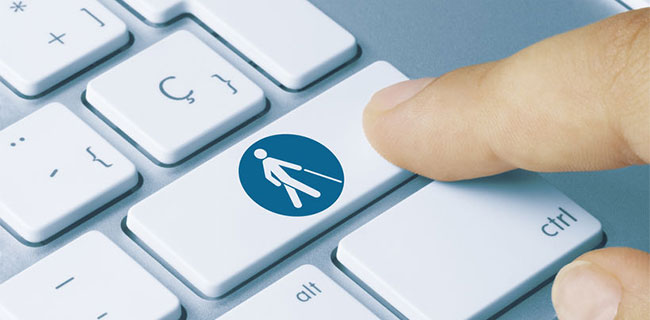
By Shruti Pushkarna
 Before you label this column (or the columnist) as being unnecessarily critical of everything (and everyone), let me dish out a few positive thoughts. I know I haven’t been an ardent supporter of the present-day leadership, and I’ve repeatedly highlighted the ignorance (and convenient oversight) of several stakeholders including our dear friends in the media, vis-à-vis issues faced by the disabled population. But I’m not a pessimist. If anything, I anticipate a better tomorrow.
One such promise was reflected in my recent reading of the National Education Policy (NEP) 2020. It left me exhilarated. Education in fact has been in the news for quite some time now. Starting with the Class X and XII results, college applications, Delhi University Open Book Examinations, and now the debate around NEET and JEE. But this new policy can be a serious gamechanger and anyone working in this space should be excited.
Online classrooms, digital techniques of teaching and training, and tech interventions have been the subject of various webinars and Zoom sessions post the lockdown. Several progressive discussions have ensued since the pandemic has pushed us into adapting to newer methods and modes of delivery.
In one such engagement online, a conclusive utterance by a resource person from an NGO in Jalandhar caught my attention. A visually impaired teacher, who has been empowering blind students to set higher goals, said: “If you have a laptop, a smartphone and the right attitude, nothing can stop you.”
Most people are unable to comprehend how a blind person can use these devices to study. But thanks to Covid, education is no longer limited to a traditional physical classroom. Although technology has played a transformative role in the lives of persons with disabilities for quite a few years, it wasn’t widely recognised. And us humans, we only believe what we see.
Our society and academia have been governed by an ableist approach for years together. Disabled children presumably belong to special schools and institutions where they can interact with their ilk. As they grow up, a parallel universe accommodates them, outside of the space occupied by the able-bodied.
A student in Udaipur, Rajasthan, was forced out of a mainstream school when he suddenly lost his eyesight. In addition to the vision loss, the boy had to battle with discriminatory behaviour. Five years later, repeated attempts and a live demonstration of the use of technology got him another chance at regular schooling. Currently, pursuing Class XI through the online mode, his equal and active participation among sighted peers has widened the teachers’ imagination. They don’t have to deliver the lesson to him in a ‘different’ shape or form.
But not every student is lucky enough. Several simply drop out as they can’t put up a sustained fight against the system. Many of them are unaware, helpless, misinformed even.
NEP 2020 comes with an assurance of giving an equal opportunity to all. It accords for better integration with the use of technology and cross-disability training for special educators. Section 6 on ‘Equitable and Inclusive Education: Learning for All’ states: “Ensuring the inclusion and equal participation of children with disabilities in ECCE and the schooling system will also be accorded the highest priority. Children with disabilities will be enabled to fully participate in the regular schooling process from the Foundational Stage to higher education. The Rights of Persons with Disabilities (RPWD) Act 2016 defines inclusive education as a ‘system of education wherein students with and without disabilities learn together and the system of teaching and learning is suitably adapted to meet the learning needs of different types of students with disabilities’. This Policy is in complete consonance with the provisions of the RPWD Act 2016 and endorses all its recommendations with regard to school education. While preparing the National Curriculum Framework, NCERT will ensure that consultations are held with expert bodies such as National Institutes of DEPwD.”
A reformist policy, modern-day technology and a willingness to change might reduce the intensity of the battle against acceptance in a mainstream academic environment. Among the many pluses of Covid, technology has crept into every aspect of our daily living. Education, employment and entertainment have been redefined by a ‘digital’ outlook.
Here’s hoping that students with disabilities stand to gain the most from it. Amen.
Shruti Pushkarna is a former journalist (part of the founding team of MxMIndia) who has moved full-time to the social sector. She heads operations of the New Delhi-based Score Foundation where she works as Director-Programmes & Communications. Shruti writes for MxMIndia every other Thursday. Her views here are personal. She can be reached via Twitter at @shrutipushkarna

 The new National Education Policy (NEP) has stirred up a hornet’s nest among columnists who are busy parsing what it says more than what it doesn’t. The NEP is progressive, aiming to nurture independence of thought and decision. (I stress on “aiming to” because it was submitted by an eminent team of scientific tempered people, but in implementation, our government does have a suspected habit of appropriating institutions.) However, the NEP does little to instil specific forms of responsibility among young citizens. The responsibility towards gender mainstreaming is one such.