Tag: NASSCOM

  • Nasscom Foundation appoints Six Degrees BCW

    Nasscom Foundation has appointed Six Degrees BCW as its strategic communications partner. The collaboration with Six Degrees BCW aims to strengthen Nasscom Foundation’s brand presence and expand the reach and impact of its TechForGood initiatives across India.

    Said Nidhi Bhasin, CEO, Nasscom Foundation: “We are excited to partner with Six Degrees BCW to advance our mission of leveraging technology for social impact. Our organization has been instrumental in driving digital inclusion in marginalised communities and creating equal opportunities for all sections of the society, and we hope that this collaboration will enable us to amplify our impact even further. Six Degrees BCW’s expertise in strategic communication and the team’s understanding of the socio-technological landscape aligns with our vision. We believe this partnership will enable us to communicate our initiatives more effectively and inspire greater participation from all stakeholders.”

    Added Vandana Sandhir, India Lead at Six Degrees BCW: “With India at the cusp of digital transformation, we are thrilled to be partnering with Nasscom foundation on its journey towards driving inclusive digital progress. We will leverage our strong presence in India and our expertise in reaching diverse audiences via a focused approach to drive increased visibility for the foundation’s initiatives and further strengthen its position as a catalyst for positive change.”

  • Zee & Nasscom forge partnership

    By Our Staff


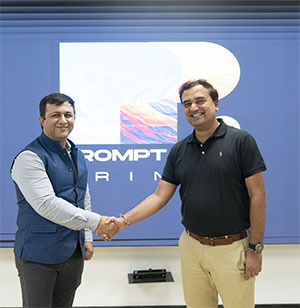
    Nitin Mittal, President – Technology & Data, ZEE and Ankit Bose, Head of Nasscom AI

    Entertainment conglomerate Zee Entertainment Enterprises Ltd has partnered with software and services companies apex body National Association of Software and Services Companies (Nasscom*) for its recently-launched Generative AI Foundry programme, that aims to foster innovation and growth in the start-up ecosystem. Through the strategic partnership, Zee’s Technology and Innovation Centre will primarily focus on enabling and supporting co-piloted generative AI solutions for India’s media and entertainment ecosystem.


    Said Nitin Mittal, President – Technology and Data, Zee: “We are delighted to embark upon this exciting journey in collaboration with Nasscom, aiming to shape the future of India’s AI community. The synergy between our endeavours, Nasscom’s commitment to nurturing tech startups, and Zee’s leadership in media innovation signifies more than just a convergence of minds—it represents a fusion of futuristic visions poised to define the industry’s next chapter. As a frontrunner in India’s M&E ecosystem, this partnership stands as a testament to our commitment towards elevating consumer experience by leveraging digital technologies. At Zee, we believe that collaborations of this nature are instrumental in propelling the growth of startups and fostering innovation in the India’s AI landscape.”


    Added Ankit Bose, Head of Nasscom AI: “The partnership between both organisations is a significant one for the Generative AI startups. It is heartening to witness excellent initiatives from the industry to collaborate with these startups. The innovative solutions possess the potential to transform various sectors including media and entertainment (M&E).”


    *Ed: Since December 2022, Nasscom writes its name entirely in lower case. Hence: nasscom


  • 10 Trends Shaping Digital Media


    By A Correspondent


    KPMG, in association with NASSCOM, Kalaari Capital and YourStory launched a report titled – ‘India Trends 2018: Trends shaping Digital India’, that delves into the key internet trends that are likely to shape businesses in India in 2018.


    We publish here the 10 trends as listed in the report.

    1. ‘Mobile-first’ consumption for media, gaming, entertainment generating significant avenues for consumer outreach and engagement.

    2. Digital future lies in the Indian language internet users

    3. Rise of social and content-based commerce

    4. Ecosystem creation by internet business players to increase monetisation avenues

    5. Emergence of ‘alternate commerce’

    6. Emerging sectors – Health-tech, Agri-tech and Ed-tech

    7. Emergence of Indian brands accelerated through digital platforms

    8. Robotics pushing boundaries

    9. Digital payments going mainstream

    10. Frontier-tech solutions like AI, ML and blockchain likely to gain precedence


    The report is available at https://assets.kpmg.com/content/dam/kpmg/in/pdf/2018/05/IndiaTrends2018-Trends-shaping-Digital-India-Internet.pdf


  • Mobile gaming to garner $1bn revenue by 2020

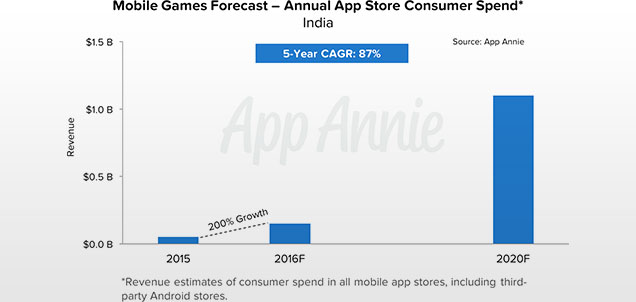
    Image courtesy AppAnnie


    The mobile gaming market in India is gaining traction, and predicted to garner revenue as high as USD1.1bn by 2020.


    The National Association of Software and Services Companies, in association with App Annie and Deloitte, released two whitepaper reports outlining substantial growth in the mobile and applied games sectors in India and the opportunities for both local and foreign mobile game publishers and investors, as well as best practices for applied game developers.


    “Both the Mobile Gaming on the Rise in India and the Applied Games in India white paper reports, demonstrate the growth of both mobile and applied games in India, for both local and international developers and publishers”, said Rajesh Rao, Chairman of the Nasscom Gaming Forum. “At Nasscom Gaming Forum we are excited by these findings and the opportunities these give to both local developers and publishers and look forward to continuing to build a thriving and innovative games economy in India”.


    The Nasscom Gaming Forum and App Annie report ‘Mobile Gaming on the Rise in India’ discusses how Indian consumers are taking to games, with game downloads doubling in the last two years, and the overall amount of time Indian users spent in mobile games growing sharply over the past year. Mobile game downloads are expected to grow at a CAGR of 58 per cent over the next five years going from 1.6 billion downloads in 2016 to an estimated 5.3 billion downloads in 2020, as a result of growing adoption of games, the rapid proliferation of smartphones, affordable data and universal implementation of direct carrier billing, India presents an ideal opportunity for local and foreign mobile game publishers and investors.


    Across the region, Indian gamers continue to embrace globally popular titles, including Candy Crush Saga, Clash of Clans and Subway Surfers. Local Indian publishers are enjoying increasing success in simulation, sports and social card games, with Teen Patti social card games succeeding and proving popular amongst younger consumers in the marketplace. The report continues to discuss how multiplayer and social features have become key engagement drivers critical to the success of games in India and how publishers should draw upon these proven mechanics and incorporate localised and culturally relevant content to grow their user base.


    The Nasscom Gaming Forum and Deloitte report ‘Applied Games in India’ discusses the growth of applied games with a focus on traditional learning, business, marketing or social experiences, that are predominantly used for simulation based training (in the fields of aviation and military). The reports discusses how the Indian market for applied games is expected to grow at a compound annual growth rate of 14-16 per cent, from USD 40 million in 2016, to USD 80 million in 2021. Currently across India there are 40 developers of Applied Games (Independent studios, IT firms venturing into Applied Games and e-learning companies), that operate out of Bangalore, Hyderabad, Mumbai and NCR.


    Report can be downloaded from: http://go.appannie.com/report-mobile-gaming-india-november-2016


  • Employment in India’s App Economy to leap manifold by 2016

    By A Correspondent


    India’s App Economy is witnessing exponential growth. A study published by ICRIER and IAMAI titled “An Inquiry Into The Impact Of India’s App Economy” estimates direct employment in this industry to range between 1,51,230 and 1,59, 010 by 2016. Apps currently account for 75,000 jobs in India. Accordingly, the increase in direct employment attributable to India’s App economy is expected to range between 76,230 and 84,010 jobs from 2014 to 2016. Besides, Apps create downstream jobs in sales and marketing and in customer sales management. They also cause income growth that has its own secondary impact on jobs. These indirect and induced effects could result in an increase in total employment by up to 8 times during the period 2014 to 2016. At its best, the App economy could generate over 6,00,000 jobs. The study also uses existing data to estimate the size of India’s app economy at Rs. 1964 crores in 2016.


    Speaking at the launch of the Report, R Chandrasekhar, President – NASSCOM said, “Digitization of data at source is critical and therefore mobile is the way forward to speed up the implementation of projects. Mobile apps offer an interesting way of digitization and save both time and money but the challenge is to create a conducive ecosystem. Harmonious commercial synergies between app developers and telecom operators have to be created. App development coupled with infrastructure development will lead to the growth of the app economy.”


    The Report illustrates four scenarios that determine the range of potential employment that can be generated by the app economy in India. These are

    1. Business As Usual (BAU) with no regulatory intervention
    2. Mature Industry (IM) with high smartphone penetration and data usage
    3. Government Intervention (GI) providing digital infrastructure enabling demand

    4 .Aggressive Government Intervention (AGI) and Mature Industry (IM) playing pivotal role


    According to the Report, smartphone penetration in India is estimated at less than 20 percent, the country experiences 100 million downloads per month placing it amongst the top five regions for Google Play, the official Android app store. The number of 3G Sims in India is also expected to increase from 35 million in 2012 to an impressive 272 million by 2017. India also significantly contributes to app development as roughly ten percent of apps worldwide are developed by Indians either based abroad or at home.


    Rajat Kathuria, Director & Chief Executive – ICRIER, said, “The increase in start-ups coupled with an enhanced ecosystem could create employment opportunities. At present the app economy has created approximately 75,000 direct jobs, and has the potential to reach 6,00,000 over a period of time, due to indirect and induced impacts of App development.


    Providing insights on the report, Dr. Subho Ray, President – IAMAI (Internet & Mobile Association of India) said, “India’s App economy is at the cusp of exponential growth. With e-commerce companies going mobile only and unprecedented growth in the hyperlocal segment, the industry will not be surprised to witness a faster growth rate than projected in the report.”


  • @FF12: NBSA chief suggests independent regulation for media

    By A Correspondent


    In 1950, Jawaharlal Nehru said that freedom of speech should be granted to good and bad editors, but they should use it in national interest for he believed that if it is left to the government to decide, the good editors will be jailed and the only the chamchas will survive. This was the opening Justice JS Varma, former chief justice, Supreme Court and  News Broadcasters Standards Association (NBSA) Chairperson used for his keynote address for the session ‘Freedom of Media: Significance of self regulation’.


    Justice Varma said that freedom of speech is precious and we have to preserve it. The way to do so is self regulation as the media is mature enough to know to do it themselves and ward off the danger of state regulation.


    He said that it is not media’s right but rather an obligation to keep the people informed so that they can participate in government decision making process. It is the media’s duty to ensure transparency to ensure accountability.


    Justice Varma emphasised that the media should not give the government a chance to step in and hold it accountable. He said that the media (which reports) and judiciary (which decides) are the two strongest pillars of our democracy and they shouldn’t use their strength (power) to harm anyone, lest their power be curtailed due to lack of their accountability.


    Moving on, Justice Varma criticised the media, especially the broadcast media’s tendency for breaking news. He said that the key tenets of journalism should be kept in mind while reporting ‘breaking news’- is it true, fair and in public interest. He said that objectivity and due diligence must be applied while covering news. He cautioned the media, which has tremendous reach, to be cautious in its reporting as the effect of the news it flashes is instantaneous. He closed his address by saying “The more potential for damage, the more is the accountability you have”.


    The moderator, Barun Das, Zee News CEO and Vice President, News Broadcasters Association (NBA) spoke about how the media can’t be regulated as it is an essential pillar of democracy. He opined that free media can be good or bad but media which is not free can never be good.


    Mr Das said that regulation is a process of evolution. The media needs to introspect and understand where it stands.


    He outlined the dilemmas faced by the media while trying balance the content and the bottomline where news is trivialised for gaining eyeballs. The broadcast media especially is constantly grappling with trying to strike a balance between what the audience ‘would like to see’ and what they “should see”.


    The stage was then thrown open for the panel discussion. Each of the panellist was given time to speak and answer questions by the moderator.


    The discussion was opened by KVL Narayan Rao, executive vice chair person NDTV and President, NBA.


    Mr Rao said that there is no question of compromise on the fact that that media is free and that is the way it should be in a democracy. He said thatIndiais the largest free news market with a reach of 500 million households (news TV reaching nearly 115 million households).


    He said that in the early 2000s, after the private players were allowed in, they got together to set up the NBA to set up a code of programming and ethics which will regulate their broadcasting. He emphasised that it was important to have an independent and respected authority to keep a vigil on what is happening in the industry. He was proud of the fact that they telecast a scroll reminding the viewers that they have a forum to go to if they have any complaints.


    He also spoke about the NBSA which has been an advisory to the media with regards to improvement in news coverage and takes up issues suo moto if the media is found lacking.


    When questioned by Mr Das about balance or conflict on interest between news and business, Mr Rao was emphatic that there should be a “Chinese wall separating news and commercial interests”. He opined that news is to inform, educate and entertain the public independent of government and advertisers. He allowed that some compromise may take place but said that with digitisation, more cost can be spent on content and hence the scenario will change.


    Next to take the mike was Nitin Desai, Former under Secretary General, United Nations and member NBSA.


    Mr Desai started by saying that he disliked the term self regulation and “independent regulation would be a more appropriate term”. He said that emphasis should be given to developing the independent regulation in such a way that it is credible in the eyes of the media, the people and the view makers.


    His main concern was about the emergence of new media and challenges presented to regulate it.  He reiterated the need for due diligence to be given to fair and unbiased reporting, rights of an individual to privacy and avoiding trial by media.


    He said that he had already noticed a change in the fact that the mindset of the editors and the non-media members on the NBSA was converging due to the internalising the sense of responsibility.


    When questioned about the trivialisation of content, Mr Desai said that it was being done as the measurements showed that the audience preferred it. He said that there was a need for a different measuring system for news channels. He also opined that news channel have to stop behaving like money making operations and take responsibility to cover news that “people should know”.


    Phillip Turner, Chief of Bureau, CNN International, South Asia said thatIndiahad a long tradition of journalism but we tended to forget it. He emphasised that focus should be on stories that have a relevance to the rest of the world and maintaining the integrity of the media. He agreed with Mr Desai that the new media is presenting a challenge for regulation but he was of the opinion that everything would work out if the media stuck to the basic tenets of journalism – fair, relevant, responsible and accurate reporting.


    When asked about the need for a NBA-like worldwide authority, he wasn’t sure that such a platform could work globally.


    Kiran Karnik, member NBSA and former president of NASSCOM spoke about the challenges of new media. He said that today, when the news is available instantly as reported by citizen journalists and through the new media, it is the responsibility of the media to separate what is true and what is not. He also opined that news media today has shifted from reporting news to making news. He cautioned them to use the power they have responsibly by maintaining their standards and not infringing on the rights of the people.


    When questioned on the challenges thrown up by the new media, he agreed that technology is not amenable to censorship and also the consumer is becoming the creator and consumer. But he emphasised that there should be zero tolerance for unverified news and the news media as the aggregators of news should use their own censors.


    Mr Das wrapped up the session by stating that now is the time to convert challenges into opportunities and inclusive growth through media is the way forward.