Tag: Narendra Ambwani

  • What will Brahm say to this at the next AGM?


    He was more than just the Hawkins big boss. A great marketer with a keen sense of (and on) advertising. His contribution to the various industry associations has been huge, and will always be remembered by those who knew him. Brahm Vasudeva passed away late on Friday, July 10. He was Vice Chairman and Managing Director of Hawkins from 1968-84, Chairman and Managing Director from 1984 to 2006 then Non-Executive Chairman. Our ‘Namaste’ to him.


    We carry here tributes by senior industrypersons Arvind Sharma, Ramesh Narayan, Narendra Ambwani and Jayesh Ravindranath.


    Brahm Vasudeva, RIP

    By Arvind Sharma

     

    On July 10 afternoon, many industry WhatsApp groups started sharing the news of Mr Brahm Vasudeva’s passing away. He was eighty-four years old.


    This sad news got me reflecting. About Brahm and about me.


    When I joined the advertising industry in my early 20s, a handful of large consumer marketing companies wielded enormous clout in the industry. That is true to a degree even today. However, what was strikingly different in that era of nascent consumer marketing was the influence a few individual consumer marketers exerted on the industry. They punched far above the weight their revenues or their marketing budgets should have given them. The position they commanded in the industry came from their intellectual caliber.


    Brahm was one such individual.


    He used the might of his intellect to change consumers’ lives for the better. His pressure cookers liberated Indian housewives from hours of sweaty drudgery in the kitchen. He constantly innovated- in products, distribution and marketing. Pressure cookers on EMIs, I’m told, was one his category penetration driving ideas. Of course, he built a very successful business in the process. But what many of us admired him most for were his enduring contributions in moving the industry forward on a number of fronts.


    We live in an era where we get agitated about our leaders bending the truth. And that is the way it should be. But can you imagine an era where there was no way of knowing the truth! Or no agreement on how to go about discovering the truth!!


    Brahm pushed on so many industry fronts to change that.


    As a major voice at the Indian Society of Advertisers, he demanded that media should charge for exactly what it delivered based on precise measurements. Whether the measurement was in terms of column centimeters of ads actually printed or in terms of opportunities to see delivered. His sessions with his agencies with piles of newspapers to measure the exact sizes of ads seemed quirky to many. But his insightful and counter-intuitive-to-many stance that for dependable media measurement, advertisers and advertising agencies must contribute their share of measurement costs has been proven right over time. It is now the bedrock principle underlying two major media measurement institutions in the country- Media Research Users’ Council and Broadcast Audience Research Council. Among others, they provide measurement on two of the most important media in the country- Print and TV.


    While being a champion of freedom of commercial speech, Brahm understood and advocated that as industry consisting of advertisers, ad agencies, media and associated advisory firms, we must self-regulate ourselves and our content. Otherwise somebody else will. He was one of the moving spirits behind creation of the Advertising Standards Council of India. He was actually the pen that wrote ASCI’s code of conduct. In 1985, in mere 3500 words, he wrote the principles that define good advertising. Those principles hold good even today-after 50 years of rapid change.


    The four pillars of these principles are taught in every advertising class in India today


    # Truthfulness and honesty in claims

    # Non-offensiveness to the public

    # Against harmful products & situations

    # Fairness in competition


    Brahm selflessly championed these and many other ideas he believed were good for the industry while he was in office at these institutions. And for decades after that at every possible opportunity. And long after he had physically left these boardrooms, the force of his thinking has continued to guide them with a simple question, repeated often: “What will Brahm say to this at the next AGM?”


    Brahm will not be there anymore at the AGMs of these institutions. And the truth is that he has not been there at most of them for the last few years. But the question, ‘What will Brahm say to this at the next AGM?’ has become such a habit with the industry that it has continued to echo in the boardrooms. It is the industry’s way of internalising the ideas and principles of a man who shaped its past and will continue to influence its future.


    About a decade ago, Brahm started championing the use of ‘Namaste’ in place of a handshake. But then Brahm always had great foresight! He was always ahead of his times!


    Brahm, those of us who knew you personally, will miss you as a friend. As an industry, we will do well to keep your memory alive by continuing to ask ourselves: ‘What will Brahm say to this at the next AGM?’


    Arvind Sharma is a veteran adperson and former Chairman & CEO, Leo Burnett

    ~ ~


    Namaste Brahm!

    By Ramesh Narayan

     

    The Year was 1982. Delhi was hosting the AdAsia 1982.


    I was an aspiring advertising person, attending the Congress to see what advertising was all about, and whether it could offer me a career. And there, one of the things etched in my memory was the final session where Mr Brahm Vasudeva summed up the entire proceedings.


    I was so impressed with his presentation. The way he chose the right points to highlight, his impeccable delivery, the ease with which he held the attention of the audience, it was just perfect.


    And perfection is something I would grow to associate with Brahm.


    I told him about the impression he had made on me and he always chuckled that he was responsible for me getting into advertising.


    Fast forward to an IAA Congress in Cancun. As a rookie, I was using conferences as a place to learn more about my profession. Brahm, for want of any other company, was indulging me. “Nice hotel” I said, nervously. “Yes”. he replied. “Why do you say so?” he  asked me.


    “Large rooms, great view”, I said. And countered: “Why do you like it?”


    “Wooden hangars,” was his laconic reply. And then went on to add: “the little things really matter”.

    Quintessential Brahm, as I was to learn as the years rolled by.


    The IAA was a fledgling association with and managing committee meetings would be held at the Trattoria restaurant. Pradeep Guha was the Hon Secretary and I was the Hon Treasurer, and I was presenting the annual accounts to the small committee which included Brahm. At one point he raised his index finger and I paused and said “Brahm, any doubts?”


    And he replied in his even tone, “Doubts? When Ramesh presents, I have no doubts. Just some clarifications maybe?” A lesson in using the right word at the right time.


    Somehow, Brahm was slightly intimidating to most people. Yet, he was uniformly gracious and kind to me. He even confided in me one evening at the Oberoi (now Trident) that he really didn’t care much for my father (whom he knew earlier) but “you, Ramesh are different”.


    Somehow, I didn’t take offense to that statement because there was something very genuine in his tone and demeanour.


    I learned that perfection in every little thing was important to him. Preparedness for a meeting, or presentation and equally, he valued the intent of a suggestion, so I made it a point when I was President Advertising Club to talk to him before the meeting and explain my point of view. After that, he was a formidable ally.


    And of course, I was tickled pink that he made it a point to publicly announce, every time we met, that the only desk calendar that adorned his table, was the one I sent him.


    Long before Corona, he had decided that Namaste was better than shaking hands.


    Rest well, my friend. Your life was a lesson worth learning from.


    Ramesh Narayan is a veteran adperson and Founder, Canco Advertising


    ~~


    He chose every single word he spoke so patiently

    By Narendra Ambwani


    I used to love his refusal to shake hands and do namaste. So thoughtful an idea well ahead of Corona times. Also I admired the way he would think and chose every single word he spoke so patiently.


    Narendra Ambwani is a veteran corporate leader and coach, and Former Managing Director, Johnson & Johnson

     ~~


    A Man Ahead of His Time

    By Jayesh Ravindranath


    As the person who helmed and ran what was then Pressure Cookers & Appliances Ltd, now renamed as Hawkins Cookers Ltd, Brahm Vasudeva was a legend. There were people who either hated Brahm or adored him. Very few who dealt with him, were in the ‘grey’ area.


    I had the good fortune of working closely with him when I was with Everest Advertising in the 80s. While most people saw him as a difficult man to deal with, I believe I understood what made the man tick, and hence created a rapport and an equation with him.


    He had a phenomenal eye for detail and a great believer in offering high-quality products to his consumers. I learnt a lot from him, and this is what I would like to acknowledge today, about the man and his work.


    Brahm was a stickler for detail and a man who spent copious hours going through every aspect of his business, be it product design, packaging, advertising and communications, media plans, or even the recipes that went into the legendary Hawkins cookbook. The end-product that would reach his consumers was nothing but the best.


    Some examples:

    In the 80s, before the advent of the internet, all communication was through postal mail. Users of Hawkins products would regularly write in to the company, commenting on the recipes Hawkins would offer, or they would send in their own recipes. Brahm would have each and every postcard and inland letter sent to the agency for translation from the respective Indian language to English. This translation would then be reviewed by his team, an appropriate reply drafted in English and sent back to us, the agency. We then got our translators to translate the English to the relevant language on an inland letter, which then got mailed to the person who wrote in! All this clearly at a cost. This was Brahm. He wanted to ensure his customers were engaged positively, and got the best product and service from Hawkins, even though he had to expend a huge resource to do so. I cannot think of any organisation then, that would go to such lengths.


    He ran a full-fledged professional kitchen with properly experienced F&B people, at his Mahim Mumbai service centre. This kitchen was constantly preparing and testing recipes for inclusion in the cookbook. The food prepared was then trialed on housewives who hailed from that particular ethnicity or state of India, to get feedback & approval, before the recipe was published.


    His eye for detail was such that he would spend hours with his technical and engineering team on minute details of the range of cookers, to ensure that the best quality of material was used to make the final product, and that they were tested before being put out to retail. One of the results of such an eye for detail was that the Futura was the only pressure cooker in the world to have been displayed by The Metropolitan Museum of Art, New York. When I saw it there during my visit in 1997, my heart filled with pride!


    Equally, his eye for detail on all advertising that went out was legendary. We would start meetings at his corporate office in Cuffe Parade at 9.30am with an agenda of say 15 items to be covered. By 8pm we would have barely touched 5 or 7, much to the consternation of those around the table, but those 5 or 7 would have been thoroughly discussed and closed.


    I recall one instance where he had asked for a logo unit to be in a particular size on the Futura packaging, which was underway. I took back a layout and Brahm’s sharp eye felt it was not the right size. He fished out his scale and ticked me off for not following his instructions. His next comment to me was – “Young man when I ask you for something please follow my request, as I am paying for this service. If you have another view, or your creative team would like to propose another option, by all means, but do not dishonor my request”. Lesson learnt!


    The other aspect about Brahm was in spite of his reputation for being a task master, he was a fair man. He was also one of the few advertisers who back then paid his agency on time! Unheard of then in India, where clients where notorious for paying two or three months beyond the due date. One instance I would like to highlight. At Everest one day I got a call from my then Chairman Ahmed Ibrahim saying that we were short on funds and INS (Indian Newspapers Society) payments were to be made. In those days, not paying the media would get the agency on the black list. So, I trotted off to Brahm and requested for a payment of that month’s dues, one week ahead of the schedule. Brahm looked me straight in the eye and asked me with a smile though, why he should finance the agency! He made his point, and a few seconds later he called his Finance head Teckchandani to issue the cheque immediately.


    Such was the man, principled, an eye for detail and a businessman and business partner with integrity. A man way ahead of his time.


    Jayesh Ravindranath started his career in advertising in Mumbai in the 80s. After 20 years he moved over to marketing. Now he runs an independent consultancy focusing on business mentoring & strategy, out of Dubai.

  • Benoy Roychowdhury elected ASCI chairman

    By A Correspondent


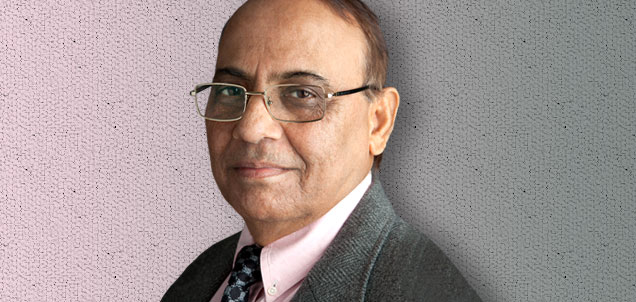
    Benoy Roychowdhury

    At the Board Meeting of The Advertising Standards Council of India (ASCI), Benoy Roychowdhury, Executive Director at HT Media Ltd. and Whole time Director of Hindustan Media Ventures Ltd., was unanimously elected Chairman of the Board of ASCI. As a member of the Board of Governors for four years, he has represented print media and provided active support to Self-Regulation.


    Srinivasan K. Swamy, Chairman and Managing Director, R.K. Swamy BBDO Pvt. Ltd., was elected Vice-Chairman; and Shashidhar Sinha, CEO, Media Brands Pvt. Ltd. was re-appointed the Honorary Treasurer.


    Other members of the Board of Governors are Abanti Sankanarayan (Vice President, CIABC), Al Rajwani (Managing Director & Chief Executive, Procter & Gamble Hygiene and Healthcare Ltd), Arunab Das Sharma (President, Bennett Coleman and Co Ltd), D. Shivakumar (Chairman & CEO, Pepsico India), I Venkat ( Director, Eanadu), Narendra Ambwani (Director, Agrotech Foods Ltd), Paritosh Joshi (Director, Provacateur), Prema Sagar (Vice Chair, Burson-Marsteller, Asia Pacific & Principal/Founder, Genesis Burson-Marsteller), Rajan Anandan (Managing Director, Google India Pvt Ltd), Sameer Singh (Executive Director Personal Care, Hindustan Unilever Ltd), SK Palekar (Management Educationist, S.P. Jain Institute), Subhash Kamath (Managing Partner, BBH Comms India Pvt Ltd) and Sunil Lulla (Chairman & Managing Director, Grey Group).


    Narendra Ambwani, the outgoing chairman of ASCI said “It has been quite an eventful year for ASCI. We had set four key priorities for the year i.e. Collaboration with the regulators, easier consumer access to ASCI services, inculcate self-discipline among creators of advertising and be seen as fair adjudicator by all stakeholders. Not only were we able to deliver on all four priorities; but we also received recognition for all the good work ASCI has been doing. The Department of Consumer Affair (DCA) engaged ASCI as their “Executive Arm” to curb misleading advertisements and has entrusted ASCI to process complaints received on DCA’s portal “Grievances Against Misleading Advertisements (gama.gov.in)”. Recent launch of our mobile app ASCIonline is a major milestone and an example of how technology is helping bridge the gap between ASCI and consumers. The app brought home The Maddies Mobile Bronze Award in the “Social / Not for Profit Mobile App” category.  Launch of E-Learning Program to educate the creators of advertisements and our Mega Event titled “Creativity for Goodness’ Sake” have been our other significant accomplishments.


    The incoming Chairman, Benoy Roychowdhury said, “There has been a remarkable transition in the last couple of years of how newer sectors like e-commerce and media such as digital advertising have changed the game. Over 90% of consumers send in their complaints to ASCI online or via e: mail versus letters or phone calls. ASCI has also evolved to match the pace by significantly improving the efficiency and speed in ASCI’s consumer redressal process. These continuous efforts are now being backed by regulatory agencies such as the Ministry of Information and Broadcasting as well as the DCA, and more and more Government organizations are approaching ASCI to seek help in adjudicating on various complaints related to advertisements. Responsibility for the success of self-regulation rests with every player – Advertisers should advertise with a conscience, media which carry the ads should be more responsible and regulators should back self-regulation by lending their support.”


    During the year 2014-15, the CCC met 47 times and deliberated on complaints against a total of 1877 advertisements. Of these, complaints against 1389 ads were upheld, while 486 were not upheld and 2 were outside ASCI’s purview.   ASCI has been able to achieve close to 90% compliance, which is certainly a healthy figure for a Self-Regulatory Organization.


  • ASCIonline App gets a thumbs-up from consumers

    By A Correspondent


    With a purely organic reach approach, ASCIonline mobile app has garnered good success and has directly seen a boost in the numbers of complaints received. Now complaints through Mobile App are contributing to almost 15 per cent of the total number of complaints received by ASCI. The app has surpassed 1000 downloads within just two months since its launch on 17th June, 2015.


    ASCIonline is India’s first mobile app to facilitate convenient filing of complaints against misleading of advertisements. It is the first time that a Self-Regulatory Organization like ASCI has leveraged the power of technology anywhere in the world, although there are over a 100 bodies in as many countries created to do an identical job as ASCI.


    Speaking on the occasion, Narendra Ambwani, ASCI chairman said “While the web-based online complaint registration system has been functional for over three years, the Mobile App has truly broken the “Reach” barrier. With the dramatic and ever growing increase in Smartphone penetration and its use for various transactions, the Mobile App has been a great enabler for end Consumers. Analysis of complaints received via Mobile App is the real “proof of the pudding”.


    For promoting the Mobile App, ASCI coined the “SnapItandAppIt” tagline as the App allows one to take a picture of the objectionable ad and send it through the App to ASCI. Social Media is being leveraged to create awareness. Prasar Bharati of the Government of India also took note of this Mobile App and actively supported this by tweeting about the app. Even industry stalwarts and twitteratis like Rajan Anandan (MD, Google), SK Swamy (MD, RK Swamy BBDO), Sanjeev Kotnala (Head Catalyst, Intradia), Paritosh Joshi (Director, Provacateur) created a buzz causing a ripple effect.


  • ASCI launches mobile app to curb misleading advertisements

    By A Correspondent


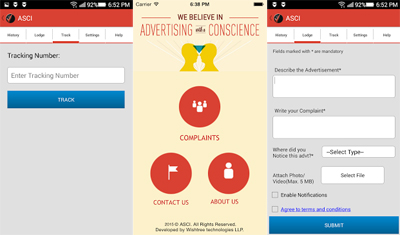
    Continuing with the mission to address misleading advertisements, Advertising Standard Council of India (ASCI) has launched India’s first consumer complaint mobile app – ASCIonline, to provide consumer complaint services on a mobile app besides providing the facility online. The mobile app is currently available on android and iOS platforms.
     

    Speaking on the occasion, Narendra Ambwani, ASCI Chairman added, “One of the goals of ASCI is to provide convenient access for lodging complaint and hence this launch of mobile app. Today mobiles devices are more widely used compared to desktops. With growing use of smart phones consumers want apps to put power of doing transactions in their pocket. ASCIonline Mobile App is consumer friendly and can be freely downloaded. It will be very useful as one can track the status of the complaints which he or she registered on our portal with the help of the App.”


  • ASCI launches e-learning training on responsible advertising

    By A Correspondent


    The Advertising Standard Council of India (ASCI) has launched an online training programme for advertisers and communication professionals at http://ascionline.org/asci-learning.html). It is offered at a nominal price and is available to organizations, educational institutions and individuals. It is powered by e-learning platform e-veda and individuals can enroll in the course for Rs 1000.


    Speaking on the launch,   Narendra Ambwani, Chairman – ASCI said: “It is a proactive approach that would enable the creators of advertising to get their advertisements “Right the first time”. There is a direct and tangible business benefit associated with it, as a trained individual would be able to avoid costly reworks of modifying or pulling down of advertisement by adhering to simple do’s and don’ts set out in the code.”


    ASCI’s e-learning programme will see leading professionals like Piyush Pandey, R Balki, Sam Balsara participating and lending their support to the various modules.


    Users can complete as per their own pace within a six-month window. Each of these modules consists of engaging multimedia content followed by a quiz

    • Introduction to ASCI (1 module)- Advertising Self-regulation and ASCI
    • ASCI advertising Codes (4 modules)- Truthful and honest representation, Non-offensive to public, Against harmful products/situations and Fair in competition
    • ASCI category guidelines (4 modules)- Brand Extension, Food and Beverages, Educational Institutions and Automotive vehicles
    • ASCI processes (4 modules)- Supers, Complaints Registrations and Monitoring, Complaint processing and ASCI Membership


    On successful completion, the user is awarded with a certificate.


  • Consumer Affairs ministry engages with ASCI to curb misleading ads

    By A Correspondent


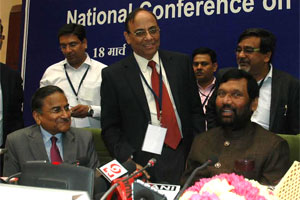
    From L-R Mr. Narendra Ambwani- Chairman, ASCI & Mr. Ram Vilas Paswan- Minister of Consumer Affairs, Food and Public Distribution

    Continuing with the mission to address misleading advertisements and avoid unfair trade practices, Department of Consumer Affairs (DoCA) launched web portal GAMA recently – GAMA being an acronym for “Grievances Against Misleading Advertisements”. The portal was launched by the Minister of Consumer Affairs, Food and Public Distribution Shri Ram Vilas Paswan at the National Conference on Consumer Rights in New Delhi. DoCA has partnered with the Advertising Standard Council of India (ASCI) as an Executive Arm to process the incoming consumer complaints.


    The collaboration will see joint efforts to evaluate and pass strictures against the violators. The six priority sectors that would be covered are:

    – Agriculture and food

    – Health

    – Education

    – Housing

    – Financial services

    – E-commerce


    The complaints will be evaluated across media like print, packaging, internet, outdoor, wall paintings, posters, bill boards, etc.


    The complaints of misleading advertisements received on GAMA portal (gama.gov.in), will be handled in a three level system i.e. first by ASCI, the second level of escalation in case of non-compliance would be by a sub-committee headed by the Joint Secretary DoCA, under Inter Ministerial Monitoring Committee (IMMC) and in the end the concerned regulator will take action in case of persistent offenders. DoCA is also leveraging the network of Grahak Suvidha Kendra to make it easier for consumers in remote areas to complain.


    Commenting on the partnership, Shri G. Gurucharan, Additional Secretary, DoCA added, “The problem of misleading advertisements and the consequent unfair trade practices that arise is widespread – across sectors, mediums and geographies.  DoCA’s partnering with ASCI is an important step in empowering self-regulatory bodies and demonstrating “More Governance – Less Government”.


    Speaking on the occasion, Narendra Ambwani, ASCI Chairman added, “We are very happy to have been entrusted with this responsibility by DoCA. GAMA portal will be very consumer friendly as one can track the status of the complaints which he or she registered on this portal.”


  • Action time at ASCI


    Narendra Ambwani, chairman of advertising self-regulator Advertising Standards Council of India (ASCI), talks to ‘dna of brands’ about the extensive campaign to connect with consumers and educate them on how to file complaints, and seek redress, against ads which make tall claims. Everyone, from local agencies and state governments to the Centre, are now happy to partner with ASCI.


    Although established way back in 1985, would you say that 2014 was a landmark year for the Advertising Standards Council of India (ASCI), given all the activities that were undertaken in its capacity as a self-regulator for advertising?

    We have seen growth in leaps and bounds at ASCI every year, but 2014 was definitely a notable year for the organisation.


    The year started off with ASCI bagging a gold at The European Advertising Standards Alliance (EASA) Global Best Practice Awards for ‘significantly reducing’ average time taken to handle complaints. We were credited with reducing the lead time for processing complaints from an average of 45 days in 2011-12, to 28 days in 2012-13 and just 12 days in 2013-14. Recognising our efforts to curb misleading advertisements, ASCI was also made a key stakeholder in the Inter-Ministerial Monitoring Committee (IMMC) by the Department of Consumer Affairs. Further, during the year, ASCI’s role was strongly appreciated and acknowledged by the Medical Council of India (MCI) for taking action against misleading advertisements by doctors. We were approached by various ministries for a potential partnership to look into this issue. So all in all, last year was indeed a landmark year for ASCI.


    From a government that was, some years ago, questioning the role of ASCI as self-regulator, to one that is collaborating with it, ASCI has a come a long. Your comments?

    Even though ASCI was considered a self-regulating industry body, it has received considerable support from the Ministry of Information and Broadcasting (MIB). A notification dated August 2, 2006, issued under the Cable Television Network Rules, 1994, states that “no advertisement which violates the Code for Self-regulation in advertising, as adopted by the Advertising Standard Council of India, Mumbai, for public exhibition in India, from time to time, shall be carried in the cable service”. After that, ASCI received statutory recognition. The FDA authorities have also been sending us complaints against advertisements violating the Drugs and Magic Remedies Act. Besides this, ASCI is a key stakeholder in the Inter-Ministerial Committee of the MIB, as well as the Inter Ministerial Monitoring Committee of the Department of Consumer Affairs. Efforts at ensuring ethical advertising practices have earned ASCI its credibility, and the confidence of the government of India.


    While policing unethical ads is taking place through ASCI’s Consumer Complaints Council (CCC), there is still a view that by the time any penal action is taken, the damage is already done. Is this correct?

    ASCI has to provide due process for the advertiser, whose advertisement has been complained against, to respond to the allegations. Providing adequate time for the advertiser to respond, is mandated by law. However, ASCI has recently instituted three new initiatives to speed up the CCC decision process. One is to have the CCC meet four times a month instead of once, so that decision-making takes places within 12 days on an average (as opposed to a month or 45 days previously). And two, starting the Fast Track Intra-Industry complaint (FTCC) redress process, where decisions regarding complaints from one member advertiser against the advertisement of another, are taken within seven working days. Since March 15, 2013, ASCI has initiated the Suspension Pending Investigation (SPI) process. According to this, ASCI can, ex-parte, ask an advertiser to suspend an advertisement, pending final decision by the CCC if, prima facie, it is seen to cause harm or hurt to consumers and the society in general.


    If one feels an ad is making unrealistic claims and complains to ASCI, in how much time can one expect a response?

    In the past few years, ASCI has made significant changes in the complaints processing system. Thanks to electronic communication, weekly meetings of the Consumer Complaints Council and the Online Complaint Monitoring Services, the average lead time to take a decision on a complaint is 12 working days from the date a “complete” complaint was received. This includes full details of the print advertisement, the name and date of publication, and clippings or a copy of the print advertisement. In case of a TVC airing, we require the name of the channel, the date and time of the broadcast; a reasonable description of the clip, specific claims or visual depictions which are considered to be false, misleading or objectionable, and the reasons for the same.


    Would you recommend a Censor Board-like pre-release certification for ads, just as it exists for films?

    Throughout the country, there are a large number of advertisements being released every year. Under our National Advertisement Monitoring Service (NAMS) initiative, we scan at least 45,000 print ads and 1,500 TVCs every month. It is impossible to create a mechanism and run an efficient system to pre-approve every advertisement which is released in the country. No system would be able to cope with such a large number. So we as an organisation, from inception, have been promoting the concept of “self-regulation in advertising content”, and truly believe in this best practice which is being implemented all over the world.


    There are several advertisers who release ads directly through specific media, like mailers or SMS blasts. How do you check these, especially if the publication is not an ASCI member?

    Ever since the launch of our Online Complaint and Monitoring Service (OCMS), we have received complaints against misleading advertisements across all media. While complaints relating to mailers and SMSes comprise a small percentage, they are increasing year on year. Currently, we are monitoring print and TV advertisements via NAMS. However, we do have plans to also track digital media. The processing of complaints is uniform across advertisers, regardless of whether they are an ASCI member or not.


    Your Clean Ad Campaign seemed to have been quite a hit. Tell us more about it. Are you going to make it an ongoing exercise?

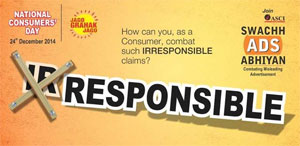
    We launched the ‘Swachh Ads Abhiyan’ to mark National Consumers’ Day on December 24, 2014, and made a splash about it on social media (Facebook, Twitter, LinkedIn and YouTube). Since it resonated with the Swachh Bharat campaign, it created a great amount of media buzz. The aim of the campaign was to increase awareness about false claims [made by advertisers] and combat misleading advertisements to safeguard consumer interests.


    We engaged with consumers through our virtual platforms, and this drove consumer attention towards the campaign, educating them about not to be misled through advertisements, and the importance of taking action by lodging an online complaint. We believe this initiative has empowered and encouraged consumers to make the right choices, when it comes to advertisement claims.


    The campaign was conducted through videos that lent clarity to misleading claims and invited interaction from consumers culminating with a call for action to lodge a complaint online. This resulted in 150% more people engagement and the message reached more than 2.5 lakh consumers. It also resulted in tangible change that was sustained by the social media thrust. For instance, the number of online complaints increased by 166%.


    What’s next at ASCI? What are the other activities you propose to take up?

    Our priorities for the year have been chalked out as self-discipline by creators of advertising, easier access to ASCI services, collaboration with regulators and we are keen on being viewed as fair by all stakeholders. Our major focus, therefore, would be on activities enabling these goals. We are going to launch, shortly, an online training programme called the ASCI e-learning. We have plans to further increase awareness and accessibility regarding ASCI. As mentioned earlier, in terms of collaboration with the regulator, we are in talks with the Department of Consumer Affairs and the FSSAI.


  • ASCI unveils ‘Swachh Ads Abhiyan’ on National Consumers Day

    By A Correspondent


    Observing  National Consumer’s Day on December 24, the Advertising Standard Council of India (ASCI) launched a ‘Swachh Ads Abhiyan’ campaign with the purpose of combating misleading ads. This follows the government’s Department of Consumers Affairs asking ASCI to come up with an initiative to create awareness amongst consumers to action for misleading content. The campaign was initiated across various social platforms like Facebook, Twitter, LinkedIn and YouTube.


    Said Narendra Ambwani, Chairman, of the advertising self-regulator: “It’s really important that consumers don’t blindly believe in advertisements and understand unethical and misleading claims. ASCI engaged with consumers through social media activities on Twitter, Facebook LinkedIn and YouTube which have massively driven consumer attention towards the campaign. We hope this initiative from ASCI will empower and encourage consumers to make the right decisions.”


    Added Sucheta Dalal – ASCI’s Consumer Complaints Council Member: “As a member of the consumer complaints committee (CCC) I have seen the big leap in ASCI’s effort to track misleading advertisements across different media and languages on a nationwide basis. ASCI has also made it easy to file and track complaints online or engage with it through social media. All we need now is better consumer awareness and action by concerned citizens to keep ASCI on its toes by filing complaints and making themselves heard on the evolving issue of misleading advertisements”.


  • DoCA partners with ASCI to halt violators of misleading ads

    By A Correspondent


    Strengthening its mission towards self-regulation in advertising, Department of Consumer Affairs (DoCA), of the Ministry of Consumer Affairs, Food & Public Distribution has officially partnered with Advertising Standard Council of India (ASCI) to augment the efforts on stopping misleading advertisements. The collaboration will see joint efforts to evaluate and pass strictures against the violators. The six priority sectors that would be covered are:


    ::  Agriculture and food

    :: Health

    :: Education

    :: Housing

    :: Financial services

    :: E-commerce


    DoCA will redirect the complaints received by it to ASCI to avoid duplication of processing of complaints against advertisements that is already under process by ASCI. The complaints will be evaluated across media like print, packaging, internet, outdoor, wall paintings, posters, bill boards, etc.


    Commenting on the partnership, G. Gurucharan, Additional Secretary, DoCA added, “The problem of misleading advertisements and the consequent unfair trade practices that arise is widespread – across sectors, mediums and geographies. DoCA’s effort is to build a coalition of stakeholders to combat this menace – partnering with ASCI is an important step”.


    Narendra Ambwani, ASCI Chairman added, “It’s a moment of pride for ASCI to have received such support from DoCA. Earlier our work has been recognized by various government bodies like Ministry of Information and Broadcasting (MIB), Medical Council of India (MCI) etc. It’s highly motivating to see such developments and this partnership has widened ASCI’s scope for complaints.”


    While the operational aspects of this collaboration between DoCA and ASCI is being worked upon, DoCA has requested ASCI to flag off  advertisements that are in clear violation of the law (e.g. claims regarding cure of diseases such as diabetes, cancer, sexual impotence, leucoderma (white spots), paralysis etc. covered under the Drugs and Magic Remedies Act. This would enable prompt action against such non-scrupulous advertisers and protect consumer interest.


    This partnership will go a long way in ensuring that all ads released in the country are honest, decent, safe and fair to competition.