Tag: Namo

  • Ranjona Banerji: Election of the Trivial & Telegenic


    By Ranjona Banerji


    If this general election is indeed a watershed moment for Indian polity then it is no less a groundbreaker for the Indian media. Television has dominated this election practically setting agendas and leading the battle from the frontlines when it comes to chosen candidates and parties. The battle is won by the trivial and the telegenic. The smaller India grows in terms of communication thanks to telephony and technology, the larger the disconnect from reality: or so it appears.


    If the media is going to play such a significant role from here on, then the elements within the media must come out and identify themselves by their ideological and philosophical bearings. The old argument used by journals that they are all things to all people cannot stand any longer. It is in many cases patently untrue. Further, it has reached a stage where you are taking readers for a ride.


    Television has no such argument at all and instead has created an atmosphere of rumours, allegations and gossip to thrive. Even within the media fraternity, there is a constant stream of stories about which channel has been sold to which political party or who favours which candidate. Some parties are barely being mentioned when it is evident that they will have some bearing on these elections. Thrown a few corporate houses into the mix and you have a great Indian muddle which barely resembles a delicious homemade khichdi.


    Who has financed all these opinion polls to project election results for instance? What is the consumer of news to make of them when ground reports from journalists are at odds with those surveys? In a two-month long voting schedule, a constant stream of opinion polls amounts in fact to trying to influence those who have not yet voted, even if the Election Commission has not cottoned on to it yet. The figures for conducting these polls which are going round the grapevine are astronomical.


    It is time therefore for all newspapers, news channels and websites to declare their political leanings. There is no shame in this. All over the world, the reader and viewer knows what their chosen media outlet stands for. This is not just about individual columnists to declare their leanings. This is about the organisation itself. Given the growth of the influence of the media – and these are strong words – to fool your consumer any more is tantamount to fraud.


    It is evident that it is not just a nudge from one corporate house and a wink from another that dictates media flow. We have seen epic and sudden changes of direction from left to right to centre and back. What most newspapers do to cover this up is provide a variety of columnists on their opinion pages to portray first one point of view and then another to prove that they are “neutral”. It no longer cuts it.


    TV of course is another jungle with its own rules, quite distinct in some cases from print. Editorialising and on the spot opinion-making is now par for the course. As a very senior editor who has a career in both print and television pointed out to me, if a star anchor, who is also the editor, asks a young reporter on live television, “Isn’t the political rally proving what I say?”, what is the young reporter to do? Disagreeing with the boss is not an option. And so news is created, not reported.


    For a long time in India, journalists were more left of centre than right but that was not an absolute truth. For instance Girilal Jain, a colossus in the Times of India was distinctly right of centre and the Indian Express was distinctly anti-establishment in the days when the only establishment was Congress.


    One must distinguish between the need for media outlets to declare their politics and the accusations and muck thrown at individuals on social media. Gutter language and threats will continue. But now the target will be clear and much larger. And in the interests of fairness, everyone will have a target!
     

  • Etailers make hay with poll merchandise

    By Harsimran Julka


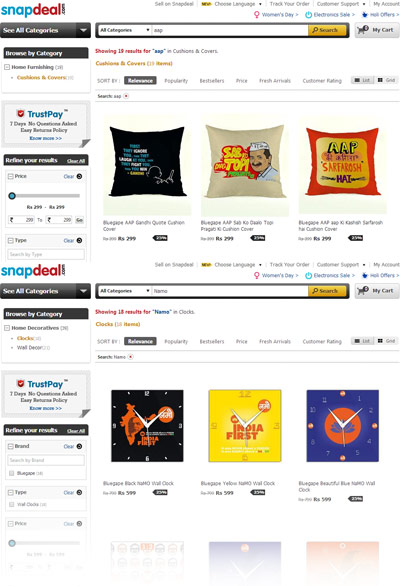
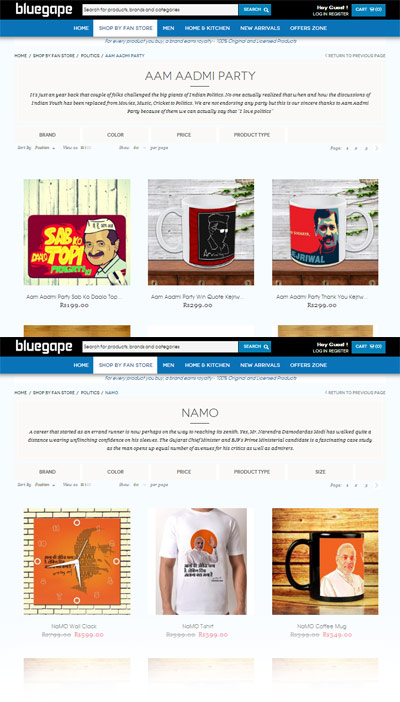
    Several online retailers are cashing in on election fervour by selling a wide variety of political merchandise , helped along by the willingness of citizens to flaunt their political affiliations.


    They are hawking a range of personal accessories, home décor and utility items that are branded with images and logos of mainline political parties which will fight it out for the affection of voters this summer.


    “We just launched our political merchandise category three months ago and are already seeing 30% of daily orders coming from this category,” said Sahil Baghla, founder of merchandise portal BlueGape, who started the business in 2011 while still studying at the Indian Institute of Technology in Kanpur.


    “We capture the political messaging of a party and present in a glamorous fashion on a product just like we would do for a Bollywood movie star. It appeals to the youth instantly,” said Mr Baghla, 22, who raised Rs 1.5 crore for his venture last year.


    Online marketplace Snapdeal that first launched the ‘NaMo’ brand of phones aimed at followers of the Bharatiya Janata Party’s prime ministerial candidate, Narendra Modi, now offers merchandise for followers of the Aam Aadmi Party which include wall clocks and covers for phones and tablets. For BlueGape, customers for Aam Aadmi Party’s caps and T-shirts come mostly from Delhi and Bangalore.


    Narendra Modi brand of mugs, shirts and clocks are popular amongst customers from Andhra Pradesh and Maharashtra. He added that products with Congress’ development theme or Rahul Gandhi as its ambassador are selling less, due to lack of a strong theme.
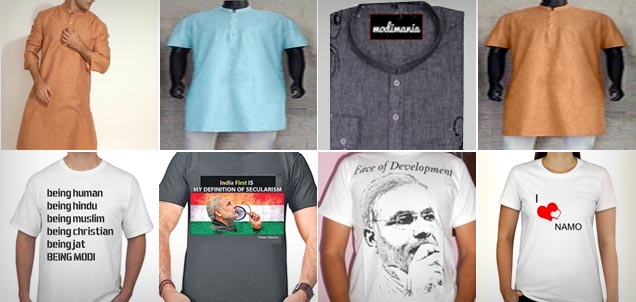

     

    “Other political parties such as Samajwadi have mixed messaging which makes it difficult to make a merchandise around a theme for them,” said Baghla, who is aiming for 5,000 orders per day by end of this year. Entrepreneurs said the increase in social media usage is leading to greater willingness amongst people to flaunt their political leanings, a dramatic shift from the reticence evident during even the previous general election in 2009.


    Tony Navin, vice president overseeing business development at Snapdeal, which raised $138 million from eBay last month, said sales of political merchandise have increased fourfold since last month. He said most customers for such merchandise are from tier 2 and tier 3 towns and cities, with an average age of 25- 40 years.


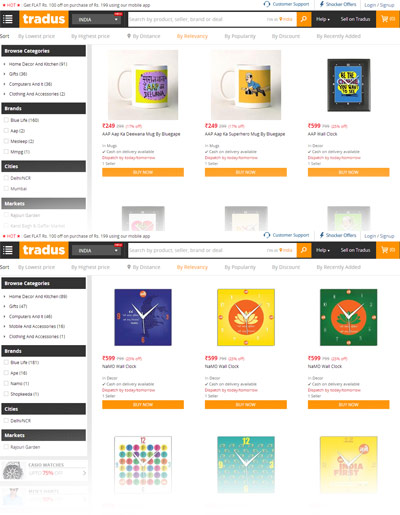
    The trigger for selling political merchandise peaked in January, when sellers on location-based marketplace Tradus started retailing Aam Aadmi Jhadus (brooms) for Rs 5 each.


    “The launch was an instant hit and we sold 2,000 brooms within two hours. Over three days, after the win of AAP in Delhi, about 6,000 brooms got sold on the platform,” said Mudit Khosla, CEO at Tradus, an online marketplace owned by South Africa’s Ibibo Group. With the maturing of Indian democracy, youth are now more open to flaunting their political affiliations, said Saurabh Kochar, founder of online portal Print-Venue , which is backed by German incubator Rocket Internet.


    “We are seeing demand even from individuals who are ordering shirts, caps and even decorative pieces for personal use and to gift to their party donors and members,” said Kochar, a graduate of IIT-Roorkee, who started the online portal in 2012. He is seeking ideas for design of such merchandise.


    Although this business is seasonal, entrepreneurs believe that with India’s large electorate of 81 crore voters, and heightened political activity, it will provide a strong stream of revenue. About 2.3 crore Indians are first-time voters, many of whom are hooked on to social media and will reach out for merchandise that proclaims their loyalties. “The youth now want to speak out about their identity,” said Mr Baghla of Bluegape.


    Source:The Economic Times

    Copyright © 2014, Bennett, Coleman & Co. Ltd. All Rights Reserved

    Licensed to republish


  • The Making of Brand ‘Namo’

    Kurtas and t-shirts like these on Modimania.com are among the many products riding the Narendra Modi popularity wave


    By Rasul Bailay


    An Ahmedabad-based company has filed to trademark Namo, the acronym by which Gujarat chief minister and BJP prime ministerial candidate Narendra Modi is becoming widely known around the country.


    Take India Beyond Merchandising has filed dozens of applications on various versions of the name in Hindi and English. These include Namo, Namo Lekh, Namo and a sketch of a lion with the tagline – The Lion of India, Namo Mantra – Taking India Beyond and Namo Mantra – The Turning Point.


    The applications have been filed in various trademark classes including beer mugs, paper towels, lunch boxes, bed linen, dairy products, soft drinks, potato chips and others.


    Ketan Amichand Vora, one of the two promoters of Take India Beyond Merchandising, said the company has filed for the trademarks in order to leverage brand Namo.


    In the coming months, the company plans to launch Namo-branded merchandise, toys, colour paints for children, etc, he said.


    People close to Modi have been planning to start Namo-branded stores nationwide to sell various products including the distinctive kurtas that Modi wears, books, candles, incense sticks and various products as part of the effort to drum up support for the candidate in national elections next year.


    One person close to the Namo retail push said the group behind Take India Beyond is the same as that’s associated with the retail venture. They said the retail rollout was on hold as Delhi, Rajasthan, Chattisgarh and Madhya Pradesh were in the process of holding state elections. With these having got over, the plan will now proceed, they said. The venture is in talks with malls in cities including Delhi and Ahmedabad for taking on retail space, they said.


    The applications were filed in September and most of them are currently being processed at the trademark office.


    However, some applications may be contested by others who have already filed to trademark the name under various categories before the Namo brand became famous in the last year or so.


    For example, Gun Sagar Jain has been using the Namo brand since 2000 and has also registered it for the distribution and wholesale retailing of hosiery garments. Namo India Developments applied in September 2012 to trademark the name under building construction, repair and installation services. That application has been challenged, according to the website of India’s Controller General of Patents, Designs and Trademarks.


    Take India Beyond Merchandising is the latest in a string of companies trying to capitalise on the aura of the BJP leader. In the recent past, sari merchants in Surat to hosiery makers in Ludhiana have introduced Namo-branded products hoping to make a quick buck. Market watchers estimate the overall product and merchandising market growing around the BJP leader to be around .’400-500 crore. That’s why Modi’s followers are preparing for a nationwide retail push to sell their own Namobranded products including apparel and general merchandise.


    This initiative comes with two aims – to build on the buzz around Modi and to fuel it further by creating lifestyle products that add to the appeal of the leader. Political analysts say it’s part of the Modi’s well-oiled PR machinery to strengthen his base in the run-up to the general elections next year.


    Santosh Desai

    Some marketing experts are skeptical about a retail campaign bearing fruit. “Namo is a brand no doubt but using the brand to make t-shirts and soaps is another matter altogether,” said Santosh Desai, CEO of Future Brands.


    Source:The Economic Times

    Copyright © 2013, Bennett, Coleman & Co. Ltd. All Rights Reserved

    Licensed to republish