Tag: N Ram

  • Navaneeth L V to take over from Rajiv Lochan as Hindu CEO

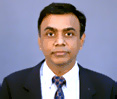
    Navaneeth L V

    By A Correspondent


    THG Publishing Private Ltd, the publishers of The Hindu and other group publications, has announced the appointment of LV Navaneeth as the new Chief Executive Officer of the Company from June 1 on completion of the term of the CEO and Managing Director, Rajiv C. Lochan, who has decided to move on.


    According to a statement issued by company Chairman N Ram: “The Board of Directors records its appreciation of Mr Lochan’s excellent contributions to the newspaper organisation and wishes him the very best,” adding: “For Mr Navaneeth, this represents a homecoming: he served this organisation between 1998 and 2006 in a senior position in Advertising and Marketing. Going on to get a diverse media experience in radio, television, media planning and buying, and digital advertising, he brings with him expertise and hands-on experience to play an effective leadership role in the Company in the face of far-reaching changes and challenges in the media landscape and in an increasingly interconnected digital ecosystem.”


    Navaneeth started work with HCL and took a two-year break to do a two-year course at MICA, Ahmedabad. He then joined The Hindu where he was General Manager – Advertising and Marketing. After an eight-year stint there, he moved to Radio One as Station Director and Head of Programming. A three-year stint there, he moved to Sun TV as Vice President – Programming where he spent six years. He later moved to Indonesia as Leader – Trading for Mindshare there.


  • N Ram, Kuldip Nayyar & 20 others presented Press Club Mumbai RedInk Awards

    By A Correspondent


    The Press Club Mumbai’s RedInk Awards 2013 for excellence in journalism were presented on Saturday, May 25 at the NCPA’s Tata Theatre. RedInk trophy and prize money of Rs 1 lakh in each category were awarded to the winners and runners-up.


    Maharashtra Governor K Sankaranarayanan conferred the RedInk Life Time Achievement Awards upon veteran journalists  Kuldip Nayar and N Ram. The award for Mr Nayar was received by his wife Bharti Nayyar. Broadcaster Star India won the RedInk Awards for Excellence in Journalism for its issue-based reality show ‘Satyamev Jayate‘.


    Manish Tewari, Union minister for Information and Broadcasting was the guest of honour for the event. The scintillating awards evening regaled the 600-plus audience with an inward looking debate on the profession of journalism, titled ‘Keeping Media Free & Fair’ hosted by Times Now Editor-in-Chief Arnab Goswami, with media veterans N Ram and Uday Shankar (the Star India CEO was a former journalist) and Mr Tewari.


    During this occasion, Manish Tewari called for a robust self regulation regime for media organisations in the country.  “Content regulation in the media space is not going to come out of political executive, but will come out of the judicial process. Make self-regulation more inclusive and robust to keep out judicial intervention.”  “With exponential growth in the media space, a paradigm shift has taken place, wherein regulations have to keep pace with changing technologies and have to be universal,” Mr Tewari said.


    Mr Sankaranarayanan had the audience in splits as he spoke beyond his prepared speech. “During the last few years, the media has brought out scores of cases of corruption and wrongdoings by public servants and officials. They have also exposed wrongdoings by private organizations and individuals”.


    REDINK 2013 WINNERS
    Category Rank Name Publication
    Sports Winner Aditya Iyer The Indian Express
    Runner-Up Akshay Sawai Open
    Health & Environment Joint Winner Santosh Andhale DNA
    Joint Winner Vinod Kumar Menon Mid-Day
    Runner-Up Reji Joseph Deepika Daily, Kerala
    Television Story Joint Runner-Up Manu Kumar Manorama News
    Joint Runner-Up Brajesh Rajput ABP News
    Science & Innovation Winner Priyanka Pulla Open
    Runner-Up Mohan Sundara Rajan The Hindu
    Picture of the Year Winner Raju Shinde Mumbai Mirror
    Runner-Up Atul Kamble Mid-Day
    Entertainment & Media Winner Samanth Subramaniam Caravan
    Runner-Up Rekha Dixit The Week
    Politics Joint Winner Samanth Subramanian Caravan
    Joint Winner Nauzer Bharucha The Times of India
    Runner-Up Aman Sethi The Hindu
    Business Winner Joe C Mathew BusinessWorld
    Runner-Up Khyati Dharamsi The Economic Times
    Crime Winner Priyanka Dubey Tehelka
    Runner-Up Ratnadip Chowdhary Tehelka

    List courtesy: Press Club, Mumbai


  • Press Club Mumbai to honour Kuldip Nayar and N Ram with Lifetime Achievement Awards

    By A Correspondent


    The Press Club Mumbai has announced it will honour veteran journalists Kuldip Nayar and N.Ram with the RedInk Lifetime Achievement Awards for 2013 for a career dedicated to good journalism. The awards will be handed over by the Governor of Maharashtra, K Sankaranarayanan, on Saturday, May 25, at the Tata Theatre in Mumbai. More than 20 other journalists will receive awards in various categories for excellence in journalism at the Awards event.


    The Lifetime Achievement Awards were selected by the managing committee of the Press Club based on a survey of leading and senior journalists from across the country.


    “It’s a privilege to honour such distinguished journalists at the RedInk 2013 Awards. Their contribution to the media and professional achievements speak volumes and serve as motivations to us all. We are pleased to felicitate such inspirational personalities,” said Gurbir Singh, President, The Press Club, Mumbai.


    This year, The RedInk Awards received over 900 entries from journalists all across India. Winners have been chosen in nine competitive categories including Sports, Media & Entertainment, Health & Environment, Crime, Business, Politics, Television Story, Science & Innovation and PhotoJournalism. Some of the eminent judges included Ravi Shastri, Rahul Bose, Kumar Ketkar, Pritish Nandy, Minhaz Merchant, Shirish Inamdar, Hussain Zaidi, Khalid Mohammad and Colvyn Harris. The media partners of the event are Star India, Podar Enterprise, Glenmark Pharmaceuticals Ltd., Eros International, Yes Bank, Magarpatta City, and Zee Entertainment.


  • RIP, G Kasturi, Editor, The Hindu (1965-91)

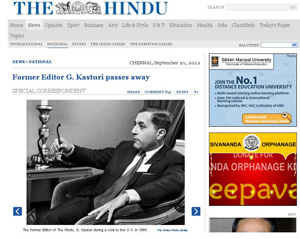
    Screengrab of The Hindu report announcing the passing away of G Kasturi

    By A Correspondent


    Mr G Kasturi, veteran journalist and Editor of The Hindu from 1965 to 1991 passed away last Friday (September 21). He was 87.


    Reports The Hindu: “The end came peacefully at 2 a.m. on September 21. He had been unwell for some time, but was alert and active till the last. The cremation took place on Friday afternoon at the Mylapore crematorium. He is survived by his wife of 64 years, Kamala, sons K. Balaji and K. Venugopal, daughter Lakshmi Srinath, and five granddaughters and two great-grandchildren.”


    Links to coverage on Mr G Kasturi:

    Report in The Hindu and former Editor-in-Chief N Ram’s comment:

    http://www.thehindu.com/news/national/former-editor-g-kasturi-passes-away/article3919690.ece


    Photo feature in The Hindu

    http://www.thehindu.com/news/national/a-photo-feature-on-g-kasturi/article3919952.ece?homepage=true&ref=slideshow


    Links to various tributes in The Hindu

    http://www.thehindu.com/system/topicRoot/G__KASTURI__1924-2012_/


    Mahesh Vijapurkar on G Kasturi in Firstpost

    http://www.firstpost.com/india/what-made-g-kasturi-different-from-other-editors-464693.html


    Sans serif: Hindu’s longest serving editor G. Kasturi: RIP

    Hindu’s longest serving editor G. Kasturi: RIP


  • @FF12: Day 3: Industry expects thoughts to lead to pertinent actions

    By A Correspondent


    The last day of FICCI Frames 2012 was an eventful day — insightful sessions, a lot of networking, sharing of ideas, deals being cracked — and amongst all of this, the highlight was the session on Women in Media and Entertainment.


    The day started off with a keynote presentation by Ashok Chawla, Chairman, Competition Commission of India (CCI). He said that the media and entertainment (M&E) industry was one of the fastest growing sectors inIndiawith an expected CAGR of 14-15 per cent. He then proceeded to outline the role of the CCI and its importance: “CCI is an overall market regulator whose objective is to ensure that market forces operate with transparency and fair play. It has been put in place to identify the boundaries of behaviour of the industry.


    Mr Chawla opined that self-regulation was of prime importance to avoid infringement of law or market practices and cautioned industry players that consumers should be given primary importance.


    Taking on the Digital threat

    The next session was on “Sustaining Long-term Newspaper Loyalty” by two biggies — N Ram, former Editor-in-Chief, The Hindu and Girish Agarwal, Director, Dainik Bhaskar Group, who shared their views on the future prospects of the newspaper industry.


    Mr N Ram started off his speech by stating that there was ‘anxiety and gloom’ over the fact that journalism was seeing a meltdown in the mature markets. He outlined two media world phenomenon next, where the less developed countries are witnessing increase in circulation of newspapers unlike the mature market. But he added a word of caution when he said that TV, even in the developing world, is going through a crisis which it has so far covered by showing entertainment as part of news. Inspite of this, Mr Ram was optimistic that the medium term prospects for the media industry are looking good.


    As is been spoken widely about, the key factor for the decline in the newspaper is the increasing popularity of the digital media. Mr Ram called this the Digital Age Paradox and added that in recent times the newspapers have seen an increase in the readership of their online editions but have witnessed a “double squeeze” on their revenue, as they have had to subsidise digital journalism, which in turn is cannibalising their circulation.


    On how to sustain loyal readers, he tipped, “Stick to the basic principles of journalism – they can build a relationship with the readers, which it can rent out to the advertisers. And most important – “newspapering” should not be reduced to consumer marketing of news.”


    Mr Girish Agarwal took the stage next. Contrary to Mr Ram’s belief, he said that Indian newspapers are growing in their circulation and readership. He spoke about the need to engage the ‘consumer’ by asking “How relevant are we (newspapers) to the reader?”


    He opined that a newspaper cannot rest on its past glory but should move ahead by acknowledging and understanding what the consumer wants and giving him what they think he needs. On how to keep pace with changing times, Mr Agarwal said that newspapers should have global vision and hyper local content.


    After the speeches the floor was opened to the audience who questioned Mr Ram and Mr Agarwal about threat perception of the culture of medianet and media houses being bought over by MNCs. Mr Ram denounced paid news as a rogue practice which has been rubbished by the Press Council. Mr Agarwal said that ethically media should report anything that may be perceived as defaming by the parent company but the ground reality is not always so rosy.


    Women to the fore

    A big highlight of Day 3 was a session titled   ‘Women in Media & Entertainment circa 2012: Leading from the front’.

    The panel members of this session were Vidya Balan, Actor; Anurradha Prasad, Managing Director, BAG Films; Jeni Tosi, CEO, Film Victoria; Ekta Kapoor, Creative Director, Balaji Telefilms; Barkha Dutt, Group Managing Editor, NDTV; and Usha Uthup, Singer. The session was moderated by Rajeev Masand, Entertainment Editor, CNN-IBN.


    This session discussed the journey of each of the above eminent women personalities and the challenges they faced during their journey. As the moderator, Rajeev Masand put it: “Traditional media, for long, was dominated by men, but not any longer. It’s become outdated.”


    All the eminent women personalities claimed that despite all their challenges they had an incredible journey and the results have been fruitful.  Ms Tosi observed that there would always be obstacles in a woman’s journey but, at the same she also admitted that at times a little bit of luck and timing also plays a part in one’s success nevertheless, she must also be hard working and committed to succeed.

    According to Ms Dutt, the real heroes are the women who came before them i.e. those who made a mark and their presence felt in the male dominated industry.


    One of the topics discussed at the session was whether ambition for men meant one thing and another for women, and how society reacts to ambitious women. Ms Ekta Kapoor agreed that ambition for men is a virtue, but for women it is seen as something negative. “I never took being a woman as a disadvantage. Today I am successful not in spite of being a woman but, because I am a woman,” she added.


    Ms Prasad said: “Today women have become mature, and so have their families. Women have to juggle multiple roles. Had I thought that since I am a woman, I cannot take on a task, then I would not have been successful. If you are happy with what you are doing, you will be successful in life.”


    Ms Uthup was of the view that what has really changed is the audience. “The field of Arts has been a level playing field for women. You really don’t have gender bias. I believe if we want change to take place, the people need to be awakened. Men and women must work together, but then there are things that women can do and men can’t and there are things men can and women can’t do.”


    Ms Balan said: “The Indian actress today has been humanized; she is getting to play a part in the story. I have never seen my gender as a disadvantage, all I knew was I had to be strong to move ahead in life. There is a wide variety of roles for women today and the fact that there is no model code for women any more is liberating.”


    While all these eminent women had plenty of inspiring stories to share, each of them have had to overcome their own tough challenges, change the societal mindset about women being weak and docile, to climb their way to the top.


    The road is set for 2013


    In a session which ran parallel to the one on Women in M&E, a panel of regional TV experts got together to discuss growth avenues. Moderated by Nachiket Pantvaidya, Executive Vice-President, Star Pravah and with speakers like K Madhavan, Managing Director, Asianet and Sharada Sunder, EVP – Regional Channels, Zee, the session concluded that “Regional was the new National.” One issue which was discussed in the session was how to attract talent and also how does regional broadcast channels attract youth, the single largest segment inIndia.


    A session on GEC regulation discussed dos and don’ts as far as content is concerned, what is permissible and what not. It included Justice AP Shah, Prof Jonathan Askin, Ashok Nambissan of Sony Entertainment Television and Naresh Chahal of IBF.


    The general feedback from delegates was that Frames 2012 had pertinent topics discussed. One hopes that industry put the many ideas and resolutions discussed to action.

     

  • @FF12: How relevant is newspaper content to the reader?

    By Archita Wagle


    N Ram, former Editor-in-Chief, The Hindu, opened his keynote address by stating that there is ‘anxiety and gloom’ over the fact that journalism is in ‘meltdown’.


    Speaking on ‘Building Deeper Reader Engagement- Sustaining Long Term Newspaper Loyalty over Regions’, Mr Ram said that news media is in crisis in the mature markets, due to which there has been a decrease in the circulation and readership of newspapers. But the fact to be noted was that the decline started in mature markets like theUSeven before advent of the Internet. He added that even the broadcast media, ‘the dominant player’, has also seen a sharp decline.


    Mr Ram outlined Two Media World Phenomenon next, where the less developed countries are witnessing increase in circulation of newspapers unlike the mature market. He illustrated his point with the example of the regional, especially the Hindi, newspapers which have seen increase in their circulation. But he added a word of caution when he said that TV, even in the developing world is going through a crisis which it has so far covered by showing entertainment as part of news. Inspite of this, Mr Ram was optimistic that the medium term prospects for the media industry are looking good.


    The key factor for the decline in the newspaper is the increasing popularity of the digital media. Mr Ram called this the Digital Age Paradox and added that in recent times the newspapers have seen an increase in the readership of their online editions. But he added that the recent paid content model will impact the readership in a big way.


    Mr Ram opined that the paid content model will not replace the old revenue model of the newspapers any time soon as a lion’s share of the revenue earned goes to the search engines like Google and content providers like iPad apps.


    He added that the paid content model has put a “double squeeze” on the newspapers’ revenue, as they have to subsidise digital journalism, which in turn is cannibalizing their circulation.


    Mr Ram was optimistic about Indian newspapers surviving the challenge of the Internet as he believed that India has a “new kind of advantage” due to its fact the media here is still growing at the time when it is faced by the Internet challenge. But he said that the media can’t afford to be complacent about the time before it faces ‘a mature market-like situation’, estimating that the newspapers have around 3-7 years before the negative trends overtake us.


    After taking the audience through a detailed study of the challenges being faced by the newspapers, Mr Ram turned his attention towards how the newspapers can engage the readers to sustain their loyalty.


    Mr Ram said that readers today have real time access to information and could check out the information that was provided by the newspapers. He was of the opinion that if the newspapers stuck to the basic principles of journalism – context, accuracy, perspective, fact checking and verification – they can build a relationship with the readers, which it can rent out to the advertisers. But he was emphatic that “newspapering” must not be reduced to consumer marketing of news.


    He advised the newspapers not to target “attractive demographics” which help in getting revenues, but to provide news for all sections. He said “trust is the key to good journalism”. He asked the newspapers to be clear about their identity, core values and focus on where they want to go and cautioned them against imitating anybody else.


    He said that the readers today want shorter articles and more analyses and editorial content and views, especially in the digital viewing context. But he expressly warned against “editorialising in the guise of news”.


    He concluded his address by stressing the importance of having an internal mechanism for correction of the mistakes that ran independent of the editorial and the advertisers which will help the newspapers to do the right thing.


    Director of the Dainik Bhaskar Group Mr Girish Agarwal took the stage next for a short but relevant address. He started off by stating that he agreed with Mr Ram about maintaining the standards and fundamentals of journalism but begged to differ from him by stating that Indian newspapers are growing in their circulation and readership.


    He said that India had a huge advantage in terms of number due to the gap between those who can read and those who actually read a newspaper.He spo


    ke about the need to engage the reader by asking “How relevant are we (newspapers) to the reader?” He said the need for an intellectual organisation like newspaper is external understanding and internal adaptation. He opined that a newspaper cannot rest on its past glory but should move ahead by acknowledging and understanding what the consumer wants and giving him what they think he needs.


    He also differed from Mr Ram when he empathetically suggested that newspapers need to be simplified and adapt themselves to the readers’ requirements. He ended by saying that newspapers should have global vision and hyper local content.


    After the speeches the floor was opened to the audience who questioned Mr Ram and Mr Agarwal about threat perception of the culture of medianet and media houses being bought over by MNCs


    Mr Ram denounced paid news as a rogue practice which has been rubbished by the Press Council and Mr Agarwal added that since only one company had this practice it was not fair to generalise about the industry. Mr Agarwal said that ethically media should report anything that may be perceived as defaming by the parent company but the ground reality is not always so rosy.


  • Arun Anant will be CEO, Hindu from Feb 6

    By Tuhina Anand


    It is learnt from sources close to the development that Mr Arun Anant is all set to join Kasturi & Sons Ltd as its Chief Executive Officer. He is slated to join on February 6, 2012 and will be responsible for all the non-editorial operations of the company.


    Mr Anant’s appointment comes following the recent development of Mr N Ram, the Editor-in-Chief and Publisher of The Hindu, Business Line, Frontline, and Sportstar stepping down thus paving way for restructuring at the senior level. Mr Ram had mentioned the appointment of a new CEO very soon.


    Mr. Anant, a B. Tech from BHU and a Post-Graduate in Management from IIM Ahmadabad, has earlier worked with The Economic Times and was the CEO of UTVi (now Bloomberg UTV). After moving from UTVi, he has set a management consulting firm called Inc Value. He has also worked on the agency side at Lowe where he was the GM Strategy.


    Also read

    N Ram to call it a day at Hindu

    http://www.mxmindia.com/2012/01/n-ram-to-call-it-a-day-at-hindu/


    Don’t be complacent: N Ram’s goodbye letter

    http://www.mxmindia.com/2012/01/dont-be-complacent-n-rams-goodbye-letter/


    Photograph: incvalue.com

  • Don’t be complacent: N Ram’s goodbye letter

    By Tuhina Anand


    On his last day as the Editor-in-Chief and Publisher of The Hindu, Business Line, Frontline, and Sportstar, N Ram bid his colleagues farewell and exhorted them to seize the opportunities of the media world and face the challenges of the tough business environment the media faces today.


    Mr Ram’s mail states that Siddharth Varadarajan, D Sampathkumar, R Vijayasankar, and Nirmal Shekhar, all Editors, will take over, with effect from January 19, 2012, as Editors of The Hindu, Business Line, Frontline, and Sportstar respectively responsible for the selection of news under the Press and Registration of Books (PRB) Act of 1867.


    K. Balaji, Managing Director of Kasturi & Sons Ltd, takes over as Publisher of all Hindu Group publications and also as Printer as applicable. Ram informs that he will continue to be a wholetime Director of Kasturi & Sons Ltd.


    He states in the letter- “These changes on the editorial side are significant, indeed milestones in our progress as a newspaper-publishing company. On the one hand, they represent a conscious and well-prepared induction of fresh and younger blood at the top levels of our editorial operations, not of course as one-person shows but as captains of teams of talented professionals who work on the basis of collegiality, mutual respect, trust, professional discipline, and cooperation. On the other hand, these editorial changes are a vital part of the process of professionalization and contemporization under way in all the Company’s operations. I am clear that this is the only way to face the future – the opportunities as well as the challenges.”


    In the letter he also mentions, “About us it will certainly be no cliché to say: individuals come and go, the institution goes on.”


    He talks about the current situation of print press and broadcast television being in crisis across the developed world. He mentions Indian media being fortunate, “The chief differentiating characteristic of this media world is that printed newspapers (and also broadcast television) are in growth mode, some of us in buoyant growth mode. How long this duality will endure is a matter of conjecture. But there are exciting opportunities out there in our media world and they must be seized strategically and with deft footwork. Digital journalism – good journalism on the existing and emerging digital platforms – is an exciting domain where a combination of quality, reliability, interactivity, creative ways to engage the reader, and growth with commercial viability will be key. There are, equally, tough challenges – especially a hardening business environment and rising commercial pressure on editorial values and on the independence and integrity of editorial content, seen, for example, in the recently exposed notorious practices of paid news and private treaties. The negative tendencies that have surfaced in the Indian news media have been sharply criticized by the Press Council of India Chairman, Justice Markandey Katju; and Nobel Laureate Amartya Sen has reflected on the problem in a rather different way. The last thing we need is complacency.”


    “In my understanding, the two central functions of a trustworthy and relevant press (and news media) are (a) the credible-informational and (b) the critical-investigative-adversarial. A third is the pastime function, which is important, especially for engaging the reader in a wholesome way; but it must be constantly kept in perspective and proportion and must not, in my view, be allowed to outweigh, not to mention squash, the two central functions.”


    He concludes by thanking people he has interacted during his tenure and assures that after completion of the process of editorial succession, The Hindu publications will be in able and trustworthy hands and their values as strong as ever.