Tag: Myntra

  • Digital catches the Bollywood bug


    By Ishani Duttagupta


    From watches to sportswear to jewellery to apparel to even soap, the connection between Bollywood and fashion goes back a long way – perhaps more than 80 years back Leela Chitnis became beauty brand Lux’s first brand ambassador (followed by the likes of Madhubala, Nargis and Waheeda Rahman).


    Today, in the digital age, even as Lux persists with the starlet formula – its latest endorser is Deepika Padukone – there’s a relatively new segment of retailing that’s reaching out to the Bollywood brigade. A clutch of online retailers has signed up stars of the silver screen as brand ambassadors to sharpen their connect with potential customers. For instance, recently when online fashion brand Jabong launched a first of its kind event, the India Online Fashion week, it roped in actress Yami Gautam, who played the lead female role in Vicky Donor, as a brand ambassador for the event.


    Star Power

    Jabong is not the only online fashion brand that’s taking a trip down the Bollywood boulevard. Myntra, an e-commerce platform for fashion and lifestyle products that was recently acquired by another online retailer Flipkart, signed up actor Ranveer Singh to endorse its in-house contemporary jeanswear brand Roadster. LimeRoad, an online fashion brand that raised $15 million in a second round of funding in May, has inducted Neha Dhupia, who has several Bollywood hits to her credit, into its management team to help connect with social media-savvy customers.


    Then Yepme, an online fashion brand launched in 2011, has not just one but three Bollywood icons on board – while Bollywood strongman Sonu Sood endorses PlayCool, a line of sportswear and sports shoes, actress and model Esha Gupta, who is seen in the recently released flick Humshakals, is endorsing Yepme’s women’s wear line in a TV commercial; and filmmaker and actor Farhan Akhtar is not just brand ambassador but has also extended the association by writing and singing a song for a Yepme music video composed by musicians Ehsaan and Loy. Finally, Snapdeal, another online marketplace, recently signed on mint-new Bollywood star Pulkit Samrat as brand ambassador to be in sync with a young target audience.


    The online ambassadors appear to match the brands they endorse as well as the customers they address in their online savviness. “In a world where online shopping is fast catching up amongst the youth, it’s a matter of pride for me that I get to represent a brand most sought after for any fashion essential,” says Gautam explaining her role as celebrity mentor of the online fashion week event. She sees herself in the role of nurturing young talent among Jabong’s consumers and giving guidance as a fashion influencer.


    Explains brand consultant Harish Bijoor: “Brand ambassadors bring with them a very important item: their awareness scores with potential consumers of such fashion brands. Fashion offerings from online brands are at best generic in their identification and differentiation scores. It is these brand ambassadors that add a clear identity and differentiation.”


    Riding on the Net

    The internet has become the go to destination for fashion essentials, explains Praveen Sinha, cofounder and managing director of Jabong. “Bollywood plays a big role in shaping the fashion scene in India. Consumers today draw their sense of style and fashion from celebrities because there is a certain value attached to their judgement,” points out Sinha. He adds that for e-commerce sites, this outreach is not restricted to the metros but is even going to tier II and III cities where the demand and purchasing power were always there; the only hassle was that accessibility to fashion was restricted.


    “We at Jabong are giving access to these consumers to dress up like celebrities. Mainstream brand ambassadors give a certain level of authenticity to the brand and help weave a better connect with the target audience,” adds Mr Sinha.


    For Myntra, the choice of Ranveer Singh to endorse brand Roadster was driven by the current position of the brand in the market and the position that it aspires to achieve. Launched in December 2012, Roadster has become one of the top-selling brands on Myntra within a span 18 months, claims Vikas Ahuja, chief marketing officer, Myntra. “With this association, the brand will truly elevate itself beyond Myntra and become one of the most sought after labels for denims in the country,” he says.


    Myntra’s private labels, explains Mr Ahuja, play a significant role in creating differentiation, choice and value for shoppers, thereby contributing to making Myntra the preferred fashion destination of the country. Roadster products, for instance, are known for their combination of style and class and unparalleled quality, he points out. “Signing on Ranveer Singh, known for his power-packed and unconventional persona, is a sturdy step towards the evolution of the Roadster brand, which we intend to take to another level,” adds Ahuja.


    Similarly, Yepme too is becoming a far more widely known brand with its new celeb campaigns, according to Vivek Gaur, CEO, Yepme. “We believe in democratizing fashion and our audience base is a large one – people in their 20s and 30s who are interested in accessing the latest styles online, irrespective of geography. Bollywood is a source of inspiration and influence and the use of icons such as Farhan, Esha and Sonu will help highlight different ranges within the Yepme collection,” he says.


    Bollywood’s Appeal

    Well-known fashion designer Ravi Bajaj, too, agrees that roping in Bollywood stars is important for fashion brands – online and offline – in India to connect with the mass market. “For any fashion brand that has to reach out to the masses and sometimes even create a classy niche for itself in India, the focus has to be on movie stars. In fact, it’s not just the upcoming online fashion brands; sometimes even established and iconic luxury fashion brands need to rope in Bollywood stars,” he says.


    Endorsing online brands calls for a differentiated strategy, and to that extent endorsers have to accordingly calibrate their actions, explains Bijoor. “Online brand ambassadors need to be engineered to connect with consumers in a different manner than offline brand ambassadors. While offline brand ambassadors can get away by being macro and generic in their sway, online brand ambassadors need to be specific and focused.”


    Example: online offers scope for interactivity from a distance, something that LimeRoad is leveraging by having Neha Dhupia as a style director who engages with customers to help them shop for different products online based on their previous purchases. According to the company, so far roughly 10,000 women have created some 300,000 looks with Dhupia as the mentor. “She is not just a pretty face, she has a distinct fashion identity, dedication to make it big in life and a strong connect with social media-savvy customers. We are building a social discovery platform for making shopping a great experience and Neha brings this social media connect,” explains Suchi Mukherjee, CEO and cofounder, LimeRoad.


    For her part, Dhupia sees herself in a new role as a businesswoman and believes that LimeRoad is a breakthrough company. “Exclusive products being shown through beautiful user-generated scrapbooks [visual looks created with clothes, footwear and accessories] via live streaming on mobile is a one-of-a-kind concept in India. I want every girl/woman across the country to find a platform to express her own personal style,” she says.


    The fashion ecommerce space is a crowded one too with, at last count, at least a dozen online fashion brands slugging it out to connect with young consumers. Having a familiar, iconic and admired face endorsing it will clearly help in brand recall. “Bollywood celeb endorsements quickly provides a captive audience for the products sold online as people strive to wear or use something a celeb wears or endorses; they also help provide an instant credibility to the brand,” says Ashish Jhalani, founder, eTailing India, an e-commerce consultancy. As for fashion mongers, what’s in and what’s not is now theirs to know at the proverbial click of the mouse.


    Source:The Economic Times

    Copyright © 2014, Bennett, Coleman & Co. Ltd. All Rights Reserved

    Licensed to republish

     

  • Myntra brings onboard Kangana ‘Queen’ Ranaut as ambassador of DressBerry

    Myntra.com has brought on-board KanganaRanaut as its brand ambassador and the face for its fast fashion in-house brand DressBerry. With Ranaut’s recent run at the box office, Myntra saw Kangana as an ideal choice for endorsing its bold and stylish range of apparel and accessories.



     

    As the brand ambassador, KanganaRanaut will be featured in some of the promotional initiatives by Myntra.com, helping build a strong connect between the brand and its fans across the country.


    To begin with, Ranautwill be the face of a young, confident and fashionable brand ‘DressBerry’, dedicated to young women. Myntra launched DressBerry in 2013, and within a span of 15 months, it has gained commendable popularity, making it one of the largest selling women’s western wear brands on Myntra.com.


    Vikas Ahuja

    Speaking on the celebrity association, Vikas Ahuja, Chief Marketing Officer, Myntra said, “Myntra is a youth fashion brand, presenting the latest trends for men and women who are bold and stylish in the way they carry themselves. Just like KanganaRanaut. I believe this partnership will strengthen Myntra’s position as India’s preferred online fashion destination and will mark a new step in DressBerry’s evolution.”


    Myntra.com ventured into private brands in December 2012 and has since developed a strong portfolio of eight private brands including Roadster, HRX by HrithikRoshan, Sher Singh, Anouk, Kook N Keech and Mast &Harbour among others.


    Myntra.com also recently collaborated with the popular Bollywood actor Ranveer Singh for its in-house brand – ‘Roadster’ and Lisa Haydon as its brand ambassador.


  • Flipkart buys Myntra. Finally!


    By Archana Rai


    So, finally Flipkart has bought Myntra, exposing an open secret and sending a not-so-subtle message-to rival Amazon. Despite loud protestations, it is quite clear that the investors, three of whom own shares in both companies, played a big role in seeing this deal through. Bringing together India’s largest online retailer and the country’s hippest fashion portal makes financial sense for the investors, and also strategic sense. The hard part is going to begin now.


    Flipkart-Myntra deal: The anticipated FDI in e-retail a big driver


    By Mehak Chawla


    The Indian e-commerce industry has fared pretty well, especially if we consider that there are only about 200 million internet users in India. This number could grow to 500 million by 2015, according to consulting firm McKinsey & Co.


    The size of India’s e-commerce market in 2013 was around $13 billion, according to a joint report of KPMG and Internet and Mobile Association of India (IAMAI). The online travel segment contributed over 70 per cent of the total consumer e-commerce transactions last year.


    Online retail companies earned revenues of around 139 billion rupees ($2.24 billion) in the financial year that ended on March 31, 2013, according to a Crisil report. Though this is just 0.5 per cent of the total revenues of brick-and-mortar retail companies, online retail sales have been growing much faster. Revenue of e-commerce firms grew by 56 per cent annually between the financial year that ended March 31, 2008, and the year ended March 31, 2013, according to Crisil.


    The pressures on e-commerce companies have long been known, be it cost competition with brick and mortar retail or the first mover advantage. And while the Flipkart-Myntra acquisition is surely a step to combat Amazon, the looming FDI regulation could also be a big factor in this deal. Once the 100 per cent FDI in e-commerce comes in, big retailers like Amazon and eBay will be able to follow an inventory-based model, as against the marketplace model they are currently bound to follow.


    Currently, global B2C e-commerce firms like Amazon and eBay operate in India as online marketplaces. In this model, these companies do not own any inventory and do not sell any of their own merchandise to Indian shoppers. They offer products from third-party sellers. This model can completely upturn if the 100% FDI in e-retail is to come in. Indigenous products from the likes of Amazon and Walmart (and their own inventories) can change the dynamics of the Indian e-commerce industry like never before. No wonder then, that the home-grown players like Flipkart are upping their ante.


    Though the stand of the Modi led government on 100% FDI in retail, especially in e-retail is not yet very clear, chances are that the regulation will go through. According to Vishal Tripathi, Principal Research Analyst, Gartner India, chances are that FDI in e-retail will happen. “Even if they don’t allow 100% FDI investment in retail immediately, chances are they will make the retail environment (including online retail) friendlier. NDA has always leaned towards private enterprises and they are likely to bring business savvy regulations.”


    The pressure on the government to pass this regulation is also high with the likes of Walmart lobbying for it and UK based Tesco showing a keen interest in entering the Indian e-commerce space.


    When 100 per cent FDI in (online) retail does come in, chances are that we shall see a lot more consolidation happening in the e-commerce space, believes Tripathi. Given the fact that global brands will intensify the competition in an already fiercely competitive e-commerce space, desi ventures are likely to start rolling up their sleeves.


    Other than the FDI in retail segment consideration, there are of course other elements that both Flipkart and Myntra were dealing with. The biggest of them being the cost considerations. According to market sources, Flipkart is losing close to Rs 70 crore a month. Myntra on the other hand, is fast losing market as well as mind share to the likes of Jabong.


    As a result, the deal seems like a win-win for both the parties because they have several synergies in their processes (and investors) that they can exploit for innovation. “The e-commerce market will be eventually decided by the customer experience. And Flipkart and Myntra have a lot to do in that regard in order to match up to the Amazon experience,” says Tripathi.


    Source:The Economic Times

    Copyright © 2014, Bennett, Coleman & Co. Ltd. All Rights Reserved

    Licensed to republish


    Instead of Flipkart and Myntra burning more cash to battle each other and the rest of the lot in the crowded online retail industry, investors now have the comfort of knowing their money will be used to fight the real challenger- Amazon-whose founder Jeff Bezos views India as a key market where he is willing to commit considerable sums of money from his considerably large war chest.


    Myntra, which informed observers estimate has been valued at around $370 million, is a strategic fit for Flipkart. As fashion becomes the premier battleground for online portals in India, Myntra with its higher margins from branded apparel, will help bolster Flipkart’s defences.


    With a product mix dominated by electronics, books and low-cost apparel, the seven year-old company founded by IIT-Delhi graduates Sachin Bansal and Binny Bansal has demonstrated that it is willing to think different and think big.


    Even as talks with Myntra’s Mukesh Bansal started and stalled in recent months, Flipkart has been busy. Inhouse logistics arm eKart now delivers products sold by rivals, while payment gateway PayZippy is being nurtured as a separate business, the first of several technology products the company says it will build.


    But these are just good beginnings. So far, Flipkart’s Bansals, who hope to sell everything apart from cars and groceries, have wooed customers with steep discounts that have coloured their books red. To grow faster, they need higher margins that are delivered mostly by products designed in-house.


    Myntra will help with its portfolio of private label apparel that enjoy margins of up to 60%, but Flipkart needs more such arrows in its quiver. Private label electronics-as Kindle has done for Amazon-can boost notoriously low margins in the segment. They can also do well by scouting for ideas and products in India’s technology startup space that is throwing up innovations ranging from wearable devices to technology that can automate warehouses and help customers get a feel of the clothes displayed on their portal.


    More boldness has to be the calling card for the Bansals, who claim to draw inspiration from Jack Ma’s Alibaba, as they take on Bezos’s challenge on their home turf. Investors who have sunk money into this battle and are banking on Sachin Bansal’s famed “cool temperament” to see them through, will need to ensure he has enough motivation to invest skin in the game.


    Bezos owns nearly 18% of Amazon, while Ma’s 8.9% in Alibaba is set to deliver a fortune to the Chinese entrepreneur who has built an empire that spans the gamut from a wholesale portal to an investment platform for online shoppers Flipkart’s Bansals are estimated to together own about a fifth of their company that is now valued at about $ 2.5 billion. With Myntra in the fold, surely they have much to do battle for.


    Source:The Economic Times

    Copyright © 2014, Bennett, Coleman & Co. Ltd. All Rights Reserved

    Licensed to republish


  • Myntra hopes to maintain high with Lowe & Ogilvy in tow

    By Radhika P Nair


    Myntra, a fashion portal, has roped in advertising agencies Lowe Lintas and Partners and Ogilvy India Worldwide to spearhead its marketing strategy in a bid to maintain its leading position as an online apparel retailer.


    The Bengaluru-based company will also create separate brand identities for a few of its in-house labels that it plans to sell on other portals and offline stores, as these will provide higher margins. While Ogilvy will focus on the private-label branding, Lowe will handle the overall strategy for Myntra.


    Companies such as Flipkart and Myntra are vying for a pie of an overall online retail industry worth more than $3 billion ( 18,000 crore). Lifestyle, including fashion, accounted for 35% of the industry. Myntra aims to be a 10,000-crore firm in the next three to four years and is targeting 1,500 crore in sales during the next fiscal year.


    “A couple of our private labels have become quite large and we will now create a brand identity for them beyond Myntra,” said Vikas Ahuja, Myntra’s chief marketing officer. “They will also be available in other online and offline stores by end of the year.” Some of the private labels in the company’s stable have the potential to become a 500-crore brand in two years, Mr Ahuja said.


    The company is also finalising kidswear and men’s formalwear ranges to be unveiled in the coming months. A private label is a range of products manufactured and sold by a multi-brand retailer. While third-party apparel brands provide margins of between 30% and 40%, in-house labels can provide over 60%.


    Mr Ahuja said the appointment of the two agencies was the next step in the company’s journey. “Our objective is to be the largest and preferred fashion destination in the country. Brand communication is almost as important as the products on offer,” said Mr Ahuja, who was Nestle India’s country business manager til last year.


    Online retail market leader Flipkart, on the other hand, has so far used a little known Bengaluru-based agency, Happy Creative Services, which came up with the retailer’s distinctive kids-masquerading-as-adults ads.


    Lowe’s recent ads include the one for Tanishq which was scripted around the topic of remarriage and the series of Micromax ads featuring Hollywood actor Hugh Jackman.


    While Myntra and the agency did not go into specifics of the marketing strategy, G V Krishnan, Lowe’s executive director, said the focus will be on creating a ‘fandom’ for Myntra. “We want to make the brand endearing, aspirational and yet inclusive to all its consumers.”


    Myntra’s Mr Ahuja said the company is still finalising the private labels around which they will announce specific marketing campaigns. The firm, which raised $50 million (over Rs 300 crore) earlier this year, has a range of western casual wear labels for men and women and an ethnic wear label for women.


    Poran Malani, president at Ogilvy India Worldwide, said Myntra was “forging the New Digital India.”


    It makes business sense for Myntra to create specific campaigns around their successful labels, Aashish Bhinde, executive director at financial services firm Avendus Capital, said. “The idea is to bring in higher margins and they will keep introducing private labels for that.”


    Source:The Economic Times

    Copyright © 2014, Bennett, Coleman & Co. Ltd. All Rights Reserved

    Licensed to republish


  • Billon Dollar Bansals


    By Radhika P Nair


    It was a 10,000-a-month allowance from their parents for almost 18 months that helped Sachin Bansal and Binny Bansal launch an e-commerce website retailing books in October 2007. Today, the near-20% stake they hold, along with the top management, in Flipkart is valued at almost Rs 2,000 crore.


    Sachin Bansal

    Sachin Bansal, the chief executive of Bengaluru-based Flipkart, says he has a knack for underestimation. That is exactly what happened in March 2011 when he and Binny Bansal, who are not related to each other, announced they would reach the $1-billion (Rs 6,100-crore) sales mark in 2015. Last week, the site, which now sells everything from books to electronics, apparel and jewellery, reached the milestone, a full year ahead of the target.


    Flipkart, Lenskart, Myntra & Snapdeal: All have Bansals at the helm


    By Biswarup Gooptu & Harsimran Julka


    Even a decade ago, the name “Bansal” would have brought in images of coaching classes in Rajasthan’s Kota, but today it is the common factor binding the who’s who of India’s fledgling e-commerce sector.


    Five young men who answer to that name have emerged as trailblazers of Indian e-commerce, taking on global biggies like Amazon and eBay for top honours in the country’s exploding market for online retail.


    Online marketplaces Flipkart and Snapdeal, apparel retailer Myntra and eyewear retailer LensKart all have Bansals at the helm. Such is their clout that they account for nearly Rs 10,000 crore of the total online retail pie of about $2 billion.


    But their adeptness at trade and commerce is not a state secret. As a sub-sect of the Aggarwal community, the Bansals are known for running a tight ship when it comes to business and entrepreneurship.


    “We (Bansals) have the math, finance and data skills that are extremely important for e-commerce,” said Rohit Bansal who teamed up with schoolmate and Wharton alumnus Kunal Bahl to set up online marketplace Snapdeal in 2010.


    The Bansals of the new economy also sport degrees from IIT and IIMs. The five Bansals with their four companies – Flipkart, Myntra, Snapdeal and LensKart – set up shop within the last seven years and control about 85% of India’s entire e-tailing industry.


    But they have to contend with the might of $75-billion (Rs 4.5 lakh crore) Amazon, which entered India last year and is investing heavily.


    Heading the fightback are Sachin Bansal, 32, and Binny Bansal, 31- founders of Bengaluru-based Flipkart – who met each other while studying at IIT-Delhi. Their company today generates about Rs 6,100 crore in sales, half the industry total.Flipkart is also the biggest challenge for Amazon, a company where both the Bansals honed their skills before setting up on their own in 2007. Coming second is Snapdeal, whose Rohit Bansal, 31, graduated ahead of Sachin and Binny from IIT Delhi.


    “My ancestors from my paternal and maternal sides have all been businessmen,” said Rohit Bansal, who is from Malout, a small town in Punjab, just four hours from Chandigarh where the Bansals from Flipkart grew up.


    Snapdeal’s turnover is now half of Flipkart, and it is expected to cross the $1 billion mark next year. The Bansals are making a mark not just in horizontal marketplaces, but also single-category retail. Bengaluru-based Myntra Designs, founded by another IITian Mukesh Bansal, is giving stiff competition to Flipkart in apparel, one of the highest-margin categories, where profits range from 30 to 50 percent.


    “It has come full circle with me getting in fashion retail online,” said Mukesh Bansal, CEO at Myntra, who hails from Haridwar. His father had opted for a public sector job over joining the family business — ironically, clothes trading. “No family influence made me think of entrepreneurship. But the startup bug bit me in Silicon Valley,” said Myntra’s Bansal, 38, who moved to India to start Myntra in 2007. His venture is targeting sales of Rs 1,500 crore next fiscal from apparel sales, the largest in its category.


    LensKart, founded by another Peyush Bansal, 30, is considering selling his other portals such as WatchKart, BagsKart and JewelKart to a horizontal player at the ‘right price’ to focus on the eyewear market. “My parents didn’t understand while I was starting up. But they came around later. You have to understand that they are products of their generation,” said Bansal, who is targeting revenue of Rs 100 crore from LensKart next fiscal.


    RBI Chair Professor for Economics & Social Sciences at IIM Bengaluru Charan Singh says that a community’s dominance over a certain trade is a factor of its social interactions. “It can be likened to the Jewish community in the US which continues to hold top posts in US banking and technology industry.” Ashish Jhalani, head of retail advisory firm eTailing India, agrees. “Certain communities in India do encourage entrepreneurship. The Bansals and Aggarwals have definitely dominated businesses in India, particularly retail trading, for centuries.”


    (With inputs from Radhika P Nair)


    Source:The Economic Times

    Copyright © 2014, Bennett, Coleman & Co. Ltd. All Rights Reserved

    Licensed to republish


    “To say billion-dollar in 2011 was crazy when we were doing a $10 million (Rs 61 crore) run rate,” says Sachin, 32, in his first interview after the firm achieved the sales target. “It was just a belief.”


    Sachin, like his co-founder, grew up in Chandigarh. That is not the only coincidence. Both went to IIT-Delhi and worked at different companies for about a year before ending up in the same team at Amazon. It was during this stint that the two decided to start up.


    The duo pooled in Rs 2 lakh each and with two computers launched the site from their two-bedroom apartment in Koramangala, a primarily residential locality in Bengaluru where the company now has multiple offices. For 10 days, the site did not see a single sale and then a customer from Andhra Pradesh placed the first order for the book ‘Leaving Microsoft to Change the World’ by John Wood.


    “We were not thinking about numbers then, but we knew something big can be built out of ecommerce,” says Binny. The two co-founders, who have a tendency to finish each other’s sentences in conversations, are close friends. What has helped maintain the bond through the ups-and-downs of entrepreneurship? “By fighting every day,” says Binny, 31, as the two burst out laughing. “But seriously, it is important to know what the other guy is thinking. That becomes very important as the message and the thinking become consistent. Communication is key.”


    The two are demanding bosses, say their employees. “Both have high expectations, but that raises our bar. That makes working with them rewarding as well,” says Amod Malviya, head of engineering at Flipkart. He says the Bansals have complementary personalities. While Binny is analytical and driven by logic, Sachin is more instinctive and is driven by emotion and passion, says Malviya, who joined the company in 2010 as a senior manager.


    Employees are also impressed by the simplicity the duo has managed to retain. As they live close to work, both walk to office. They also fly and stay budget while travelling and eat with other employees whenever possible. “They are very much in the Azim Premji mould and shy away from ostentation,” says an employee, who did not want to be identified.


    Experts say the success of Flipkart can be chalked down to the founders’ attitude. “The two have the right attitude. They are cocky and confident, and along with that they have the ability to execute,” says Arvind Singhal, chairman of retail consultancy Technopak. This attitude has helped them deal with the ever-shifting baselines in Indian ecommerce.


    After raising about $190 million (over Rs 1,150 crore) until 2012 from Tiger Global and Accel Partners, industry insiders had begun questioning the viability of the business, which was burning about 50 crore of cash each month. In 2012, the company took action, by tightening its employee base, using more technology to cut costs and shutting down its music downloads category, which was not scaling up. More importantly Flipkart, which started out as a direct seller of goods, changed to an asset-light marketplace model where multiple merchants, along with the company’s own WS Retail, sell to customers on the site.


    In 2013, the company raised $360 million (about Rs 2,200 crore) in two tranches, primarily from South African Internet major Naspers at a whopping valuation of $1.6 billion (Rs 9,772 crore). At the time, Sachin termed the cash infusion as a “great validation” and one which refuted the scepticism about his company in particular and Indian ecommerce in general.


    Supam Maheshwari, founder of online babycare site Firstcry, says Sachin and Binny Bansal managed to find early investors who kept backing them. “They executed well, especially in logistics and warehouse, and did not lose focus,” says Supam. “But they have had to spend a lot to reach the billion-dollar mark.”


    Flipkart’s sales milestone could also send out a signal to international players that the Indian ecommerce market is mature enough for them to enter, says Maheshwari. One such player could be Alibaba, which only has its business-to-business portal at present in the country.


    Comparisons with Alibaba’s Jack Ma are inevitable. Jack too started out from a small apartment in China’s Hangzhou in 1999.


    Jack diversified into payments, cloud computing and multiple ecommerce models. Bansals have made their intentions to diversify clear and have already done so by opening up their online payments solution and logistics for use by other Internet companies.


    Jack has, however, already beaten Amazon in China. Alibaba expects to triple the volume of transactions to $490 billion (almost Rs 30 lakh crore) in 2016. For Flipkart, the battle has just begun. Peyush Bansal, founder of Delhi-based eyewear e-tailer Lenskart, says competition will intensify between the large multi-category portals. Amazon, which entered the Indian market a little over six months ago, has rapidly expanded into 18 categories of products and has been busy setting up its logistics and warehouse network. Snapdeal, which is targeting $1 billion in sales next year, recently raised a further 830 crore from investors led by eBay. “The site that would come out on top could be the one with the deepest pockets or the one with the best economic efficiencies,” said Peyush Bansal.


    Technopak’s Arvind says Flipkart, which employs about 10,000 people, will have to continue to maintain its lead in technology, customer experience, supply chain management and consumer logistics to hold onto leadership.


    “It is like a three-hour movie where just the first 30 minutes are over; the plot is still unfolding,” says Arvind.


    Flipkart, which has over 1,000 sellers on its platform, is now shifting focus towards scale with intelligence, which will lead its mobile commerce drive. Sachin believes mobile will revolutionise ecommerce and Internet businesses. “My four-year-old son does not even understand keyboard. He expects the television to also be a touchscreen device,” says Sachin, who expects Flipkart to become a mobile commerce platform in the near future with features customised to individual users. “The next six-and-a-half years are going to be even more exciting.”


    (With inputs from Biswarup Gooptu and Harsimran Julka)


    Source:The Economic Times

    Copyright © 2014, Bennett, Coleman & Co. Ltd. All Rights Reserved

    Licensed to republish


  • Ogilvy shows off its digital power with ‘Techtonic’

    By A Correspondent


    The agency’s dominance in the traditional creative advertising has been so major that one doesn’t really associated Ogilvy with the digital media.


    But over the past few years, OgilvyOne has grown to become India’s largest, most awarded full-service digital agency. But there is more to this story than just growth and fame. It’s built specialist capabilities, completed digital acquisitions and now has over 400 digital resources across Ogilvy India.


    On Thursday, the agency organized Ogilvy Techtonic in Mumbai with an attempt to bring to its clients a series of relevant, usable conversations around the shifting digital landscape. Perspectives from industry leaders from Facebook, Google, Myntra, social influencers Miss Malini and Gabbar Singh and Ogilvy’s own digital leaders from across the country. The venue was the Bluefrog nightspot in Central Mumbai… we aren’t like some of those newspapers which only carry the venue name if it’s paid for.


    Guest speakers included Kirthiga Reddy, Guneet Singh, Mukesh Bansal, Miss Malini and Gabbar Singh and the Ogilvy speakers were Abhijit Avasthi, Vikram Menon, Karthik Srinivasan, Sanjay Ramakrishnan, Shivakumar Viswanathan, Nalini Guhesh, Anand Morzaria, Upasana Roy, Dharam Valia and Kunal Jeswani. And we even spotted bossman Piyush Pandey also in the house.


  • Nestle’s Vikas Ahuja joins Myntra as CMO

    By A Correspondent


    Vikas Ahuja

    Myntra has announced the appointment of Vikas Ahuja as its Chief Marketing Officer. In his new role, Mr Ahuja will be responsible for the sales and marketing functions and driving the overall brand strategy at Myntra.


    Speaking on the occasion, Mukesh Bansal, CEO & Co-Founder, Myntra said, “This is a critical and incredibly exciting time for Myntra as we continue to scale our business. Our focus is on being the next generation fashion destination in the country. Vikas has an excellent track record of building and scaling businesses, and we are truly convinced, with his strong leadership qualities, Vikas will be a tremendous asset in helping us shape and create the next phase in our evolution.”


    Mukesh Bansal

    With over 18 years of sales and marketing experience, Mr Ahuja has held various roles with Nestle. In his last role as Country Business Manager, he was responsible for setting up new businesses, notes a communiqué from Myntra. Earlier, he was CMO of egurucool.com.


  • E-commerce brands Myntra, HomeShop18 and Ebay top in overall social engagement with consumers.

    By A Correspondent


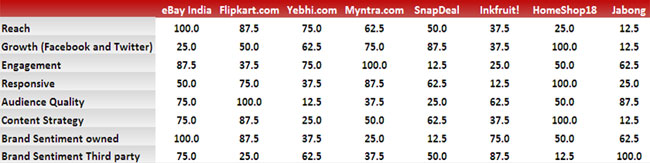
    Social media agency WATConsult has released a report on the social health of e-commerce brands in India at the 3rd WATSummit. The report extensively tracks the social media sentiments of eight leading e-commerce brands, Flipkart.com, Inkfruit.com, HomeShop18.com, Jabong.com, Myntra.com, Snapdeal.com, Yebhi.com and Ebay.in.


    Based on the multiple scoring parameters of the analysis, Myntra.com, HomeShop18.com and Ebay.in come forward as the scorers among the top 8 e-commerce players in the industry. The report analyses the social media and online trends of the e-commerce portals on parameters like Social Reach, Engagement, Growth, Response Time, Content Type and Audience Quality. The report also analyses the share of voice, brand sentiment, online reputation, source and keywords for each player in the online space.


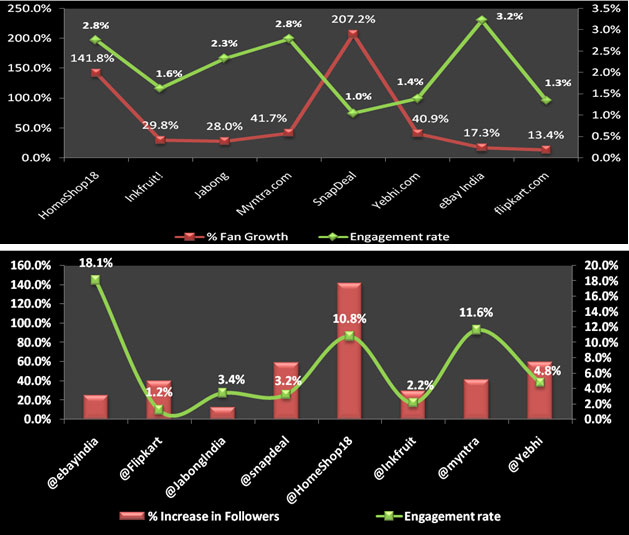
    Snapdeal.com, Homeshop18.com and Myntra.com are e-commerce players with faster growing base on Facebook and Twitter. However Ebay India boasts of the highest engagement on Facebook and Twitter followed by Homeshop18.com and Myntra.com.


    Homeshop18.com tops the chart as e-commerce player with the highest YouTube growth but Yehbi.com has the highest YouTube engagement.


    The top three players with high overall social media engagement are Myntra.com, Ebay India and Yebhi.com.


    Homeshop18.com is the brand with the fastest response time on Facebook and Twitter. The top 3 players with high overall response time are Homeshop18.com followed by Myntra.com and Flipkart.com.


    From an overall e-commerce industry perspective negative sentiment stands at a 48 percent as against the positive sentiment of 13 percent. The rest of the conversations of 38 percent were found neutral. Jabong.com has managed to sustain the top position for neutral and positive sentiment while Flipkart.com on the other hand has the highest neutral conversations of 64 percent to its credit.


    While comparing the social image of brands on Facebook, Myntra.com is a brand with least negative and maximum positive conversations.


    Only 16 percent of the products ordered from an ecommerce player were received on time. Delay in delivery still is a big concern for all players in this industry.


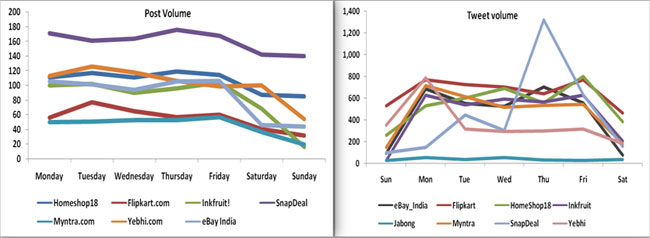
    The report also gives a closer look at the posting activity on leading platforms like Facebook and Twitter. While Tuesdays and Thursdays are the most active days on Facebook, Mondays and Fridays dominated twitter with the maximum tweets. Surprisingly, social media activity on weekends on both platforms reduced as compared the activity on weekends.


    In terms of engagement, the top three brands on both Facebook and Twitter are Ebay India, Homeshp18.com and Myntra.com.


    Commenting on the analysis, Rajiv Dingra, Founder & CEO, WATConsult said, “Crores of rupees are spent regularly by e-commerce brands to acquire new customers, but who are the champions who have managed to engage with their consumers consistently and coherently? Our report highlights the activities carried out by these eight leading ecommerce players on various online platforms and seeks to identify trends related to the digital marketing of these brands.”


  • AdStrat: Easy, anytime shopping with Myntra

    Agnello DiasAgnello Dias, Chief Creative Officer, Taproot India


     

    Name of the Campaign/Ad: Myntra.com – Real Life Mein Asia Hota Hai Kya?


    The Brief: The new TVCs have a clear objective of showcasing the wide range of products and convenience of shopping on Myntra.


    [youtube width=”400″ height=”220″]http://www.youtube.com/user/myntradotcom[/youtube]

    Research insights: The TVCs highlight the fact that shoppers have access to over 500 brands ‘anytime, anywhere’ and easy product return with the tag line ‘goods once sold can always be returned’. So it’s the promise of convenience at a click of a mouse and assurance that if not satisfied then it can be returned.


    The thought process behind the creative: The first film depicts a boardroom setup where three colleagues stumble upon Myntra while in a meeting and start visualizing stylish models walking on the boardroom table as they scroll through the website. The second film shows a finicky female shopper who wants to return her dress for unreasonable reasons and her request is immediately accepted by Myntra.


    Media vehicles chosen: The new TVCs are being shown across most GEC channels. Along with television ads, Myntra will reach out to its audience online with an innovative digital campaign on portals like Yahoo and YouTube which builds on the theme of the TVC. Myntra made the commercials available exclusively for its 7.5 lakh Facebook fans a day before they were aired on national television.


    Key issues kept in mind while executing the ad: Agnello Dias, Chief Creative Officer, Taproot India added, “This is a further extension of the original campaign thought – ‘Real Life mein aisa hota haikya?’ which had worked very well for the brand the first time round. Myntra does indeed have a wide range of fashion brands parading on the site at any given point in time and we thought it would be interesting to dramatize that fact by exaggerating the grand parade of fashion apparel through a catwalk in a place and at a time when one least expects it. Similarly, the second TVC emphasizes on a core offering of Myntra – hassle-free return and exchange.”


    What is the differentiating factor about the ad? This is a step ahead from the previous campaign focused on demystifying myths about online shopping by communicating the key benefits of shopping with Myntra.


    [youtube width=”400″ height=”220″]https://www.youtube.com/watch?v=T3etshTW-vc[/youtube]

    The TVCs were conceptualized by Mumbai based advertising agency, Taproot. The film was directed by Prashant Issar and produced by Radhika Sawhney from Tubelight films. Maxus is managing the media placements of the TVC.


    Client comment: Mukesh Bansal, Founder & CEO, Myntra.com said, “Having created a successful campaign showcasing the benefits of shopping online, we are now extending our communication to a wider audience with two new TVCs. This campaign is aimed at showcasing our entire range with shoppers being able to mix and match from our wide catalogue. With over 500 fashion brands, we are further consolidating our leadership position in the online fashion and lifestyle space”.


  • Does social media boost ROIs for e-commerce sites?

    By Robin Thomas


    Merely setting up shop is not enough today, and brands are not limiting themselves to advertisements on television, print, radio or even the internet alone. They are logging onto social media in a big way, interacting with and updating their consumers about new products or other initiatives, and e-commerce sites are not far behind. Myntra, for instance is already said to have registered over 7 lakh Facebook fans. Myntra also has a fashion blog, ‘Style Mynt’, wherein it shares information about the latest celebrity fashion trends, new product offerings on Myntra.com and so on. Another e-commerce site, Indiatimes Shopping, started its Facebook page early this year and is said to currently have more than 2 lakh fans on Facebook.


    eBay on the other hand claims to answer over 1,200 queries every month across social media platforms. It is said to resolve over 120 post-transaction complaints every month and is ranked sixth in Social Bakers’ ‘Top 100 Global Brands on Facebook’ index and is also said to be the third most engaging FB Brand Page in India. In addition to these, eBay also conducts online contests enabling the e-commerce site to engage with its consumers. For instance, it conducted a contest called ‘Battle of the Fans’ around the IPL last year. It also launched a Facebook application called ‘Battle of the Fans FB App’ for the contest. As a result, the ‘Battle of the Fans’ app is said to have become the most popular Facebook IPL app two years in a row. Simultaneously, over 15,000 streams were said to have been published from within the app and is also said to have witnessed nearly 27 percent click-through from app-to-merchandise on the site. Besides Facebook, e-commerce sites like Indiatimes Shopping, Myntra, eBay India, Olx etc. are also active on other social networking sites like Twitter, Google Plus and so on.


    Social media vs sales targets

    Ashutosh Lawania

    According to industry estimates, nearly 25 percent of the time spent online is on social media platforms. Out of this, 50 million are said to be on Facebook, and 13 million on Twitter. The question however is, do social media activations lead to better ROI’s (Return on Investments)? Do the ‘likes’ and interactions or engagements with consumers translate into sales? According to Mr Ashutosh Lawania, Co-Founder and Head – Sales & Marketing, Myntra.com, “Though engagement is our focus on social platforms, the activities there do contribute to traffic and sales on Myntra, and we keep track of it. Contributions from these platforms are in the lower single digit figures (percentages) when compared to other channels but they do add up. Besides, Twitter and Google Plus, we also use Facebook for advertising along with generating organic traffic. About 80 percent of all Facebook traffic on Myntra is paid with the remaining 20 percent driven via organic.”


    Subhanker Sarker

    Myntra uses tools such as Facebook, Twitter, Pinterest, Google Plus to make announcements about new products, trends and to give out regular fashion updates which Mr Lanwania observed results in increased awareness and in turn influences purchase decisions.


    Having a slightly different take on the impact of social media activities on the sales, Subhanker Sarker, COO,Indiatimes Shopping was of the opinion that social media activities at times do result in better ROI’s. “Experimentation is the key. There is a certain tonality of communication, a very precise targeting of the message and a very strong follow through that can work magic. Social media is an excellent tool to keep expanding the circle of trust. The offer ads introduced recently drive a lot of sales for us now. The revenue percentage would still be in low single digits, but it all depends how you define it. Measured over a longer time period and favourable attribution logic, it touches double digit percentages.”


    Kashyap Vadapalli

    Kashyap Vadapalli, Chief Marketing Officer, eBay India observed, “Social media channels get us over 12% of our daily traffic which translate into deeper reach and higher conversions. In terms of ROI, they are one of the cheapest tools for generation of daily visits and excellent mediums for acquisition & retention marketing.”


    Anurag Gupta

    Anurag Gupta, MD, DGM India was also of the opinion that social media activities surely do reflect on the sales and revenues of e-commerce business. “Most of the e-commerce companies are using advertising on social media to drive transactions in addition to engagement activities. This is on an increase especially since platforms like Facebook have begun providing re-targeting capabilities. Sub-optimal use of social media platform by brands happened earlier, now brands have graduated and are using social media beyond likes and onto engagement and transactions.”


    The road ahead

    Social media is said to play a significant role in driving rapid growth for e-commerce brands. Only recently Myntra is said to have used social media platforms to launch its latest TVC before launching it on other media platforms. “It is an important platform to engage the audience, increase awareness and drive top of mind recall. It also plays a significant role in collecting feedback and giving customers a platform to voice their opinion and share their views on what they like or dislike” explained Mr Lanwania.


    According to Mr Gupta, social media activities for brands are increasing significantly. Most brands today have their presence on social media, including e-commerce brands. The brands are now using social media for engaging with users and a lot of e-commerce brands are increasingly using social media for commerce as well.


    However Mr Sarker was of the opinion that although social media has become a very significant platform today, brands must not be seen intruding their consumer’s privacy. “Social media can give you immense insights into your customers psyche. How you leverage that is up to you. Hence it is definitely significant for everybody. But one must respect the privacy of the audience. They are on social media mainly to socialize. If they were in the mood of buying something they would be on an e-commerce website. Intrusion is not taken kindly. We see social media as a customer insights opportunity rather than a sales one.”


    Taking social media onto a different level altogether, e-commerce sites are beginning to effectively use advertising on social media to drive their transactions. Although the revenue generated or the revenue percentage from social media activities are still said to be in single digits, it is believed to grow depending on the innovations and the engagement that e-commerce sites have to offer to their consumers.


    “Offline shopping tends to be a social phenomenon, and this will catch up with online shopping as well. We foresee online shopping getting integrated with social media as more and more enthusiasts will start seeking opinions before they indulge and seek compliments post indulgence. This could take the form of deeper and richer integration of social tools in the online shopping experience. One would also e-commerce players leveraging the social graph to add engaging ways to enable users to talk & share about shopping on various social media channels” concluded Mr Vadapalli of eBay.


  • Myntra, clicking faster

    By A Correspondent


    Myntra.com, an online retailer of fashion and lifestyle brands, has expanded its range of apparel to sarees this month. The online retailer of fashion offers 12 brands of sarees namely, FabIndia, Satya Paul, Satyavee Designs, Ambica Bridal Sarees to name a few. Myntra which is said to be witnessing consumer interest and traction in this category also expects to register daily sales average close to 1000 units within the next 30-45 days. In addition to these brands more brands and designs are expected to be added soon. While 65 per cent of its shoppers are males and 35 per cent are females, Myntra eyes an increase in female shoppers with its introduction to apparels like cosmetics and sarees.


    Myntra will be promoting these new categories across online platforms including Google ads, affiliates and social media platforms. On basis of its research findings, Myntra found that there is a huge demand for categories like sarees and cosmetics especially from tier 2 and 3 markets because of lack of choice and availability. Myntra aims to further strengthen is leadership position through its strong connect and high reach.


    Ashutosh Lawania

    In an email interaction with MxMIndia, Ashutosh Lawania, Co-Founder and Head – Sales and Marketing, Myntra.com said that Myntra is working on launching private labels in a few months time. These private labels will be Myntra’s own brand of clothing line. More details were however not available at the time of filing the report. “We are working towards launching our private labels which would go live in a couple of months,” said Mr Lawania.


    Footwear continues to be the most popular category on Myntra which is said to contribute approximately 45 to 50 per cent of its daily sales. Footwear is then closely followed by clothing for men, women and children, along with accessories such as jewelry, watches, glares, handbags, and so on.


    In addition to these developments, Mr Lawania also spoke about his mobile plans in the coming few months. “We believe that mobile will be the next big thing and that today it is only at a tipping point. We are working towards enabling our interface to make it ready to deliver the full Myntra experience across a plethora of handheld devices.”


    Speaking about the scope of e-commerce business in India and whether online buyers would increase their trust in online transactions, Mr Lawania said, “With the internet penetration currently at 120 million and expected to touch 300 million by 2015, we believe that ecommerce has a huge potential to grow over the years. We believe that CoD will play a huge role in the success of ecommerce in India. CoD is here to stay as we (India) are a huge cash economy and people are comfortable transacting in cash. Online retailers need to make this process of handling cash more efficient and cost effective.”