Tag: Music

  • Music Rules, and How!


    By A Correspondent


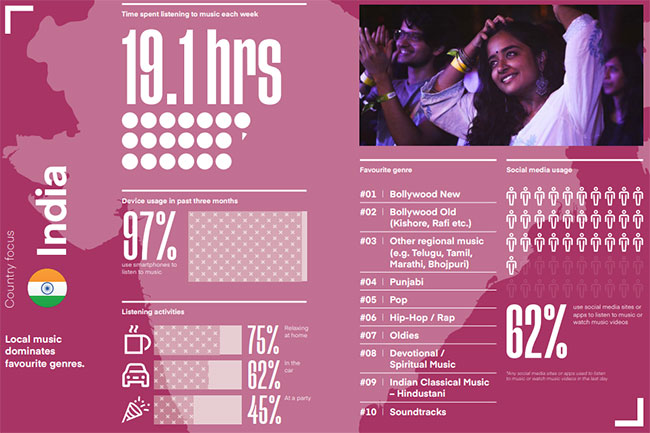
    IMI, the organisation that represents the recorded music industry in India, has released the Digital Music Study 2019, which examines the ways in which music consumers aged 16 – 64 engage with recorded music in India.

    Some highlights from the report include:

    – Music listening is up: respondents typically spend 19.1 hours per week listening to music – higher than the global average of 18 hours. This equates to about 2.7 hours – or the equivalent of listening to 54 three-minute songs – daily.


    – Most people (80 per cent) identify as loving or being fanatical about music, much higher than the global average of 54 per cent.


    – Older age groups increasingly embrace audio streaming services: engagement with audio streaming in India is strong, with 90 per cent of all respondents accessing a music streaming service in the past month. The highest rate of growth for engagement is in the 16 – 24-year-old age group, with 97 per cent of that group accessing a music streaming service in the past month.


    Said Blaise Fernandes, President and CEO, IMI: “The Digital Music Study 2019 has revealed some illuminating trends in India: the 80 per cent music fandom base, the highest in the world, is the main reason for the 21.3 per cent growth rate India achieved over the past years. The top two favourite genres are Bollywood new and old. The fastest growing segments are of consumers in the age groups 25-34 and 35-44, which is the perfect launch pad for a premium subscription-based model in India. 67 per cent piracy rates remain a matter of grave concern.”


  • The Anchor: Anil Garg on 10 reasons why specialty channels are the need of the hour

    By Anil Garg


    The television landscape in India has seen a paradigm shift in the last few years.  From a plethora of channels offering General Entertainment, News including Business & Market News, Music, Movies, Kids, Sports and so on, one is seeing the emergence of newer specialized genres such as Infotainment, Food, “Classroom” Education, Science and Technology, Specialty Sports (e.g. Golf), Home Shopping and Travel.  There are dozens of reasons for this (be it advances in technologies, affordability, availability, changing lifestyles and such) here are TEN reasons why specialty content will not only survive but thrive in the coming years:


    1. Consumer Awareness and Demand

    India, like most other countries, is fast realising that audiences are increasingly discerning especially with multiple TV households in Tier I, II and even III cities across all SEC groups.  Look at how Discovery has diversified from a single channel to Discovery Science and Discovery Turbo; or for that matter NatGeo. Infotainment content is entertaining and educative. Today people increasingly want to learn and know more about the world they live in. For instance, one would never stop a child watching a clip on the “Blue pottery of Jaipur” as opposed to watching cartoons on a kid’s channel.


    2. The Nature of Specialized Content

    Specialised content such as a cookery show or a travel show does not need to be in a 30 minute format, so typical of traditional television. Specialised content can be “snacky”; a five minute show on the “Fishing Nets of Kerala” or “48 hours in Cairo” can ignite the angst and aspiration in the mind of viewers who have or would love to experience this. Such content can be informative, educative and yet entertaining. Also such content appeals across all age groups four-adult. Plus, it is non-controversial as in there is no rape or murder or such.


    3. Passion

    People who want specialized content are passionate about it. So are the viewers! Take for instance Food or Travel. Specialised content has to be produced by people serious about the domain. As more and more people choose to work in their field of interest, so will they choose to talk about it in more and more creative ways. Likewise, an ever increasing consumer base aware about the affordable availability of such content will tune into what they are passionate about.


    4. Forever Content

    Most specialized content is forever in that it does not age. A show on the Taj Mahal or the Pushkar Mela is timeless. Unlike most soaps, reality shows or sporting events, most infotainment content is ageless and can be watched again and again for generations. We still love to watch a clip on what Mumbai looked like in the 50’s even though it is black and white; this will be the case even fifty years hence!


    5. Technology including New Media

    Affordable technology makes it possible to offer thousands of channels to viewers.  Technology trends, be it the downward cost of increasingly powerful Cameras, inexpensive video editing Software, dramatically reducing Storage cost, affordable and increased Bandwidth, ever increasing Connectivity, Interactive and Mobile devices and increasing use of innovative Applications – all this makes it possible for a specialized channels to stream to their audiences, anytime, everywhere. As rich content moves from Beta tapes to digital video formats, from huge physical libraries to compact server scale storage in a box, growing a business around this new realisation that the concept of space has changed will help new age entrepreneurs build organisations and brand architectures with specialized content.


    6. Portable Content

    The very nature of specialised content is interesting. There is a growing need and demand for on the move infotainment and on demand infotainment (e.g. what to see and do inSingapore), as opposed to a two-three hour movie. As consumer attention spans get shorter, information they seek has to be at their finger tips “here and now”.  Thanks to technology, this is made possible. Specialised content is easy to port for on-demand viewing.


    7. Going Digital – Growth of Television and the Net

    As India moves to digitization with the possibility of a 500-1000 channels though fibre and cable to the home, multiple TV households, increased Internet bandwidth and technologies such as 3 and 4G for the masses, affordable yet powerful handheld devices, access to specialized content will be easier and affordable for consumers.  Also for aggregators and distributors of such content, it will be imperative to reach out to every single viewer with a rich and varied offering.


    8. Education

    As the Indian population comes to grips with evolving technologies, the nature of content, applications and their usage will explode. From ten years ago when not many people used an ATM machine or a cell phone, the scenario is changing rapidly and dramatically. As people learn how to use a phone for purposes other than talking, to using the net for purposes other than checking emails or making a railway booking, we will see people searching for informative content and entertainment.


    9. Targeted appeal

    For advertisers, sponsors and the like, specialized channels offer a focused, targeted audience. Also, technology is fast reducing the costs for reaching out to the customer and getting a better handle of behavioural and psychometric testing – e.g. social media and viral.


    10. Business Sense

    Businesses understand the reasons above.  Channels like a GEC, Movies, or Sports are very expensive to setup and operate; in India we have seen many such channels go down.  For the cost of a single show on a channel in these traditional genres, it is possible to setup and operate a specialized channel and also to make it profitable. Ten years ago not many people thought that a channel like Discovery made any business sense! Also, specialized infotainment channels have multiple revenue streams; the touch-points for consumers sourcing information of interest are multiple.  The same content can be sampled on TV, researched in print and enabled/fulfilled via the web as an example – all thanks to technology.


    In a nutshell, emerging technologies are playing a big role in bringing about this shift from traditional TV (latent viewing) to active TV (active viewing).  For instance in a specialized genre such as Travel, television can provide excellent programming backed up by a supporting interactive mechanism either through a website or an interactive mobile gadget which can create lead generation for travel booking, with applications that can provide ‘here and now’ information while at home or office or on the go. This increases the opportunity base and revenue potential for all possible trade partners – traditional travel operators, tourism boards, hotels and airlines, fleet operators and more – with the help of emerging new media technologies which help link up all possible interactions.


    As all trends point to specialized content, such content will become the trend!


    Anil Garg is Chairman & Managing Director, Explore Travel Channel
     

  • Asha Bhosle, Babul Supriyo enthral at Prabhat Khabar event

    By A Correspondent


    Jharkhand’s number one Hindi daily Prabhat Khabar organized musical evening “Sur Sandhya” on January 8, featuring queen of melody and versatile singer Asha Bhosle along with acclaimed playback singer Babul Supriyo.


    The gala evening, which was organized at Birsa Munda Football Stadium, Morabadi Ranchi, had approximately 40,000 passionate music lovers, besides 4,000 army officials experience a thrilling performance during the open-air programme.


    The dignitaries attending the event included the deputy chief minister, chief justice, senior army officers, ministers and IAS officials.


    The golden-voiced singer sang many of her best scores which left audiences and dignitaries spellbound. As the dusk fell, the audience were completely wrapped in the singer’s sensational tunes. Bhosle was ably accompanied by an all-charged up Babul Supriyo, known for his unique voice, who entertained with his famous scores.


  • The Anchor: 4 striking trends among Hindi music channels

    By Amar Tidke


    Year 2011 can be called the year of growth for the music television industry, and that has benefited not only the entire genre but also music lovers who now have varied choices for music consumption on TV.  As we all know, music knows no boundaries, it’s free from the boundaries of languages or countries and communities.


    Year 2011 saw music that cuts across all these boundaries and become the most popular hits. Four major trends that the industry witnessed are: Rise of many players in the music television space, the Digital interface, Regionalisation of media and the Innovation of content.


    #1 New channel launches

    Year 2011 saw the advent of many new channels in the music television space. We started the year with about 10 odd music channels and today we have 14 channels.  The launch of new channels has not only been a boost for the industry but also provided brands and viewers with varied choices to choose from.


    #2 Experimentation on content 

    Due to so many new entrants in the music television space, channels tried experimenting on their offerings and the audience was given assorted choices to select from. The audience demanded pure music content which was the focus of 2011. The year 2011 also proved that the audience is the final decision-maker, and channels were made to rethink their positioning to appeal to the viewers.


    #3 Regionalisation of media and innovation of content

    Another trend that was prominently seen in 2011 was concentration on regional audiences. 9X Media Group launched 9X Tashan, a Punjabi Music channel and Marathi Music channel 9X Jhakaas in the year 2011.


    #4 The digital interface

    Lastly, but very important, a trend that was seen in 2011 was the major use of Digital and Social media platforms. One of the major examples of this was the ‘Kolaveri Di’ song that was first seen on YouTube and then made its way to all popular music channels. That is the power of the digital wave and, given the interactive ability of this platform, many channels and youth brands were seen creating content for their target audiences on these platforms. We will see this platform only grow in 2012.


    Amar Tidke is Head of Programming and Senior VP, 9X Media Group.

  • Pay up or face the music, PPL tells major hotels & pubs

    By A Correspondent


    The city may fall short of venues to welcome the New Year this time as the Phonographic Performance Ltd. (PPL) has served notices to many well-known hotels and pubs. These legal notices have been issued to venues that have not paid the requisite music license fee to play music at their year-end events. PPL plans to initiate strict legal action against defaulters in case the license fee is paid ahead of their planned events. The following hotels have been given interim injunction by the Delhi High Court: Radisson Blu Hotel, Paschim Vihar, Hype at Shangri-La Hotel, QBA, Sheraton Hotel, Hilton Hotel, Double Tree Hilton, ChalChitra, Crowne Plaza, Wyndham Hotel, Club Sirocco, Nautica, Play Lounge Bar, 3 Stories, The Glassy Junction, Hang Out, Club Headquarters, Pritampura. PPL has issued notices to all prominent places which have failed to pay music license fee across the country.


    Vipul Pradhan, CEO, PPL said: “New Year parties attract people promising them a good time through a combination of entertainment, food and beverage. A significant component of the sum charged from the customers is for music. Therefore, the music companies whose sound recording is regularly used have a right towards claiming their due because their product is also getting consumed.”


    Any performance of Indian or even international music, in public places or commercial establishments such as hotels & resorts, restaurants, bars, pubs, discotheques, cruise liners, cinema halls, shops, offices, and so on, rendered without first having obtained a licence from PPL constitutes an infringement of Copyright under the Copyright Act,  1957. Under the statutory sanction of section 35 in the Indian Copyright Act, playing commercial music in public without paying the requisite license fee is an offence liable to contempt of court. Section 35 grants exclusivity to PPL to issue licenses to hotels/ pubs for playing music during the events in their respective premises. The tariff for the same is calculated on the basis of the number of hours the music is to be played and the number of people expected to attend the event.


    “Musical nights and customized New year events rake in huge revenues for organizers. A year ending event cannot be imagined without music! Yet, when it comes to paying for the commercial use of music, the event organizers chose to evade the license fee,” said Mr. Sowmya Chowdhury, Country Head, PPL.


    Mr Avinash D’Souza, National Sales Manager, PPL feels: “Music labels have complete authority over the sound recordings and using them without a proper license can bring the events & parties to a standstill. People should also act proactively and check with their chosen properties to avoid a last minute inconvenience or embarrassment. To prevent such situations, this year we have expanded our operations to a National Campaign in all major cities.”


    Every year pubs/ hotels target revenues with customized New Year packages but are reluctant to pay a nominal license fee (which varies depending on the number of hours for which the music is played) to PPL. Thus, flouting the norms and eating into the royalties of the music labels. DJs, too, need to abide by PPL guidelines if they continue to play music without paying the license fees.


  • The Anchor: Devraj Sanyal on the 10 songs you’re sure to hear on FM radio

    #1Satyameva Jayate: From the most awaited album SuperHeav’… It’s the track which brings the nation together… has that anthemic feel.

    #2 Lady Gaga, The Edge of Glory: A must-have artist in your playlist, the biggest pop icon the world is gaga over.

    #3 Enrique Iglesias, Dirty Dancer: The most loved artiste in India, one of the highest selling in the country.

    #4 JLO, On the Floor: The biggest club hit in recent times… gets JLo back on the music scene.

    #5 Raab Rakha, Love Breakups Zindagi: Very young and vibrant song, a direct connect to today’s youth.

    #6 Jessie J, Price Tag: Purely for its lyrics… It’s not about money money money.

    #7 Watch The Throne, I love you so: A must-have for hiphop fans – two hiphop idols in one album!

    #8 Pal Pal Dil Ke Paas, Blackmail: Played on all the radio stations on their classic shows… Kishore Kumar is definitely hamaare dil ke paas.

    #9 Yeh Dosti, Sholay: An evergreen friendship track.

    #10 Senorita, Zindagi Na Milegi Dobara: Very cool, very young, from a new-age young film.


    Devraj Sanyal is the Managing Director of Universal Music India