Tag: Mumbai

  • Red Alert! Monsoon Mazaa or Disability Distress?

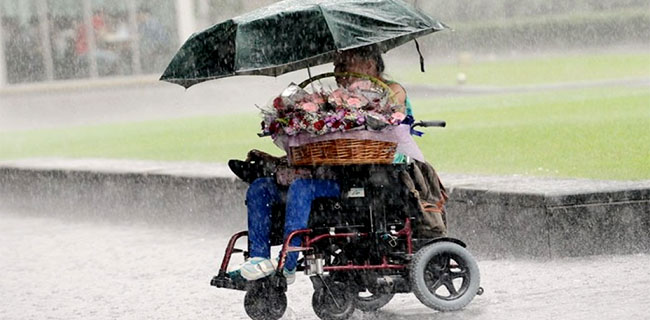
    Representative image. Photograph source: https://www.ohchr.org/


    By Shruti Pushkarna

     

    Shruti PushkarnaIn the past few weeks, monsoon fury has topped news headlines across different parts of India. If you google rain+news, the search throws updates of orange and red alerts in parts of Maharashtra, Gujarat, Karnataka and more. Then there’s the frightful, shrieky voices of television anchors warning us about the dangerously rising levels of Yamuna and Ganga. Not to miss the conspiracy theories and political buck-passing between neighbouring states on releasing excess water.


    Growing up in Delhi, I haven’t witnessed the city at such a standstill in the past, with roads completely blocked off because of water-logging. The situation is definitely bad. In fact, climate conditions across the world have been uncertain and alarming.


    Both traditional and digital (and social) media are brimming with accounts of lives lost, infrastructural damage, crops destroyed, poor urban planning, homes demolished, et cetera. Average (wo)man is posting photos and videos on social media from their places of work/ study and residence, highlighting the respective perils they are facing.


    I still recall the horror of July 26, 2005, one of the first few serious news stories I witnessed as a budding journalist. ‘Mumbai Deluge’, the headline and the corresponding pictures are vividly etched in my brain. The city received 944 mm rain, the eighth-heaviest 24-hour rainfall recorded ever, claiming thousands of lives.


    Then too, similar coverage ensued. Eighteen years on, our cities and states still seem unprepared to battle the nature’s wrath. But I’ll leave that debate for another day.


    For the average Indian citizen, what does monsoon mean? Baarish or pitter-patter raindrops throw up varied imagery and meaning for different people. A steaming cup of tea paired with hot pakodas, swaying lush green trees, potholes, overflowing sewers, watered-down roads, damp clothes, dripping huts, traffic snarls, careless children jumping in muddy puddles. I’m sure you can think of more!


    Ever think of what it means for an average disabled citizen?


    Twenty-nine-year-old Payal Bhattad lives in Virar near Mumbai and until recently, she traveled to Wilson College in Mumbai to teach history to undergraduates. The daily commute in the local train would easily take up three hours of her day. And Payal is a totally blind person who uses a white cane to navigate her way across the bustling city. When the heavy raindrops fall on the tin sheds of the train station, Payal is unable to register any other audio cues which otherwise guide her to move forward, backward, left, or right. She cannot hear the murmurs of fellow passengers, or hawkers’ cries, nothing that indicates any familiar direction or territory to her. Once, the roaring rain misled her to the edge of the platform and she fell onto the tracks. And no one noticed or stopped to help her up.


    Akash Nimbalkar is a 30-year-old social worker who also lives in Virar. He is a person with low vision, who finds it extremely challenging to wade through knee-deep water on his way to work, using a cane. He is always worried of submerging into an open gutter or losing balance and slipping on the flooded road. His family hesitantly stops him from going to the office every day, as they worry about their visually impaired son getting stranded in the rain.


    With wind blowing amidst heavy rain, it’s hard to steadily hold an umbrella, and manage to stay dry. Additionally, there’s personal belongings to juggle with the gamp. Forty-six-year-old Shirin Kheriwala works as a counsellor with a national helpline for the blind. She usually relies on sighted people to help her cross busy main roads and assist with directions. But during the monsoon, everyone is running to find shelter and save themselves. Coming back from work one day, she found herself isolated on the highway. And her umbrella broke. But as they say, necessity is the mother of invention. Shirin folded the umbrella to use as a cane and held her white cane up in the other hand as an indication to the rushing traffic, that she was walking across.


    The situation is equally precarious for persons with orthopaedic or locomotor disabilities. It is difficult, sometimes even impossible to use wheelchairs, crutches, or any other assistive aids in such extreme weather conditions.


    Saurabh Kohli is a 40-year-old person with multiple sclerosis (MS). Apart from the usual fatigue accompanying MS, he experiences balance issues and severe weakness in his legs. Although he drives a slightly modified automatic car to his office at Amity University in Noida, he uses a walker or wheelchair to get from one place to another. Walking without such assistance is next to impossible for him. He drives around 70 kms every day, but in rainy weather, he avoids stepping out alone. The humid weather conditions also adversely affect his medical condition.


    Prosenjit Chakraborty is also a person with multiple sclerosis. He lives in Guwahati, and drives a battery-operated tricycle to run his errands, visit the doctor’s clinic and the hospital for follow-ups. He fears the day when rainwater seeps into the battery of his vehicle and stops it from functioning, leaving him helpless on the road. So far, he’s been lucky!


    All these folks, like many other persons with disabilities don’t want to stay home, take leave, or not show up to work because of the additional challenges they face due to their disability, in the monsoon season. Instead, they look for solutions and brace up for perilous times.


    But is the administration aware of their difficulties? Are policies being designed and implemented to prevent or tackle such hazardous situations facing approximately 2.68 crore people?


    And what about the fourth pillar of democracy? Why doesn’t the media focus on reporting issues and accounts of persons with disabilities who have equal rights as citizens of India? Before raging another debate on urban development woes, climate change, or disaster management, the media should understand and include the stories of millions of overlooked disabled stakeholders.


    Wondering why MxMIndia publishes a disability advocacy column? Well, we strongly feel that the media can dramatically transform the world of persons with disabilities. And this series can help bring forth issues that the media must champion to create a truly inclusive and accessible India. To write this column, we invited Shruti Pushkarna, a former journalist who is now a disability inclusion advocate based in New Delhi. Her views here are personal. To access the archives of her 75-plus columns, please visit: https://www.mxmindia.com/category/ columns/shruti-pushkarna/


    If you have a view on the issues raise or would like to align with MxMIndia on this cause, write to us at editor [at] mxmindia.com.


  • Ranjona Banerji: For a profession in tatters, there’s some real work happening

    By Ranjona Banerji


    Journalists are at the forefront of the Covid-19 pandemic, as we have discussed. We do not really care except to pay lip service because it’s so much more fun debating over some toxic TV personality’s rants and rights.
    But enough of him. As more and more field journalists test positive in India, we need to urge their employers and news organisations to have better safety guidelines and measures for their staff. The general tendency in newsrooms has been “to get on with it”. Safety is of little concern. And post-incident help is not formalised. It’s all ad hoc depending on management/owner mood and senior editorial power. Imagine what that must be like in these sycophantic, spineless times.

    This is a witty, courageous and understanding personal account by Simrin Sirur, a young reporter, who has just tested positive for Covid-19. She is also a friend’s daughter, which is when you realise how close you are to this virus. (This is the second friend’s daughter who has tested positive. The other is a doctor in the UK, forced back to work after two weeks, but that’s another story.

    https://theprint.in/iwitness/disbelief-guilt-regret-amusement-when-a-covid-reporter-herself-tests-positive/411840/?fbclid=IwAR3QbsDbNML5d21EviOuBFvDPUsfCeBLkDPF8IM-F9fdy0RlNEkMKdX92J4

    **

    Luckily for a profession in tatters in several senses, there also is some real work happening out there. The Scroll has this report on the problems of tea garden workers forced back to the grind because of hunger. These are also India’s forgotten people whom no one wants to think about.

    https://scroll.in/article/960142/one-reason-why-tea-garden-employees-went-back-to-work-despite-covid-19-fears-hunger

    Livemint goes to Tirupur, India’s textile hub, which is now stretched thin:

    https://www.livemint.com/news/india/a-tense-textile-hub-spins-out-of-control-11588261831485.html

    I share these stories because I know that not many will read them and most people do not care. Yet, even as we mourn the terrible loss of two talented movie actors, the lives of the forgotten people also impact us. It is heartening therefore that some sections of the media provide space for such reports even in such times. Revenue loss has led to budget cuts which have led to salary cuts, size cuts, and all the rest of the horror.

    Freelancers have it especially tough because they are seen as the most expendable. They have lost assignments, columns, consultancies, and also any future prospects. Sadly, they are often the first casualties when money is tight, even though they do exemplary work. We understand. Rock and a hard place. But lack of spine and plans are also evident in newsrooms where managements are permitted to get away with murder. And that’s not really a metaphor either.

    **

    Amidst all this doom and gloom, luckily we have some media gems to lift our spirits.

    Both these are from my former employer, Bennett Coleman.

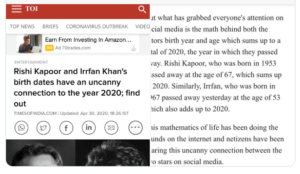
    In this first one (please see the screenshot), a little bit application of mind and a little less dependence on Whatsapp forwards may have saved the “brand” some embarrassment. Is there no desk which works here?

    It can work for anyone, not just late lamented talent. If you add your age today and your date of birth, guess which number you will reach? Take a minute to think it through. Even my third grade maths got this one!

    The second is not about a media mistake but in fact a perfect story to get you laughing. Rich person’s privilege is always a fantastic release mechanism!

    https://mumbaimirror.indiatimes.com/mumbai/cover-story/industrialist-sues-guest-for-spilling-wine-on-his-sofa/articleshow/75438612.cms?fbclid=IwAR0OBWqn61BBdgVM6Qz1eeUYUBR_q-haJ8BSmVKG6v0pgfl6LQk2C6Eailg

    **

    On which note, Happy May Day. Please take that any way you like!


    Ranjona Banerji is a senior journalist and commentator. She is also Consulting Editor, MxMIndia. Her views here are personal

  • Spare a Thought (& some monies) for Kerala


    From Team MxM

    You’ve seen the pictures and videos. Some of them may have been mixed up and are possibly not of the current tragedy. But what’s happening on the ground (or whatever is left of it) and from what we hear from family and friends paints a horrendous image of the scene on the ground.

    It’s commendable that some media companies have taken a lead for the cause. The Mathrubhumi group, Star India, Viacom18, India Today, Times Network and many more.

    In our own small way, while we have made a donation to a social organisation, MxMIndia is offering a platform to all media companies who are conducting relief drives for the cause of Kerala.

    MxMIndia will be happy to publish a certain number mailers free of cost, and free of any obligations whatsoever.

    Let us repeat: these will be published without any cost to you, and free of any future obligations. This, frankly, is the least we can do for the cause of the state and people we all love so much.

    Write to pradyumanm [at] mxmindia.com


  • Mumbai to go Social next Week


    By Fatema Rajkotwala


    After garnering much success and kudos in over 20 cities globally, New York strategy firm Crowdcentric’s brainchild, Social Media Week (SMW), comes to Mumbai. Digital buffs and enthusiasts will attend their first solely focused social media conference. Organized by Bengaluri-based marketing services firm RSquare Consulting the event will comprise over a hundred scheduled sub-events spread over a span of a week starting Monday, September 23 to Friday, 27 September, 2013 across six venues in Mumbai.(*See Disclaimer)


    Toby Daniels, Founder & Executive Director, Social Media Week, and CEO, Crowdcentric is excited about the experience of bringing the Social Media Week to Mumbai, “Given India’s presence in the mobile and tech space, Mumbai felt like a natural fit for SMW13. SMW is a distributed conference and we’re honoured to have RSquare Consulting taking the helms for SMW Mumbai. The team has been responsive and quick to help us understand the cultural aspects of hosting SMW in India. We can’t wait to see the week unfold.”


    MxMIndia is curating and hosting two sessions at Social Media Week Mumbai.

    The details of these are as follows:


    How Social Media dictates Journalism

    Date: Tuesday, September 24, 2013

    Time: 12noon to 1pm

    Venue: The Barking Deer, Mathuradas Mills Compound, Lower Parel


    Like it or not, social media dictates the way journalism in India happens. Newspapers and television channels track celebrites and people in office zealously and that dictates the way the news flow works. For many newsmakers, Facebook and Twitter are a godsend as they can now reach out to their TG and the media directly and with much ease.


    Panelists:

    1. C P Surendran

    Editor-in-Chief, dna


    2. Sidharth Bhatia

    Senior journalist and author


    3. Sachin Kalbag

    Executive Editor, Mid-Day


    Moderated by Pradyuman Maheshwari

    Editor-in-chief and CEO, MxMIndia


    How ETC rules Social Media

    Date: Wednesday, September 25, 2013

    Time: 12noon to 1pm

    Venue: The Barking Deer, Mathuradas Mills Compound, Lower Parel


    News and discussions on EntertainmenT and Cricket rule the social media. How has it changed the way cinema, television and cricket function? Do cricketers get influenced by what is being discussed on social media. Ditto with cinema and television?


    1. Raj Nayak

    CEO, Colors


    2. Deepa Gahlot

    Senior journalist, awardwinning critic and Head of Theatre and Films, NCPA


    3. Omar Qureshi*

    Editor-in-chief, Zoom


    4. Hemant Kenkre

    Former cricketer, commentator, columnist and PR consultant


    Moderated by Pradyuman Maheshwari

    Editor-in-chief and CEO, MxMIndia


    *To be confirmed


    What to expect?

    Social Media Week will host to an array of over 100 events themed around advertising, marketing, politics, government, science and technology, business and entrepreneurship, lifestyle and culture, media and publishing, society and environment, education and learning, health and wellness and ofcourse opportunities to network and party.


    Over the week, there is a mixed bag of workshops, seminars, exhibitions, parties and speakers lined up such as Dr Subramanian Swamy, Suhel Seth, Gul Panag, Kiran Khalap, Deveika Bhojwani, Subhamoy Das (e-Bay), Harshil Karia (FoxyMoron), Toby Daniels and Benjamin Scheim (Crowdcentric) among others.


    The multiple venues across the city are also eyebrow-raisers. These include Mantralaya, National Centre for Performing Arts (NCPA), GroupM office, Bluefrog, the Barking Deer, the Westin and Trident. As reported earlier by MxMIndia, the event is open to the general public, being an essential part of the social media.


    SMW has a visibly city-focused angle. Toby Daniels spoke of how Mumbai and India are viewed globally in terms of their digital footprint, “India is emerging as a major digital force. Its Facebook userbase has amassed more than 60 million. Yet, we know that it’s only beginning to grow. Social media is available for only 60 per cent of the entire Indian audience, and we think Mumbai’s digital industries will be a leader in helping bridge this digital gap.”


    Social Media Week Mumbai kickstarts on Monday, 23 September at Bluefrog with a power packed day of interesting topics hosted by IMI Mobile, RSQUARE, International Advertising Association (IAA) and SAP, followed by music performances by artists and the SMW Mumbai Opening Bash by Mindshift Interactive.


    From the advertising and marketing arena, September 27 is another day to watch for. The Barking Deer and Westin will host various talks by Group M and other media agencies. Buzz generating topics such as “I’ve got my fans, now show me the money” by Drizzlin Media, “Social by Design: Vada Pav meetup” at Mantralaya are some others to keep an eye out for.


    Tushar Vyas, Managing Partner, Group M South Asia spoke of GroupM’s association with SMW, “Social media is becoming central to communication – helping integrate all communication channel. We would like to help highlight the role of social media in marketing communication. Social media is at the heart of adaptive marketing and to look at it as an island would be a big folly. One needs to step back and also peer in at the same time. This is why we at Group M are trying to weave in elements of this medium into everything we do – from activation to content to campaign.”


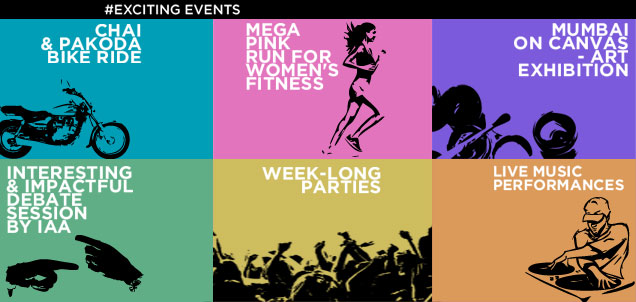
    The week will also see exhibitions themed on Mumbai, wildlife photography and art at the Piramal Art Gallery, NCPA hosted by CRY, R Square Consulting and Indianartcollectors.com. Nokia will also be conducting a Masterclass on Mobile Photography.


    The Bombay Street Style Party at Olive Bar and Kitchen is another event to mark your calendar for.


    SMW will begin with ‘Mega Pink’, registrations for the women’s fitness run at Shivaji Park by Maximus Events and will end on 28 September with the Chai and Pakoda Bike Ride hosted by the Indian Bike Week.


    Why should you be there?

    If you use social media on a professional front or as a means for individual brand development or deal with anything in the digital space, Social Media Week is the place to be. In today’s hyper-connected world though, this includes everyone from brands, digital agencies, entertainers, individual artists, government verticals, and basically, everyone.


    Shedding light on Crowdcentric’s philosophy and vision for social media, Mr Daniels said, “We are experiencing one of the biggest shifts in how we communicate in human history. Because of this, our aim is to provide the best information, ideas and inspiration to help people understand how to achieve more in a hyper-connected world. We are often asked about the direction we plan to give Social Media Week and what we’ll do when social media is no longer en-vogue. Whether social media as a term is popular in the future or not has no bearing on the mission we’re embarking on. The world is changing is fundamental ways due to the speed at which technology has permeated our lives and created a connected society.”


    Social Media Week promises to be the platform to bring together people from different walks of life to come and share their experiences and learnings of how social media has benefitted them. R Square Consulting, the city organizer for the event, has partnered with the Government of Maharashtra, advertising professionals, photographers and individuals from the entertainment industry who will guide the public through the events chalked out each day.


    Hemant Soreng, Co-Founder and Managing Partner of the firm spoke to MxMIndia about how an event of this scale will provide multiple takeaways for the public. “Some of the objectives are to help learn to collaborate to share and educate; amplify existing causes/issues within the social media industry; networking and meeting people from different backgrounds; a city-based event that will put Mumbai on the social media map globally. Our vision is for Social Media Week becoming one of the regular annual festivals of Mumbai.”


    The Buzz creators

    Talking about the challenge in organizing a new format event such as this, R Square founder Rohit Varma told MxMIndia, “As a format, Social Media Week is unconventional in terms of venues chosen, partnerships and its audience. The basic philosophy here is to collaborate and connect. India has not witnessed this kind of a conference format, which is why when we began talking to partners it took a little while for everyone to realize the power of this format. With this event, we are building the community as social media touches everybody, making it a B2B and B2C event. It is not just about brand development or social media tools; it is about how individuals, artists, a brand use social media, or how an agency uses tools to understand consumer behavior. That is the amazing part of SMW – it is by the community for the community.”


    Talking about the challenges and preparations that went into putting the event in place, Mr Soreng said that the newness of the format of the conference that is based on crowdsourcing, posed some difficulty in the beginning but things eased up along the way, “We started the process five months ago by putting an advisory board in place, which comprised experts and veterans from the advertising, marketing, government, media and entertainment industries. We are primarily based out of Bengaluru and have an office in Mumbai. With a systematic plan, timelines and a project plan, along with the global team that we worked with, now there is a buzz that is helping. We believe that next year it would be bigger. The experience has been great so far, challenging but we have learned a lot.”


    From the company’s business philosophy perspective, an event focused on social media neatly fits into their ideology. Mr Varma added: “One of the services we provide is events and activations. This is what we want to do and this year being the maiden event in India, I’d say this will go bigger and bigger.”


    These features contribute to what makes this conference unique in its own right. The Social Media Week has been favourited the world over for its potential for global collaborations, interesting and educative workshops, knowledge sharing and eclectic mix of speakers and attendees. Mumbai sure is awaitin’


    * Disclaimer: MxMIndia is a trade partner of the event and is also curating and hosting two sessions


  • Jaldi 5 with Ashwin Padmanabhan: The retro way to rise in ratings in Mumbai

    Two Sundays back, Reliance Broadcasting Network Ltd’s 92.7 Big FM in Mumbai switched from being a current hits radio station to one that plays retro music. Last year, after it did the same in Delhi, the station leapfrogged the RAM ratings charts to the Top 3. With the change to retro, the RBNL thinktank hopes to achieve much success in Mumbai too.We posed a few questions to Ashwin Padmanabhan, Business Head of the 45-station 92.7 Big FM. Here goes the Q&A.


    1. So why the switch to retro in Mumbai too?
    We initiated an exhaustive research to evaluate the preferences of our listeners and understand our brand positioning better. The results showed that listeners favoured retro music and there emerged an opportunity to offer listeners music and content of their choice. This decision was also influenced by the success generated at the 92.7 Big FM Delhi Station, which went retro sometime ago and the market has reacted exceedingly well. The response from listeners was overwhelming, with the station reaching leadership numbers.


    2. Would you go retro with your other stations too?

    We have never believed in a one-shoe-fits-all format. We evaluate and treat each market independent of the other and understand the requirements of each individual market. We have gone retro in six markets – Mumbai, Delhi, Baroda, Kolkata, Bhopal and Rajkot.


    3. 92.7 BIG FM was meant to be a mainstream FM radio station. By going retro, while your listenership rises, you move away from the mainstream… something that you would’ve possibly have as your second station do post Phase 3?

    The team has mapped out its positioning strategy based on unique yet strong on-air and digital concepts, while taking into consideration the lifestyle of Mumbaikars, the amount of time they spend in travelling and the blend of listeners in Mumbai. Although the stationality has been changed to retro, the revamped content strategy will also bring to listeners a plethora of current happenings in the city including stock and gold updates, city affairs, traffic and weather updates, sports, music-related trivia and more. In addition to this, 92.7 Big FM Mumbai intends to keep up with the local roots of Maharashtra by airing Marathi music and will have Marathi-speaking RJs as well. So no, I would think we are still very mainstream.


    3a. Tell us more about the local Marathi content? How much of it will be at peak hour?

    We are still working on this and might be a little early to talk about.


    4. How do you anticipate the retro positioning faring in terms of ratings?

    Well, we believe this will work in the Mumbai market. Our endeavour is to break the clutter and offer listeners content that is engaging and meets their aural preferences. Right now might be a little premature, but the feedback coming in from across the city has been extremely encouraging. We are confident it will work well with listeners.


    4a. Yes, your Delhi ratings have most certainly improved… In terms of ads, how has the higher ranking helped?

    Advertisers pan India have supported our decision. Differentiation is the way forward, and our advertisers realize that.


    5. What does your Delhi experience say… does retro music alienate the young and restless?

    Certainly not. We think the music from the sixties and seventies has always been appreciated by listeners across age groups. We think 92.7 Big FM can offer a distinctive change from the monotonous pattern of music that is heard elsewhere. We have seen an increase in listenership and are very happy with the results of the new positioning.


  • Guardian Editor Alan Rusbridger in Mumbai next week

    By A Correspondent


    Alan Rusbridger, Editor-in-chief of the British daily ‘The Guardian’, will give a presentation at the Press Club, Mumbai, on The Future of Journalism in a Digital Age, on March 19 at 5.15pm.


    The presentation will cover a wide gamut of issues from the changes wrought by technology to concerns about regulation and ethical standards in journalism.


    It will be followed by a Q & A session. Seating will be on a first-come-first-served basis, and reporters and local editors may cover the event.


    Mr Rusbridger, known for his fierce independence and his liberal views, has been the editor of The Guardian since 1995, having joined it as a reporter in 1979. He recently wrote the book ‘Play It Again’ about how he took a year off from news to rediscover himself as a pianist.


    The Guardian, known until 1959 as The Manchester Guardian (founded in 1821), has grown from a 19th-century local paper to a national paper with a wide web presence. It has a certified average daily circulation of over 200,000. The paper currently identifies with social liberalism.


  • RAMcheck: Besides Mumbai, no change in #1s

    By A Correspondent


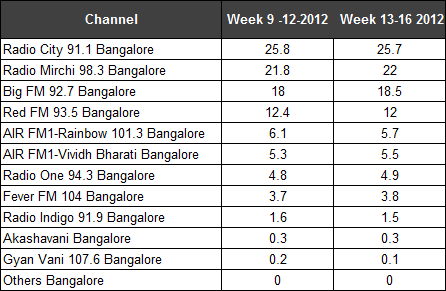
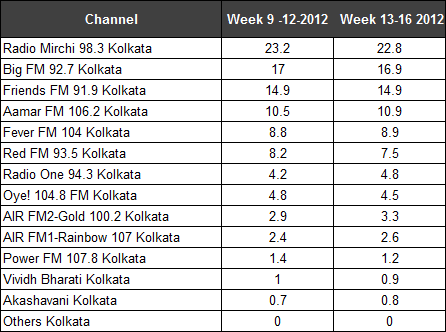
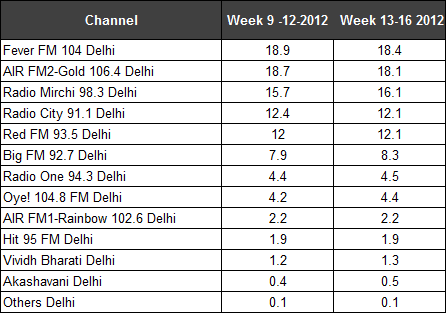
    TAM Media’s Radio Audience Measurement (RAM) – which covers four key metros, Mumbai, Delhi, Kolkata and Bengaluru – released its latest radio listenership figures for wk 13 to wk 16, 2012 (Last week of March to first three weeks of April, 2012). According to the latest RAM data, for listeners of 12 years of age and above, all places of listening, and according to radio channel shares, RadioCity, Radio Mirchi, Fever FM, Big FM, Red FM, Radio One, Oye! FM continue to be the top FM stations in the big four metros.


    Mumbai:


    Radio Mirchi emerges as the number one FM station in Mumbai with a market share of 15.3 per cent, followed closely byRadioCityat 15.2 per cent. The two FM stations are closely competing for the top spot, but what remains to be seen is which of these two FM stations retains the top spot. AIR FM2 Gold, Fever FM and Big FM make the top five FM stations in Mumbai. The other FM stations in the Mumbai market include Red FM, Radio One, Oye! FM, AIR FM1 Rainbow, Vividh Bharati and Akashavani.


    Delhi:


    Fever FM continues to be the most popular FM station in Delhi with a market share of 18.4 per cent, its nearest rival is the AIR FM2 Gold which is comfortably placed at number two with 18.1 per cent market share. Ranked three is Radio Mirchi followed by RadioCity which is ranked four and Red FM as ranked five in theDelhimarket. The rest of the FM stations in Delhi include Big FM, Radio One, Oye! FM, Hit FM, AIR FM1 Rainbow, Akashavani and Vividh Bharati.


    Bengaluru:


    RadioCity continues to maintain its leadership position in the city. RadioCity, Radio Mirchi and Big FM are the top three most popular FM stations in Bengaluru. RadioCity received a market share of 25.7 per cent whereas Radio Mirchi and Big FM received a market share of 22 per cent and 18.5 per cent respectively. Ranked four is Red FM with 12 per cent and the fifth most popular FM station is AIR FM1 Rainbow with 5.7 per cent. The other FM stations in Bengaluru include AIR FM1 Vividh Bharati, Radio One, Fever FM, Radio Indigo, Akashavani and Gyan Vani.


    Kolkata:


    Radio Mirchi is the clear winner in Kolkata with a market share of 22.8 per cent. The top three FM stations in Kolkata haven’t changed as Radio Mirchi continues to be the number one FM station of the city followed by Big FM with a share of 16.9 per cent and at the number three FM station of Kolkata, Friends FM received a share of 14.9 per cent of the share. Ranked four and five are Aamar FM and Fever FM with a share of 10.9 per cent and 8.9 per cent respectively. The other FM stations in the city are Red FM, Radio One, Oye! FM, Power FM, AIR FM1 Rainbow, AIR FM2 Gold, Vividh Bharati and Akashavani.


  • RAMcheck: No change in #1 stations across RAM markets

    By A Correspondent


    TAM Media’s Radio Audience Measurement (RAM) – which covers four key metros, Mumbai,Delhi, Kolkata and Bengaluru – released its latest radio listenership figures for Wk 8 to Wk11 (Last two weeks of February 2012 and first two weeks of March 2012).


    According to the latest RAM data, for listeners of 12 years of age and above, all places of listening, and according to radio channel shares,RadioCity, Radio Mirchi, Fever FM, Big FM, Red FM, Radio One, Oye! FM were some of the top FM stations in the big four metros.


    WhileRadioCityretained its leadership position in Mumbai and Bengaluru, Fever FM and Radio Mirchi also continued to remain the leading FM stations inDelhiand Kolkata respectively.


    Mumbai:

    RadioCitycontinues to be the most popular FM station in Mumbai, as the FM station has maintained its leadership position in the city. Ranked second is Radio Mirchi followed by AIR FM2 Gold, Fever FM and Big FM which are ranked third, fourth and fifth respectively. These top five FM stations and Red FM, ranked sixth have secured their listenership share in double digits. The other FM stations in the city include Oye! FM, Radio One, AIR FM1 Rainbow, Vividh Bharati and Akashavani Mumbai.


    Delhi:

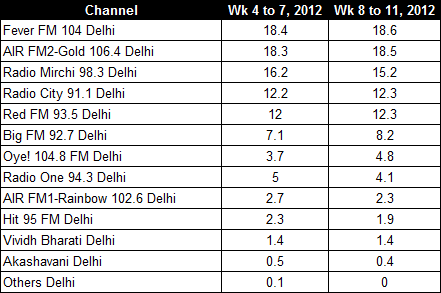
    According to the Wk8 to Wk 11 RAM data, Fever FM has once again retained its leadership position inDelhiwith a listenership share of 18.6 per cent followed by AIR FM2 Gold which garnered a share of 18.5 per cent. Although Fever FM is the number one FM station ofDelhi, the government owned AIR FM2 Gold is a close second. What remains to be seen is whether Fever FM is able to widen the gap between the number one and number two FM station? Or will AIR FM2 Gold claim the leadership title?  Once the undisputed leader ofDelhi, Radio Mirchi is now ranked three with a share of 15.2 per cent followed byRadioCityand Red FM with a share of 12.3 per cent respectively. The top five FM stations have received their station share in double digits. The other cluster of FM stations inDelhiincludes Oye! FM, Radio One, AIR FM1 Rainbow, Hit FM, Vividh Bharati and Akashvani Mumbai.


    Bengaluru:

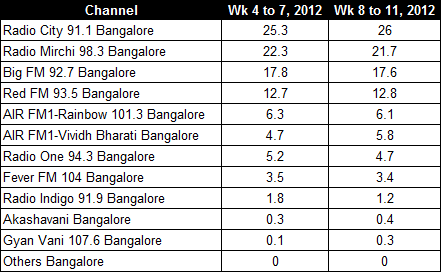
    RadioCitymaintained its leadership position in Bengaluru with a share of 26 per cent, its nearest rival Radio Mirchi, on the other hand, received a share of 21.7 per cent. Ranked three is Big FM with a share of 17.6 per cent followed by Red FM which received a share of 12.8 per cent. While the top four FM radio stations in Bengaluru received a double digit share, AIR FM1 Rainbow which is ranked five received a share of 6.1 per cent. The other clusters of FM station in the city are Fever FM, Radio One, Radio Indigo, Gyan Vani, Akashavani and Vividh Bharati.


    Kolkata:

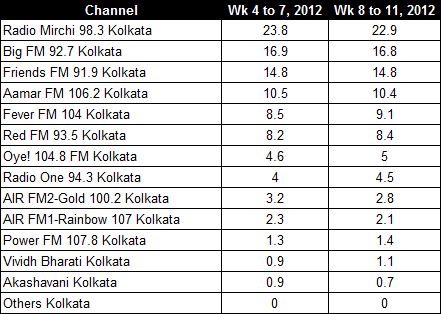
    The top five FM stations of Kolkata continue to remain the same. Radio Mirchi is unanimously the most popular FM station in Kolkata with a whopping 22.9 per cent of the station share. Its nearest rival is Big FM which received a share of 16.8 per cent followed by Friends FM and Aamar FM which are ranked four and five respectively. Kolkata is the only RAM market which perhaps has not seen a change in the top four rankings in a long time. While Fever FM and Red FM are ranked five and six respectively, other clusters of FM station in Kolkata are Oye! FM, Radio One, Power FM, AIR FM1 Rainbow, AIR FM2 Gold, Vividh Bharati and Akashavani Kolkata.


  • RAMcheck: More surprises for FM players

    By A Correspondent


    TAM Media’s Radio Audience Measurement (RAM) – which covers four key metros, Mumbai,Delhi, Kolkata and Bengaluru – released its latest radio listenership figures for Wk 4 to Wk7 (Last two weeks of January 2012 and first two weeks of February 2012).


    According to the latest RAM data, for listeners of 12 years of age and above, all places of listening, and according to radio channel shares,RadioCity, Radio Mirchi, Fever FM, Big FM, Red FM, Radio One, Oye! FM were some of the top FM stations in the big four metros.


    Mumbai:

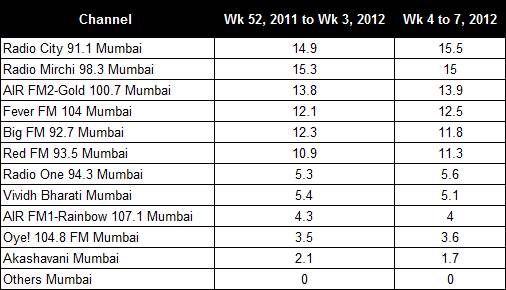
    Radio City surged ahead of Radio Mirchi as the most popular FM station in the city with 15.5 per cent channel share from Wk 4 to Wk7, 2012 whereas Radio Mirchi’s channel share stood at 15 per cent. Ranked three is AIR FM2 Gold which more or less remained unchanged in listenership share from wk 4 to 7, 2012 as against Wk 52, 2011 to Wk 3, 2012. As compared to Wk 52, 2011 to Wk 3, 2012, six FM stations witnessed growth in their listenership share in Wk 4 to Wk 7, 2012 namely, Radio City, Fever FM, Red FM, Radio One, Oye! FM and AIR FM2 Gold.


    Source : RAM

    Market: MUMBAI

    Demographic: All People 12+ Filter Demographic: None

    Statistic: Share %

    Daypart: Sun – Sat 12:00 AM – 12:00 AM

    Place of Listening: All


    Delhi:

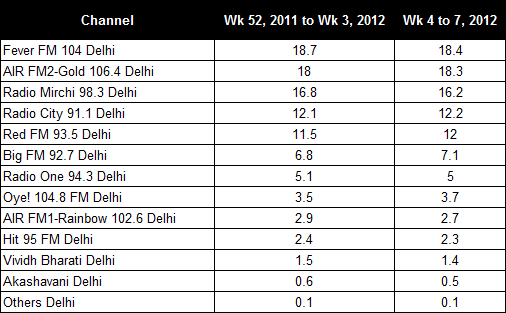
    Fever FM once again manages to retain its leadership position inDelhi, its nearest rival in Delhi is Radio Mirchi, if the government owned AIR FM2 Gold is excluded. According to figures for Wk4 to Wk 7, 2012, AIR FM2 Gold is close behind Fever FM for the top spot. What remains to be seen is whether or not Fever FM is able to retain its leadership position inDelhi.


    The Wk4 to Wk 7, 2012 RAM numbers reveals that in comparison to Wk 52, 2011 to Wk 3, 2012 only five FM stations witnessed any growth in the Delhi market. The FM stations to have seen growth in their listenership shares are Radio City, Big FM, Red FM, Oye! FM and AIR FM2 Gold.

    The other FM stations in the Delhi market are Radio One, Hit FM, AIR FM1 Rainbow, Vividh Bharathi and Akashavani Delhi.


    Market: DELHI

    Demographic: All People 12+ Filter Demographic: None

    Statistic: Share %

    Daypart: Sun – Sat 12:00 AM – 12:00 AM

    Place of Listening: All


    Bengaluru:

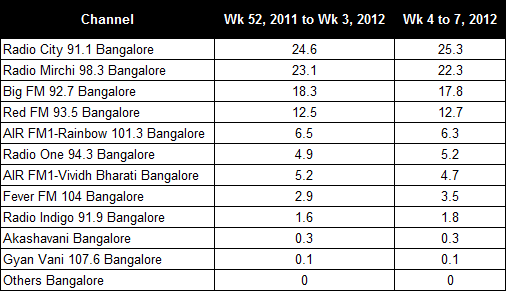
    In Bengaluru too, Radio City continues maintain its numero uno position, the FM station has managed further grow its listenership share in Wk 4 to Wk 7, 2012 as against Wk 52, 2011 to Wk 3, 2012. The second most popular FM station in Bengaluru is Radio Mirchi followed by Big FM and Red FM, ranked third and fourth respectively. Ranked fifth is AIR FM1 Rainbow and Radio One is ranked sixth. The five of the eleven FM stations in the Bengaluru market which witnessed growth in listenership share areRadioCity, Red FM, Radio One, Fever FM and Radio Indigo.


    Market: BENGALURU

    Demographic: All People 12+ Filter Demographic: None

    Statistic: Share %

    Daypart: Sun – Sat 12:00 AM – 12:00 AM

    Place of Listening: All


    Kolkata:

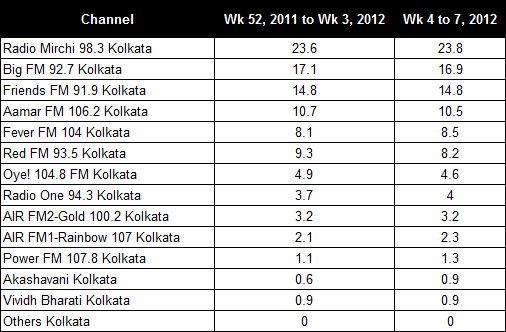
    Radio Mirchi has not only maintained its leadership position in the city, but has also witnessed some growth according to the Wk4 to Wk 7, 2012 RAM data as against Wk 52, 2011 to Wk3, 2012. Kolkata is the only RAM market to have seen no change in atleast the top three rankings. Radio Mirchi, Big FM and Friends FM continue to be the top three FM stations in the city. Ranked four is Aamar FM, followed by Fever FM, Red FM and Oye! FM. Of the thirteen FM stations in Kolkata, six FM stations in the city have witnessed growth in their listenership shares: Radio Mirchi, Fever FM, Radio One, Power FM and AIR FM1 Rainbow. Although Friends FM remained stagnant in its listenership share, nevertheless it is comfortably placed at number three. The other FM stations in the Kolkata market include Radio One, Power FM, AIR FM1 Rainbow, AIR FM2 Gold, Akashavani Kolkata and Vividh Bharati.


    Market: KOLKATA

    Demographic: All People 12+ Filter Demographic: None

    Statistic: Share %

    Daypart: Sun – Sat 12:00 AM – 12:00 AM

    Place of Listening: All


  • Mid-Day re-launches Meter Down

    By A Correspondent

    Mid-Day has re-launched its Meter Down Campaign in Mumbai to put errant Rickshaw drivers to task. The campaign will be launched as a joint programme with the traffic department and the RTO. This year’s Meter Down campaign aims to take on the uncouth auto drivers to teach them a lesson. The campaign will go on for a period of four weeks and aims to garner support from the citizens across the city. According to Mid-Day, people have anger towards rickshaw drivers mainly for reasons such as tampered meters, refusal to ply and also for their rude behaviour.


    Mid-Day will identify key locations in the city where the authorities concerned will be present to reduce the hassles caused to the citizens. The focus will be on peak timings in the morning and in the evening when most office-goers are affected. The offenders will have strict fines levied on them and serious offences could also lead to cancellation of licences.


    Last year’s Mid-Day Meter Down campaign, which targeted the taxi drivers, received overwhelming support. In a span of just one month, the campaign saw as many as 1,551 taxis being booked for refusing fares across the city. In addition about 317 taxi drivers’ licenses were cancelled. Mid-Day followed up tirelessly with each department to ensure that the errant drivers are booked.


    Speaking on the re-launch of the campaign, Mr Manajit Ghoshal, MD and CEO, Mid Day Infomedia Limited said, “Mid-Day is a local city newspaper and therefore it is our endeavour to cater to issues pertinent to the people of the city. Mid-Day Meter Down campaign is an effort to resolve issues that a Mumbaikar faces on a daily basis. The last season saw great response from the city and we are more than happy to launch this campaign once again as people have again started facing a lot of issues with the rickshaw drivers. The kind of success that the campaign received last year makes us hope that this campaign will make a stronger impact.”

  • Claims and counter-claims start after IRS 2011Q2 release


    By A Correspondent

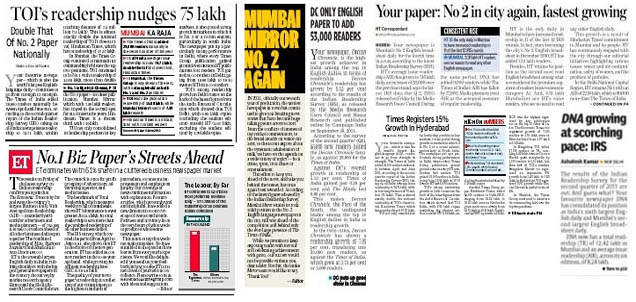
    The claims and counter-claims have begun. In Mumbai, Mumbai Mirror said it’s No 2 again. So did Hindustan Times. Both weren’t incorrect: Mirror may have the second-largest readership, next only to The Times of India, but Hindustan Times is the second-most read broadsheet English daily. DNA’s report too says it’s the second-largest broadsheet daily.

    Sadly, the conferences which the Market Research Users Council and Hansa Research Group would conduct to release every round of the Indian Readership Survey have been done away with. The detailed dump is curiously no longer handed out to the trade media.

    Consequently, what the MRUC and Hansa expect the trade media to do is to either carry unverified claims of various media entities. Or depend on friendly publications and agencies to give out data.

    MxMIndia.com requested veteran media consultant Sundeep Nagpal and his firm Stratagem Media to dig a little deeper and help us come up with a variety of insights given IRS 2011 Q2 data.

    For instance: the DNA report quotes a total readership (TR) figure for itself which most media agencies do not recognise. Media agencies and MxMIndia recognise Average Issue Readers (AIR) as currency. Interestingly,  when you look at the numbers for Greater Mumbai, while DNA is a distant third amongst English language broadsheets vis-a-vis The Times of India, it’s difference with #2 English broadsheet Hindustan Times is just 63,000. For HT of course the growth story in Greater Mumbai is tremendous: 27.2% year-on-year and 4.1% in the second quarter.

    We asked Strategem for the following:

    1. Given the toplines mailed to us by IRS, could we analyse it vis-a-vis the Q1 data for 2011 as well as the Q2 data for 2010 so that we can do a year-on-year analyses?

    2. Can we also similary analyse the data region-wise – Hindi belt and North, West, South and East and North East?

    3. Can we look at the numbers for the 8 metros combined and separately?


    Stratagem has provided us this data, and we present these to you as follows:


    First, take a look at the table withe the Top 10 publications across the country – urban and rural India.


    Publications

    IRS 2011 Q2

    IRS 2011 Q1

    % growth in IRS 11 Q2 over 11 Q1

    IRS 2010 Q2

    % growth in IRS 11 Q2 over 10 Q2

    Est. Individuals (000s)

    889070

    885122

    0.4

    871443

    2.0

    Dainik Jagran

    16393

    15910

    3.0

    15925

    2.9

    Dainik Bhaskar

    14174

    14016

    1.1

    13303

    6.5

    Hindustan

    11985

    11810

    1.5

    10143

    18.2

     Malayala Manorama (Daily)

    9962

    9938

    0.2

    9841

    1.2

    Amar Ujala

    8891

    8747

    1.6

    8417

    5.6

     Lokmat

    7595

    7486

    1.5

    7402

    2.6

     The Times Of India

    7471

    7442

    0.4

    7088

    5.4

     Daily Thanthi

    7290

    7187

    1.4

    7402

    -1.5

    Rajasthan Patrika

    6941

    7033

    -1.3

    6900

    0.6

     Mathrubhumi

    6690

    6800

    -1.6

    6566

    1.9


    Let’s also look at the combined numbers for the eight metros of Mumbai, Delhi, Kolkata, Chennai, Bengaluru, Hyderabad, Pune and Ahmedabad.


    Combined 8 metros-Mum,Kol,Ahm,Bang,Pune,Chen,Del,Hyd

    Publications

    IRS 2011 Q2

    IRS 2011 Q1

    % growth in IRS 11 Q2 over 11 Q1

    IRS 2010 Q2

    % growth in IRS 11 Q2 over 10 Q2

    Est. Individuals (000s)

    73117

    72672

    0.6

    71138

    2.8

     The Times Of India

    5114

    5073

    0.8

    4879

    4.8

     Ananda Bazar Patrika

    2708

    2725

    -0.6

    2821

    -4.0

     Hindustan Times

    2690

    2675

    0.6

    2566

    4.8

     Navbharat Times

    2392

    2349

    1.8

    2216

    7.9

     Gujarat Samachar

    1606

    1641

    -2.1

    1503

    6.9

     Daily Thanthi

    1365

    1319

    3.5

    1233

    10.7

     Lokmat

    1224

    1268

    -3.5

    1295

    -5.5

     Daily Sakal

    1175

    1213

    -3.1

    1089

    7.9

     Hindustan

    1128

    1142

    -1.2

    1167

    -3.3

     Divya Bhaskar

    1124

    1129

    -0.4

    1039

    8.2


    The growth story is undoubtedly that of Hindustan which has grown 18.2 percent over the second quarter of 2010, though the growth in the second quarter of this year has now steadied at 1.5 percent. But the winner of the quarter from the toplines of 2011Q2 for across the country is undoubtedly Dainik Jagran with a 3% growth. On a base of 1.59 crore this is big.  The other stories of the big players is also noteworthy. Bhaskar 6.5% y-o-y, Amar Ujala 5.6% y-o-y and The Times of India too at 5.4% y-o-y. Jagran’s y-o-y is 2.9% and Lokmat has grown 2.6 percent over 2010 Q2.
    We urge you to click on the links below (these will come up later in the day) for detailed numbers.It is important to note that the numbers thrown up in the above table are not truly indicative of the power of the various publications. Remember, these ratings are only for metros, and the picture is dramatically different for an ABP in West Bengal, and Gujarat Samachar in Gujarat or Thanthi in TN and Sakal and Lokmat in Maharashtra. Ditto with Hindustan and Bhaskar.

    Links:

    IRS Q2 2011 Hindi Belt & North


    IRS Q2 2011 – South


    IRS Q2 2011 – East


    IRS Q2 2011 Maharashtra & Gujarat

    Information courtesy: